
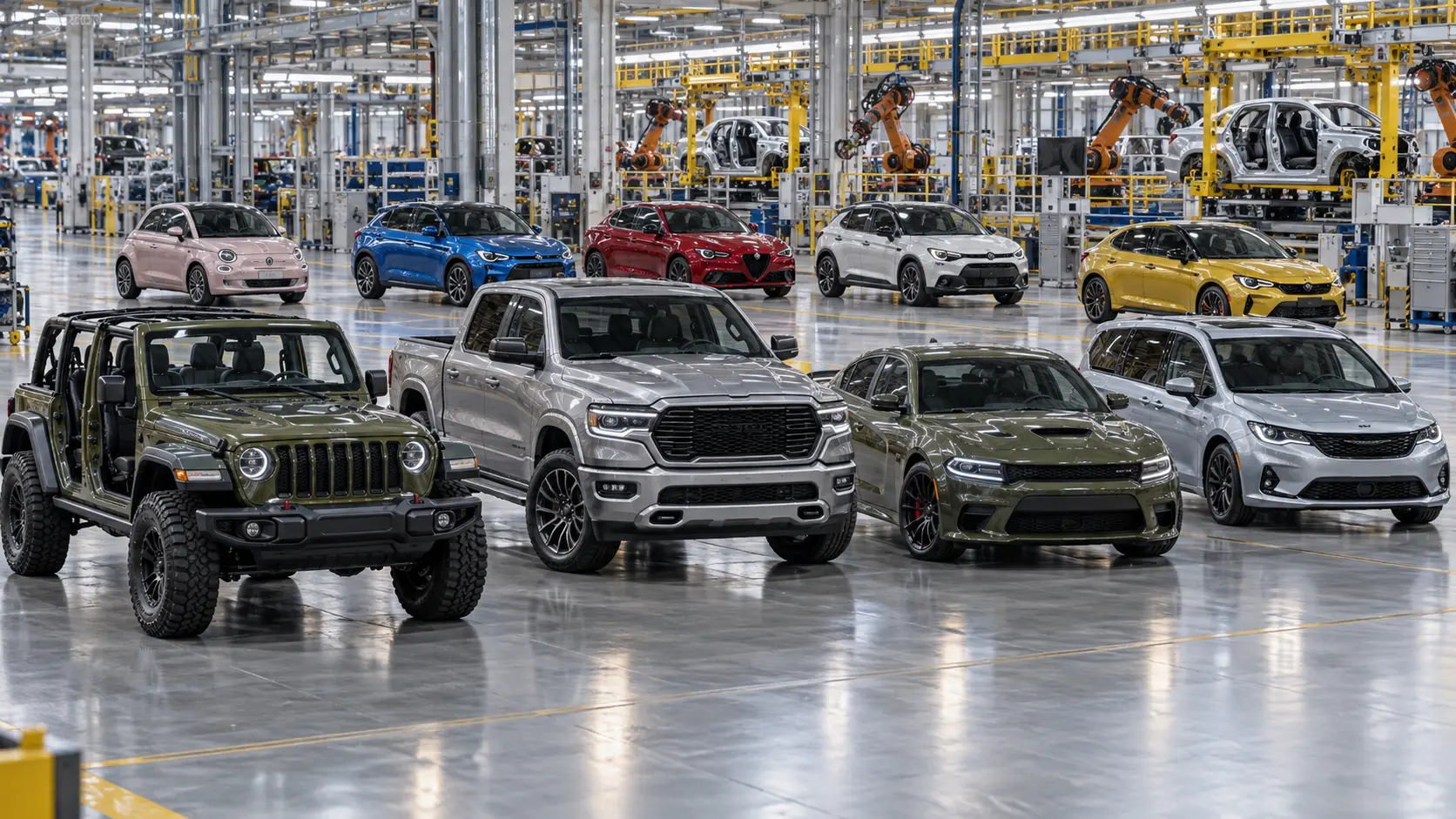
If you drive a Jeep Wrangler, Ram 1500, Dodge Charger, or Chrysler Pacifica, your vehicle ultimately comes from the same enormous automaker: Stellantis.
But Stellantis is much bigger than its familiar American nameplates. The company controls 14 automotive brands spanning the United States and Europe, along with businesses involved in vehicle financing, leasing, mobility, data, parts, and other automotive services.
That makes the Stellantis family tree surprisingly complicated. Here’s how the company’s major brands and businesses fit together.
What Is Stellantis?
Stellantis was created in 2021 through the merger of Fiat Chrysler Automobiles (FCA) and France’s PSA Group. The combination brought brands such as Jeep, Ram and Dodge together with Peugeot, Citroën and Opel under one corporate parent.
Today, Stellantis has 14 automotive brands. It also operates mobility brands Free2move and Leasys and a collection of related automotive businesses.
Stellantis Brand Family Tree
STELLANTIS
│
├── American Brands
│   ├── Jeep
│   ├── Ram
│   ├── Dodge
│   └── Chrysler
│
├── Italian Brands
│   ├── Fiat
│   ├── Abarth
│   ├── Alfa Romeo
│   ├── Lancia
│   └── Maserati
│
├── French Brands
│   ├── Peugeot
│   ├── Citroën
│   └── DS Automobiles
│
├── German / British Brands
│   ├── Opel
│   └── Vauxhall
│
├── Mobility & Leasing
│   ├── Free2move
│   └── Leasys
│
└── Other Automotive Businesses
    ├── Stellantis Financial Services
    ├── Mopar
    ├── SUSTAINera
    ├── Mobilisights
    ├── Stellantis Design Studio
    └── Stellantis Ventures
Stellantis’ American Car Brands
Jeep
Jeep is Stellantis’ SUV and off-road brand and one of the company’s most globally recognizable names. Its lineup ranges from smaller crossovers to the Wrangler, Grand Cherokee and Wagoneer family.
Jeep has also become increasingly important to Stellantis’ global strategy. In 2026, Stellantis identified Jeep as one of four global brands receiving particular emphasis in its new strategic plan.
Ram
Ram is Stellantis’ truck and commercial-vehicle brand in North America. It was separated from Dodge beginning with the 2010 model year, which is why today’s Ram 1500 is sold as a Ram rather than a Dodge Ram.
Like Jeep, Ram is now one of Stellantis’ four strategic global brands.
Dodge
Dodge remains Stellantis’ American performance-oriented brand. Its history includes everything from family sedans to muscle cars, but its modern identity is heavily associated with performance vehicles.
Chrysler
Chrysler is one of the oldest names in the Stellantis portfolio, having celebrated its 100th anniversary in 2025. Its current lineup is much smaller than it was historically and is centered on the Pacifica and Voyager minivans, although Stellantis has announced additional Chrysler products for the future.
Stellantis’ Italian Brands
Fiat
Fiat is one of Stellantis’ highest-volume European nameplates and has a particularly strong presence in Italy and other international markets. Stellantis now classifies Fiat alongside Jeep, Ram and Peugeot as one of its four core global brands.
Abarth
Abarth is Fiat’s performance-oriented sister brand. It is best known for sportier versions of small Fiat-derived vehicles.
Alfa Romeo
Alfa Romeo is Stellantis’ Italian performance and premium brand. Its modern lineup includes vehicles such as the Giulia, Stelvio and Tonale.
Lancia
Lancia has a long history that includes luxury cars and legendary rally machines. Its modern footprint is considerably smaller. Under Stellantis’ 2026 strategy, Lancia is being developed as a specialty brand managed alongside Fiat.
Maserati
Maserati occupies the luxury end of the Stellantis portfolio. Unlike Fiat or Peugeot, its role isn’t to generate enormous sales volumes. Instead, it gives Stellantis a dedicated luxury marque competing in the upper end of the market.
Stellantis’ French Brands
Peugeot
Peugeot was one of the central brands of PSA Group before the Stellantis merger and remains a major European automaker. Stellantis now considers Peugeot one of its four principal global brands.
Citroën
Citroën is known for practical vehicles and a history of unconventional French engineering and design. Stellantis’ current strategy classifies it as one of the company’s major regional brands.
DS Automobiles
DS began as a premium Citroën sub-brand before becoming a standalone marque. It occupies a more upscale position in the Stellantis lineup. Under the company’s 2026 strategy, DS is being developed as a specialty brand managed alongside Citroën.
Opel and Vauxhall
Opel and Vauxhall are essentially sister brands serving different markets. Opel is primarily used in continental Europe, while Vauxhall is the familiar badge in the United Kingdom.
Both trace part of their modern corporate history through General Motors. PSA Group acquired Opel and Vauxhall from GM in 2017, several years before PSA merged with Fiat Chrysler to form Stellantis.
Stellantis Is More Than a Collection of Car Brands
The car badges get most of the attention, but Stellantis also has businesses that operate around the vehicle itself.
Stellantis Financial Services
Stellantis Financial Services is the company’s vehicle-finance operation. It provides financing products that help customers and dealers purchase, lease and stock Stellantis vehicles.
In the United States, Stellantis Financial Services U.S. offers retail loans, leases and dealer financing. This is an important distinction for anyone familiar with the old Chrysler Capital arrangement: Stellantis terminated its agreement with Santander Consumer USA in 2025 and has been building its own U.S. captive-finance operation.
Free2move
Free2move is Stellantis’ mobility business. Rather than manufacturing another line of cars, it focuses on services built around transportation and vehicle use.
Leasys
Leasys is Stellantis’ leasing and mobility brand, giving the company another way to participate in the vehicle market beyond simply selling new cars.
Mopar
Mopar is the familiar parts, service and accessories name associated especially with Chrysler, Dodge, Jeep and Ram vehicles. For owners of those vehicles, Mopar is one of the most visible Stellantis businesses outside the automaker’s actual vehicle brands.
SUSTAINera
SUSTAINera is Stellantis’ circular-economy business. Its activities include extending the useful life of automotive parts and materials through approaches such as remanufacturing, repair, reuse and recycling.
Mobilisights
Mobilisights is Stellantis’ vehicle-data business. Its purpose is to develop products and services using connected-vehicle data generated across the company’s enormous vehicle fleet.
Which Stellantis Brands Matter Most?
Not all of these brands play the same role inside the company. Stellantis made that especially clear with its 2026 strategic plan.
The company identified Jeep, Ram, Peugeot and Fiat as its four global brands with the greatest scale and profit potential. Chrysler, Dodge, Citroën, Opel and Alfa Romeo are being treated as major regional brands, while DS and Lancia are being developed as specialty brands. Maserati remains Stellantis’ dedicated luxury brand.
That structure gives a better picture of modern Stellantis than simply listing all 14 brands side by side.
Why Does Stellantis Own So Many Car Brands?
The answer mostly comes down to decades of mergers and acquisitions.
Chrysler accumulated brands such as Dodge and Jeep. Fiat later took control of Chrysler and created Fiat Chrysler Automobiles. Meanwhile, Peugeot and Citroën formed the heart of PSA Group, which later acquired Opel and Vauxhall from General Motors.
When FCA and PSA merged, all of those automotive family trees suddenly came together.
The result is one corporation selling everything from small Fiat city cars and Jeep Wranglers to Ram pickups, Alfa Romeo sports sedans and six-figure Maseratis.
Bottom Line
Stellantis owns 14 automotive brands: Abarth, Alfa Romeo, Chrysler, Citroën, Dodge, DS Automobiles, Fiat, Jeep, Lancia, Maserati, Opel, Peugeot, Ram and Vauxhall.
It also reaches well beyond vehicle manufacturing through businesses such as Free2move, Leasys, Stellantis Financial Services, Mopar, SUSTAINera and Mobilisights.
So when you see a Jeep parked next to a Ram, Dodge or Chrysler, they aren’t merely distant corporate cousins. They all sit under the same Stellantis umbrella—and so do some of Europe’s most recognizable automotive brands.
“`
Leave a Reply