
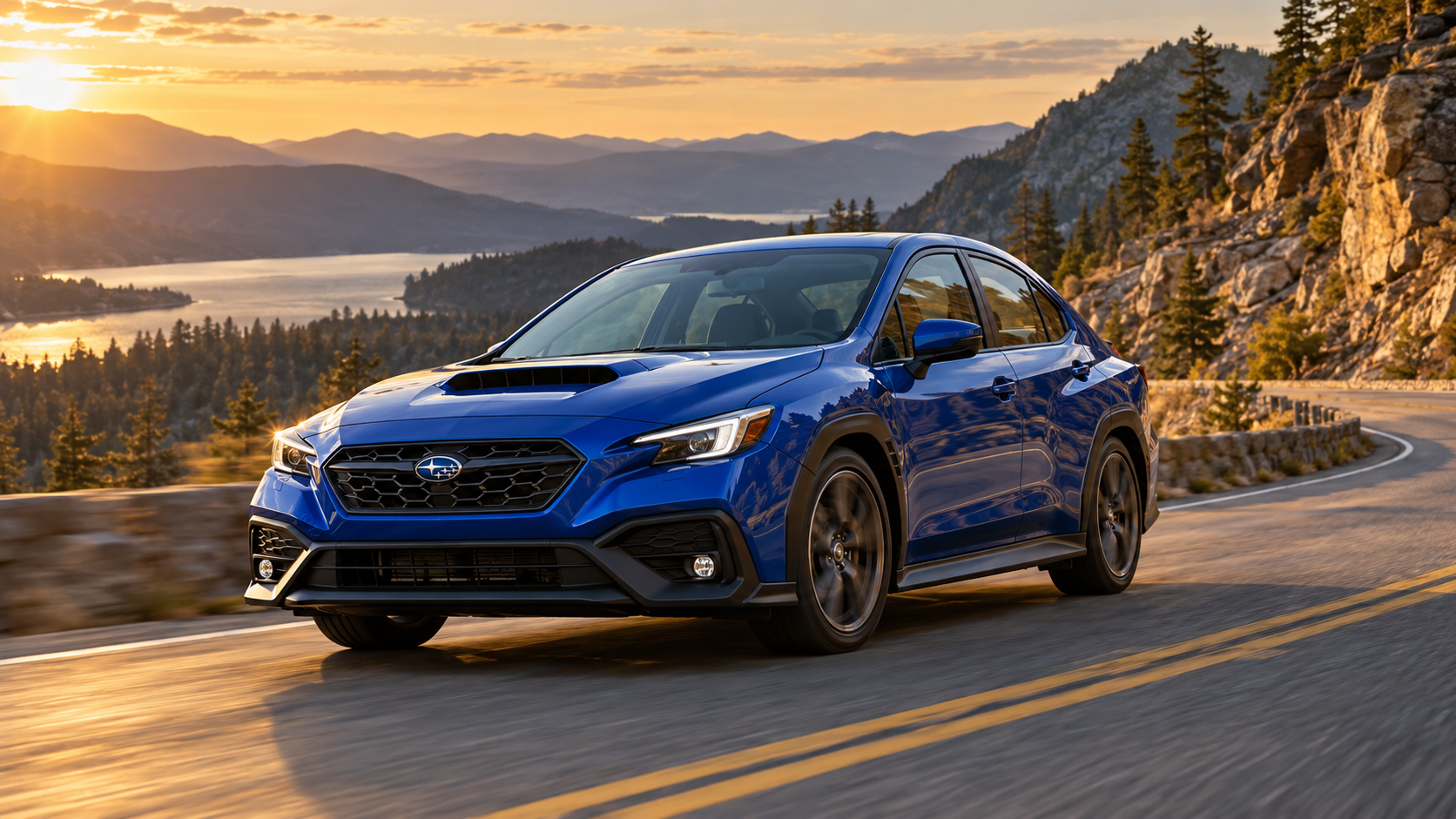
Some cars are designed to get you from one place to another as comfortably and efficiently as possible. Others are built to make the journey itself the best part of owning the car.
The Subaru WRX belongs firmly in the second category. Its turbocharged boxer engine, manual transmission, rally-inspired all-wheel-drive system, and firm suspension give it a personality that many modern cars lack. It isn’t the fastest sports sedan or the most refined, but that’s part of its appeal.
The WRX is what enthusiasts call a driver’s car: a vehicle that rewards driver involvement, communicates what it’s doing, and makes even ordinary driving interesting.
But the WRX is only one interpretation of this philosophy. From the playful Mazda Miata to the precision of a Porsche Cayman, some of the most memorable cars ever built prioritize the experience of driving over outright performance numbers.
What Makes a Car a Driver’s Car?
A true driver’s car isn’t necessarily the most powerful or expensive vehicle on the road. What matters is how effectively it connects the driver to the machine.
Several characteristics distinguish enthusiast-focused cars from ordinary transportation:
- Steering feedback: The steering communicates how the front tires are interacting with the road, rather than simply changing direction.
- Responsive handling: The car reacts predictably to steering, throttle, and braking inputs.
- Driver involvement: A manual transmission, responsive engine, and well-tuned controls encourage active participation.
- Balanced performance: The chassis, brakes, tires, and engine work together rather than relying on horsepower alone.
- Distinctive character: Engine sound, power delivery, chassis behavior, and mechanical sensations give the vehicle an identifiable personality.
A 500-horsepower luxury sedan might be objectively faster than a 181-horsepower Mazda Miata. However, the lighter car can be more engaging because the driver experiences more of its performance at ordinary speeds.
That distinction is central to understanding the WRX and its enthusiast-oriented competitors.
The Subaru WRX: Rally-Inspired Driving Character
The Subaru WRX has earned its reputation by combining the practicality of a compact sedan with the mechanical personality of a performance car.
The 2026 WRX uses a turbocharged 2.4-liter horizontally opposed four-cylinder engine producing 271 horsepower and 258 lb-ft of torque. Subaru’s Symmetrical All-Wheel Drive is standard, and the six-speed manual transmission remains a central part of its enthusiast appeal.
Unlike a rear-wheel-drive sports car designed around delicate balance and rotation, the WRX emphasizes traction, stability, and confidence.
Turbocharged Power Delivery
The WRX’s turbocharged boxer engine gives it a different personality from a naturally aspirated sports car.
Rather than demanding extremely high engine speeds to produce useful acceleration, the 2.4-liter engine delivers substantial torque across a broad portion of its operating range. Its twin-scroll turbocharger also helps reduce the pronounced lag associated with some older turbocharged engines.
The result is strong midrange acceleration that makes passing, climbing hills, and accelerating out of corners satisfying.
Earlier generations of the WRX often delivered a more dramatic sensation as turbo boost increased. The current 2.4-liter engine is smoother and more predictable, sacrificing some of that old-school excitement for better everyday response.
All-Wheel-Drive Confidence
The WRX’s defining characteristic is arguably the way it puts power onto the pavement.
Its permanent all-wheel-drive system distributes power to both axles, providing traction that a comparable rear-wheel-drive car may struggle to match on wet, loose, or otherwise low-grip surfaces.
During enthusiastic cornering, the WRX feels planted and secure. Where a rear-wheel-drive sports car might invite the driver to adjust its attitude using the throttle, the WRX generally encourages a clean corner entry followed by a confident acceleration out.
This doesn’t mean the WRX is immune to understeer or the laws of physics. All-wheel drive improves the ability to accelerate when traction is limited, but it doesn’t eliminate braking or cornering limits.
Nevertheless, the combination of a rigid chassis, responsive steering, and all-wheel drive creates a distinctive rally-inspired driving experience.
Steering, Suspension, and Road Feel
The WRX has a firmer ride than an ordinary compact sedan, and that firmness is immediately noticeable on rough pavement.
The suspension limits excessive body movement and helps the car respond quickly to steering inputs. The steering itself is direct, although the electric power steering doesn’t deliver the same detailed road feedback associated with some older hydraulic systems.
The current WRX feels more mature and refined than earlier generations. It remains entertaining on winding roads, but some of the rawness that made older models memorable has been reduced.
For buyers who prioritize chassis control, the 2026 WRX tS offers STI-tuned electronically controlled dampers and upgraded Brembo brakes. The limited-production Series.Yellow builds on the tS specification.
The Importance of the Manual Transmission
The six-speed manual transmission plays a significant role in the WRX’s personality.
Having to coordinate the clutch, throttle, and shifter makes acceleration an interactive process. Selecting the appropriate gear before entering a corner and matching engine speed during downshifts are skills that reward practice.
The manual shifter isn’t as short or polished as the best gearboxes from Honda or Mazda, but its mechanical character fits the WRX’s personality.
Buyers should note that WRX transmission availability varies by trim. The GT uses Subaru’s Performance Transmission, a continuously variable automatic with simulated gear ratios, while manual models provide the more traditional experience described here.
The WRX’s defining personality: Turbocharged, planted, practical, slightly rough-edged, and especially enjoyable when the road becomes challenging.
10 Other Cars Known for Their Driving Character
Not every driver’s car follows the WRX formula. Some prioritize low weight, others emphasize high-revving engines, and a few deliver their appeal through exceptional steering and chassis engineering.
| Car | Drivetrain | Driving Personality |
|---|---|---|
| Mazda MX-5 Miata | RWD | Lightweight and playful |
| Toyota GR86 / Subaru BRZ | RWD | Balanced and communicative |
| Honda Civic Type R | FWD | Precise and focused |
| Toyota GR Corolla | AWD | Aggressive and rally-inspired |
| Hyundai Elantra N | FWD | Lively and theatrical |
| Cadillac CT4-V Blackwing | RWD | Powerful and sophisticated |
| Porsche 718 Cayman | RWD | Precise and beautifully balanced |
| Lotus Elise | RWD | Raw and uncompromising |
| Honda S2000 | RWD | High-revving and demanding |
| BMW E46 M3 | RWD | Analog and rewarding |
Note: This list includes current vehicles and discontinued enthusiast favorites. The driving characteristics described refer to their respective model generations, not necessarily vehicles available new in 2026.
1. Mazda MX-5 Miata: The Purest Form of Driving Enjoyment
Few cars illustrate the driver’s-car philosophy as clearly as the Mazda MX-5 Miata.
Its formula is remarkably simple: a lightweight roadster, naturally aspirated four-cylinder engine, rear-wheel drive, and an excellent six-speed manual transmission.
The Miata’s appeal comes from how easily the driver can sense what the car is doing. Its low weight makes directional changes feel immediate, while its relatively modest power encourages drivers to maintain momentum through corners.
The suspension allows some body movement, which helps communicate weight transfer instead of disguising it.
Unlike a much more powerful sports car, the Miata can make a winding road entertaining without requiring extraordinary speeds.
Best for: Drivers who value lightness, steering feedback, and involvement over outright acceleration.
2. Toyota GR86 and Subaru BRZ: Affordable Rear-Wheel-Drive Balance
The Toyota GR86 and Subaru BRZ share their basic platform and 2.4-liter naturally aspirated boxer engine.
Both prioritize low weight, rear-wheel drive, a low center of gravity, and direct responses to driver inputs.
Compared with the WRX, the GR86 and BRZ feel more agile and less focused on outright traction. Their rear-drive layouts allow skilled drivers to adjust the car’s cornering attitude using the throttle, particularly in controlled track environments.
The engine is responsive but lacks the WRX’s turbocharged midrange punch. Drivers generally need to use more engine speed to extract its strongest performance.
Neither is as practical as the WRX, but both offer a more traditional sports-car experience.
Best for: Enthusiasts who want to develop car-control skills and enjoy balanced handling.
3. Honda Civic Type R: Front-Wheel-Drive Precision
The Honda Civic Type R demonstrates that front-wheel drive doesn’t prevent a car from delivering an exceptional driving experience.
The 2026 model produces 315 horsepower from a turbocharged 2.0-liter engine and uses a six-speed manual transmission.
Its sophisticated front suspension, limited-slip differential, powerful brakes, and exceptionally well-tuned chassis allow it to corner with remarkable precision.
The manual transmission is another highlight, delivering short, accurate shifts and a satisfying mechanical feel.
Compared with the WRX, the Type R feels more focused on precision and maximum cornering performance. The WRX emphasizes all-wheel-drive traction and rugged versatility.
Best for: Drivers seeking sharp handling and track-capable performance in a practical hatchback.
4. Toyota GR Corolla: A More Aggressive Rally-Inspired Hot Hatch
The Toyota GR Corolla is one of the WRX’s most natural alternatives.
Its turbocharged 1.6-liter three-cylinder engine produces 300 horsepower in the 2026 model. It also features Toyota’s GR-FOUR all-wheel-drive system and offers a six-speed manual transmission.
The GR Corolla feels compact, urgent, and energetic. Its unusual three-cylinder engine, short wheelbase, performance-oriented suspension, and available manual gearbox create a more intense personality than most everyday hatchbacks.
Where the WRX feels like a practical sports sedan with rally influences, the GR Corolla feels closer to a dedicated performance machine adapted for daily use.
Its trade-offs include a firmer ride, less refinement, and reduced passenger and cargo flexibility compared with larger performance vehicles.
Best for: WRX enthusiasts who want an even more concentrated rally-inspired experience.
5. Hyundai Elantra N: Performance With Personality
The Hyundai Elantra N is a front-wheel-drive sport sedan that prioritizes entertainment as much as lap times.
The 2026 model has a 276-horsepower turbocharged four-cylinder engine, electronically controlled suspension, an electronically controlled limited-slip differential, and a choice of manual or dual-clutch transmissions.
Its distinctive character comes from its lively powertrain, sharp front-end response, and configurable performance settings.
Compared with the WRX, the Elantra N is more theatrical and playful in its presentation. The WRX is more understated mechanically, with its character coming largely from its boxer engine and all-wheel-drive behavior.
Best for: Drivers who want a practical performance sedan with an energetic personality.
6. Cadillac CT4-V Blackwing: A Modern Analog Performance Sedan
The Cadillac CT4-V Blackwing proves that a driver’s car doesn’t have to be small, lightweight, or inexpensive.
Its 3.6-liter twin-turbocharged V6 produces 472 horsepower, sent to the rear wheels through either a six-speed manual transmission or an available ten-speed automatic.
What distinguishes the Blackwing is how successfully it combines serious power with responsive handling, communicative controls, and a sophisticated suspension.
The available manual transmission also includes performance-oriented features such as rev matching and no-lift shifting.
While the WRX feels like a rally-influenced compact, the Blackwing is a powerful traditional sport sedan engineered to reward experienced drivers.
Best for: Enthusiasts seeking high horsepower without sacrificing engagement.
7. Porsche 718 Cayman: Mid-Engine Precision
The Porsche 718 Cayman represents a different approach to the driver’s-car formula.
By positioning its engine behind the seats but ahead of the rear axle, the Cayman achieves a balanced distribution of mass that contributes to its responsive handling.
Its steering, brakes, and chassis are engineered to work together with exceptional precision. Direction changes feel deliberate, and the car remains composed through demanding corners.
Manual-equipped versions offer additional driver involvement, while higher-performance variants provide increasingly focused driving experiences.
Unlike the WRX’s rugged, traction-focused personality, the Cayman emphasizes exactness and composure.
Best for: Drivers who prioritize handling precision and sports-car balance.
8. Lotus Elise: Minimal Weight, Maximum Feedback
The discontinued Lotus Elise is among the clearest examples of a car engineered around the driving experience rather than everyday convenience.
Its lightweight chassis, mid-mounted engine, compact dimensions, and famously communicative steering make it unusually responsive to small driver inputs.
The Elise transmits far more road sensation than most modern sports cars, partly because it offers relatively little insulation from vibration, noise, and pavement imperfections.
That rawness is central to its appeal, although it also makes the Elise significantly less comfortable and practical than the WRX.
Best for: Enthusiasts willing to sacrifice comfort for an exceptionally direct connection to the road.
9. Honda S2000: The Joy of High Engine Speeds
The Honda S2000, produced from 1999 through 2009, remains a favorite among enthusiasts who appreciate naturally aspirated engines and manual transmissions.
Early North American AP1 models featured a 2.0-liter four-cylinder engine with a remarkable 9,000-rpm redline. Later AP2 models used a 2.2-liter engine with a lower 8,000-rpm redline and stronger low-end torque.
Unlike the WRX, which delivers substantial torque through the middle of its rev range, the S2000 encourages the driver to explore the upper reaches of the tachometer.
Its precise six-speed gearbox makes the process particularly rewarding.
The S2000’s rear-wheel-drive chassis can also be demanding near the limit, especially in earlier versions, making smooth driver inputs important.
Best for: Drivers who love high-revving engines, crisp shifting, and traditional roadster dynamics.
10. BMW E46 M3: A Classic Performance-Car Formula
The BMW E46 M3, sold in the United States for the 2001 through 2006 model years, combined an extraordinary naturally aspirated inline-six with rear-wheel drive and finely tuned handling.
Its 3.2-liter S54 engine produces 333 horsepower in U.S. specification and rewards drivers who use its high-rpm powerband.
Unlike many modern sport sedans, the E46 M3 uses hydraulic power steering, contributing to the detailed steering feel for which it remains celebrated.
Six-speed manual models are especially desirable among enthusiasts, although BMW also offered the sequential manual gearbox known as SMG.
The E46 M3 strikes a balance between daily usability and old-school mechanical engagement that helps explain its enduring appeal.
Best for: Drivers seeking a classic naturally aspirated performance car with substantial character.
How Does the WRX Compare With Other Driver’s Cars?
The Subaru WRX occupies an interesting middle ground.
It is more practical and weather-capable than lightweight rear-wheel-drive sports cars such as the Miata and GR86. However, it doesn’t communicate the road quite as directly as those cars, and its extra weight makes it feel less delicate when changing direction.
Compared with the Toyota GR Corolla, the WRX is generally the more conventional daily driver. Its sedan body and broader emphasis on refinement make it easier to live with, while the GR Corolla offers a more concentrated performance character.
The Civic Type R and Elantra N take yet another approach, using sophisticated front-wheel-drive chassis engineering to achieve exceptional handling and driver engagement.
Which driver’s car fits your priorities?
- Best all-weather driver’s car: Subaru WRX
- Best lightweight roadster experience: Mazda MX-5 Miata
- Best affordable rear-drive coupe experience: Toyota GR86 / Subaru BRZ
- Best precision-focused hot hatch: Honda Civic Type R
- Best rally-inspired hot hatch: Toyota GR Corolla
- Best high-powered manual sport sedan: Cadillac CT4-V Blackwing
- Best raw, lightweight classic: Lotus Elise
Are Older Cars More Engaging Than Modern Cars?
Many enthusiasts believe older cars offer more character, and there are legitimate mechanical reasons behind that perception.
Older performance cars were more likely to feature hydraulic steering, naturally aspirated engines, manual transmissions, and comparatively limited electronic intervention.
They also tended to provide less sound insulation and fewer systems designed to smooth out vibrations and road imperfections.
These characteristics can make a vehicle feel more connected to the driver, although they don’t automatically make it better.
Modern performance cars benefit from improved chassis rigidity, advanced suspension geometry, better brakes, and sophisticated traction-control systems. In many cases, they’re substantially faster and more capable than their predecessors.
The trade-off is that greater refinement can filter out some of the sensations enthusiasts enjoy.
The current Subaru WRX illustrates this evolution. Its newer 2.4-liter engine offers smoother, more accessible power than some earlier turbocharged versions, but it also feels less dramatic. Likewise, its chassis is more composed and refined than older generations, even if some drivers miss the rougher personality.
Whether that represents an improvement depends on what the driver values.
Does a Driver’s Car Need a Manual Transmission?
No. A manual transmission can significantly increase involvement, but it isn’t a requirement.
A well-engineered automatic or dual-clutch transmission can provide excellent responsiveness, and some modern sports cars deliver extraordinary feedback through their steering, brakes, and chassis regardless of transmission type.
Still, a manual transmission adds another skill to the driving experience.
Coordinating shifts, controlling the clutch, and managing engine speed give drivers more responsibility for how the vehicle performs.
That’s one reason manual-equipped versions of the WRX, Miata, GR86, Civic Type R, and CT4-V Blackwing appeal so strongly to enthusiasts.
The goal isn’t necessarily to achieve the fastest acceleration time. It’s to make the process of accelerating, braking, and changing gears rewarding.
Why Horsepower Doesn’t Define Driving Enjoyment
One of the most important lessons from enthusiast-oriented cars is that additional power doesn’t always translate into additional enjoyment.
On public roads, a very powerful car can reach legal speed limits almost immediately, leaving little opportunity to explore its capabilities.
Lower-powered sports cars often require more thoughtful driving. Maintaining momentum, choosing the correct gear, and smoothly connecting corners become more important than relying on acceleration.
Weight is equally significant. A lighter car generally requires less effort to accelerate, brake, and change direction, all else being equal.
That’s why a Miata or GR86 can feel exceptionally entertaining despite having far less horsepower than a luxury performance sedan.
The WRX offers a compromise: enough turbocharged power to feel quick, combined with an engaging chassis and the everyday usability of a four-door sedan.
The Bottom Line: A Great Driver’s Car Makes the Journey Matter
The Subaru WRX has character because it combines several distinctive mechanical traits into one cohesive experience. Its boxer engine, turbocharged torque, manual transmission, and all-wheel-drive traction make it feel different from ordinary sedans and many conventional sports cars.
It isn’t the purest handling car on the market. A Miata provides a more intimate connection to the road, a GR86 offers more playful rear-wheel-drive balance, and a Civic Type R delivers exceptional front-end precision.
But the WRX succeeds at something relatively few cars can match: providing an engaging, rally-inspired driving experience without demanding major sacrifices in everyday practicality.
Ultimately, the best driver’s car isn’t necessarily the one with the highest horsepower, quickest acceleration, or most impressive track time.
It’s the car that makes you look forward to taking the longer route home.
Leave a Reply