
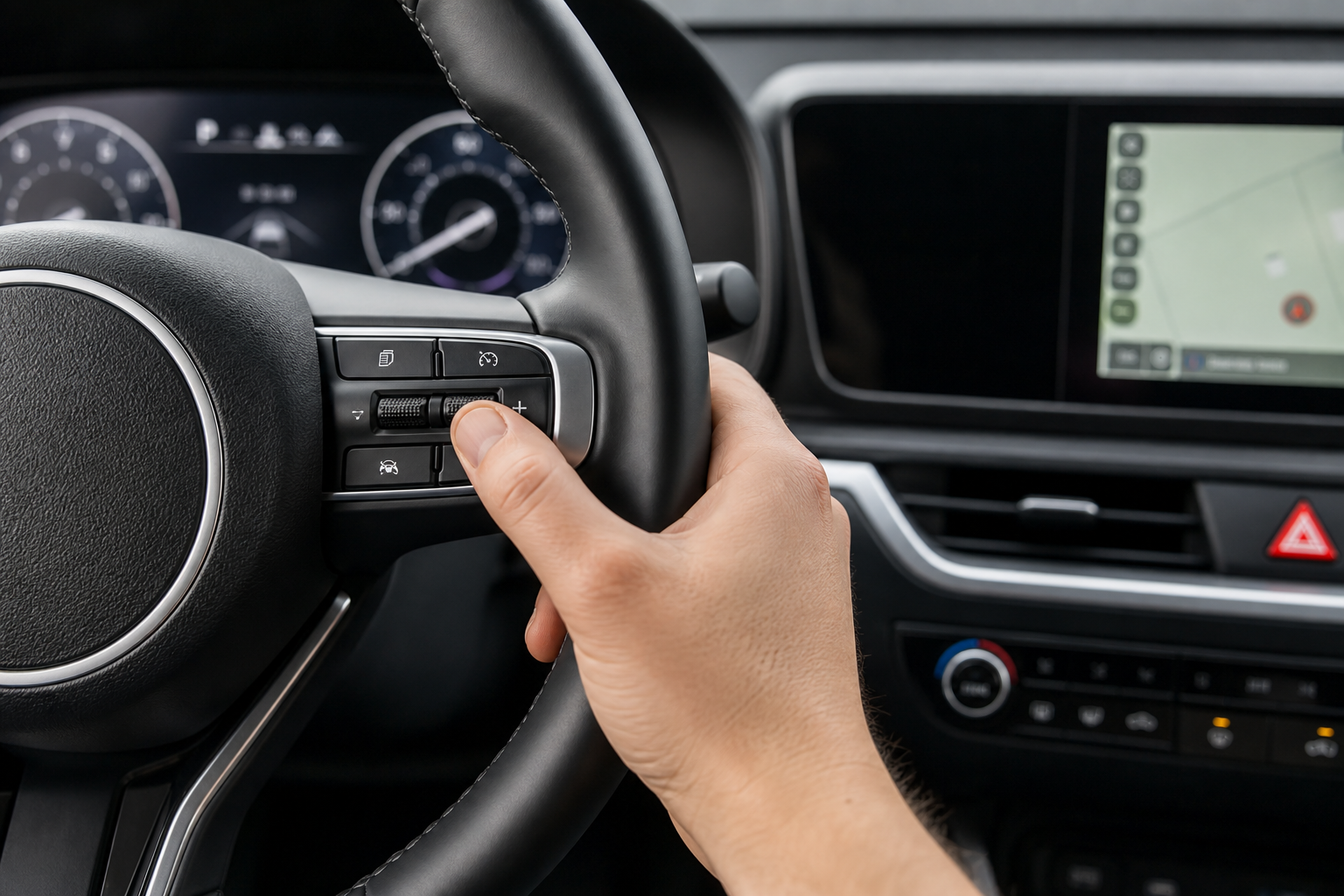
If you’ve driven a Kia Sportage with Smart Cruise Control and felt like the car was making decisions you didn’t ask for, braking for cars that merged in front of you three seconds ago, or creeping up on slower traffic instead of holding a steady speed, you’re not imagining things. That’s the radar-based adaptive system doing exactly what it’s designed to do. The question a lot of Sportage owners ask is whether they can just turn that off and get old-school, set-it-and-forget-it cruise control instead.
The answer depends heavily on which Sportage you’re driving, and it’s not as simple as flipping a hidden switch. Below is what actually determines whether your Sportage can run in conventional cruise mode, how to activate it when it’s available, and what the dashboard is telling you either way.
Does the Kia Sportage Have Regular Cruise Control?
Here’s the part that surprises most owners: on the Sportage, conventional cruise control and Smart Cruise Control (SCC) aren’t two modes living inside the same system that you toggle between. They’re tied to different hardware. Whether you get one or the other comes down to your trim level and model year, not a menu setting you can change after the fact.
Trims that don’t have the front radar sensor installed only get standard, fixed-speed cruise control. There’s nothing to switch because adaptive following was never built into that car. Trims that do have the radar sensor, which is most mid and upper trims on both the 4th and 5th generation Sportage, only offer Smart Cruise Control when you press the cruise button. You can adjust the following gap, but you can’t tell the car to ignore the vehicle ahead and just hold your set speed no matter what.
This is different from some competitors that let you disable the radar following behavior in a settings menu. Kia doesn’t offer that option on the Sportage as of this writing, and if you’ve been searching for a hidden button combination to force conventional mode on an SCC-equipped Sportage, it doesn’t exist. Anyone telling you otherwise is guessing.
Model Year Breakdown: 2017-2022 vs 2023-2025+
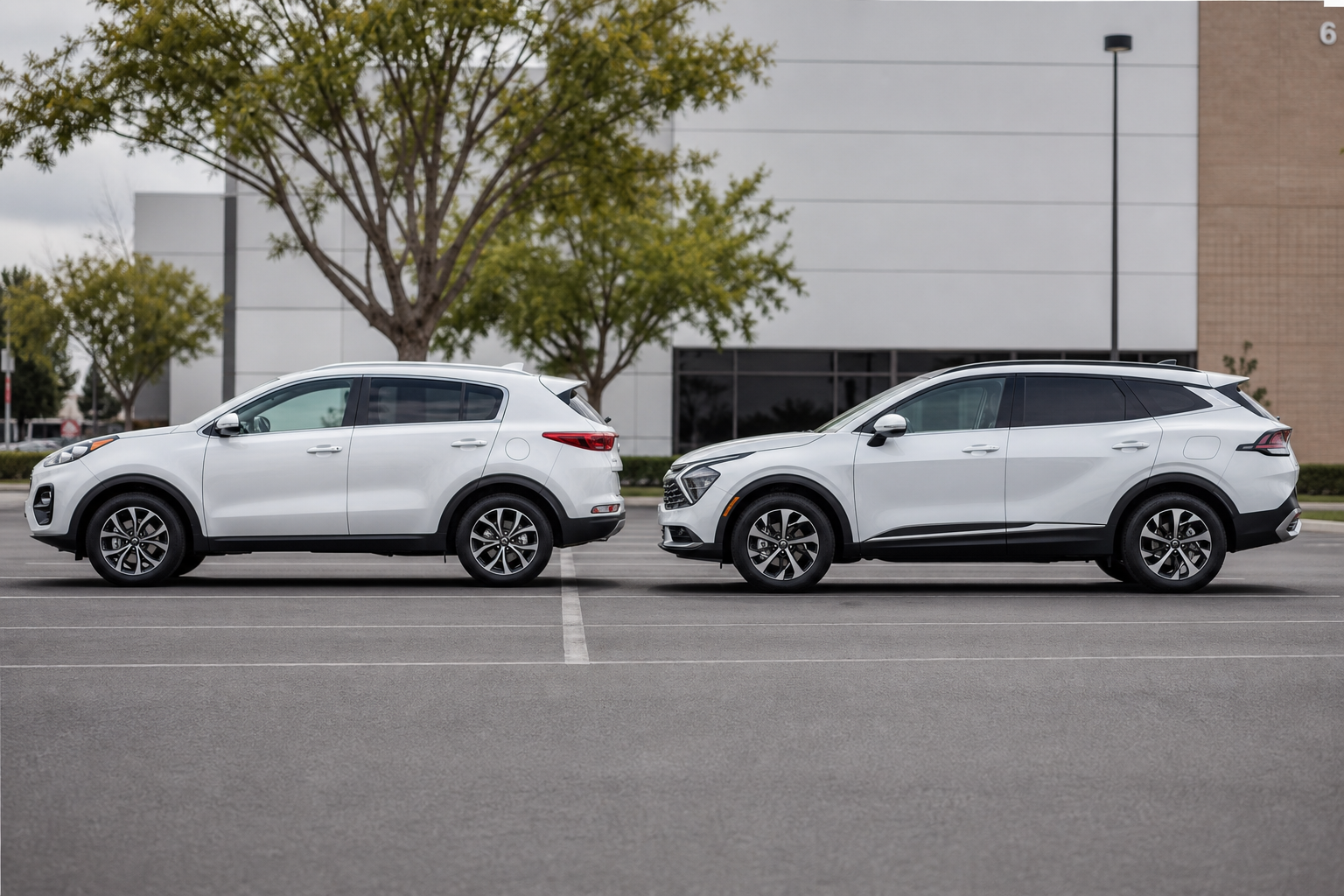
On the 4th generation Sportage (2017 through 2022), the base LX trim came with standard cruise control and no radar sensor at all. Step up to EX or SX trims, and Smart Cruise Control became standard equipment, replacing conventional cruise entirely rather than adding it as an option alongside it.
The 5th generation Sportage, which launched for the 2023 model year, follows the same pattern but pushes Smart Cruise Control further down the lineup. On many 2023 and newer LX trims, Smart Cruise Control is now standard, meaning fewer buyers than before end up with a Sportage that has true fixed-speed cruise. If you specifically want conventional cruise control on a newer Sportage, you’ll need to check the window sticker or build sheet for your exact trim, because Kia has shifted SCC availability around between model years and regions.
If you’re cross-shopping and this is a dealbreaker for you, it’s worth noting the Sportage’s platform-mate, the Hyundai Tucson, follows a nearly identical trim structure. If you already own a Tucson or are comparing the two, our guide on resetting the TPMS light on the Hyundai Tucson covers a related maintenance task on that same shared platform.
Steering Wheel Control Sequence for Conventional Cruise (When Equipped)
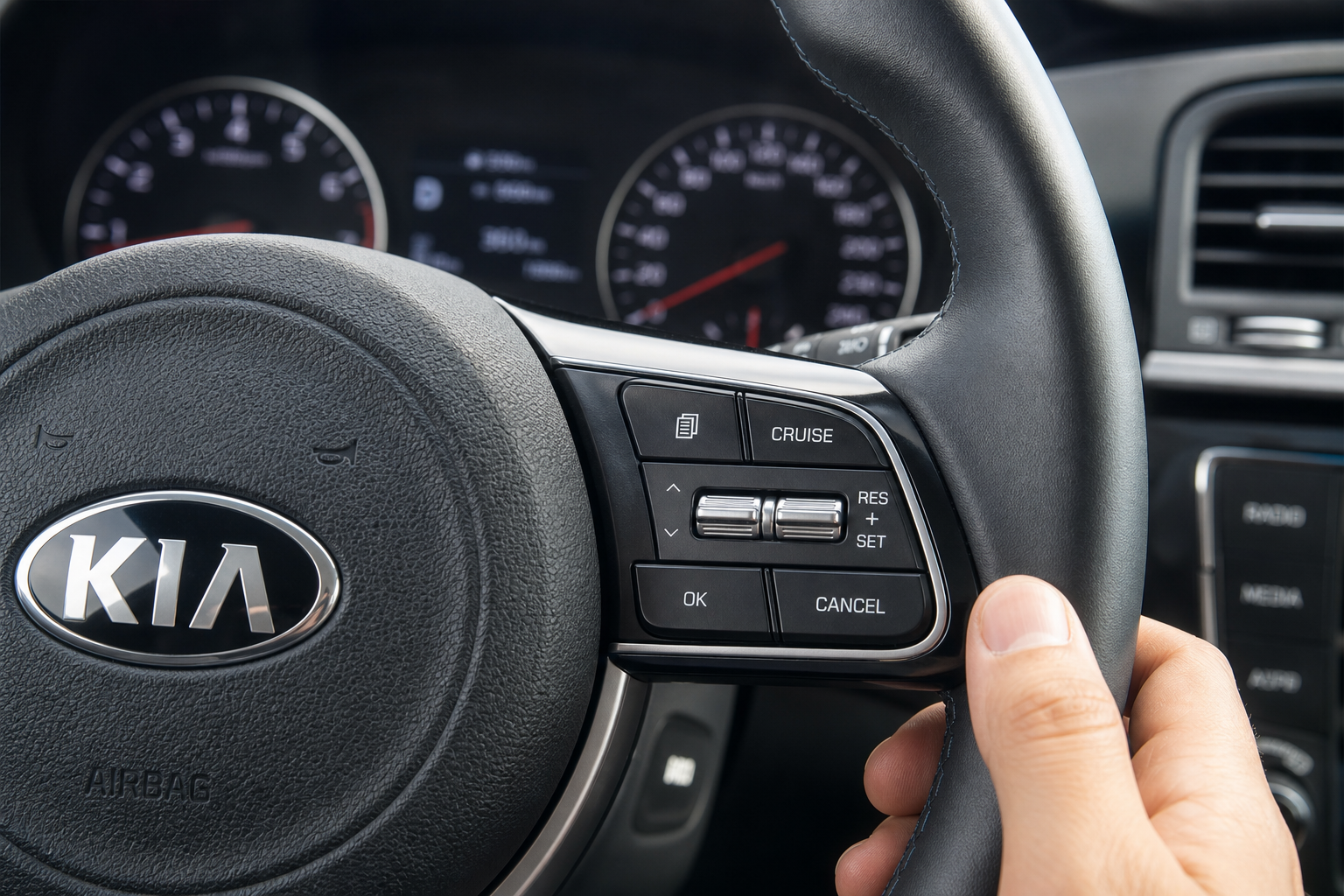
If your Sportage is one of the trims without the radar sensor, standard cruise control operates through the buttons on the right side of the steering wheel. Here’s the sequence:
- Press the CRUISE button (usually labeled with a speedometer icon) to power on the cruise system. You’ll see a white cruise indicator light up on the instrument cluster.
- Accelerate to your desired speed, then press SET (often combined with the “-” button) to lock in that speed.
- Use RES/+ to resume a previously set speed or nudge it up in small increments, and use SET/- to reduce speed while cruise is active.
- Tap the brake pedal or press CANCEL to disengage cruise without turning the whole system off.
- Press CRUISE again to fully shut the system down.
This is genuinely fixed-speed cruise on these trims. It won’t slow down for traffic ahead and it won’t brake automatically, so you’re fully responsible for managing following distance the old-fashioned way.
Dashboard Indicators: How to Tell Which Mode You’re In
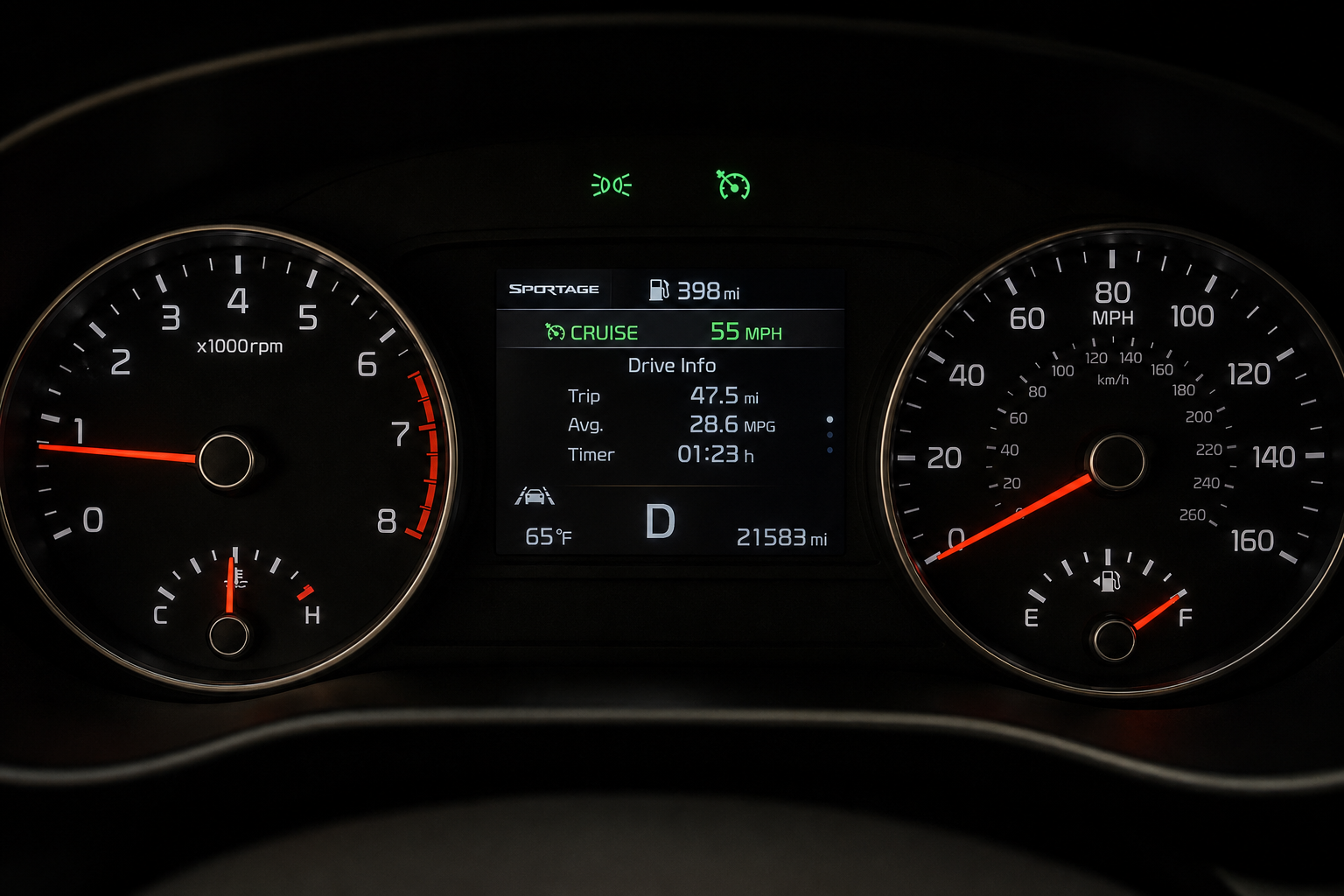
Kia makes the distinction pretty clear once you know what to look for. Conventional cruise control shows a simple white speedometer-style cruise icon in the instrument cluster, with your set speed displayed as a plain number. There’s no car icon, no distance bars, and no radar symbol anywhere near it.
Smart Cruise Control looks noticeably busier. You’ll see a car icon with wavy lines radiating from the front of it, representing the radar beam, along with a row of bars or dots underneath that show your selected following distance setting. When SCC is actively tracking a vehicle ahead, that car icon typically turns a different color, often green or white depending on the trim’s cluster style, and the vehicle ahead is shown directly under your own car icon on the display.
If you ever see the distance bars and the car-with-radar-waves icon, you’re in SCC and that following behavior can’t be turned off through the dash. If you only see a plain cruise light with your set speed, that’s genuine fixed-speed cruise control, and it behaves exactly the way older, simpler cruise systems always have.
This same layered approach to driver assist information shows up across a lot of modern vehicles. If you’re curious how another manufacturer handles similar tech, our breakdown of the Pre-Collision System with Pedestrian Detection on the Toyota Corolla walks through a comparable dashboard alert setup.
Working With Smart Cruise Control If You’re Stuck With It
If your Sportage only has SCC and you’re not thrilled about it, you do have some control over how intrusive it feels. Setting the following distance to its maximum setting gives you the most buffer before the system starts braking, which makes it feel closer to conventional cruise on open highways with light traffic.
You can also just avoid using cruise control in stop-and-go conditions or construction zones where the radar tends to react to lane changes and merging vehicles more aggressively than most drivers would. Many owners end up using SCC only on long, steady highway stretches and driving manually the rest of the time, which honestly is where adaptive cruise works best anyway.
Kia isn’t alone in locking owners into one system based on trim. Recalls and feature changes across the industry happen often enough that it’s worth staying current, and our recent roundup on recalls hitting Lucid, Kia and Ford is a good example of how quickly these details can shift between model years.
Frequently Asked Questions
Can I disable Smart Cruise Control and use regular cruise instead on the same Sportage?
No. On the Sportage, conventional cruise and Smart Cruise Control are tied to different hardware configurations depending on trim and model year. There’s no menu setting or button combination that converts an SCC-equipped Sportage into a fixed-speed-only system.
Which Sportage trims come with plain cruise control instead of adaptive cruise?
Historically, base LX trims without the front radar sensor package have shipped with conventional cruise control, while EX, SX, and SX Prestige trims get Smart Cruise Control as standard equipment. This has shifted some with the 2023-2025 redesign, so check your specific trim’s feature list or window sticker to confirm.
How do I know if my Sportage has the radar sensor for Smart Cruise Control?
Look for a small sensor housing behind the Kia badge on the front grille, and check your owner’s manual feature list under Driver Assistance. On the dashboard, if the cruise indicator shows following distance bars and a car icon rather than just a plain speed number, your Sportage has the radar-based system.
Related posts:
 How to Use Regular Cruise Control Instead of Adaptive Cruise on Toyota Highlander
  How to Use Regular Cruise Control Instead of Adaptive Cruise on Honda CR-V
  How to Use Regular Cruise Control Instead of Adaptive Cruise on Honda Pilot
  How to Use Regular Cruise Control Instead of Adaptive Cruise on Subaru Outback
Leave a Reply