
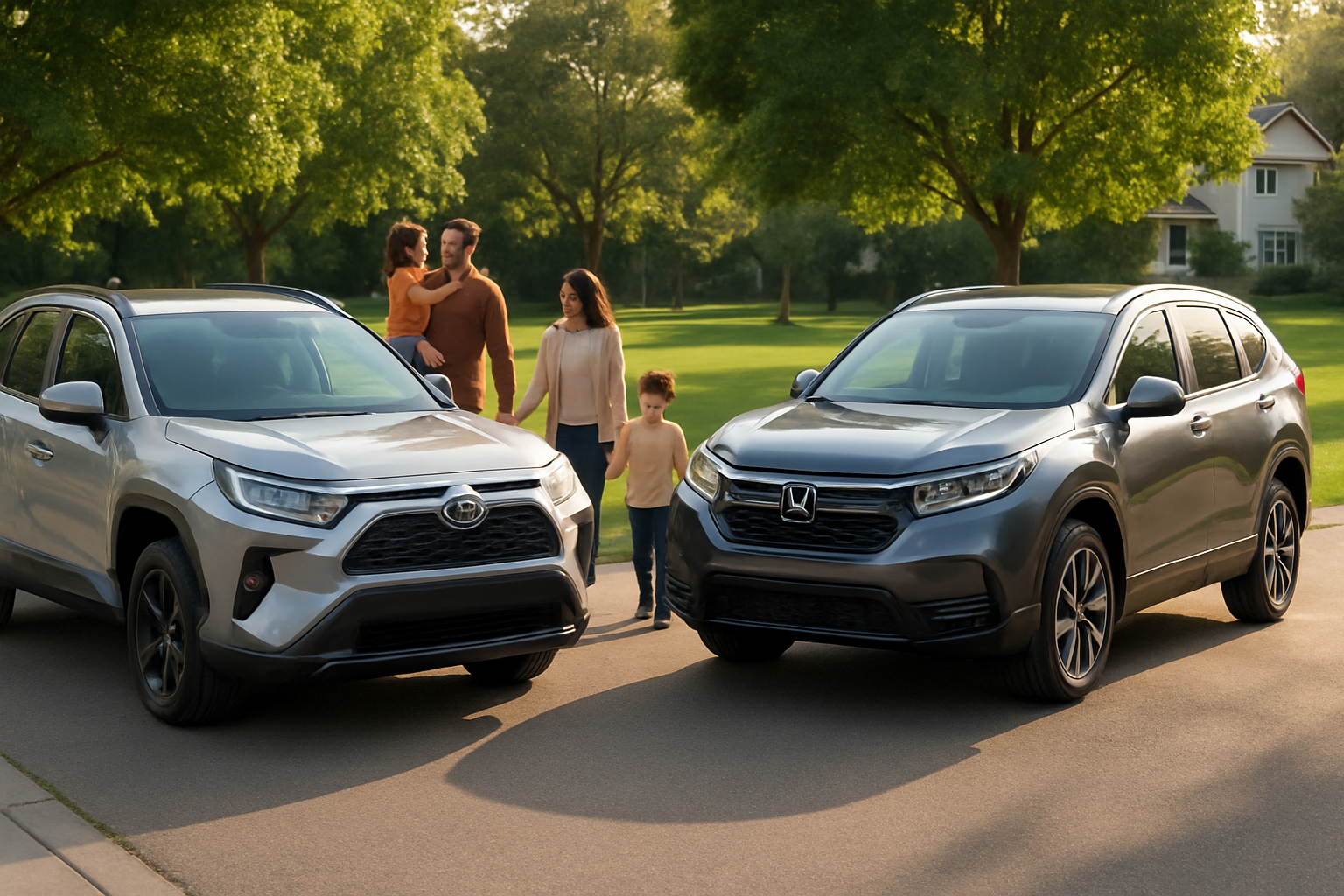
Choosing the right SUV for your growing family comes down to the details that matter when you’re juggling car seats, strollers, and soccer gear. The Toyota RAV4 and Honda CR-V consistently rank as top choices for families, but each brings distinct advantages to your daily routine.
Cargo Space: Where Your Stuff Actually Goes
The Honda CR-V gives you 39.2 cubic feet behind the rear seats, while the RAV4 offers 37.5 cubic feet. Those extra 1.7 cubic feet in the CR-V might not sound like much, but you’ll notice the difference when you’re loading a double stroller and grocery bags.
More important than the raw numbers is how the space works. The CR-V’s cargo area sits lower, making it easier to lift heavy items like a Pack ‘n Play or cooler. The RAV4’s higher load floor means more ground clearance for off-road adventures, but your back might disagree after loading multiple bags of soccer equipment.
Both vehicles offer 60/40 split-folding rear seats. The CR-V’s seats fold nearly flat, creating a smooth loading surface that extends to 75.8 cubic feet total. The RAV4’s folded seats leave a slight step, but you still get 69.8 cubic feet of maximum cargo space.
Back Seat Reality Check
Your kids will spend years in these back seats, and the differences matter more than you’d expect. The CR-V provides 40.4 inches of rear legroom compared to the RAV4’s 37.8 inches. That extra 2.6 inches means your growing teenagers won’t be complaining about cramped legs on long road trips.
The CR-V’s rear seat cushions sit higher off the floor, giving better thigh support for passengers of all ages. The RAV4’s lower seating position works fine for kids but can feel awkward for adults riding in back.
Both vehicles offer rear air vents, but the CR-V places them in the B-pillars where they’re easier for kids to adjust themselves. The RAV4’s rear vents mount in the center console, requiring more reaching from the outer seats.
Car Seat Installation: The Real Test
Installing car seats correctly shouldn’t require an engineering degree, but some vehicles make it unnecessarily complicated. Both the RAV4 and CR-V earn good marks here, with easily accessible LATCH connectors and clear anchor point markings.
The CR-V’s wider rear door openings give you better access when wrestling with bulky convertible car seats. You’ll appreciate this advantage during those parking lot installations when you’re parked between two other vehicles.
Both vehicles accommodate three car seats across the back row, though it’s tight. The CR-V’s extra width makes this configuration slightly more manageable. If you’re planning for three kids or frequently carpool, test this setup during your test drive with your actual car seats.
The RAV4’s rear seat bottoms are firmer, which can provide better stability for certain car seat models. However, the CR-V’s softer cushions often create a more secure fit by allowing the car seat base to nestle slightly into the upholstery.
Safety Technology That Actually Helps
Both vehicles come standard with comprehensive safety suites, but they work differently in daily family life. Toyota Safety Sense 2.0 in the RAV4 includes pre-collision detection, lane departure alert, automatic high beams, and dynamic radar cruise control.
Honda Sensing in the CR-V offers similar features but with notable differences in execution. The CR-V’s collision mitigation braking system tends to be less intrusive during normal driving, while the RAV4’s system can feel overly sensitive in stop-and-go traffic with kids distracting you.
The RAV4’s available blind spot monitoring displays warnings in the side mirrors, exactly where you’re already looking. The CR-V’s system uses dashboard indicators that require you to shift your attention away from the mirrors.
Both vehicles offer rear seat reminder systems to help prevent leaving children or pets in the car. The CR-V’s system activates based on rear door usage, while the RAV4’s relies on weight sensors in the rear seats.
Reliability: What Breaks and When
Both Toyota and Honda built their reputations on reliability, but recent years tell a more nuanced story. The RAV4 has experienced some issues with its CVT transmission in 2019-2021 models, particularly rough shifting and premature wear.
The CR-V faced oil dilution problems in 2017-2018 turbocharged models, where gasoline would mix with engine oil in cold weather conditions. Honda extended warranties and updated software to address this issue.
Current generation models from both brands show improved reliability. The RAV4’s naturally aspirated 2.5-liter engine has proven more dependable than the previous turbocharged variants. The CR-V’s revised 1.5-liter turbo engine addresses earlier oil dilution concerns through updated programming and hardware changes.
Both vehicles require maintenance every 10,000 miles under normal conditions. Toyota dealers are often more widely available in rural areas, while Honda’s service network excels in suburban markets. Parts costs run slightly higher for the RAV4, but the difference rarely exceeds $50-100 for routine services.
Resale Value: Your Future Financial Reality
Toyota’s reputation for holding value remains strong, with RAV4s typically retaining 60-65% of their original MSRP after three years. The CR-V follows closely at 55-60% retention, but this gap has been narrowing as Honda’s reliability reputation rebounds.
Certain trim levels hold value better than others. RAV4 XLE and Limited trims with all-wheel drive show the strongest resale performance. CR-V EX and EX-L models similarly outperform base LX trims in the used market.
Color choices affect resale more than most buyers realize. White, black, and silver remain the safest bets for both vehicles. Avoid bold colors like the RAV4’s Electric Storm Blue or CR-V’s Radiant Red Metallic if maximizing resale value is your priority.
Hybrid versions of both vehicles command premium resale values, often exceeding their gas-only counterparts by $2,000-3,000 in the used market. This premium helps offset the higher initial purchase price over your ownership period.
Fuel Economy in Family Life
EPA ratings tell part of the story, but real-world fuel economy depends heavily on your driving patterns. The RAV4 achieves 27 city/35 highway mpg with front-wheel drive, while the CR-V delivers 28 city/34 highway mpg.
All-wheel drive versions see modest decreases, with the RAV4 dropping to 25/33 mpg and the CR-V to 27/32 mpg. These differences matter more for high-mileage families who drive 15,000+ miles annually.
The RAV4 Hybrid stands out with 41 city/38 highway mpg ratings. The CR-V Hybrid achieves 40 city/35 highway mpg. Both hybrid systems work seamlessly in family driving, switching between gas and electric power without drama.
Technology Your Family Will Actually Use
Both vehicles offer Apple CarPlay and Android Auto compatibility, but implementation differs. The CR-V’s 7-inch touchscreen responds more consistently to inputs, while the RAV4’s 8-inch system occasionally requires multiple taps to register commands.
The RAV4’s available 9-inch touchscreen in higher trims provides better visibility for navigation and backup cameras. However, Toyota’s insistence on capacitive touch controls for climate functions frustrates many owners who prefer physical knobs.
Honda’s infotainment system includes a volume knob and climate control buttons, making it easier to adjust settings while driving. This practical approach wins points from parents who need to make quick adjustments without taking eyes off the road.
Both vehicles offer multiple USB ports for rear passengers. The CR-V provides two USB-A ports and one USB-C port in the rear, while the RAV4 includes two USB-A ports. Consider your family’s device charging needs when comparing these setups.
All-Wheel Drive: When You Need It
Both vehicles offer capable all-wheel drive systems, but they work differently. The RAV4’s system can send up to 50% of power to the rear wheels and includes a terrain selection dial with multiple modes for different conditions.
The CR-V’s all-wheel drive system focuses on on-road traction and fuel economy. It automatically engages when sensors detect wheel slip but doesn’t offer selectable drive modes like the RAV4.
For families living in snowy climates or those who venture onto dirt roads for camping trips, the RAV4’s more robust all-wheel drive system provides additional confidence. The CR-V’s system handles typical weather conditions and light off-road driving adequately.
Cost of Ownership Beyond the Purchase Price
Insurance costs run similarly for both vehicles, with the CR-V often costing $50-100 less annually due to lower theft rates and repair costs. The RAV4’s higher ground clearance can lead to more undercarriage damage from road debris, resulting in occasional unexpected repair bills.
Tire replacement costs vary by trim level and wheel size. Both vehicles offer 17-inch wheels on base trims and 18-19 inch wheels on higher trims. Larger wheels look better but cost more to replace and provide harsher ride quality over broken pavement.
Extended warranty options from both manufacturers offer similar coverage, but Toyota’s plans often include longer powertrain coverage periods. Honda’s warranties typically cost less upfront but may have higher deductibles for certain repairs.
Making Your Decision
Choose the Honda CR-V if you prioritize interior space, ride comfort, and user-friendly technology. Its superior cargo capacity, rear seat room, and intuitive controls make daily family life easier. The CR-V works best for families who primarily drive on paved roads and value comfort over capability.
Pick the Toyota RAV4 if you want better off-road capability, stronger resale value, and more robust all-wheel drive. The RAV4 suits families who venture beyond suburban streets and want a vehicle that can handle camping trips, beach drives, and winter weather with greater confidence.
Both vehicles will serve your growing family well, but the winner depends on your specific priorities and driving needs. Test drive both with your family aboard, install your car seats, and load your typical cargo to see which feels right for your lifestyle.
Frequently Asked Questions
Which vehicle offers better long-term reliability?
Both vehicles offer excellent long-term reliability, but Toyota historically edges out Honda in long-term ownership studies. Recent CR-V models have closed this gap significantly, and both should provide 200,000+ miles with proper maintenance. The RAV4’s simpler naturally aspirated engine may have slight advantages over the CR-V’s more complex turbocharged unit.
Is all-wheel drive necessary for family use?
All-wheel drive adds about $1,500 to either vehicle’s price and reduces fuel economy by 2-3 mpg. It’s beneficial for families in snowy climates, those who frequently drive on gravel roads, or families who enjoy camping and outdoor activities. For primarily urban and suburban driving, front-wheel drive versions provide adequate traction and better fuel economy.
Which hybrid version offers better value?
Both hybrid versions command premium pricing but offer substantial fuel savings for high-mileage families. The RAV4 Hybrid’s superior fuel economy (41 city mpg) and standard all-wheel drive make it more appealing for families who drive 12,000+ miles annually. The CR-V Hybrid costs less initially but doesn’t include all-wheel drive as standard equipment.
How do cargo space differences affect real-world use?
The CR-V’s 1.7 cubic feet advantage in cargo space translates to easier loading of bulky items like strollers and sports equipment. More importantly, the CR-V’s lower load floor reduces lifting height for heavy objects. Families who frequently load large items will appreciate the CR-V’s more practical cargo area design over the RAV4’s slightly smaller but higher space.
This article contains affiliate links. If you purchase through these links, we may earn a small commission at no extra cost to you.

Leave a Reply