
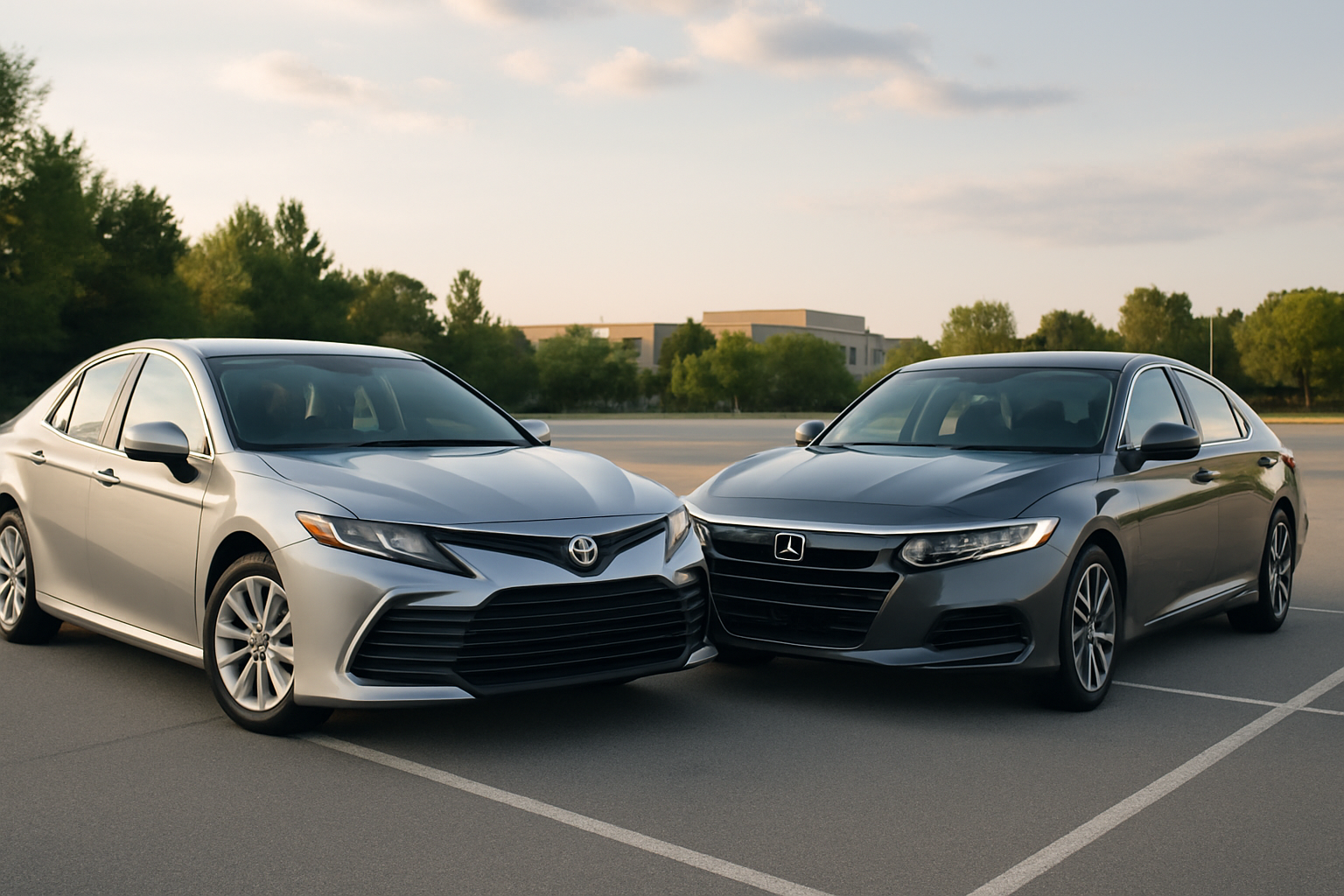
When you’re shopping for a reliable midsize sedan, two names consistently rise to the top: the Toyota Camry and Honda Accord. Both have earned reputations as dependable daily drivers, but which one actually delivers the best ownership experience? I’ve spent years working with both models, and there are some clear differences that matter for real-world driving.
Current Generation Overview
The current Toyota Camry (2018-2024) and Honda Accord (2018-2024) both received complete redesigns that transformed them from conservative family sedans into surprisingly engaging cars. The Camry sits on Toyota’s TNGA-K platform, while the Accord uses Honda’s redesigned global platform.
Both cars offer similar engine options: naturally aspirated four-cylinders, turbocharged fours, and hybrid powertrains. However, the execution and real-world performance tell different stories.
Reliability: The Long-Term Picture
Toyota’s reputation for reliability isn’t just marketing hype. The current Camry continues this tradition with fewer reported issues than the Accord during the first few years of ownership. The Camry’s 2.5-liter Dynamic Force engine has proven particularly robust, with minimal oil consumption issues or timing chain problems.
The Honda Accord, while still reliable, has experienced some hiccups with its 1.5-liter turbocharged engine. Some owners report oil dilution issues in cold climates, where gasoline can mix with engine oil during short trips. Honda issued a software update to address this, but it’s something to monitor if you live in a cold area and take lots of short drives.
Both cars’ hybrid systems have performed well, though Toyota’s hybrid technology benefits from over two decades of development and refinement. The Camry Hybrid uses a proven Atkinson-cycle engine paired with electric motors, while the Accord Hybrid employs Honda’s two-motor i-MMD system.
Ride Quality and Handling
This is where personal preference really matters. The Camry prioritizes comfort with a suspension setup that absorbs road imperfections well. You’ll notice this especially on broken pavement or highway expansion joints. The trade-off is slightly more body roll during spirited cornering.
The Accord strikes a different balance, offering a more connected driving experience. Its suspension feels more controlled in corners, and the steering provides better road feel. If you enjoy driving and want a sedan that responds predictably to your inputs, the Accord has the edge.
Both cars use MacPherson struts up front and multi-link rear suspensions, but Honda’s tuning feels more European in character. Toyota’s approach caters more to buyers who prioritize ride comfort over handling precision.
Technology and Infotainment
The technology battle between these two has evolved significantly. Earlier versions of both cars had frustrating infotainment systems, but recent updates have improved the situation considerably.
Toyota’s current infotainment system includes Apple CarPlay and Android Auto as standard equipment. The 9-inch touchscreen responds reasonably well, though some menu structures still feel unnecessarily complicated. The good news is that Toyota includes physical knobs and buttons for climate control, which makes daily operation much easier.
Honda’s system also includes smartphone integration and offers a cleaner interface design. The Accord’s infotainment feels more intuitive to navigate, with logical menu structures and quick response times. However, Honda eliminated the volume knob on some trim levels, forcing you to use touch-sensitive controls that can be frustrating while driving.
Both cars offer excellent safety technology suites. Toyota Safety Sense 2.0 and Honda Sensing provide adaptive cruise control, automatic emergency braking, and lane-keeping assistance as standard features across all trim levels.
Interior Space and Comfort
The Accord wins the space battle, particularly in the rear seats. Back-seat passengers get more legroom and headroom in the Honda, making it more comfortable for adult passengers on longer trips. The Accord’s rear seat also reclines slightly, adding to passenger comfort.
Front seat comfort is excellent in both cars, though they achieve it differently. The Camry’s seats offer more cushioning and feel more plush during long drives. The Accord’s seats provide better lateral support and maintain their shape better over time.
Both cars offer impressive cargo space, with the Accord providing slightly more room at 16.7 cubic feet compared to the Camry’s 15.1 cubic feet. The hybrid versions of both cars sacrifice some trunk space for battery placement, but the reduction is reasonable.
Fuel Economy Performance
Fuel efficiency numbers tell only part of the story. The Camry Hybrid achieves EPA ratings of 51 mpg city and 53 mpg highway, while the Accord Hybrid manages 48 mpg city and 47 mpg highway. In real-world driving, both cars can exceed their EPA estimates with careful driving techniques.
The non-hybrid versions perform similarly, with both achieving around 32 mpg combined when equipped with their base four-cylinder engines. The Accord’s turbocharged 1.5-liter provides better performance than the Camry’s naturally aspirated 2.5-liter while maintaining similar fuel economy.
Resale Value Analysis
Toyota traditionally holds resale value better than Honda, and this continues with the current generation. After five years, the Camry typically retains about 55-60% of its original value, while the Accord holds approximately 50-55%.
Several factors contribute to this difference. Toyota’s reliability reputation, lower maintenance costs, and broader dealer network all support stronger resale values. The Camry also benefits from Toyota’s conservative approach to redesigns, which means your car won’t look as dated as quickly.
However, the gap has narrowed compared to previous generations. The Accord’s improved reliability and attractive design help it maintain value better than before.
Insurance and Ownership Costs
Insurance costs vary by location and driver profile, but both cars typically fall into similar insurance groups. The Camry sometimes edges ahead slightly due to lower repair costs and parts availability. Honda parts can be more expensive, particularly for body panels and electronic components.
Maintenance costs favor the Camry, especially as the cars age. Toyota’s service intervals are slightly longer, and routine maintenance items like oil filters and air filters cost less. Honda’s turbocharged engines require premium oil changes more frequently, which adds to long-term costs.
Both manufacturers offer competitive warranty coverage, with Toyota providing a 3-year/36,000-mile basic warranty and Honda offering similar coverage. Toyota’s hybrid battery warranty extends to 10 years/150,000 miles, while Honda covers hybrid components for 8 years/100,000 miles.
Real-World Driving Experience
Daily driving characteristics separate these cars more than specification sheets suggest. The Camry excels in stop-and-go traffic with its smooth CVT transmission and comfortable suspension tuning. Highway cruising feels effortless, and wind noise remains well-controlled at 70+ mph speeds.
The Accord provides a more engaging driving experience when you want it, but doesn’t punish you during mundane commuting. Its transmission programming feels more responsive, and the engine note sounds more refined under acceleration.
Both cars offer multiple drive modes that adjust throttle response, transmission behavior, and in hybrid models, electric motor assistance. These systems work well and provide noticeable differences in character.
Which Should You Choose?
After considering all factors, the Toyota Camry emerges as the better daily driver for most people. Its superior reliability record, lower long-term costs, better resale value, and comfortable ride quality make it the more practical choice for typical ownership scenarios.
The Camry particularly excels if you prioritize dependability, plan to keep the car for many years, or want the most comfortable ride possible. Its hybrid version offers exceptional fuel economy with proven durability.
Choose the Honda Accord if you value a more engaging driving experience, need maximum rear-seat space, or prefer a more modern interior design. The Accord makes more sense for drivers who enjoy the act of driving and want a sedan that feels more connected to the road.
Frequently Asked Questions
Which car has better build quality?
Both cars demonstrate excellent build quality, but Toyota has a slight edge in long-term durability. Paint quality, interior materials, and mechanical components tend to age better in the Camry. However, the gap is much smaller than in previous generations.
Are hybrid versions worth the extra cost?
Both hybrid versions justify their price premiums through fuel savings and reduced emissions. The Camry Hybrid offers better fuel economy, while the Accord Hybrid provides more performance. If you drive more than 12,000 miles annually, either hybrid pays for itself within 3-4 years.
Which car is better for tall drivers?
The Honda Accord provides more front and rear headroom, making it more comfortable for drivers over 6 feet tall. The Accord’s seat adjustments also offer a wider range of positions. However, both cars accommodate most drivers comfortably.
How do maintenance costs compare over 100,000 miles?
The Camry typically costs $500-800 less to maintain over 100,000 miles. This difference comes from longer service intervals, cheaper parts, and fewer required premium fluids. The Accord’s turbocharged engine requires more frequent oil changes with premium oil, adding to long-term costs.
This article contains affiliate links. If you purchase through these links, we may earn a small commission at no extra cost to you.

Leave a Reply