
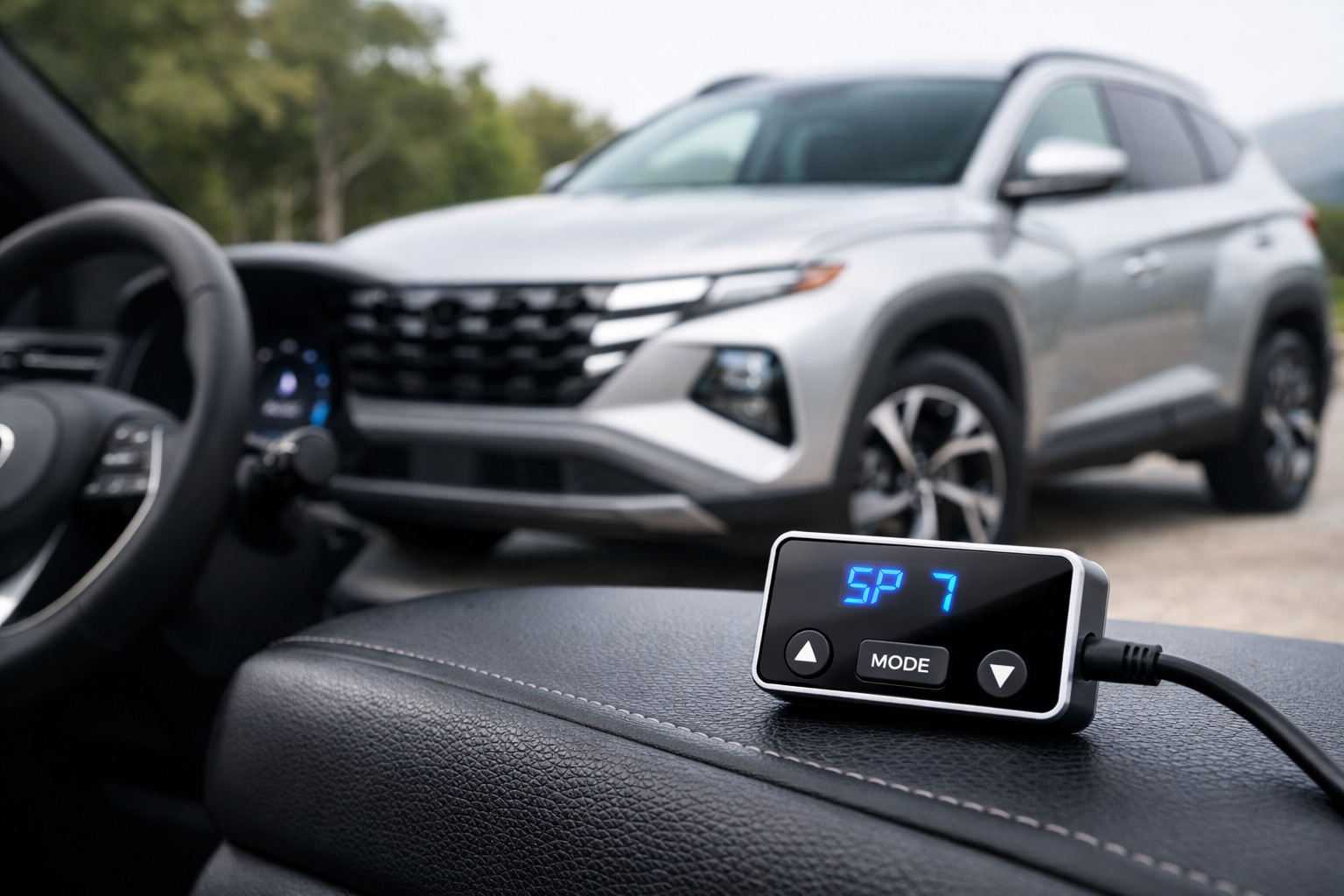
The Hyundai Tucson NX4 (2022+) is a popular crossover with a famously conservative throttle map. Hyundai prioritized smooth, appliance-like driving behavior over responsiveness, which makes the Tucson feel sluggish during merging, passing, and uphill driving. For a vehicle that many owners use for daily commuting and family duties, the lack of throttle urgency makes everyday driving feel more laborious than it needs to be.
A throttle controller is one of the simplest and most affordable upgrades for making the Tucson’s driving experience feel less like an appliance and more like a car that responds to your inputs with intention.
Why the Tucson Feels So Conservative
Hyundai designed the NX4 Tucson’s throttle curve for maximum smoothness. The first 20% of pedal travel produces almost no acceleration, creating a dead zone that makes the crossover feel underpowered despite having either a 2.5L naturally aspirated engine (187 HP) or a 1.6L turbocharged hybrid powertrain (227 HP combined). The dead zone is Hyundai’s way of ensuring the driving experience is smooth and predictable, but it comes at the cost of responsiveness.
The 2.5L engine needs every bit of its 187 horsepower to move the Tucson’s 3,500+ pounds, and the throttle mapping makes it feel like it has significantly less. Highway merging requires planning ahead because the engine takes a noticeable moment to respond after you press the gas. Passing on two-lane roads feels uncertain because the power delivery doesn’t match your pedal input for the first crucial second.
The 1.6T hybrid powertrain has more combined output, but the hybrid system’s electric motor and gas engine handoff can feel uneven during initial acceleration. The throttle mapping adds another layer of smoothing on top of the hybrid transition, which some drivers find frustrating. You press the gas and the car seems to think about it before deciding how to combine electric and gas power to fulfill your request.
The dual-clutch transmission (DCT) on the hybrid models compounds the issue. The DCT can feel hesitant at low speeds, and the soft throttle signal makes the transmission’s decision-making feel even slower. A crisper throttle input helps the DCT commit to a gear more quickly, which is one of the secondary benefits of a controller on the hybrid Tucson. If you want to understand more about how dual-clutch transmissions work and differ from traditional automatics, the DCT’s behavior makes more sense.
Best Controllers for the Tucson
Pedal Commander
The Pedal Commander for Hyundai Tucson covers the NX4 platform with both the 2.5L naturally aspirated and 1.6T hybrid powertrains. City mode at level 3 to 5 eliminates the dead zone without making the DCT transmission feel jerky. This is the sweet spot where the Tucson starts feeling like a properly responsive vehicle rather than an appliance that happens to have wheels.
Sport mode at moderate levels (3 to 5) is appropriate for highway driving where you want more confident passing and merging. Higher Sport settings (6+) can make the Tucson feel twitchy in traffic, so most owners stick with the City range for everyday use.

Pedal Commander for Hyundai Tucson
Transforms the Tucson’s conservative throttle into responsive daily driving
Budget Options
Tucson owners tend to be value-conscious, and budget controllers fit the pedal connector and deliver genuine improvement. The core function (eliminating the dead zone) works the same regardless of price. For a crossover where the primary goal is removing the sluggish feel rather than achieving maximum performance, an affordable controller does the job well. If you like the improvement, upgrading to a premium brand later is easy since the connector is the same.
Hybrid Compatibility
The 1.6T hybrid Tucson benefits from a controller just like the conventional model. The controller only modifies the pedal signal; it doesn’t interfere with the hybrid system’s electric motor assist, regenerative braking, or battery management. The hybrid system receives the modified pedal signal from the ECU and responds accordingly.
Many hybrid Tucson owners report that the controller makes the electric-to-gas transitions feel smoother because the engine responds more promptly to the accelerator input. If you’re interested in understanding how different hybrid systems handle these transitions, comparing the plug-in hybrid versus full electric experience provides useful context.
DCT Transmission Improvement
The dual-clutch transmission in the hybrid Tucson uses the throttle signal to determine shift timing and clutch engagement. A soft throttle signal (from the stock conservative mapping) makes the DCT feel hesitant, especially during low-speed maneuvers and initial acceleration from a stop. A controller provides a crisper, more definitive throttle signal that helps the DCT commit to engagements more quickly.
The improvement doesn’t change the DCT’s programming, but the better input signal gives the transmission clearer information about driver intent. The result is shifts that feel more decisive and less uncertain, which addresses one of the most common complaints about the hybrid Tucson’s driving experience.
Comparing the Tucson’s Responsiveness to Competitors
If you’re cross-shopping the Tucson with other compact crossovers, throttle response is a key differentiator. The Mazda CX-5 offers significantly better throttle response out of the box, which is one reason it’s often praised for driving dynamics. The Tucson’s conservative tuning puts it at a disadvantage in this comparison, but a throttle controller levels the playing field considerably.
For owners who’ve already purchased the Tucson, the controller is the most practical solution for matching the driving feel of more responsive competitors without trading in the vehicle.
Frequently Asked Questions
Will it make the DCT transmission shift better?
A crisper throttle signal helps the dual-clutch transmission select gears and engage clutches more decisively. Many Tucson owners report the DCT feels less hesitant and more confident with a controller installed. The controller doesn’t modify transmission programming, but the improved input quality makes a noticeable difference.
Does it void Hyundai’s warranty?
A plug-and-play controller doesn’t modify any Hyundai systems. It operates on the pedal signal only and can be removed in 30 seconds with no evidence. Under the Magnuson-Moss Warranty Act, Hyundai would need to prove the controller caused a specific failure to deny a claim.
Is it worth the money on a crossover?
If the sluggish throttle bothers you during daily driving, a controller provides the single biggest improvement in driving feel for the least money and complexity. Most Tucson owners who install one describe it as the best modification they’ve made to the vehicle, and many wish they’d done it sooner.
Does it work with the hybrid Tucson’s regenerative braking?
The controller only affects the accelerator pedal signal and doesn’t interfere with regenerative braking or the hybrid battery management system. The hybrid Tucson continues to recover energy during deceleration exactly as it did before installation. Learn more about how regenerative braking works in hybrid and electric vehicles.

Leave a Reply