
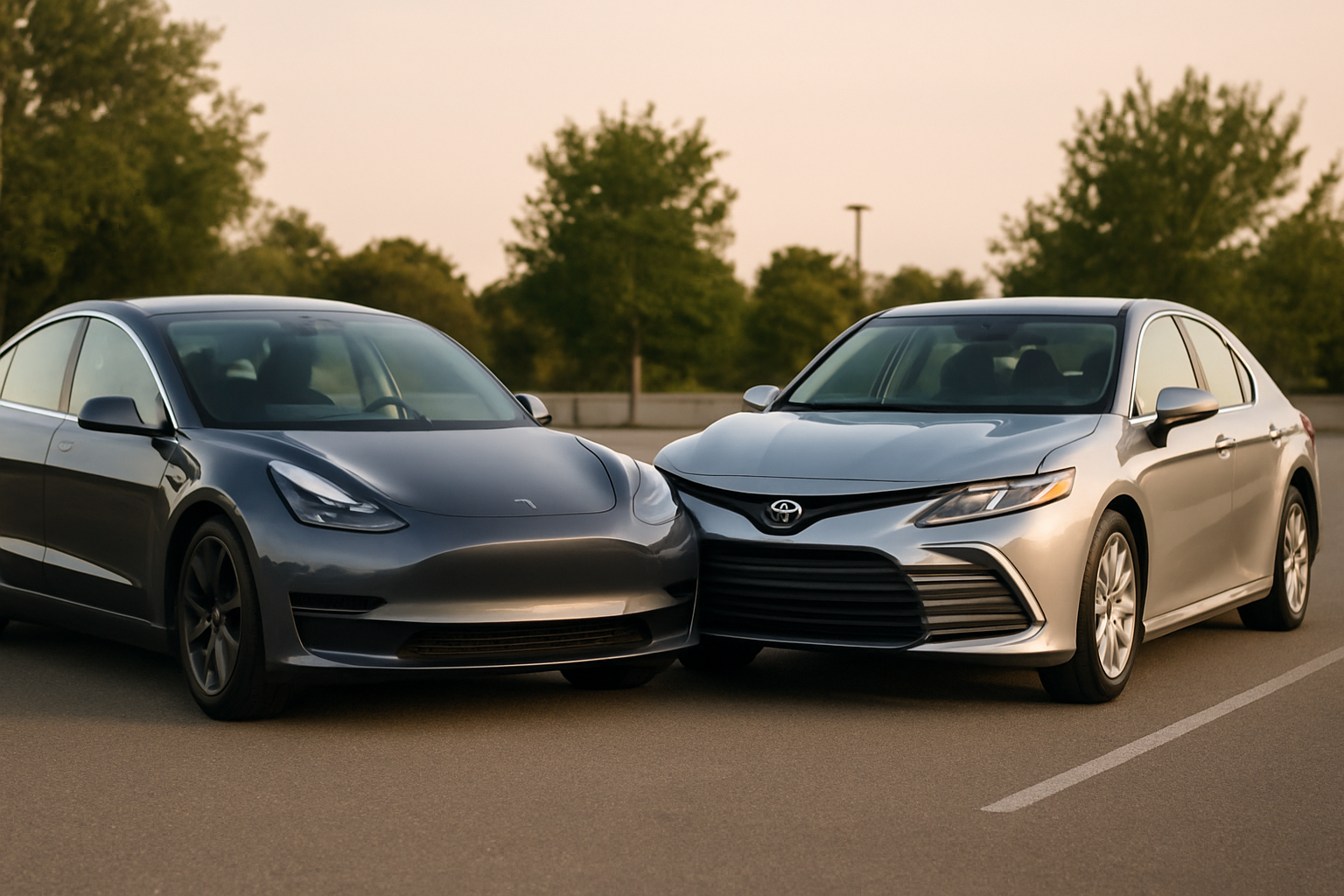
Deciding between a Tesla Model 3 and Toyota Camry involves more than just the sticker price. The real financial impact becomes clear when you calculate the total cost of ownership over five years, including everything from electricity and gas to maintenance and depreciation.
We’ll break down the actual numbers using a 2023 Tesla Model 3 Long Range ($47,740 MSRP) and a 2023 Toyota Camry LE ($25,295 MSRP) to give you a realistic comparison of what you’ll actually spend.
Purchase Price Breakdown
The Toyota Camry starts with a significant advantage in upfront costs. A 2023 Camry LE with typical options (Safety Sense 2.0, upgraded infotainment) costs around $27,500 after dealer fees and taxes.
The Tesla Model 3 Long Range, after destination charges and taxes, runs approximately $52,000. However, the Model 3 qualifies for the $7,500 federal tax credit if you meet income requirements and the vehicle meets battery sourcing criteria, bringing the effective price to $44,500.
This gives the Camry a $17,000 advantage in initial purchase price, even with Tesla’s tax credit factored in.
Fuel and Energy Costs Over 5 Years
This category reveals where the Tesla starts clawing back its higher purchase price. Using the national average of 12,000 miles per year, the numbers work out dramatically differently.
The Camry LE achieves 32 mpg combined in real-world driving. With gas averaging $3.50 per gallon over the past two years, you’ll spend about $1,310 annually on fuel, or $6,550 over five years.
The Model 3 Long Range uses approximately 24 kWh per 100 miles in mixed driving conditions. Charging at home with electricity costing $0.13 per kWh (national average), your annual electricity cost comes to about $375, totaling $1,875 over five years.
Add in occasional Supercharging trips at $0.28 per kWh, and your total energy costs reach roughly $2,200 over five years. The Tesla saves you approximately $4,350 in fuel costs compared to the Camry.
Insurance Premiums: A Significant Difference
Insurance costs heavily favor the Toyota Camry. The average annual premium for a Camry LE runs about $1,340 for a driver with a clean record and good credit.
Tesla Model 3 insurance averages $1,950 annually, reflecting higher repair costs and replacement part prices. Over five years, you’ll pay about $6,700 for the Camry versus $9,750 for the Model 3.
The Tesla costs $3,050 more to insure over the five-year period, eating into its fuel savings advantage.
Maintenance and Repair Costs
Traditional maintenance heavily favors the Tesla, but unexpected repairs can change this calculation quickly.
The Camry requires oil changes every 6,000 miles ($65 each), air filter replacements ($45), cabin filters ($35), brake pad replacements around year 4 ($350), tire rotations ($25 each), and a 60,000-mile service including spark plugs and transmission fluid ($450). Total scheduled maintenance over five years runs approximately $1,800.
The Model 3 needs tire rotations ($50 each, though many owners do this themselves), cabin air filter replacements ($25 for parts), and brake fluid replacement every 4 years ($150). Scheduled maintenance totals about $650 over five years.
However, Tesla’s repair costs can be substantial when things go wrong. Door handle replacements cost $400-600, screen replacements run $1,200-1,500, and charging port issues cost $800-1,000 to fix.
Factoring in typical repair probabilities, the Camry averages about $2,800 total for maintenance and repairs over five years, while the Model 3 averages $2,100.
Depreciation: The Largest Cost Factor
Depreciation represents the biggest expense for both vehicles, but the rates differ significantly.
The Toyota Camry typically retains about 58% of its value after five years. Your $27,500 Camry will be worth approximately $15,950, creating a depreciation cost of $11,550.
Tesla depreciation has been more volatile, but recent data suggests the Model 3 retains about 55% of its value after five years. Your $44,500 Model 3 (after tax credit) will be worth approximately $24,475, creating a depreciation cost of $20,025.
The Tesla loses $8,475 more in value over five years compared to the Camry.
Total Cost Breakdown
Here’s where all the numbers come together for a complete financial picture.
Toyota Camry 5-Year Total:
Purchase price: $27,500
Fuel: $6,550
Insurance: $6,700
Maintenance/Repairs: $2,800
Depreciation: $11,550
Total Cost of Ownership: $55,100
Tesla Model 3 5-Year Total:
Purchase price: $44,500 (after tax credit)
Electricity: $2,200
Insurance: $9,750
Maintenance/Repairs: $2,100
Depreciation: $20,025
Total Cost of Ownership: $78,575
The Toyota Camry costs $23,475 less to own over five years than the Tesla Model 3.
Regional Variations That Matter
These numbers shift based on your location and driving patterns. California owners benefit from additional EV rebates ($2,000 state rebate) and higher gas prices ($4.50+ per gallon), which narrows the gap to about $18,000.
Texas owners face no state income tax but pay more for electricity ($0.16 per kWh average) and less for gas, maintaining roughly the same $23,000 difference.
Cold weather states see reduced Tesla efficiency (20-30% range loss in winter), increasing electricity costs and potentially requiring more frequent tire replacements due to harsher conditions.
High-Mileage Scenarios
Driving 20,000+ miles annually changes the equation significantly. The fuel savings become more substantial, potentially saving $7,000-8,000 over five years compared to the Camry.
However, high-mileage driving accelerates depreciation on both vehicles and may push you outside warranty coverage for expensive Tesla repairs.
Factors Beyond Pure Economics
The Model 3 includes features that cost extra or aren’t available on the base Camry: over-the-air updates, Autopilot, premium audio system, and smartphone integration. Adding similar features to the Camry (navigation, premium audio, advanced safety features) adds $3,000-4,000 to its price.
Tesla’s Supercharger network provides convenience for road trips, while the Camry offers the flexibility of gas stations everywhere and 5-minute refueling.
Financing Considerations
Tesla offers competitive financing rates (currently 2.49% APR), while Toyota provides similar rates through Toyota Financial Services. The higher Tesla loan amount means paying about $180 more monthly even at identical interest rates.
Leasing narrows the gap significantly. Tesla’s lease deals often include the full federal tax credit, while Camry lease rates are typically lower due to higher residual values.
When Tesla Makes Financial Sense
The Model 3 becomes more competitive if you drive extensively (25,000+ miles annually), live in areas with expensive gas and cheap electricity, qualify for additional local EV incentives, or can utilize business tax advantages for EV purchases.
Company car policies favoring EVs or HOV lane access in your area can also tip the scales toward Tesla.
Frequently Asked Questions
How do luxury trim levels compare?
A loaded Camry XSE V6 costs about $36,000, while a Tesla Model 3 Performance runs $53,000 (before tax credit). The gap narrows to about $18,000 in total ownership costs, but the Tesla Performance offers significantly higher performance capabilities.
What about reliability and unexpected repairs?
Toyota’s reliability advantage is substantial. Consumer Reports ranks the Camry much higher for predicted reliability. Tesla repair costs can be extreme, with some owners reporting $4,000+ bills for relatively minor collision repairs due to specialized parts and certified repair facilities.
Do these numbers include home charging equipment?
These calculations assume you can charge using a standard 110V outlet or existing 240V outlet. Installing a dedicated Level 2 charger costs $800-2,000 depending on electrical work needed, adding to Tesla’s total cost.
How does warranty coverage compare?
Both offer similar basic warranties (3 years/36,000 miles), but Tesla provides an 8-year/120,000-mile battery warranty versus Toyota’s 5-year/60,000-mile powertrain coverage. Tesla’s warranty is more comprehensive for the electric drivetrain but may be harder to utilize due to fewer service locations.
The Toyota Camry wins on pure economics by a significant margin, costing roughly $23,000 less over five years. However, your driving patterns, local incentives, and priorities regarding technology and environmental impact may justify the Tesla’s premium for your specific situation.
This article contains affiliate links. If you purchase through these links, we may earn a small commission at no extra cost to you.


Leave a Reply