
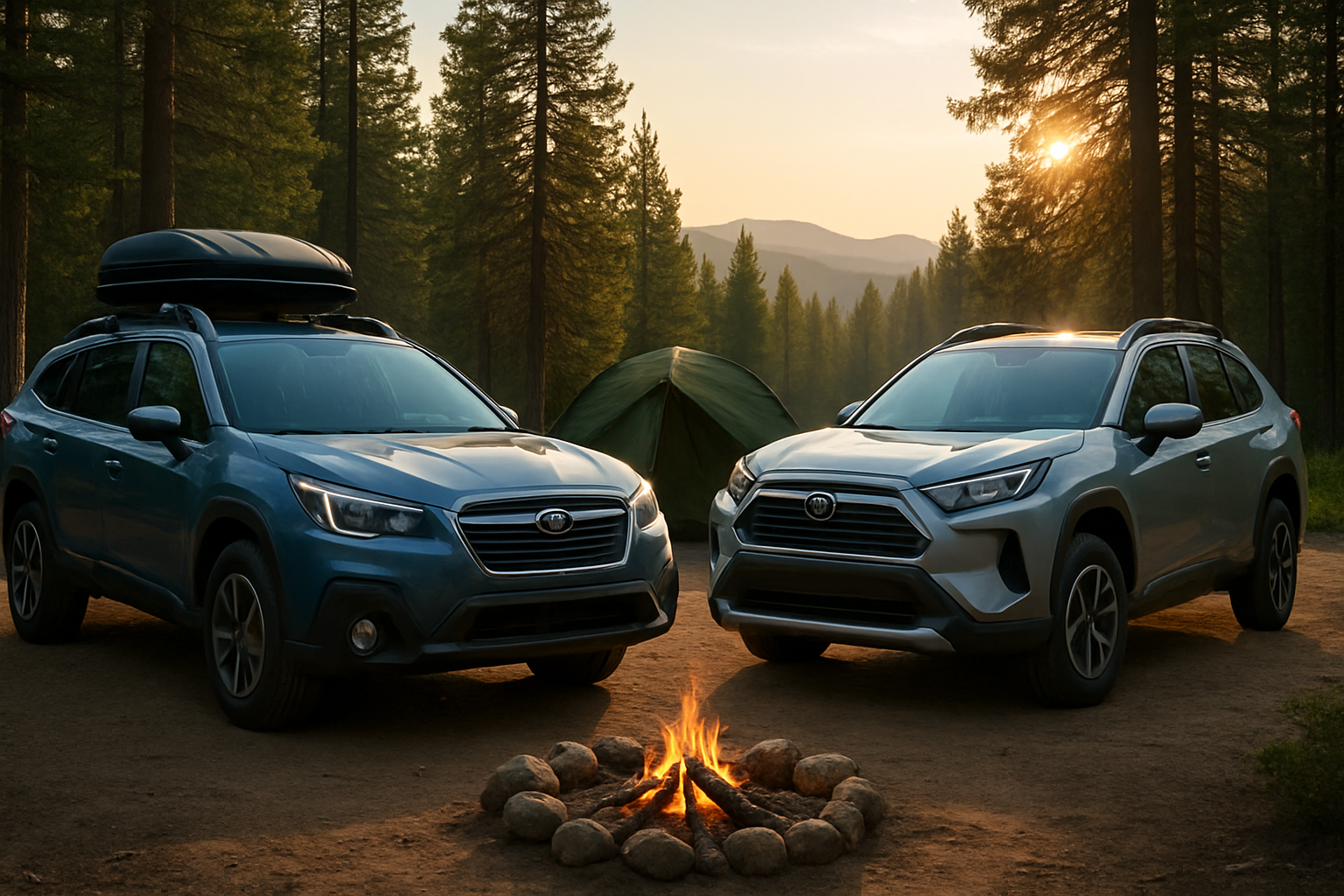
When you’re planning your next camping trip or outdoor adventure, choosing the right vehicle can make or break your experience. Both the Subaru Outback and Toyota RAV4 have earned solid reputations among outdoor enthusiasts, but each brings distinct advantages to the trailhead.
Ground Clearance: Getting Over the Rough Stuff
Your ability to reach remote campsites often comes down to those extra inches of clearance under your vehicle. The current generation Subaru Outback (2020-2024) sits 8.7 inches off the ground, while the Toyota RAV4 (2019-2024) offers 8.6 inches in most trims. The RAV4 Adventure trim bumps this up to 8.8 inches.
In real-world terms, you’ll barely notice the difference between these measurements. Both vehicles will clear typical forest service roads, rocky creek crossings, and moderate trail obstacles without scraping. The Outback’s longer wheelbase does mean you’ll need to be more careful about approach and departure angles on steep inclines.
Where ground clearance really matters is in snow camping scenarios. Both vehicles handle packed snow well, but the RAV4’s slightly more aggressive approach angle gives it a small edge when pushing through deeper drifts or over fallen logs.
All-Wheel Drive Systems: Traction When You Need It
Subaru’s standard all-wheel drive system operates full-time, constantly monitoring wheel slip and adjusting power delivery. This means you’re always ready for sudden traction loss, whether you hit a muddy patch or encounter unexpected ice on mountain roads.
The RAV4 uses an on-demand AWD system that primarily sends power to the front wheels during normal driving. When the system detects slip, it engages the rear wheels within milliseconds. This approach improves fuel economy but can feel less confidence-inspiring in consistently slippery conditions.
For camping applications, both systems work well. The Outback’s constant AWD gives you that extra security blanket when navigating unfamiliar terrain in the dark or backing up to a campsite on loose gravel. The RAV4’s system handles most camping scenarios just fine, and the Adventure trim adds additional drive modes for sand, mud, and rock crawling.
The RAV4 Adventure also includes Multi-Terrain Select, which adjusts throttle response and traction control settings for specific conditions. You’ll find this particularly useful when driving on beach sand or through muddy forest roads.
Cargo Space: Packing Your Gear
Cargo capacity can make the difference between a comfortable camping trip and a frustrating game of gear Tetris. The Outback offers 32.5 cubic feet behind the rear seats and 75.7 cubic feet with the seats folded down. The RAV4 provides 37.5 cubic feet behind the rear seats and 69.8 cubic feet maximum.
These numbers tell only part of the story. The Outback’s cargo area is longer and lower, making it easier to slide in camping gear like coolers, sleeping bags, and camp chairs. You won’t have to lift heavy items as high, and longer items like fishing rods or camp tables fit more naturally.
The RAV4’s cargo area is taller and more square, which works well for bulky items like camping stoves, lanterns, and food storage containers. You can stack items more efficiently, but loading heavy gear requires more lifting.
Both vehicles feature 60/40 split-folding rear seats, but the Outback’s seats fold completely flat, creating a smooth loading surface. The RAV4’s folded seats create a slight step that can complicate loading long items.
Roof Rack Systems: Carrying Extra Adventure Gear
Roof storage becomes essential when you’re hauling bikes, kayaks, or rooftop tents. The Outback’s roof can handle up to 165 pounds of dynamic weight (while driving) and supports up to 700 pounds when stationary. This makes it capable of carrying most rooftop tents designed for smaller SUVs.
The RAV4’s roof capacity varies by trim level. Standard models can carry 132 pounds dynamically, while the Adventure trim increases this to 176 pounds. Static capacity when parked ranges from 700 to 750 pounds depending on the year and trim.
Both vehicles come with factory roof rails that accept most aftermarket crossbar systems. Yakima and Thule both make specific fit kits for each model. The Outback’s lower overall height makes loading and unloading roof cargo easier, especially for shorter drivers.
When shopping for roof accessories, pay attention to the crossbar spread. The Outback’s longer roofline provides more mounting options for items like multiple bikes or longer kayaks.
Sleeping in the Back: Your Mobile Basecamp
Car camping has gained popularity among outdoor enthusiasts who want to skip tent setup and sleep inside their vehicle. Both the Outback and RAV4 can accommodate sleeping arrangements, but with different trade-offs.
The Outback’s flat-folding rear seats create a sleeping surface approximately 6 feet long and 4 feet wide. Adults up to about 6 feet tall can sleep comfortably lengthwise, while taller campers might need to sleep diagonally or invest in a sleeping platform that extends over the front seats.
The RAV4’s sleeping area measures roughly 6 feet long but only 3.5 feet wide due to wheel well intrusions. The step created by the folded seats also makes the surface less comfortable without additional padding or a leveling platform.
Both vehicles benefit from window covers or curtains for privacy and light blocking. You can find vehicle-specific options from companies like Weathertech or make your own using reflective windshield covers and bungee cords.
Ventilation becomes crucial when sleeping in your vehicle. Crack windows slightly or invest in vent visors that allow airflow without letting in rain. Both vehicles have enough interior volume to avoid feeling claustrophobic, but proper air circulation prevents condensation buildup.
Fuel Economy: Getting to Remote Destinations
Your fuel range determines how far you can venture from gas stations. The Outback achieves EPA ratings of 26 mpg city and 35 mpg highway with the base 2.5-liter engine. The optional 2.4-liter turbo drops to 23 city and 30 highway but provides more power for loaded camping trips.
The RAV4 delivers 27 mpg city and 35 mpg highway with front-wheel drive, dropping to 25 city and 34 highway with AWD. The RAV4 Hybrid achieves impressive 41 mpg city and 38 mpg highway ratings, making it the clear winner for fuel efficiency.
Both vehicles carry enough fuel for extended backcountry exploration. The Outback’s 18.5-gallon tank provides over 600 miles of highway range, while the RAV4’s 15.8-gallon capacity still delivers more than 500 miles between fill-ups.
Essential Camping Accessories for Your SUV
Maximizing your vehicle’s camping potential requires the right accessories. Car camping accessories for SUVs can transform either vehicle into a more capable basecamp. Sleeping platforms, organization systems, and portable power solutions all help optimize your mobile camping setup.
Roof boxes and cargo carriers expand your carrying capacity without sacrificing interior comfort. Look for aerodynamic designs that minimize wind noise and fuel economy impact. Thule, Yakima, and SportRack all make excellent options sized specifically for these vehicles.
Interior organization becomes critical when living out of your vehicle for multiple days. Modular storage cubes, hanging organizers, and collapsible containers help keep gear accessible without creating chaos in your mobile home.
Reliability on Remote Adventures
Breaking down miles from cell service can turn an adventure into a survival situation. Both the Outback and RAV4 have earned reputations for dependability, but each has specific considerations for outdoor use.
Subaru’s boxer engine design sits lower in the chassis, improving stability and reducing the risk of oil starvation on steep inclines. However, the engine’s horizontal layout can make some maintenance tasks more challenging in remote locations.
The RAV4 benefits from Toyota’s legendary reliability reputation and widespread parts availability. Even in remote areas, you’re more likely to find a Toyota dealer or mechanic familiar with the platform.
Both vehicles come with comprehensive roadside assistance programs, but coverage may be limited in extremely remote areas. Consider supplementing manufacturer coverage with services like AAA Plus or specialized off-road recovery insurance.
Technology for Outdoor Navigation
Modern camping often involves navigating to remote trailheads using GPS coordinates or exploring areas where cell service is spotty. Both vehicles offer technology features that enhance outdoor navigation.
The Outback’s standard infotainment system includes offline mapping capability and can display GPS coordinates. The larger touchscreen makes it easier to view detailed topographic information while navigating forest service roads.
The RAV4’s infotainment system provides similar navigation features with the added benefit of Toyota’s connected services. These can provide weather updates and traffic information when cellular service is available.
Both systems integrate well with smartphone apps like Gaia GPS or AllTrails, which offer detailed offline maps and trail information specifically designed for outdoor recreation.
Cost of Ownership for Adventure Use
Your total cost of ownership includes not just the purchase price but maintenance, repairs, and modifications needed for outdoor use. The RAV4 generally costs less to purchase initially, with base models starting several thousand dollars below comparable Outbacks.
Maintenance costs tend to favor the RAV4 due to Toyota’s widespread dealer network and generally lower parts costs. However, the Outback’s longer warranty coverage (10 years/100,000 miles on the powertrain versus Toyota’s 5 years/60,000 miles) can offset some of this advantage.
Both vehicles hold their value well in the used market, particularly when equipped with outdoor-friendly options like roof rails and all-weather packages. The RAV4 Hybrid commands premium resale values due to its exceptional fuel economy.
Which Vehicle Wins for Your Adventure Style
Your choice between these capable adventure vehicles depends on your specific outdoor priorities. The Subaru Outback excels for car camping, offering more interior space for sleeping and superior cargo loading ergonomics. Its standard AWD provides constant confidence on varied terrain.
The Toyota RAV4 wins on fuel efficiency, especially in hybrid form, and offers superior reliability credentials for remote adventures. The Adventure trim’s additional ground clearance and terrain management systems make it the better choice for challenging trails.
Consider the Outback if you prioritize interior space, plan to sleep in your vehicle regularly, or frequently drive in consistently slippery conditions. Choose the RAV4 if fuel economy matters most, you need proven reliability, or you want the most capable trim for serious off-road exploration.
Frequently Asked Questions
Can both vehicles handle mountain passes in winter?
Yes, both the Outback and RAV4 perform well in winter mountain conditions. The Outback’s full-time AWD provides slightly better confidence on icy passes, while the RAV4’s adequate ground clearance and traction control handle most winter camping scenarios. Both benefit from quality winter tires in severe conditions.
Which vehicle is better for beach camping?
The RAV4 Adventure has a slight edge for beach camping due to its Multi-Terrain Select system’s sand mode, which optimizes wheel slip and throttle response. However, both vehicles can handle packed sand with proper tire pressure adjustments. Neither is suitable for deep, soft sand without significant modifications.
How much gear can I realistically fit for a week-long camping trip?
Both vehicles can handle a week’s worth of camping gear for two people when packed efficiently. The Outback’s flatter cargo area makes loading easier, while the RAV4’s taller cargo space allows better vertical stacking. Plan to use roof storage for bulky, lightweight items like sleeping bags and camp chairs.
Do I need to modify either vehicle for camping use?
Neither vehicle requires modifications for basic camping use. However, both benefit from accessories like roof racks, window covers for sleeping, and interior organization systems. More serious off-road use might benefit from skid plates or all-terrain tires, but stock configurations handle most camping scenarios well.
This article contains affiliate links. If you purchase through these links, we may earn a small commission at no extra cost to you.

Leave a Reply