

Oil change intervals have quietly stretched further than most drivers realize. While your grandfather’s rule of “every 3,000 miles” still gets repeated at coffee shops, a good chunk of the vehicles on dealer lots today can legitimately go 10,000 miles or more between changes, according to the automaker’s own owner’s manual. That’s not a marketing gimmick either. It’s the result of better full synthetic oils, tighter engine tolerances, and oil life monitoring systems that actually track how the oil is holding up.
Stretching your oil changes safely means matching the right car to the right oil and understanding how your vehicle’s monitoring system actually works. Below is a rundown of vehicles with genuinely long factory intervals, what oil they require, and the caveats that can shorten that interval in the real world.
Time-Based vs. Condition-Based Oil Life Monitors
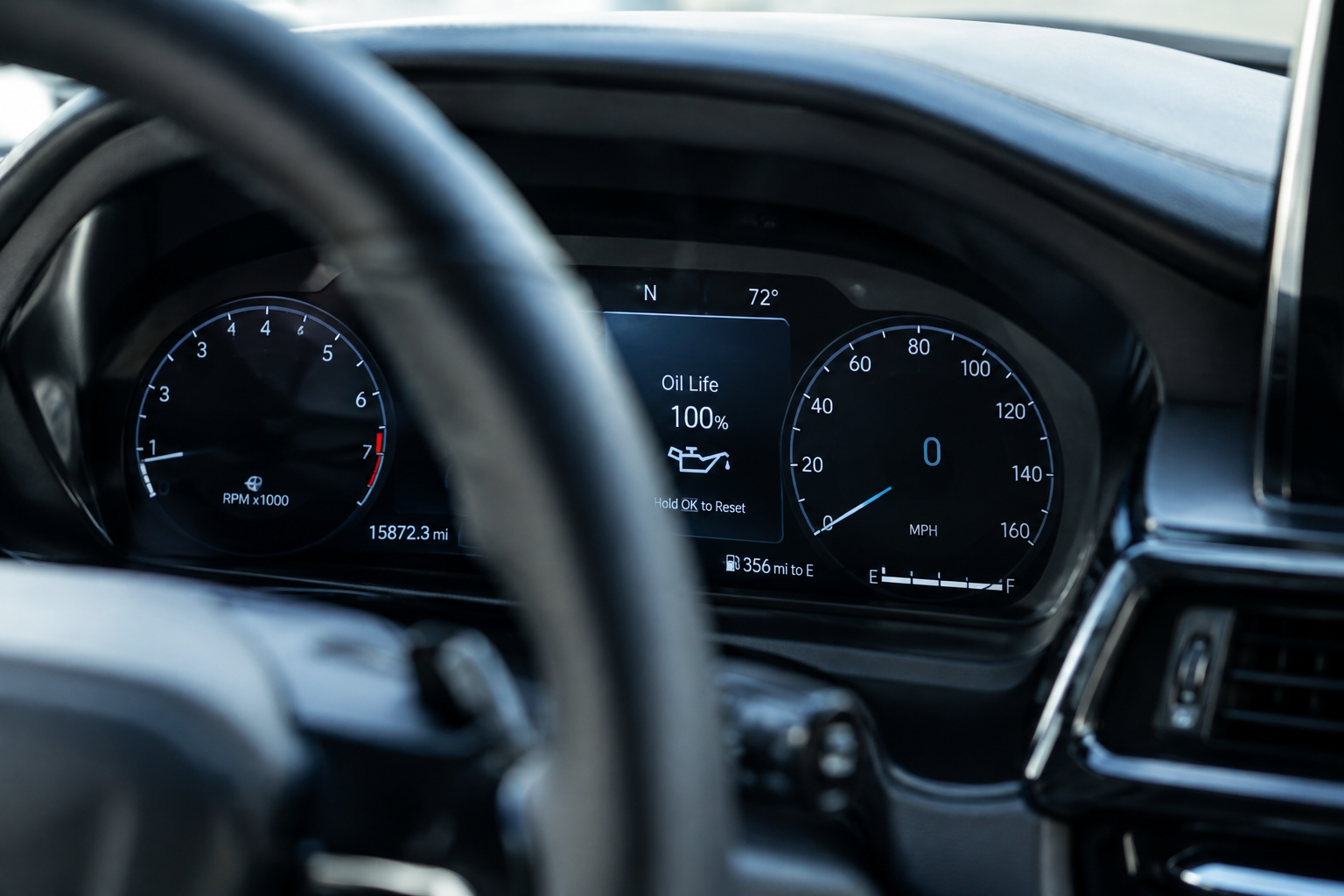
Before getting into specific vehicles, it helps to know what’s actually triggering your dashboard’s oil change reminder.
Mileage or time-based systems are the simplest. The car just counts miles (and sometimes months) since the last reset and flashes a warning at a fixed number, regardless of how you drove or what climate you’re in. These are less common now but still show up on some budget trims and older platforms.
Condition-based (algorithmic) systems are smarter. They use inputs like engine temperature, RPM, trip length, idle time, and cold starts to estimate actual oil degradation. Two identical cars driven differently can get very different reset intervals from the same starting point. GM’s dexos-linked system, Ford’s Intelligent Oil Life Monitor, and Toyota’s maintenance reminder all fall into this category, and they’ll often shorten the interval automatically if you’re doing a lot of short trips or towing.
Either way, once you’ve done the change, don’t forget to reset the system so it starts tracking fresh. Our oil life reset tool guide covers the process for multiple makes if your dash light doesn’t clear on its own.
Vehicles With 10,000+ Mile Factory Oil Change Intervals

GM Vehicles With dexos1 Gen 3 (Chevy Silverado, GMC Sierra, Tahoe, Yukon)
General Motors’ full-size trucks and SUVs running the 5.3L or 6.2L V8 use dexos1 Gen 3 approved 0W-20 synthetic oil, and GM’s Oil Life System (a fully condition-based algorithm) frequently allows 10,000 to 12,000 miles between changes under normal driving. Oil capacity runs around 8 quarts on the 6.2L V8 and roughly 6 quarts on the 5.3L. This system is one of the most trusted condition-based monitors in the industry because GM has been refining it since the early 2000s.
If you’re towing regularly, check out our guide on using Tow/Haul mode on the Silverado, since heavy towing pushes these trucks into severe duty territory and shortens the real-world interval significantly, even though the dash might not say so right away.
Ford F-150 (2.7L and 3.5L EcoBoost, 5.0L V8)
Ford’s Intelligent Oil Life Monitor on the F-150 can stretch to around 10,000 miles on the naturally aspirated 5.0L Coyote V8 running 5W-30 full synthetic, with a capacity of about 6 quarts. The turbocharged EcoBoost engines use 5W-30 as well but typically see the algorithm reset closer to 7,500 to 8,000 miles because of the extra heat turbos generate under boost.
Owners doing a lot of stop-and-go city driving or short trips under five miles should expect the monitor to shorten that window on its own. That’s the system doing its job, not a malfunction.
Toyota RAV4 and Highlander (2.5L Dynamic Force)
Toyota’s newer 2.5L Dynamic Force engines run on 0W-16 or 0W-20 full synthetic depending on trim, with capacity around 4.5 quarts. Toyota’s official maintenance guide lists intervals up to 10,000 miles under normal conditions, tracked through a condition-based system that factors in trip duration and engine load.
Hybrid variants of the RAV4 and Highlander often go even longer between changes since the gas engine runs less overall. If you’re shopping used, it’s worth checking driver assistance quirks too, like how to turn off the Driver Monitor on the RAV4 if the camera-based system gets annoying.
Subaru Outback and Forester (2.5L Naturally Aspirated)
Subaru’s non-turbo 2.5L flat-four uses 0W-20 full synthetic, holds around 4.4 quarts, and Subaru’s maintenance schedule lists 10,000 mile intervals under normal use through a condition-based monitor. The turbocharged XT models, however, are capped at 6,000 miles regardless of what the algorithm shows, since Subaru itself flags turbo engines as needing more frequent changes due to higher operating temperatures.
If you’re considering a used Outback, it’s smart to read up on which Outback model years to avoid before assuming long oil intervals alone mean a trouble-free ownership experience.
Honda Pilot and CR-V (1.5L Turbo and 3.5L V6)
Honda’s Maintenance Minder system is condition-based and well regarded for accuracy. The 3.5L V6 in the Pilot runs 0W-20 full synthetic with roughly 5.3 quarts of capacity, and the system commonly allows 7,500 to 10,000 mile intervals depending on driving style. The turbocharged 1.5L in the CR-V uses the same oil spec but Honda’s own severe duty schedule recommends shorter intervals if you’re frequently towing, idling, or driving in extreme heat or cold.
Kia Telluride and Hyundai Palisade (3.8L V6)
These corporate cousins share a 3.8L V6 that takes 5W-30 full synthetic (some trims call for 0W-20, so always check your cap and manual), with about 5.7 quarts of capacity. Kia and Hyundai’s monitoring systems allow up to 10,000 miles under normal service, though both brands specify a stricter 5,000 mile severe schedule for drivers doing a lot of towing, mountain driving, or dusty conditions.
The single biggest mistake drivers make with extended intervals is assuming “normal” applies to them by default. If you tow, idle a lot, or live somewhere with extreme temperatures, you’re almost certainly under the severe duty schedule, whether the dash admits it or not.
Severe Duty Caveats You Shouldn’t Ignore
Every manufacturer publishes two schedules: normal and severe. Severe duty typically covers frequent towing, extensive idling, dusty or off-road conditions, extreme heat or cold, and lots of trips under 10 miles. If any of that describes your driving, cut the factory’s advertised interval by roughly a third to be safe, even if the condition-based monitor hasn’t flagged it yet.
Turbocharged engines deserve extra caution across every brand on this list. Turbos run hotter and put more thermal stress on oil, so even when the factory interval says 10,000 miles, plenty of mechanics and enthusiast forums recommend splitting the difference and changing around 7,000 to 7,500 miles for long-term engine health.
Best Synthetic Oils for Extended Oil Change Intervals
Not all full synthetic oil is created equal, and if you’re planning to run a car out to 10,000 miles, you want an oil formulated specifically for extended drain intervals rather than a bargain bottle that happens to say “synthetic” on the label.


Leave a Reply