
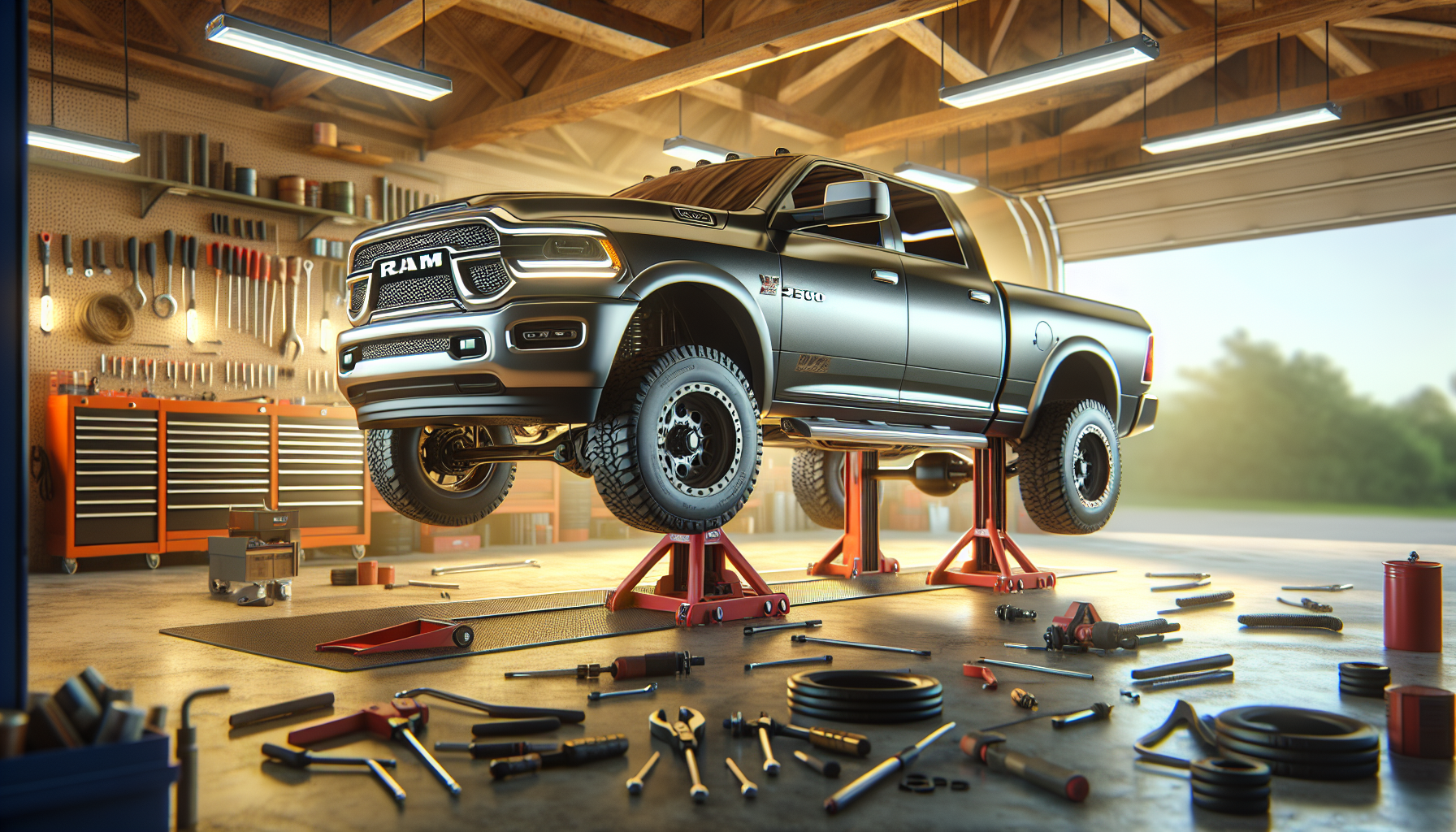
If you’ve ever experienced death wobble in your Ram 2500, you know it’s terrifying. One second you’re cruising down the highway, the next your truck is shaking violently, the steering wheel whipping back and forth so hard you can barely hold on. It usually starts after hitting a bump or pothole, and it feels like the whole front end is about to fall apart.
Death wobble isn’t just scary—it’s dangerous. And despite what some parts stores might tell you, slapping on a new steering stabilizer won’t fix it. The stabilizer is a band-aid, not a cure. The real issue comes down to worn suspension components that allow the front axle to oscillate rapidly. Once you understand what’s actually causing the problem, you can fix it properly instead of wasting money on parts that don’t address the root cause.
Common Causes
Death wobble happens when multiple worn parts work together to create a perfect storm of oscillation. The steering stabilizer’s job is to dampen small vibrations, but when suspension components are worn out, those vibrations become too much for the stabilizer to handle.
Worn Track Bar and Bushings
This is the number one culprit. The track bar (also called a Panhard bar) keeps your front axle centered under the truck. When the track bar bushings wear out or the bar itself develops play, the axle can shift side to side. Even 1/16 of an inch of movement at the axle translates to significant steering wheel movement. Grab your track bar at both ends and try to move it—if there’s any play at all, you’ve found part of your problem.
Ball Joints
Worn ball joints allow the steering knuckles to move in ways they shouldn’t. Upper and lower ball joints take a beating on these heavy trucks, especially if you’ve added larger tires or lift kits. Check for vertical and horizontal play by jacking up the truck and trying to move the tire at 12 and 6 o’clock, then 3 and 9 o’clock.
Tie Rod Ends
The tie rods connect your steering to the wheels. When the ends wear out, they introduce slop into the steering system. This slop allows the oscillation to feed back through the steering wheel. These tend to wear faster if you’ve installed a leveling kit or lift without addressing the tie rod angles.
Unit Bearings
The wheel bearings on these trucks are called unit bearings—the whole hub assembly comes as one piece. When they develop play, the wheel can wobble independently of the steering knuckle. You can check these by grabbing the tire at 12 and 6 o’clock with the truck on the ground and rocking it back and forth.
Control Arm Bushings
Less common but still worth checking. Worn control arm bushings allow the control arms to move excessively, which can trigger wobble. These are harder to spot visually—you usually need to pry on the control arms with a long bar to see if the bushings are shot.
How to Diagnose the Problem
Don’t just throw parts at this. A systematic approach will save you time and money.
Start with a visual inspection with the truck on the ground. Look at the track bar where it mounts to the frame and axle. Worn bushings will be torn, cracked, or visibly loose. Check the tie rod ends and ball joint boots for tears—if the boot is torn, chances are the joint is worn.
Next, jack up the front end and support it on jack stands. Never work under a truck supported only by a jack. With the wheels off the ground, grab each tire at 12 and 6 o’clock and try to rock it. Any clunking or movement indicates worn ball joints or unit bearings. Now grab at 3 and 9 o’clock and rock it—this checks tie rod ends and unit bearings from a different angle.
Have someone turn the steering wheel back and forth while you watch the tie rods, ball joints, and track bar. Any delay between the steering input and the wheel movement means you’ve got play somewhere. Watch carefully because the play can be subtle but still enough to cause problems.
Check the track bar with someone pushing the front of the truck side to side. You’ll see any movement in the bushings or mounting points. Some people miss this because they only check with the wheels off the ground, but the weight of the truck loads the suspension differently.
This video walks through the diagnostic process and shows you exactly what to look for:
How to Fix It
Fix the worn parts first, then consider the steering stabilizer if needed. I’ve seen too many people spend $150 on a heavy-duty stabilizer only to still have death wobble because they didn’t address the actual problem.
Replace the Track Bar
If your track bar has any play, replace it. Some people try to just replace the bushings, but on a truck with 80,000+ miles, the bar itself is often wallowed out at the mounting points. An upgraded aftermarket track bar like the Carli or Thuren unit is a smart investment—they’re built stronger than stock and use better bushings. When you install it, torque everything to spec with the truck’s weight on the suspension, not hanging in the air.
Ball Joints
Replacing ball joints on a Ram 2500 is a real job. You’ll need a ball joint press or access to a hydraulic press. If you’re not set up for this, it might be worth having a shop do it. That said, if you’ve got the tools, it’s doable in a driveway. Replace uppers and lowers together—they wear at similar rates and you don’t want to be back under there in six months doing the other side.
Tie Rod Ends
These are easier. You’ll need a tie rod separator tool (the pickle fork or the jaw-type puller). Mark the position of the old tie rod end before removing it so your alignment doesn’t get completely thrown off. After installation, you’ll still need an alignment, but at least you’ll be close enough to drive there safely.
Unit Bearings
If your bearings are worn, replace them. Don’t try to just tighten them—they’re not adjustable. You’ll need to remove the brake caliper, rotor, and axle shaft. The bearing bolts to the knuckle with four bolts accessible from behind. Use an impact wrench because they’re torqued tight. Clean the mounting surface thoroughly before installing the new bearing.
Steering Stabilizer
Once everything else is tight, a new steering stabilizer can help. But it’s the last thing you should do, not the first. The Bilstein 5100 series is a good upgrade over stock without breaking the bank. A steering stabilizer should be thought of as insurance against minor imperfections, not a fix for worn parts.
When to See a Mechanic
If you’ve checked everything and still have death wobble, something’s wrong that you’re not seeing. Sometimes the frame-side track bar mount cracks or the bolt holes wallow out. This requires welding or a frame repair kit, which most DIYers aren’t equipped to handle.
Ball joint replacement is another task that might be beyond what you want to tackle at home. It requires specialty tools and a good amount of muscle. If you don’t have a 20-ton press and ball joint adapters, you’re looking at either renting tools or paying a shop. Sometimes the shop is cheaper when you factor in tool rental and your time.
Alignment after replacing tie rods or any steering components isn’t optional. You need a proper alignment rack with specs for your specific truck, including caster, camber, and toe. This isn’t something you can eyeball or do with string in your driveway.
If your truck has been in an accident or you suspect frame damage, get it on an alignment rack where they can measure the frame. A bent frame will cause steering problems that no amount of parts replacement will fix.
Estimated Repair Costs
| Repair Item | DIY Cost | Shop Cost |
|---|---|---|
| Track Bar Replacement | $150-$400 | $400-$700 |
| Ball Joints (both sides) | $200-$400 | $800-$1,200 |
| Tie Rod Ends (both sides) | $100-$250 | $400-$600 |
| Unit Bearings (both sides) | $200-$350 | $600-$900 |
| Steering Stabilizer | $50-$200 | $150-$350 |
| Alignment | N/A | $100-$150 |
These costs assume you’re using quality aftermarket parts, not the cheapest ones you can find. On a 7,000-pound truck that you’re trusting with your life, cheap parts are a bad idea. Shop costs include labor and are averages—dealer prices will be higher.
Prevention Tips
Death wobble usually doesn’t happen overnight. It’s the result of gradual wear that finally crosses a threshold. Regular inspections can catch problems before they become dangerous.
Every oil change, take five minutes to grab your tires and check for play. It takes almost no time and can alert you to problems early when they’re cheaper to fix. Look at your ball joint boots and tie rod boots—if they’re torn, moisture and dirt are getting in and wearing out the joint.
If you’ve lifted your truck or installed larger tires, understand that you’ve increased the stress on every steering and suspension component. Bigger tires act like longer levers, multiplying the forces on ball joints, tie rods, and the track bar. Upgraded components aren’t just nice to have—they’re necessary if you want reliability.
Keep your tire pressure correct and your tires balanced. An out-of-balance tire creates vibrations that stress suspension components and can trigger wobble in a truck that’s on the edge. Rotate your tires regularly so they wear evenly.
Avoid potholes when you can. Yeah, it’s a truck and it should handle rough roads, but slamming into a pothole at highway speed puts tremendous shock loads on the front end. That one big hit might be what pushes a worn component over the edge.
When you replace parts, use quality components and torque everything properly. A track bar bolt that’s not torqued to spec will loosen over time, creating play. Many suspension bolts need to be torqued with the vehicle weight on the suspension, not hanging in the air. This is called torque-to-ride height, and it matters.
Final Thoughts
Death wobble is fixable, but only if you address the actual causes instead of just masking symptoms with a new steering stabilizer. Yes, it takes time to inspect all the components and diagnose what’s worn. Yes, the parts cost money. But compared to losing control of your truck at highway speed, it’s cheap insurance.
Start with a thorough inspection, replace what’s worn, and do the job right the first time. Your Ram 2500 is a capable truck that should drive solid and predictable. When it’s right, you won’t even think about death wobble—and that’s how it should be.
Leave a Reply