
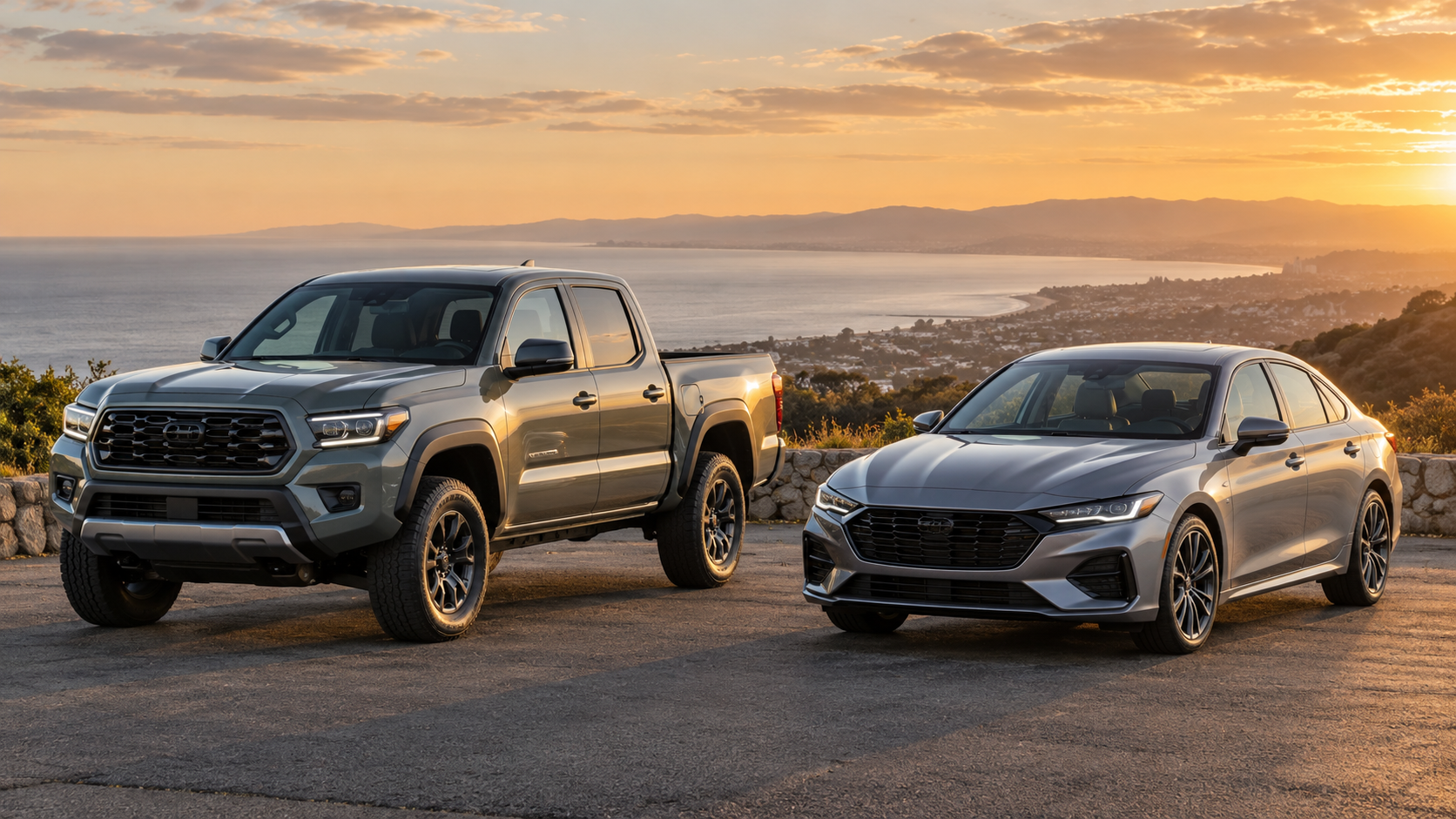
If you are deciding between a midsize pickup truck and a sedan, the better choice comes down to how often you will actually use the truck’s extra capability. A midsize truck gives you a bed, substantially more towing ability, better ground clearance, and more versatility for outdoor activities. A sedan usually costs less to operate, gets better fuel economy, rides more comfortably, and is easier to park.
For someone who mostly commutes, runs errands, and carries passengers, a sedan is usually the more practical vehicle. If you regularly haul equipment, tow, camp, surf, mountain bike, work on home projects, or drive on rough roads, the added capability of a midsize truck can easily justify its disadvantages.
Midsize Truck vs. Sedan at a Glance
| Category | Midsize Truck | Sedan |
|---|---|---|
| Fuel economy | Usually worse | Usually better |
| Ride comfort | Good, but often firmer | Usually smoother and quieter |
| Cargo | Excellent for large or dirty items | Secure but limited to trunk/cabin |
| Towing | Major advantage | Little or none on many models |
| Parking | More difficult | Easier |
| Off pavement | Much better, especially 4×4 | Limited by clearance and tires |
| Driving feel | Higher seating position, heavier feel | Lower, lighter, more agile |
| Best for | Utility and recreation | Commuting and everyday transportation |
Advantages of a Midsize Truck
1. The Bed Adds an Entire Category of Utility
The biggest advantage of a pickup is not simply that it has more cargo room. It has a completely different type of cargo space.
A pickup bed can carry bicycles, muddy camping equipment, lumber, landscaping supplies, furniture, tools, coolers, surf gear, and oversized items that would be difficult or impossible to fit into a sedan.
You also do not have to worry as much about damaging the interior. A bag of soil leaking into a pickup bed is an inconvenience. The same bag opening in the trunk of a sedan can become a major cleanup project.
2. Trucks Can Tow Substantially More
A modern midsize pickup can have surprisingly serious towing capability. Properly equipped versions of trucks such as the Ford Ranger, Chevrolet Colorado, GMC Canyon, Nissan Frontier, and Toyota Tacoma can tow trailers weighing several thousand pounds.
That opens the door to towing small travel trailers, boats, utility trailers, motorcycles, ATVs, and other recreational equipment.
Many sedans are not rated by their manufacturers for meaningful towing in the United States, and even those that can tow are generally far more limited.
3. Better Ground Clearance
Pickup trucks generally sit considerably higher than sedans. That matters when driving on rutted dirt roads, accessing campsites, crossing steep driveways, driving through deep snow, or traveling on roads where rocks and debris could contact the underside of a low car.
A 4×4 midsize truck can go considerably farther off pavement than a conventional sedan, especially when equipped with all-terrain tires and an off-road package.
4. A Truck Supports More Hobbies
A pickup can be particularly useful if your weekends involve activities that create awkward, wet, sandy, or dirty equipment.
Examples include:
- Surfing
- Mountain biking
- Camping
- Fishing
- Hunting
- Kayaking
- Home improvement
- Gardening
- Off-roading
- Towing boats or trailers
A sedan can support many of the same hobbies with roof racks, hitch racks, or careful packing, but the truck usually makes them easier.
5. Higher Driving Position
Many drivers simply prefer sitting higher. A truck provides a more commanding view over surrounding traffic and makes getting in and out comfortable for people who dislike dropping into a low seating position.
That does not automatically make a truck safer, but it can make the driving experience feel more relaxed and provide better forward visibility in some situations.
Disadvantages of a Midsize Truck
1. You Pay for Capability Even When You Aren’t Using It
A truck’s frame, ground clearance, tires, drivetrain, and body all add weight and aerodynamic drag. If your truck spends 95 percent of its life carrying one person to work with an empty bed, you are moving around a lot of extra vehicle without receiving much benefit from it.
This is one of the strongest arguments for buying a sedan if transportation is your primary objective.
2. Fuel Economy Is Usually Worse
Sedans benefit from lower weight, smaller frontal area, lower ride height, and more aerodynamic bodywork. As a result, a conventional midsize sedan will typically use less fuel than a gasoline midsize pickup.
The difference becomes especially important for drivers with long commutes. A few miles per gallon may not seem dramatic on a test drive, but it compounds over tens of thousands of miles.
You can compare official EPA ratings for individual vehicles at FuelEconomy.gov.
3. A Sedan Usually Rides Better
Pickup suspensions must be designed to handle cargo and towing loads in addition to normal passenger duty. Most midsize pickups also use a body-on-frame structure and a solid rear axle.
Modern trucks are far more comfortable than older pickups, but an unloaded truck can still feel busier over broken pavement than a well-designed sedan.
Sedans generally have a lower center of gravity and suspension tuned almost entirely around passenger comfort and handling. On a long highway commute, that difference matters.
4. Trucks Are Harder to Park
A midsize pickup is smaller than a full-size truck, but it is not small. A Ford Ranger, Toyota Tacoma, or Chevrolet Colorado is considerably longer and taller than a typical sedan.
Parking garages, older parking lots, tight parallel parking spaces, and crowded urban areas are easier to navigate in a sedan.
A truck’s height can also make it more difficult to see low objects immediately around the vehicle, which makes parking cameras and sensors especially useful.
5. The Bed Isn’t Automatically Secure Storage
A sedan’s trunk gives you weather-protected, lockable storage as standard equipment.
A pickup bed is exposed unless you add a tonneau cover, camper shell, or locking storage system. Leaving luggage, tools, electronics, or groceries uncovered in the bed exposes them to rain and theft.
A tonneau cover fixes much of this problem, but it adds cost and still does not turn every pickup bed into the equivalent of a fully enclosed trunk.
Advantages of a Sedan
1. Better Daily Transportation
If the primary job of your vehicle is carrying one to four people on paved roads, a sedan is extraordinarily good at it.
It is generally quieter, more aerodynamic, easier to maneuver, and more fuel-efficient than a pickup.
2. Better Handling
A sedan’s lower center of gravity helps reduce body roll. The lower seating position and lighter overall vehicle can also produce more responsive steering and a more connected driving experience.
This becomes even more noticeable with sport-oriented sedans.
3. More Efficient Interior Packaging
A crew-cab midsize truck may look large from the outside without providing dramatically more rear-seat space than a midsize sedan. A significant percentage of the truck’s overall length is dedicated to its bed.
If your priority is passenger space rather than hauling cargo, a sedan can use its footprint more efficiently.
4. Your Cargo Is Hidden
A trunk is underrated. You can leave groceries, luggage, work equipment, or purchases inside without displaying them to everyone nearby, and everything remains protected from weather.
Disadvantages of a Sedan
The biggest problem with a sedan is not that it performs normal transportation poorly. It is that its usefulness drops rapidly once you ask it to perform jobs outside normal transportation.
A sedan becomes inconvenient when you need to move a large appliance, carry four muddy mountain bikes, bring home sheets of plywood, tow a boat, or drive several miles down a rough trail.
You can solve some of these problems with roof racks, hitch-mounted carriers, trailers, or occasional truck rentals. Whether that is preferable to owning a truck year-round depends on how frequently you actually need those capabilities.
What About a Midsize Truck as a Daily Driver?
A midsize truck can absolutely work as an everyday commuter. Models such as the Ford Ranger, Toyota Tacoma, Chevrolet Colorado, GMC Canyon, Nissan Frontier, and Honda Ridgeline are small enough to use as primary vehicles without the bulk of a full-size pickup.
The tradeoff is that you still accept higher fuel consumption, a larger turning circle, and generally less refined road manners than a good sedan.
If you want a truck but know it will spend most of its life commuting, pay particular attention to seat comfort, highway wind noise, suspension behavior, parking visibility, and real-world fuel economy during your test drive.
When a Midsize Truck Makes More Sense
Choose the truck if several of these describe you:
- You regularly transport large or dirty equipment.
- You tow a boat, camper, utility trailer, or recreational vehicle.
- You frequently camp or travel on unpaved roads.
- You do substantial DIY or home-improvement work.
- You regularly carry bicycles, surfboards, kayaks, or outdoor equipment.
- You want 4WD and additional ground clearance.
- You would otherwise need to borrow or rent a truck frequently.
When a Sedan Makes More Sense
Choose the sedan if:
- Your vehicle is primarily a commuter.
- You drive a large number of highway miles.
- Fuel economy is a major priority.
- You regularly park in tight spaces.
- You value a quiet, smooth ride.
- You rarely tow or carry oversized cargo.
- You can rent or borrow a truck on the few occasions when you need one.
The Bottom Line
A sedan is the more efficient answer to everyday transportation, while a midsize truck is the more versatile answer to everyday life.
If you genuinely use the bed, towing capacity, ground clearance, or 4WD capability, a midsize truck can be worth the extra fuel and operating cost. If those features sound useful but you would realistically use them only a few times per year, the sedan is probably the smarter purchase.
The key is to buy for what you actually do rather than what you might theoretically do someday.
Leave a Reply