
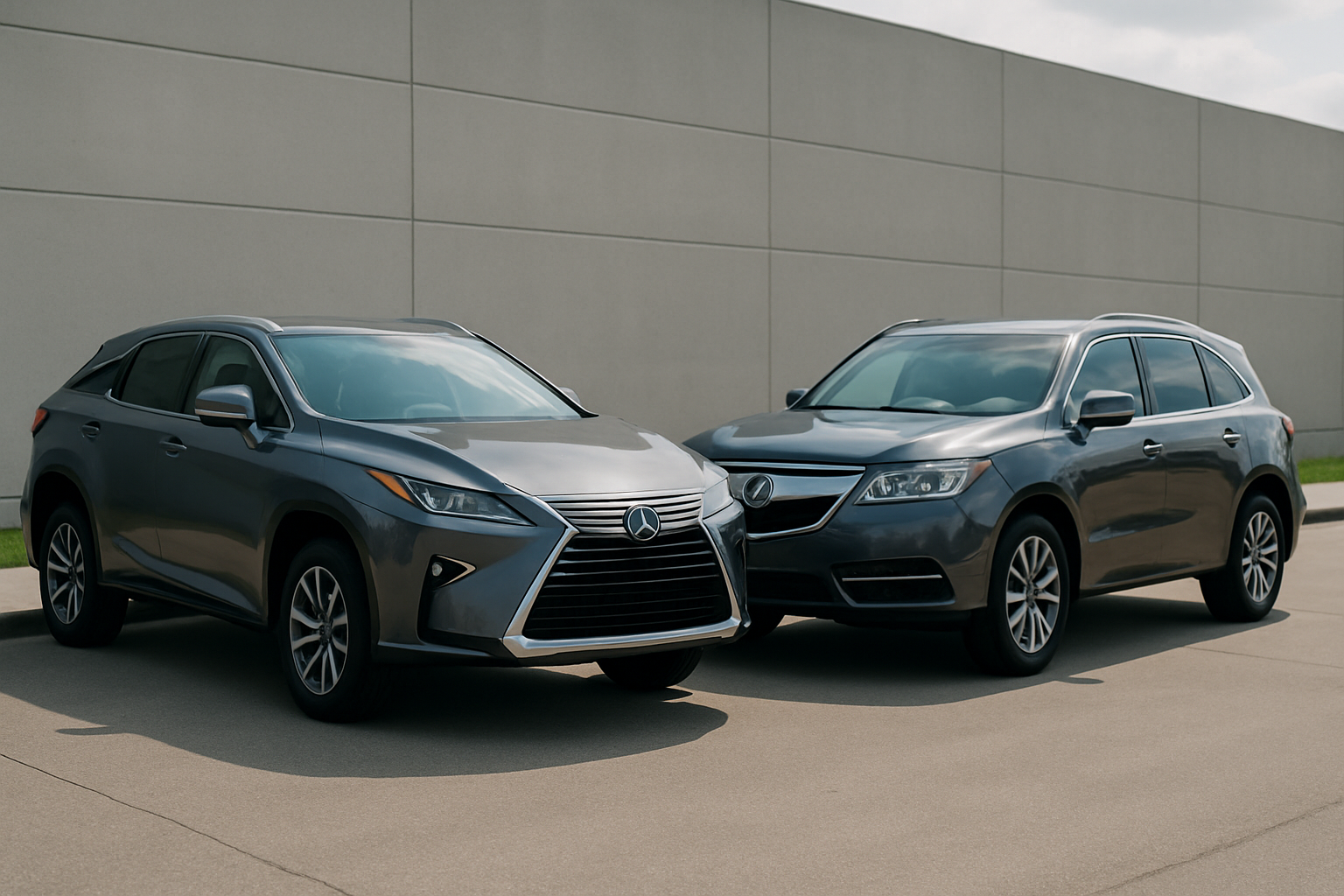
When you’re shopping for a luxury SUV, you’re not just thinking about the first few years of ownership. You want a vehicle that holds its value, stays reliable past 100,000 miles, and still feels premium when it’s a decade old. Both the Lexus RX and Acura MDX promise luxury and reliability, but they age very differently in ways that can cost you thousands.
Depreciation: Where Your Money Goes Over Time
The Lexus RX consistently outperforms the Acura MDX when it comes to holding value. After three years, a typical RX retains about 65% of its original value, while the MDX holds around 58%. This gap widens over time.
By year five, you’re looking at roughly 52% retention for the RX versus 45% for the MDX. That difference translates to about $3,000 to $4,000 more in your pocket when you sell or trade.
The RX benefits from Lexus’s stronger luxury brand perception and Toyota’s reputation for reliability. Buyers in the used market pay premiums for vehicles they believe will last longer and cause fewer headaches.
Long-Term Reliability: The 150,000-Mile Test
Both vehicles can reach high mileage with proper maintenance, but their paths differ significantly. The RX typically experiences fewer major component failures in its second decade of life.
Lexus RX Reliability Profile
The RX’s biggest advantage lies in its powertrain longevity. The naturally aspirated V6 engines in most RX models are proven workhorses that regularly exceed 200,000 miles. The CVT transmission, while not everyone’s favorite for driving dynamics, proves remarkably durable in real-world use.
Common high-mileage issues include door handle mechanisms (particularly on 2010-2015 models), dashboard cracking on earlier generations, and occasional water pump failures around 120,000 miles. These are maintenance items rather than catastrophic failures.
The hybrid RX models show exceptional longevity. The battery packs typically last 150,000+ miles, and when they do need replacement, costs have dropped significantly compared to earlier hybrid vehicles.
Acura MDX Long-Term Concerns
The MDX faces more significant challenges as it ages. The most problematic area is the transmission, particularly in 2001-2006 and 2014-2018 model years. These transmissions can fail catastrophically between 80,000 and 120,000 miles, often requiring complete replacement at costs exceeding $4,000.
The Super Handling All-Wheel Drive (SH-AWD) system, while impressive when new, becomes expensive to maintain. The rear differential and transfer case can develop issues that cost $2,000+ to repair properly.
MDX models from 2007-2013 generally show better transmission reliability, but they’re not immune to other age-related problems like timing belt failures (on V6 engines) and suspension component wear.
Maintenance Costs: The Real Ownership Experience
Both vehicles require premium fuel and synthetic oil, but their maintenance philosophies differ. Lexus designs for longer service intervals and fewer complex systems that can break.
Routine Maintenance Comparison
The RX typically costs about 15% less for routine maintenance over its first 100,000 miles. Oil changes, brake services, and filter replacements are straightforward affairs. Most independent shops can service an RX without specialized tools or training.
The MDX requires more frequent attention to its all-wheel drive system. The rear differential service (every 30,000 miles) costs $150-200 each time. The transmission service intervals are also more frequent, particularly if you tow or drive in stop-and-go traffic regularly.
Out-of-Warranty Repair Costs
This is where the differences become stark. A high-mileage RX typically needs suspension work (struts, bushings) around 100,000 miles, costing $1,200-1,800 for quality parts and labor.
The MDX often requires more expensive repairs. When the SH-AWD system develops problems, you’re looking at diagnosis costs alone of $200-300, followed by repairs that can easily reach $2,000-3,000.
Parts availability favors the RX as well. Toyota’s extensive dealer network and aftermarket support means competitive pricing on replacement parts. Acura parts tend to be more expensive and sometimes require longer wait times.
Interior Aging: How Luxury Holds Up
Both vehicles use quality materials, but they wear differently over time. Your daily interaction with these surfaces makes this difference particularly important.
Lexus RX Interior Longevity
The RX interior ages gracefully, particularly in models from 2016 onward. The leather holds up well to UV exposure and daily wear. The biggest weak points are the wood trim pieces, which can develop hairline cracks in dry climates, and the center console lid mechanism on some years.
The infotainment system represents the RX’s biggest aging challenge. Earlier touchpad systems (2014-2019) feel clunky compared to modern interfaces, and software updates are limited. However, the core climate and audio functions remain intuitive and reliable.
Seat comfort remains excellent even after years of use. The cushioning materials maintain their shape and support better than many German competitors.
Acura MDX Interior Challenges
The MDX interior shows its age more quickly in several key areas. The leather, while initially impressive, tends to develop premature wear patterns on the driver’s seat bolster. This is particularly noticeable on darker colors.
The center stack plastics in 2007-2013 models develop a sticky coating over time, especially in hot climates. This requires professional cleaning or replacement to resolve properly.
The MDX’s more complex infotainment systems age poorly. Touch screens can become unresponsive, and the integration with smartphones often breaks as operating systems update. Replacement parts for these systems are expensive and sometimes unavailable for older models.
Technology and Feature Aging
Modern luxury SUVs come loaded with technology that can become obsolete or problematic as vehicles age. Both the RX and MDX face these challenges, but in different ways.
The RX takes a more conservative approach to technology integration. Basic functions like climate control and audio remain physical buttons and knobs that won’t become obsolete. When technology features do fail, they typically don’t affect core vehicle operation.
The MDX integrates technology more deeply into the vehicle’s systems. While this creates a more modern experience when new, it can lead to cascading problems as components age. A failing infotainment unit might affect backup camera operation, climate control, or even vehicle settings.
Real-World Ownership Costs: 10-Year Analysis
When you factor in depreciation, maintenance, and repairs over a 10-year ownership period, the differences become substantial. A typical RX 350 purchased new will cost approximately $8,000-10,000 less in total ownership costs compared to an equivalent MDX.
This calculation includes the RX’s better resale value, lower maintenance costs, and fewer expensive repairs. The gap widens if you keep the vehicle beyond 10 years, as the MDX’s transmission and all-wheel drive issues become more prevalent.
Which Model Years Age Best
For the Lexus RX, the sweet spot for aging gracefully falls between 2016-2019. These models have the refined powertrain, improved interior materials, and fewer early-generation technology issues. The 2020+ models are too new to judge long-term, but early indicators are positive.
For the Acura MDX, stick with 2020+ models if buying new, or look for 2007-2013 models in the used market. The 2014-2019 generation has the most problematic transmission and should be approached with caution, especially high-mileage examples.
The Verdict: Total Cost of Aging
The Lexus RX ages more gracefully than the Acura MDX in almost every measurable way. Better depreciation curves, lower maintenance costs, fewer expensive repairs, and superior interior longevity add up to significant savings over time.
This doesn’t mean the MDX is a poor choice, but you need to budget accordingly for its higher long-term costs. If you typically trade vehicles every 3-4 years, the difference matters less. If you’re the type to drive a vehicle for 10+ years, the RX’s superior aging characteristics will save you substantial money.
Frequently Asked Questions
How much does transmission replacement cost on a high-mileage MDX?
Expect to pay $4,000-6,000 for a complete transmission replacement at a dealer, or $2,500-3,500 for a quality rebuild at an independent shop. This is one of the most expensive repairs you’ll face on an aging MDX.
Do RX hybrid batteries really last 150,000+ miles?
Most RX hybrid batteries exceed 150,000 miles with proper maintenance. When they do fail, replacement costs have dropped to $3,000-4,000 installed, and many come with substantial warranties.
Which vehicle has better parts availability for DIY maintenance?
The RX has significantly better aftermarket support. Common maintenance items like air filters, brake pads, and fluids are widely available and competitively priced. MDX parts, particularly for the SH-AWD system, often require OEM components at higher prices.
How do insurance costs compare as these vehicles age?
Both vehicles see decreasing insurance premiums as they age, but the RX typically maintains slightly higher premiums due to its better value retention. The difference is usually $100-200 annually and varies significantly by location and driving record.
This article contains affiliate links. If you purchase through these links, we may earn a small commission at no extra cost to you.

Leave a Reply