
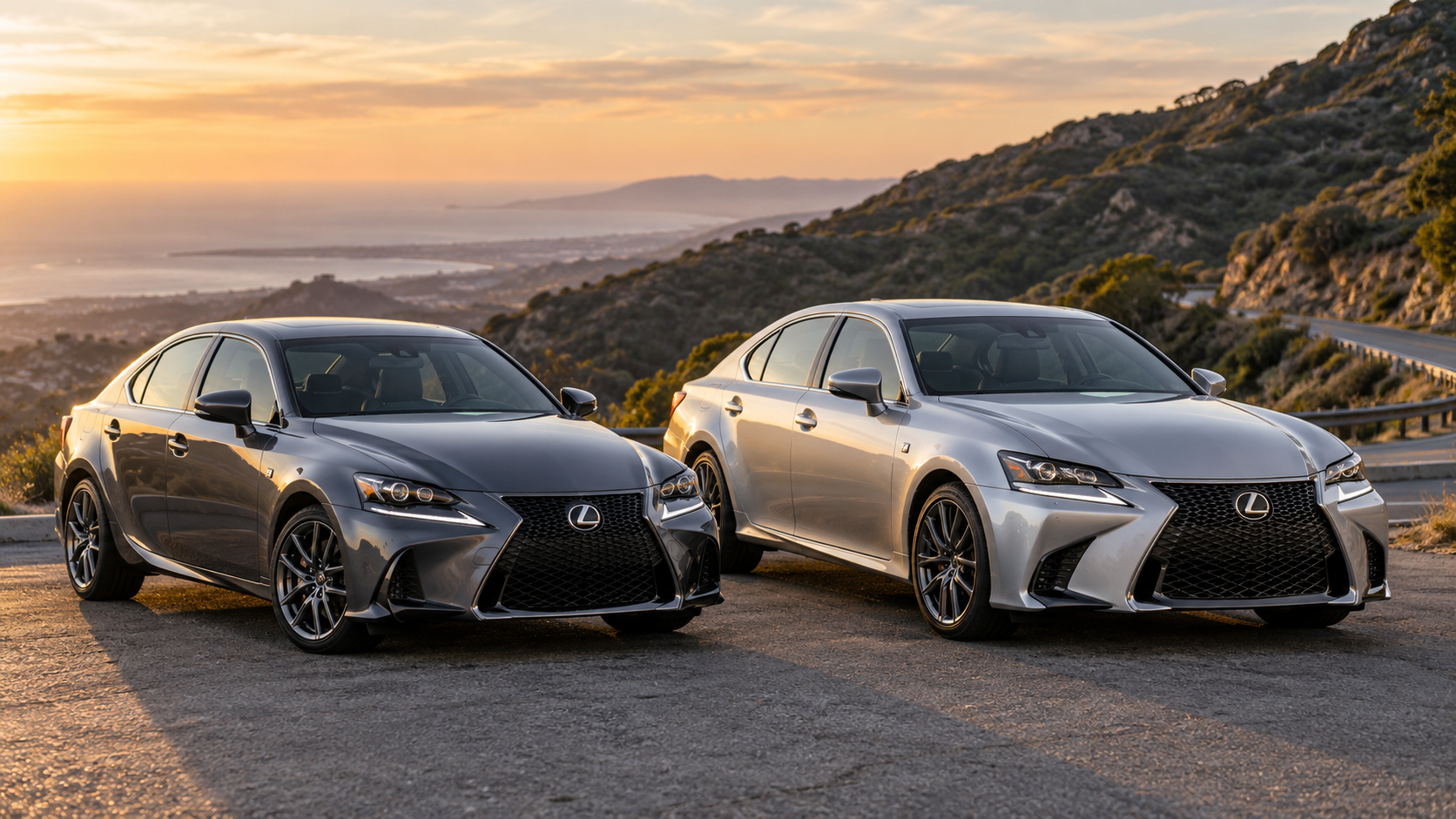
If you are choosing between a used Lexus IS and Lexus GS, the basic difference is simple: the IS is the smaller, more agile sports sedan, while the GS combines strong handling with more space, comfort, and long-distance refinement.
That does not mean the GS is simply the less-sporty choice. The fourth-generation GS was engineered as a rear-wheel-drive luxury sport sedan, and the GS 350 F SPORT in particular received substantial chassis upgrades. For a buyer with roughly $25,000 to spend, a used GS 350 F SPORT can be one of the more interesting alternatives to an IS 350 F SPORT.
Lexus IS vs. GS at a Glance
| Category | Lexus IS | Lexus GS |
|---|---|---|
| Size | Compact luxury sedan | Midsize luxury sedan |
| Driving character | Smaller, more nimble and playful | Stable, composed and refined |
| Best enthusiast version near $25,000 | IS 350 F SPORT | GS 350 F SPORT |
| Rear-seat space | Relatively tight | Much more accommodating |
| Highway driving | Good | Excellent |
| Twisty roads | More compact and eager | Very capable, especially in F SPORT form |
Which Is the Better Driver’s Car?
If “driver’s car” means the car that feels smaller and more responsive on a tight road, the IS has the advantage. Lexus actually borrowed elements of the third-generation IS suspension and steering design from the GS, then packaged them into the smaller IS chassis. When the redesigned IS arrived for 2014, Lexus specifically emphasized increased body rigidity, a multilink rear suspension, and GS-derived steering and front-suspension engineering.
The IS 350 is the version to look for if performance matters. The naturally aspirated 3.5-liter V6 has strong response without relying on a turbocharger, while rear-wheel-drive versions use an eight-speed automatic. The IS’s smaller dimensions also make it easier to place on a narrow road and maneuver around town.
But the GS 350 F SPORT is much closer to a true sport sedan than its larger dimensions suggest. Lexus equipped the fourth-generation GS with a double-wishbone front and multilink rear suspension, and the F SPORT package added performance-oriented suspension tuning and other chassis changes.
Depending on model year and configuration, GS F SPORT equipment included Adaptive Variable Suspension, larger brakes, thicker stabilizer bars, sport-oriented steering tuning, and staggered 19-inch wheels. Certain rear-wheel-drive GS 350 F SPORT models could also be equipped with Lexus Dynamic Handling, which incorporated Dynamic Rear Steering and Variable Gear Ratio Steering. Later RWD GS 350 F SPORT models were also available with a limited-slip differential.
Consequently, the GS is not merely a larger IS. It takes a different approach: less compact and playful, but exceptionally composed while still offering serious chassis hardware.
Lexus GS Trims and Horsepower
For used-car shoppers, the fourth-generation GS sold in the United States from the 2013 through 2020 model years is the most relevant generation. Its lineup changed during that run.
| Model | Engine | Horsepower | Notes |
|---|---|---|---|
| GS 350 (2013–2015) | 3.5L V6 | 306 hp | RWD or AWD |
| GS 200t (2016–2017) | 2.0L turbo I4 | 241 hp | RWD |
| GS 300 (2018+) | 2.0L turbo I4 | 241 hp | Renamed GS 200t |
| GS 350 (2016–2020) | 3.5L V6 | 311 hp | RWD or AWD |
| GS 450h | 3.5L V6 hybrid | 338 hp combined | RWD hybrid |
| GS F | 5.0L naturally aspirated V8 | 467 hp | Full F performance model |
One point that can cause confusion in used listings is F SPORT versus GS F. A GS 350 F SPORT does not receive a more powerful engine than a regular GS 350. F SPORT is primarily a handling, appearance, and equipment package. The GS F is a fundamentally different high-performance model with a 467-hp 5.0-liter V8, upgraded suspension, brakes, and other performance hardware.
Lexus IS Trims and Horsepower
The third-generation IS arrived for 2014, making it a useful comparison with the fourth-generation GS. Lexus changed the IS engine lineup several times, so horsepower depends heavily on model year.
| Model | Engine | Horsepower | Notes |
|---|---|---|---|
| IS 250 (2014–2015) | 2.5L V6 | 204 hp | RWD or AWD |
| IS 200t (2016–2017) | 2.0L turbo I4 | 241 hp | RWD |
| IS 300 RWD (2018+) | 2.0L turbo I4 | 241 hp | Successor to IS 200t |
| IS 300 AWD (2016–2017) | 3.5L V6 | 255 hp | Six-speed automatic |
| IS 300 AWD (2018+) | 3.5L V6 | 260 hp | Six-speed automatic |
| IS 350 (2014–2017) | 3.5L V6 | 306 hp | RWD or AWD |
| IS 350 (2018+) | 3.5L V6 | 311 hp | RWD or AWD |
| IS 500 (2022+) | 5.0L naturally aspirated V8 | 472 hp | F SPORT Performance; substantially above a typical $25,000 budget |
Older shoppers may also encounter the previous-generation IS F, produced before the current-generation IS. Its 5.0-liter V8 produces 416 horsepower. It is a genuine Lexus F model rather than an F SPORT appearance/handling package, but age, mileage, condition, and performance-car running costs make it a different proposition from a conventional IS 350.
IS 350 F SPORT vs. GS 350 F SPORT
This is arguably the most interesting comparison for an enthusiast shopping for a used Lexus.
The engines are closer than the badges and model years initially suggest. A 2014–2017 IS 350 produces 306 hp, increasing to 311 hp for 2018. The GS 350 similarly produced 306 hp from 2013–2015 before increasing to 311 hp for 2016. In other words, choosing between these cars should be based more on chassis, size, drivetrain, equipment, and condition than a five-horsepower difference.
The IS 350 F SPORT is the better choice if your priority is agility. It puts a strong naturally aspirated V6 into a smaller sedan and gives the driver a more compact car to work with. For frequent driving on tight, winding roads, that smaller footprint matters.
The GS 350 F SPORT makes a compelling case if you want one car to do almost everything. It sacrifices some of the IS’s compact feel but adds considerably more passenger space and a more relaxed highway personality without abandoning rear-wheel-drive sport-sedan fundamentals.
The GS also had some unusually sophisticated chassis options. A properly equipped RWD GS 350 F SPORT could include Adaptive Variable Suspension and Lexus Dynamic Handling with rear-wheel steering. Those features make equipment verification worthwhile when shopping used, because two visually similar GS 350 F SPORT examples may not have identical hardware.
What Should You Buy With a $25,000 Budget?
At a maximum purchase price of about $25,000, the IS 350 F SPORT and GS 350 F SPORT are the two versions to prioritize if driving enjoyment is the objective. Used-car prices vary substantially with mileage, condition, location, accident history, and service records, so it makes more sense to shop by condition than insist on one exact model year.
The lower-output IS 250, IS 200t/300 RWD, and GS 200t/300 can cost less, but they give up considerable horsepower. If a 306- or 311-hp V6 car fits the same overall budget, the IS 350 and GS 350 are generally the more compelling enthusiast configurations.
A rear-wheel-drive example is particularly worth considering for a buyer who does not need AWD. On both the IS 350 and GS 350, RWD versions use an eight-speed automatic in the relevant later model years, while AWD versions use a six-speed. The GS 350 F SPORT also offered some performance equipment specifically on RWD cars.
Do not buy an older or higher-mileage example simply to get the F SPORT badge, however. Service history, accident history, tires, suspension condition, brakes, fluid maintenance, and a pre-purchase inspection should carry substantial weight when comparing cars approaching or exceeding a decade old.
Bottom Line
The Lexus IS is the better choice for a driver who values compact dimensions and agility above everything else. An IS 350 F SPORT is the sweet spot, combining the smaller chassis with the naturally aspirated 3.5-liter V6.
The Lexus GS is the better all-around sport sedan. The GS 350 F SPORT retains genuine performance hardware while adding a larger cabin, greater highway refinement, and available chassis technology such as Adaptive Variable Suspension and, on certain RWD cars, rear-wheel steering.
With a $25,000 ceiling, there is no need to automatically choose the smaller IS to get the sportier Lexus. Shop both the IS 350 F SPORT and GS 350 F SPORT, verify the exact equipment on each car, and let condition and the type of driving you do determine which chassis makes more sense.
Leave a Reply