
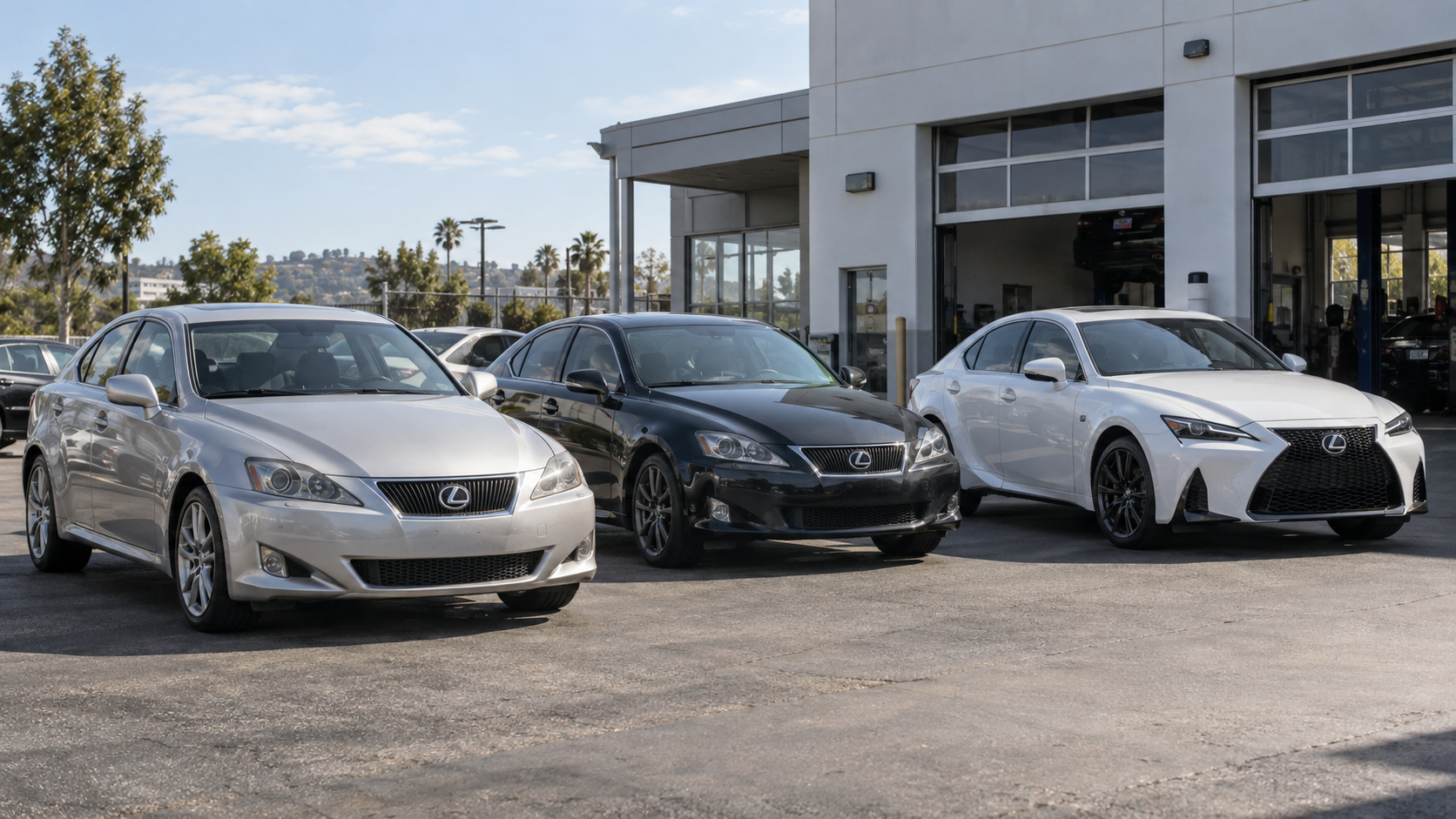
If you are shopping for a used Lexus IS, you will probably run into three familiar badges: IS 250, IS 300, and IS 350. They may look nearly identical from the outside, but there can be a substantial difference in what is under the hood.
The simplest explanation is that the IS 250 was generally the lower-powered V6 model, while the IS 350 was the higher-performance option. The IS 300 sits between them, but it is also the most confusing because Lexus has used the IS 300 name with different engines and drivetrains depending on the model year.
Here is what used-car shoppers should know about the Lexus IS 250, IS 300, and IS 350 before buying one.
Lexus IS 250 vs. IS 300 vs. IS 350 at a Glance
| Model | Typical Engine | Horsepower | Best For |
|---|---|---|---|
| IS 250 | 2.5L V6 | 204 hp | Lower purchase price |
| IS 300 RWD | 2.0L turbo four-cylinder* | 241 hp | Everyday performance and efficiency |
| IS 300 AWD | 3.5L V6* | 255–260 hp | V6 power with AWD |
| IS 350 | 3.5L V6 | 306–311 hp | Performance |
*IS 300 specifications vary substantially by model year. Always verify the engine and drivetrain of the specific car you are considering.
Lexus IS 250: The Entry-Level V6
The IS 250 was a longtime entry point into the Lexus IS lineup. In third-generation models such as the 2014 and 2015 IS 250, Lexus used a naturally aspirated 2.5-liter V6 producing 204 horsepower and 185 lb-ft of torque.
That is enough power for normal commuting, but the IS 250 is not particularly quick for a sport sedan. Its main attraction on the used market is that it can provide much of the styling, interior quality, and driving experience of the more powerful IS models at a lower purchase price.
There is an important mechanical difference between the older IS 250 and IS 350. The 2.5-liter engine in the IS 250 uses direct fuel injection, while the 3.5-liter engine in the IS 350 uses a combination of direct and port fuel injection. That distinction is worth understanding when comparing older, higher-mileage cars and their maintenance histories.
Who should consider an IS 250?
The IS 250 makes the most sense for a buyer who wants a comfortable Lexus sport sedan and finds a well-maintained example at an attractive price. If acceleration is a priority, however, moving up to an IS 350 makes a very noticeable difference.
Lexus IS 300: The Complicated One
The IS 300 badge requires a little more homework because it does not always identify the same engine.
When Lexus revised the third-generation IS lineup for 2016, it introduced an IS 300 AWD powered by a modified 3.5-liter V6. That engine initially produced 255 horsepower. Later versions were rated at 260 horsepower.
More recent rear-wheel-drive IS 300 models took a different approach. For example, the 2025 IS 300 RWD uses a 2.0-liter turbocharged four-cylinder producing 241 horsepower and 258 lb-ft of torque, paired with an eight-speed automatic transmission.
The IS 300 AWD from the same era instead uses a naturally aspirated 3.5-liter V6 producing 260 horsepower and 236 lb-ft of torque, paired with a six-speed automatic.
That means two cars with an IS 300 badge can have very different engines simply because one is rear-wheel drive and the other is all-wheel drive.
IS 300 RWD vs. IS 300 AWD
This distinction is particularly important when shopping used. The turbocharged IS 300 RWD provides strong low-rpm torque from its smaller engine and uses an eight-speed transmission. The AWD version gives buyers a naturally aspirated V6 along with additional traction, but uses a six-speed automatic.
Do not assume an IS 300 has a 3.0-liter engine based on its badge. On modern Lexus models, the number in the model name does not necessarily correspond directly to engine displacement.
Lexus IS 350: The Performance Choice
The IS 350 is where the IS lineup becomes considerably quicker.
Older examples such as the 2014 and 2015 IS 350 use a naturally aspirated 3.5-liter V6 producing 306 horsepower and 277 lb-ft of torque. More recent versions increased output to 311 horsepower and 280 lb-ft.
For comparison, that gives the older IS 350 roughly 100 more horsepower than the 204-horsepower IS 250.
Recent IS 350 models have also been available with either rear-wheel drive or all-wheel drive. The RWD version uses an eight-speed automatic, while the AWD version uses a six-speed automatic.
Lexus lists a 0-to-60-mph time of 5.6 seconds for the 2024 IS 350 RWD and 5.7 seconds for the AWD version. That is quick enough to make the IS 350 feel substantially different from the less powerful versions in everyday driving.
Is the IS 350 Worth It Over the IS 250?
For shoppers comparing similarly aged examples, the biggest argument for the IS 350 is simple: you get considerably more power without moving to a completely different vehicle.
An IS 250 and IS 350 from the same generation share much of their basic platform, styling, cabin design, and luxury equipment. The IS 350’s larger engine transforms the performance.
However, the purchase price is only part of the equation. A used IS 350 may cost more to buy and potentially more to insure, and a more powerful car may have lived a harder life with a previous owner. Condition and maintenance history should therefore carry more weight than the badge alone when comparing older examples.
Is the IS 300 Basically an IS 350?
Not quite, although the question makes sense when looking at AWD models.
Recent IS 300 AWD and IS 350 models both use 3.5-liter V6 engines, but they are not rated for the same output. For the 2024 model year, for example, the IS 300 AWD produces 260 horsepower while the IS 350 produces 311 horsepower.
That 51-horsepower difference is significant. The IS 300 AWD is better viewed as the middle step in the lineup rather than simply an IS 350 with a different badge.
What Happened to the IS 250?
Lexus changed the IS lineup for the 2016 model year. The IS 250 disappeared from the U.S. sedan lineup as Lexus introduced the turbocharged IS 200t and the V6-powered IS 300 AWD alongside the IS 350.
As a result, shoppers looking at an IS 250 are generally looking at an older vehicle than shoppers considering an IS 300. That makes age, mileage, service records, suspension condition, interior wear, and previous accident history especially important.
Which Lexus IS Should You Buy?
Consider the IS 250 if purchase price is the priority and you find a clean, well-maintained example. Its 204-horsepower V6 is adequate for everyday driving, but buyers expecting strong sport-sedan acceleration may find it underpowered.
Consider the IS 300 if you want the middle ground. Just pay close attention to the model year and drivetrain because an IS 300 RWD and IS 300 AWD can have completely different engines.
Consider the IS 350 if performance matters. Its 3.5-liter V6 provides a substantial power increase over the IS 250 and IS 300 while retaining the comfort and relatively compact dimensions that make the IS appealing as an everyday luxury sedan.
What to Check Before Buying a Used Lexus IS
Regardless of which version you choose, do not shop by badge alone. A well-maintained IS 250 can be a better purchase than a neglected IS 350.
- Confirm the exact engine and drivetrain. This is especially important with the IS 300.
- Review maintenance records. Look for consistent oil changes and evidence that recommended maintenance was performed.
- Check the tires carefully. Uneven wear can reveal alignment or suspension issues and may mean an immediate replacement expense.
- Test every interior feature. On an older luxury car, small electrical and convenience-feature problems can add up.
- Get a pre-purchase inspection. An independent inspection is particularly worthwhile on an older IS with higher mileage or an incomplete service history.
- Check the VIN for open recalls. Recall status follows the individual vehicle, so verify the specific VIN rather than assuming a model year is clear.
Bottom Line
The difference between the Lexus IS 250, IS 300, and IS 350 is primarily about powertrain and performance, but the model names do not tell the entire story.
The IS 250 uses a 204-horsepower 2.5-liter V6 and is generally the least powerful of the three. The IS 350 uses a much stronger 3.5-liter V6, producing 306 horsepower in earlier third-generation cars and 311 horsepower in later versions. The IS 300 fills the gap between them, but its engine depends on the year and drivetrain: modern RWD versions can have a turbocharged four-cylinder, while AWD versions use a 3.5-liter V6.
For used-car shoppers, that makes the model year, drivetrain, engine, mileage, condition, and maintenance history just as important as whether the trunk says IS 250, IS 300, or IS 350.