
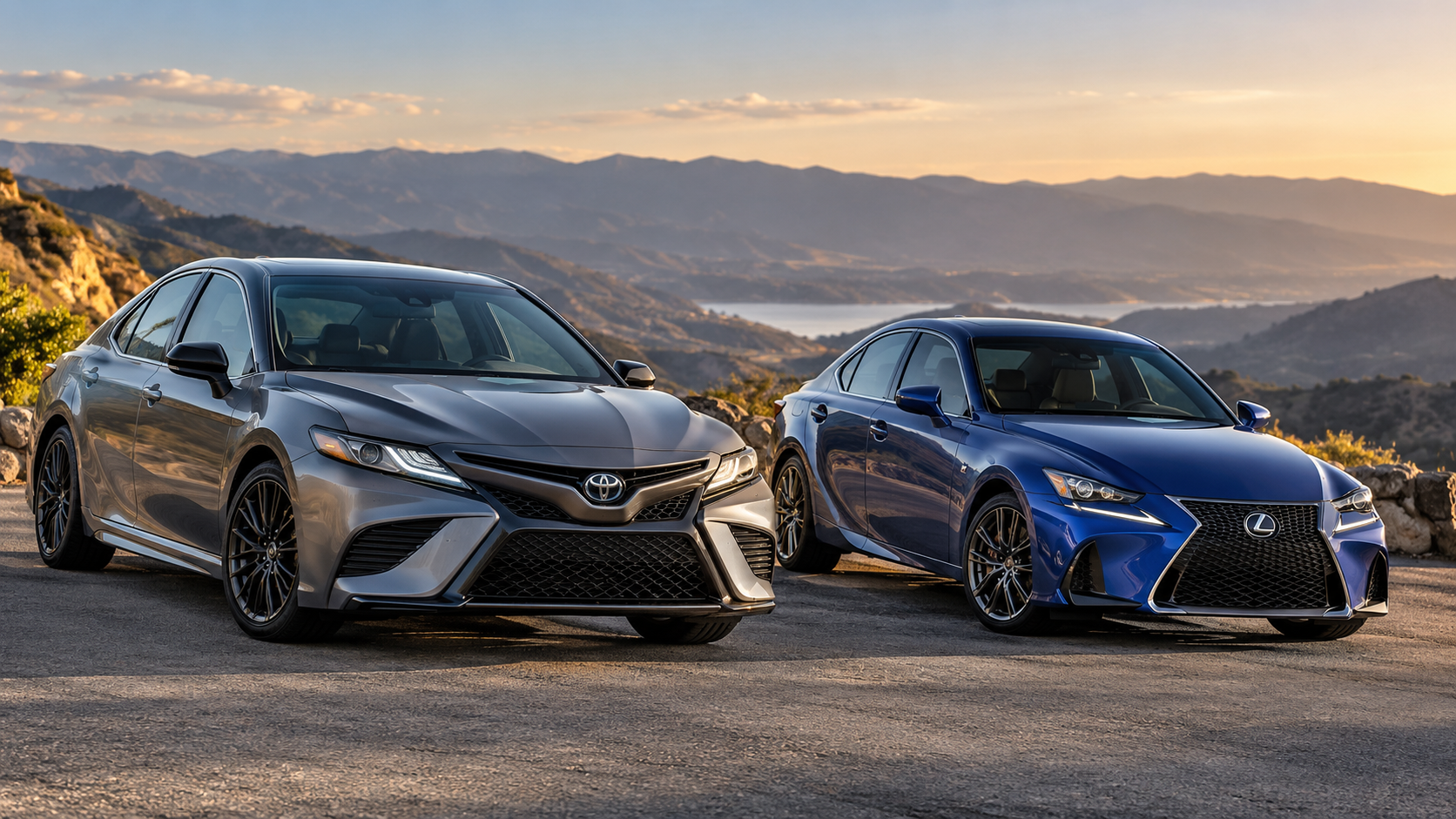
If you like the Lexus IS but would rather pay Toyota prices, it is natural to wonder whether there is essentially a “sporty Camry” hiding somewhere in Toyota’s lineup. The closest answer is the Camry XSE V6, particularly the 2018-and-newer version. For buyers willing to go newer, the 2020-and-newer Camry TRD takes the performance treatment even further.
However, neither is really a Lexus IS without the Lexus badge. The biggest difference is fundamental: the Lexus IS is a compact sport sedan built around a rear-wheel-drive platform, while the Camry is a larger, front-wheel-drive midsize sedan. That difference affects how the two cars feel even when their horsepower figures are remarkably similar.
Why the Lexus IS Is More Than a Fancy Camry
The Lexus IS and Toyota Camry share a corporate parent, but they were designed for different jobs. The Camry has traditionally prioritized passenger space, comfort, efficiency, and everyday practicality. The IS was designed as a compact luxury sport sedan.
The distinction is especially clear with the third-generation Lexus IS introduced for 2014. Lexus gave it rear-wheel drive as standard, with all-wheel drive available, along with a multi-link rear suspension and steering derived from the larger Lexus GS. The 2014 IS 350 also used a 306-horsepower 3.5-liter V6 and an eight-speed automatic in rear-wheel-drive form.
An F Sport package went further with a sport-tuned suspension, 18-inch wheels, sport seats, and other performance-oriented equipment. The IS 350 F Sport also received Adaptive Variable Suspension and a Sport S+ driving mode.
That makes the IS fundamentally different from a Camry. Its proportions, seating position, chassis layout, steering, and drivetrain are all aimed more directly at the driver.
The Closest Camry: 2018+ Camry XSE V6
For a used-car shopper looking for a sporty Toyota sedan from 2014 or newer, the 2018-and-newer Camry XSE V6 is probably the sweet spot.
The eighth-generation Camry introduced a much more sophisticated TNGA-K chassis. Toyota equipped SE and XSE models with sport-tuned springs and shocks, while the independent rear suspension used a multi-link design.
More importantly, the XSE could be ordered with Toyota’s 3.5-liter V6 producing 301 horsepower. That put its output remarkably close to the 306-horsepower 2014 Lexus IS 350.
| Model | Engine | Power | Drivetrain |
|---|---|---|---|
| 2014 Lexus IS 250 | 2.5L V6 | 204 hp | RWD / AWD |
| 2014 Lexus IS 350 | 3.5L V6 | 306 hp | RWD / AWD |
| 2015-2017 Camry XSE V6 | 3.5L V6 | 268 hp | FWD |
| 2018+ Camry XSE V6 | 3.5L V6 | 301 hp | FWD |
| 2020+ Camry TRD | 3.5L V6 | 301 hp | FWD |
On paper, then, an XSE V6 can deliver IS 350-like power without requiring a Lexus. In practice, though, the cars deliver that power very differently.
Why an XSE V6 Still Doesn’t Drive Like an IS 350
The key difference is which wheels receive the power.
The Camry XSE V6 sends its 301 horsepower through the front wheels. The IS 350 was designed around rear-wheel drive, with AWD available as an alternative.
That gives the Lexus more of the traditional sport-sedan character. The front tires primarily handle steering while the rear wheels propel the RWD car. The IS is also a smaller car designed around a more driver-focused package.
The Camry instead combines substantial power with the space and usability of a midsize family sedan. It can be very quick, but it doesn’t simply become an IS 350 because the horsepower numbers are similar.
What About the 2015-2017 Camry XSE V6?
If the 2018 XSE V6 is too expensive, the 2015-2017 Camry XSE V6 deserves a look.
Toyota introduced the XSE trim for 2015 and described it at the time as its sportiest Camry yet. The XSE received 18-inch wheels and its own suspension tuning. Buyers could also specify Toyota’s 3.5-liter V6, which produced 268 horsepower and 248 lb-ft of torque.
That’s substantially more power than the four-cylinder Camry and even considerably more horsepower than the contemporary 204-horsepower Lexus IS 250.
For someone shopping toward the lower end of the used-car market, a clean 2015-2017 XSE V6 therefore offers an appealing combination of performance, equipment, and traditional Toyota practicality.
Camry TRD: The Most Aggressive Alternative
Starting with the 2020 model year, Toyota offered something even more serious: the Camry TRD.
The TRD uses the same basic 301-horsepower 3.5-liter V6 and eight-speed automatic, but Toyota Racing Development made meaningful chassis changes rather than treating TRD as an appearance package.
Those changes included additional underbody bracing, TRD-specific springs and shocks, larger stabilizer bars, lighter 19-inch wheels, and a 0.6-inch reduction in ride height. Toyota also fitted a TRD-tuned cat-back exhaust.
The result is arguably the most performance-oriented modern Camry. If handling is the priority and the styling appeals to you, the TRD deserves consideration.
There is an important caveat, however: the TRD was based largely on the Camry SE rather than simply being a more luxurious XSE V6. Buyers primarily interested in getting a Lexus-like combination of speed, comfort, and features may actually prefer the XSE V6.
Which One Should You Buy?
Best value among older models: 2015-2017 Camry XSE V6
A good choice if you want a relatively inexpensive V6 Toyota sedan with noticeably sportier suspension and styling than a regular Camry.
Best overall Camry alternative to an IS: 2018+ Camry XSE V6
The 301-horsepower V6, newer chassis, sport suspension, larger cabin, and upscale XSE equipment make this the strongest combination of performance and everyday usability.
Most performance-focused Camry: 2020+ Camry TRD
Choose the TRD if chassis upgrades and aggressive handling are more important than maximizing luxury equipment.
Is a Camry XSE V6 Better Than a Used Lexus IS?
It depends on what you’re trying to get from the car.
If your main priorities are acceleration, reliability, passenger space, practicality, and avoiding the price premium associated with a luxury badge, a used Camry XSE V6 makes a compelling case. A 2018+ example gives you 301 horsepower in a car that can still function perfectly well as an ordinary Camry.
If you’re specifically looking for a sport-sedan driving experience, however, the Lexus IS remains meaningfully different. The rear-wheel-drive architecture, smaller dimensions, driver-focused seating position, and chassis tuning are exactly the characteristics that cannot be recreated by simply adding a V6 and firmer suspension to a Camry.
It’s also worth remembering that used-car depreciation can narrow the original price gap. Depending on age, mileage, condition, and trim, a used IS may not necessarily cost dramatically more than a comparable high-spec Camry. Comparing actual used examples is therefore more useful than comparing their original MSRPs.
The Bottom Line
The Lexus IS should not be thought of simply as a sporty Camry. They are fundamentally different cars, with the IS using a sport-sedan-oriented RWD/AWD architecture and the Camry using a more practical FWD midsize-sedan layout.
But if the real question is whether Toyota made a Camry that delivers much of the performance without the Lexus badge and price, the answer is yes.
For used models from 2014 onward, start with the 2015-2017 Camry XSE V6 if price is the priority. Move up to the 2018+ Camry XSE V6 for the best all-around combination of 301-horsepower performance, comfort, and practicality. Consider the 2020+ Camry TRD if you want the most aggressive factory suspension and chassis setup.
Just don’t expect any of them to feel exactly like an IS 350. If rear-wheel-drive balance and traditional sport-sedan handling are what attracted you to the Lexus in the first place, buying the used Lexus may still be the better way to get that particular experience.
Leave a Reply