
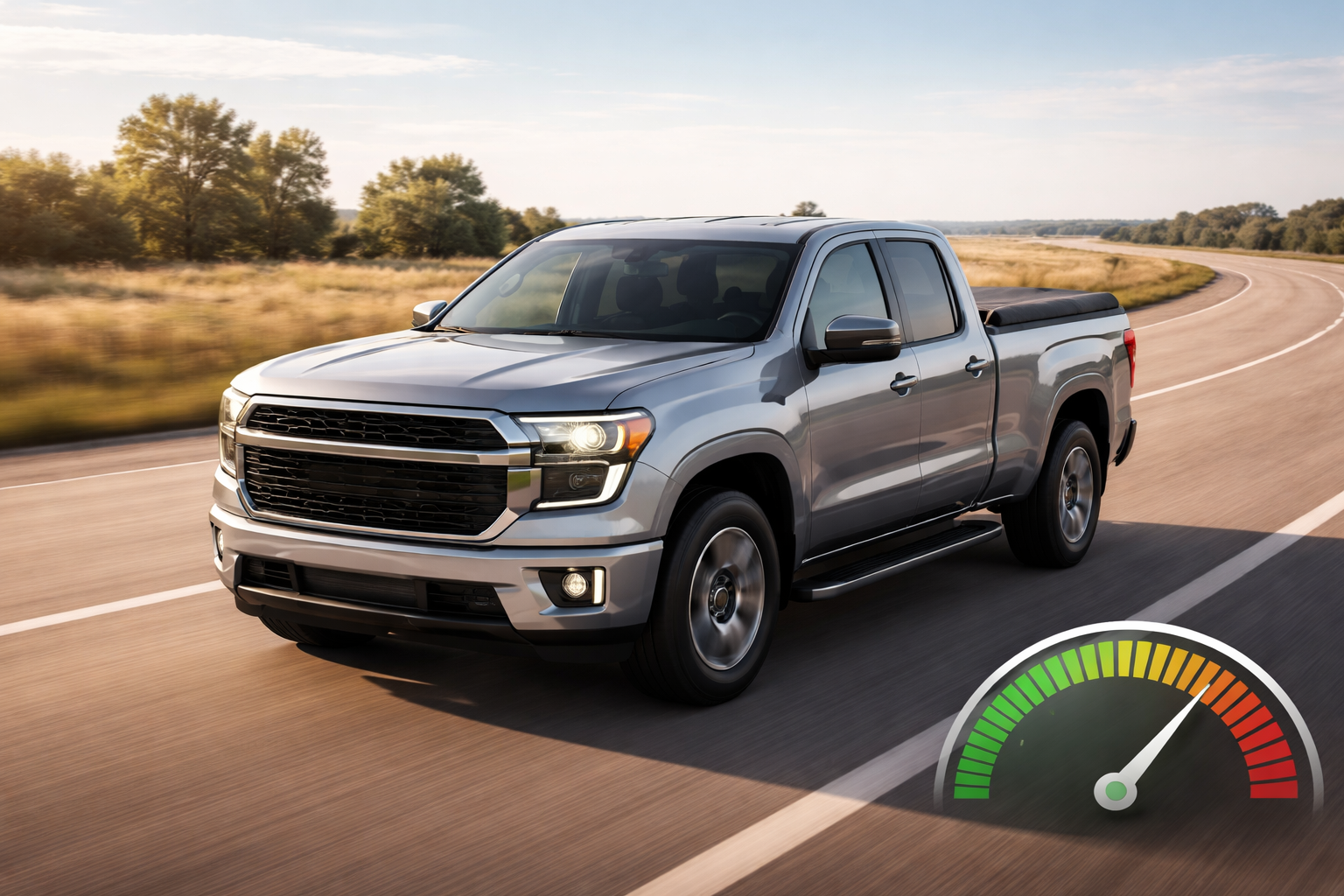
Your truck is burning more gas than it needs to. Most pickup owners lose 10-15% of their potential fuel economy to easy-to-fix issues like low tire pressure, junk in the bed, and bad driving habits. Here’s how to claw back every mile per gallon you’re leaving on the table.
Check Your Tire Pressure (Seriously, Do It Right Now)
This is the single easiest MPG win you’ll find. According to the U.S. Department of Energy, underinflated tires can lower your gas mileage by about 0.2% for every 1 PSI drop across all four tires. That doesn’t sound like much until you realize most truck owners are running 5-10 PSI low without knowing it.
On a truck like the F-150 or RAM 1500, that can mean losing a full mile per gallon for no reason. The fix takes five minutes at any gas station air pump.
Check the sticker on your driver’s side door jamb for the recommended pressure. Don’t use the number printed on the tire sidewall, that’s the maximum rating, not the sweet spot for your truck. Check your pressure when the tires are cold (before you’ve driven more than a mile or two), and do it at least once a month. Tires naturally lose about 1 PSI per month just sitting there.
If you want to take it a step further, pick up a quality digital tire gauge. The cheap pencil-style gauges from the gas station are often off by 2-3 PSI, which defeats the whole purpose.
Install a Tonneau Cover
An open truck bed acts like a giant air scoop at highway speeds. Air tumbles into the bed and creates turbulence that drags against your truck’s forward motion.
A tonneau cover smooths out that airflow. A study by the Specialty Equipment Market Association (SEMA) found that tonneau covers reduced aerodynamic drag by about 5.7% on average across multiple truck models. That translates to roughly a 1-2 MPG improvement in real-world highway driving.
The best part: you don’t need to spend a fortune. A soft roll-up cover is the best option for fuel savings because it reduces drag without adding much weight to your truck. Hard covers look great and offer better security, but the extra weight can eat into some of the aerodynamic benefit.
Some solid options to consider:
- TruXedo TruXport (soft roll-up, fits most major trucks, great value)
- Tyger Auto T1 (soft roll-up, budget-friendly pick)
- BAKFlip MX4 (hard folding, premium build quality)
One thing to keep in mind: a tonneau cover does its best work at sustained highway speeds. If you mostly drive around town at 30-40 mph, the gains will be smaller.
Slow Down on the Highway
This one hurts to hear, but speed kills your fuel economy. The faster you go above 50 mph, the more energy your engine has to burn fighting wind resistance. Aerodynamic drag increases exponentially with speed, not linearly.
For pickup trucks, the difference is dramatic. Driving at 75 mph instead of 65 mph can increase your fuel consumption by 20-27%. On a truck that gets 20 MPG at 65, you might see that drop to 16-17 MPG at 75. Over a year of commuting, that’s hundreds of dollars in wasted fuel.
You don’t have to become that person going 55 in the left lane. Even dropping from 75 to 70 makes a noticeable difference. Use cruise control whenever you can to keep your speed consistent, since constant acceleration and braking wastes fuel too.
Ditch the Extra Weight
Trucks are built to haul, but that doesn’t mean you should haul stuff you don’t need. Every 100 pounds of extra weight in your truck reduces fuel economy by about 1-2%.
Take a look at your truck bed and back seat. Are you carrying around toolboxes, sandbags from last winter, camping gear you haven’t used in months, or cases of water that have been there since who knows when? Move that stuff to the garage and only load it up when you actually need it.
The same goes for aftermarket accessories. A steel bull bar, light bar, roof rack, and heavy-duty bumper might look cool, but they’re adding hundreds of pounds and increasing your frontal area. If you’re not using a roof rack, take it off. If you installed a massive steel bumper for looks alone, understand it’s costing you at the pump every single day.
Use the Right Motor Oil
Your owner’s manual specifies a motor oil viscosity for a reason. Using the manufacturer’s recommended grade (like 0W-20 or 5W-30, depending on your truck) can improve your gas mileage by 1-2% compared to using a heavier weight oil.
Synthetic oils generally reduce friction better than conventional oils, which means less energy lost inside the engine and more power reaching the wheels. For most modern trucks, full synthetic oil is worth the upgrade.
If your truck calls for 0W-20, don’t put 10W-30 in it. The engineers who designed your engine picked that viscosity for optimal performance and efficiency.
Keep Up with Air Filter Changes
A clogged air filter restricts airflow to the engine, which can hurt performance and fuel economy on older trucks. Modern fuel-injected engines are better at compensating than the carbureted trucks of the past, but a dirty filter still makes the engine work harder.
Check your air filter every oil change and replace it when it looks noticeably dirty. For most trucks, that’s every 15,000-30,000 miles depending on driving conditions. If you drive on dirt roads or dusty job sites regularly, check it more often.
A basic OEM-style replacement filter is cheap and takes about two minutes to swap. Pop open the airbox, pull out the old one, drop in the new one. No tools required on most trucks.
Fix Your Driving Habits
Your right foot has more impact on fuel economy than almost any modification you can buy. Aggressive driving, including hard acceleration, late braking, and weaving through traffic, can lower your gas mileage by 15-30% on the highway and 10-40% in stop-and-go traffic, according to the Department of Energy.
A few habits that make a real difference:
- Accelerate gradually. You don’t need to floor it when the light turns green. Ease into it and let the truck build speed smoothly.
- Coast to stops. When you see a red light ahead, lift off the gas early and coast. Your engine burns almost zero fuel while decelerating with your foot off the pedal.
- Avoid unnecessary idling. If you’re sitting in a parking lot waiting for more than 60 seconds, turn the engine off. Idling burns roughly a quarter to a half gallon of fuel per hour on most pickup trucks.
- Use cruise control on the highway. Maintaining a steady speed is almost always more efficient than the natural speed fluctuations that come with driving manually.
Keep Your Tailgate Up
This one surprises a lot of people. You’d think that lowering the tailgate would reduce drag, but it actually does the opposite. When your tailgate is up, it creates an air bubble in the bed that deflects wind over the truck. With the tailgate down, that protective bubble disappears and air rushes into the bed, creating more drag.
MythBusters tested this and confirmed that driving with the tailgate up was more fuel efficient than driving with it down. Truck manufacturers design the bed and tailgate to work together aerodynamically. Leave it up.
Don’t Ignore the Check Engine Light
That little orange light isn’t just there to annoy you. A lit check engine light can mean your truck is running rich (burning extra fuel), has a faulty oxygen sensor, or has some other issue that’s hurting efficiency. According to FuelEconomy.gov, fixing a serious issue like a bad oxygen sensor can improve your mileage by up to 40%.
Even a loose gas cap can trigger the light and allow fuel vapor to escape. If the light comes on, get a code reader or stop by an auto parts store where they’ll scan it for free. Don’t just slap a piece of tape over the light and forget about it.
Consider Your Fuel Choice
If your truck’s manual says it runs on regular 87 octane, don’t waste money on premium. Using higher octane fuel in an engine that doesn’t require it provides zero performance or efficiency benefit. You’re literally burning money.
On the flip side, if your truck requires or recommends premium (like some of the turbocharged EcoBoost F-150s or certain GM trucks), using regular can actually reduce your fuel economy because the engine has to retard timing to avoid knock.
Check your owner’s manual. Use what it says. Period.
Think About Your Route
GPS apps like Google Maps and Waze can show you routes with less traffic, fewer stops, and smoother flow. Sitting in bumper-to-bumper traffic, constantly stopping and starting, is one of the worst things for your fuel economy.
If you have a flexible schedule, try shifting your commute by 30 minutes to avoid peak traffic. Highway miles at a steady speed are far more efficient than city miles with constant braking and accelerating.
For trucks with a 4WD system, make sure you’re in 2WD when driving on dry pavement. Running in 4WD mode on dry roads wastes fuel (the drivetrain has to spin additional components) and can actually damage your transfer case on some trucks.
FAQ
How much MPG can I realistically gain from these tips? Most truck owners can expect a combined improvement of 2-4 MPG by following all of these tips. The biggest gains usually come from fixing tire pressure, slowing down on the highway, and removing unnecessary weight. Individual results depend on your truck, driving conditions, and how far off you were on these things to begin with.
Does putting the tailgate down or removing it save gas? No. Multiple tests, including one by MythBusters, have confirmed that keeping the tailgate up is more fuel efficient. The tailgate creates an aerodynamic bubble that redirects airflow over the truck bed. Removing or lowering it disrupts that airflow and increases drag.
Are fuel additives worth it for improving MPG? Most fuel additive claims are overhyped. The best thing you can do for your fuel system is use Top Tier gasoline (available at most major gas stations like Shell, Chevron, Costco, and others), which already contains the detergent additives your engine needs. Save your money on miracle-in-a-bottle products.
Do lift kits hurt fuel economy? Yes. Lifting your truck increases its frontal area and disrupts the factory aerodynamics, which means more wind resistance. Bigger tires that usually come with a lift are heavier and have more rolling resistance too. Expect to lose 1-3 MPG depending on the lift height and tire size. If you need the lift for off-roading, that’s a trade-off you accept. Just know it comes at a cost.
This article contains affiliate links. If you purchase through these links, we may earn a small commission at no extra cost to you.
Leave a Reply