
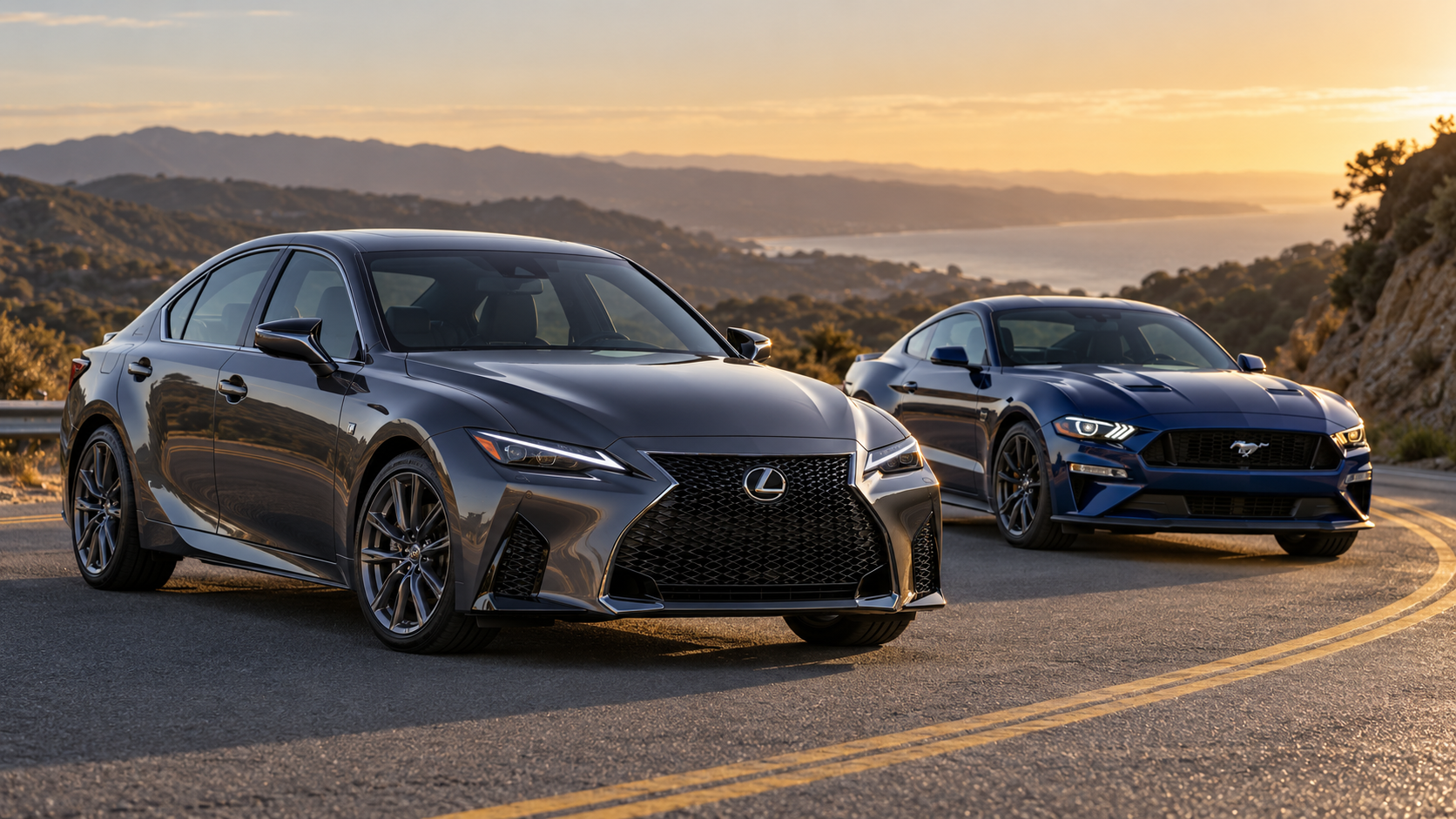
The Lexus IS occupies an interesting middle ground between a traditional luxury sedan and a performance car. It is rear-wheel-drive-based, available with genuinely strong engines, and considerably more refined than most mainstream sedans, but it is not intended to deliver the same kind of raw performance as a Ford Mustang.
For shoppers looking at used Lexus IS models, the key distinction is not simply F Sport versus non-F Sport. Engine choice matters much more. A regular IS 300 can have anywhere from 241 to 260 horsepower depending on drivetrain, while the IS 350 uses a 311-horsepower V6. Importantly, Lexus changed the lineup for 2026, eliminating the IS 300 and making the IS 350 the only regular IS powertrain.
How Much Horsepower Does a Non-F Sport Lexus IS Have?
For the 2025 model year, Lexus still sold the IS 300 as the entry-level, non-F Sport version of the car.
| Model | Engine | Horsepower | Drivetrain |
|---|---|---|---|
| IS 300 RWD | 2.0-liter turbo four-cylinder | 241 hp | Rear-wheel drive |
| IS 300 AWD | 3.5-liter V6 | 260 hp | All-wheel drive |
| IS 350 | 3.5-liter V6 | 311 hp | RWD or AWD |
The 241-horsepower rear-wheel-drive IS 300 is best thought of as a luxury daily driver with sporty handling rather than a serious performance sedan. The AWD IS 300 is more unusual: instead of the turbocharged four-cylinder, it received a detuned version of Lexus’s 3.5-liter V6 producing 260 horsepower.
The IS 350 is considerably stronger. Its naturally aspirated 3.5-liter V6 produces 311 horsepower and 280 lb-ft of torque. That engine is much closer to what buyers may expect when looking at the aggressive styling of the IS.
Lexus’s 2025 IS specifications confirm the 241-, 260- and 311-horsepower outputs.
F Sport Does Not Necessarily Mean More Horsepower
This is one of the easiest things to misunderstand about the Lexus IS lineup. F Sport is not inherently an engine upgrade.
On many Lexus IS model years, the F Sport package primarily changes styling, seats, wheels, suspension tuning and other chassis or interior equipment. An IS 350 F Sport gets its extra performance over an IS 300 primarily because it is an IS 350, not because the F Sport badge itself adds a large amount of engine power.
Likewise, an IS 300 equipped with F Sport appearance or equipment does not suddenly become a 311-horsepower IS 350.
The Lexus IS Lineup Changed for 2026
There is an important model-year cutoff for shoppers looking at new versus used cars.
For 2026, Lexus discontinued the IS 300 in the U.S. market. The lineup became exclusively IS 350, with F SPORT Design and F SPORT grades. Both use the same 3.5-liter naturally aspirated V6 producing 311 horsepower and 280 lb-ft of torque.
Rear-wheel-drive models use an eight-speed automatic transmission, while AWD versions use a six-speed automatic.
According to Lexus, the 2026 lineup is therefore both all-V6 and all-F Sport-branded. That also means there is no conventional non-F Sport IS 300 to compare in the current lineup.
The arrangement continues for 2027. Lexus announced that the 2027 IS remains exclusively an IS 350, again producing 311 horsepower from its 3.5-liter V6.
Lexus IS Generations
The IS has been around for more than 25 years, but Lexus has produced only three fundamental generations of the car.
| Generation | Approximate Model Years | Chassis | Notable Models |
|---|---|---|---|
| First generation | 1999–2005 globally; 2001–2005 in U.S. | XE10 | IS 300 |
| Second generation | 2006–2013 | XE20 | IS 250, IS 350, IS F |
| Third generation | 2014–present | XE30 | IS 300, IS 350, IS 500 |
The longevity of the third generation can be confusing because the car has received substantial redesigns during its life. In particular, the 2021 refresh changed the exterior dramatically enough that enthusiasts sometimes informally refer to 2021-and-newer cars as a fourth-generation IS. Mechanically, however, they remain part of the XE30 third-generation platform.
How Does the Lexus IS Compare With a Ford Mustang?
The Lexus IS and Ford Mustang overlap in price and both offer rear-wheel-drive layouts, but they serve very different purposes.
The Lexus is fundamentally a four-door luxury sport sedan. The Mustang is a two-door performance car. The difference becomes obvious when comparing their engines and driving character.
| Characteristic | Lexus IS | Ford Mustang |
|---|---|---|
| Primary purpose | Luxury sport sedan | Performance coupe |
| Doors | 4 | 2 |
| IS 350 output | 311 hp | — |
| Performance character | Smooth, balanced and refined | More aggressive and acceleration-focused |
| AWD availability | Yes | No |
| Daily practicality | High | Moderate |
| Cabin emphasis | Luxury and refinement | Sport and driver engagement |
The Mustang Is the Faster Choice
If acceleration is the primary objective, the Mustang is generally the stronger value proposition.
The IS 350’s 311 horsepower makes it genuinely quick enough for normal road use, but Lexus has intentionally left a considerable gap between the IS and dedicated performance cars. A Mustang GT’s V8 provides dramatically more power and a much more theatrical driving experience.
The Lexus instead emphasizes smoothness, predictability, quietness and build quality. Its naturally aspirated V6 also delivers power progressively rather than producing the abrupt surge associated with some modern turbocharged engines.
Where the Lexus IS Has the Advantage
The Lexus makes more sense for someone who wants one vehicle to handle commuting, long trips, passengers and occasional spirited driving without sacrificing luxury.
Four real doors make the IS considerably easier to live with. AWD is available for buyers who want additional traction, and Lexus has historically placed much more emphasis on isolation from road noise and everyday comfort than the Mustang.
The IS is therefore better understood as an alternative to cars such as the BMW 3 Series, Mercedes-Benz C-Class or Acura TLX rather than as a direct Mustang competitor.
Which Lexus IS Is the Sweet Spot?
For used-car buyers, the IS 350 is arguably the most appealing version of the conventional IS lineup. Its 311-horsepower V6 provides a noticeable performance advantage over either version of the IS 300 without transforming the car into an extreme performance model.
An IS 300 still makes sense for a buyer primarily interested in Lexus build quality, styling and everyday comfort. The 241-horsepower turbo model is adequate rather than fast, while the 260-horsepower AWD V6 provides a little more character.
For buyers who want a car that feels substantially more powerful, the IS 350 is the better target. F Sport equipment can improve appearance, seating and chassis behavior, but the engine designation remains the more important specification to watch.
Bottom Line
A non-F Sport Lexus IS can range from a relatively modest 241-horsepower luxury sedan to a V6-powered car with considerably more performance, depending on model year and drivetrain. For 2025 and earlier cars, shoppers should pay close attention to whether they are looking at an IS 300 or IS 350 rather than assuming the F Sport badge determines horsepower.
Starting with the 2026 model year, the choice became much simpler: Lexus dropped the IS 300 and standardized the 311-horsepower 3.5-liter V6 across the U.S. IS lineup.
The Mustang remains the better choice for drivers prioritizing acceleration, V8 theater and sports-car character. The Lexus IS is the stronger proposition for someone who wants respectable performance combined with four-door practicality, luxury-car refinement and a more understated personality.
Sources: Lexus IS, Lexus 2026 IS 350 announcement, and Lexus 2027 IS announcement.
Leave a Reply