
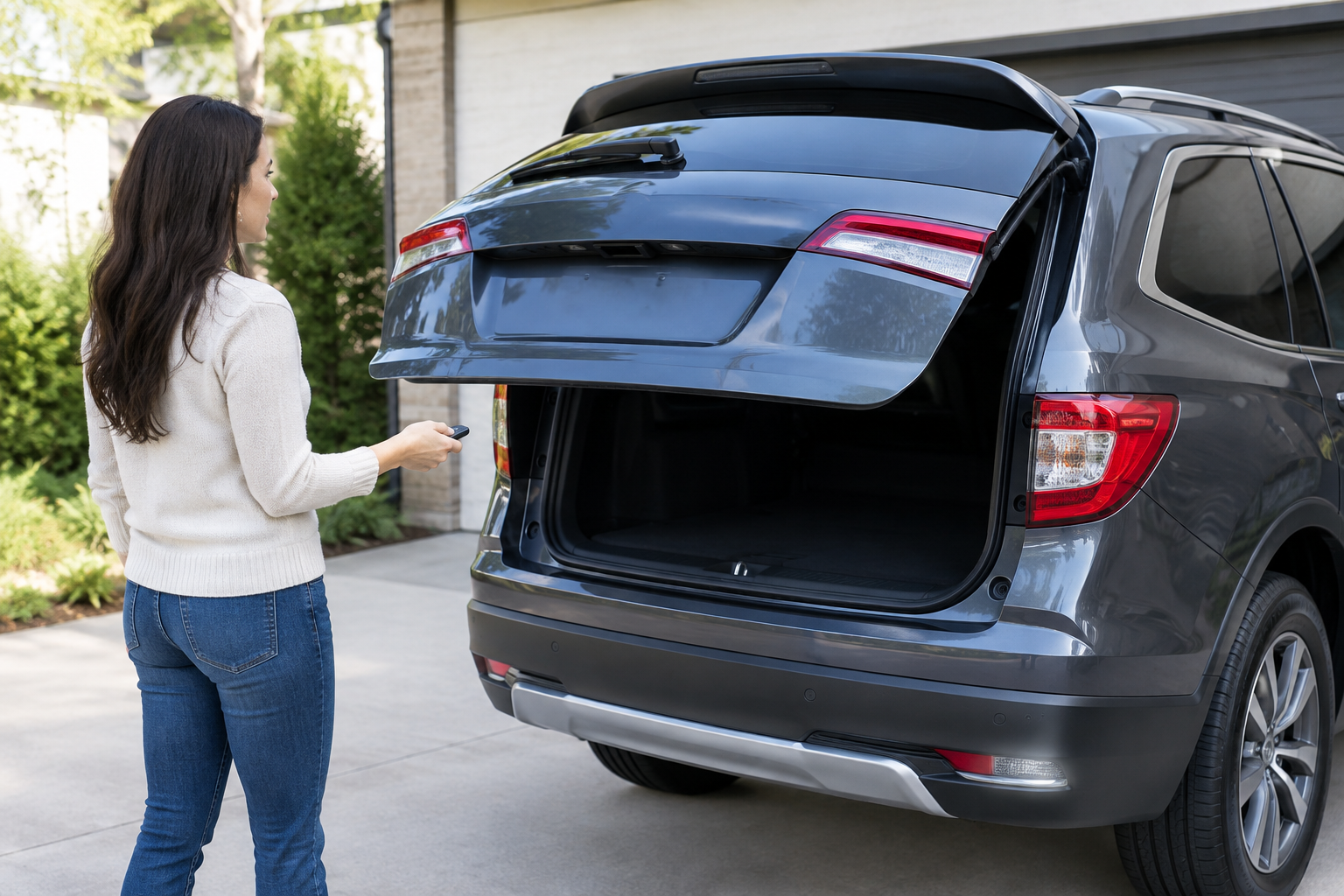
If your Honda Pilot’s power liftgate suddenly refuses to open, won’t latch shut, or reverses itself halfway through the cycle, you’re dealing with one of the most common electrical gripes owners report on this SUV. The good part is that most of these issues trace back to a handful of repeatable causes: a stuck height setting, a dirty latch sensor, a weak battery, or a worn-out liftgate strut. Before you assume you need a new motor or a trip to the dealer, work through the checks below in order.
Check the Height Memory and Obstruction Settings First
The Honda Pilot’s power liftgate remembers a maximum open height, which is handy if you park in a garage with a low ceiling. If someone (including you) accidentally set that height to something absurdly low, like six inches, the liftgate will look “stuck” or “broken” when it’s actually just doing what it’s told.
To reset the height memory, open the liftgate fully by hand, then hold the close button on the liftgate switch panel (usually located on the inside of the gate near the latch) until you hear a beep or the system confirms the new setting. On most 2016 to 2022 Pilots, you do this through the liftgate’s own control panel rather than the infotainment screen. Refer to your owner’s manual for the exact button sequence for your model year, since Honda tweaked this procedure across trims.
Obstruction detection is the other frequent culprit. The liftgate uses pinch sensors along the edge and a current-monitoring system in the motor to detect resistance. If a cargo net, ice buildup, mud, or even a loose weatherstrip is pressing against the sensor strip, the gate will stop or reverse the moment it senses that “obstruction,” even if nothing is actually in the way. Clean the rubber seal and the sensor channel around the perimeter of the opening, then try a full open and close cycle.
Latch Problems and Why the Gate Won’t Fully Close
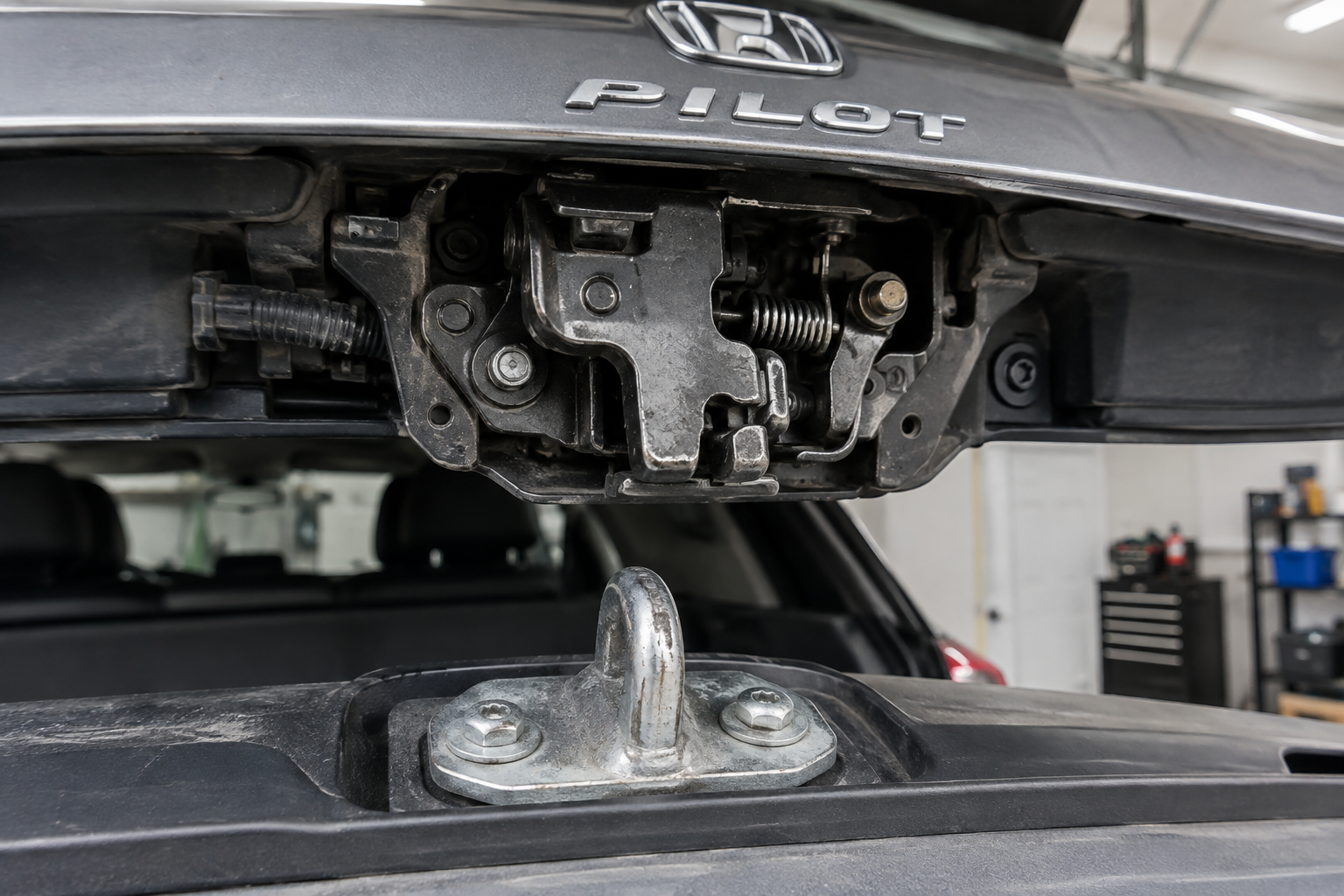
When the power liftgate opens fine but won’t latch, or it closes partway and then pops back open, the striker and latch assembly are usually to blame. Road grime, rust, or a bent striker pin can prevent the latch from sensing a full closure, which tells the computer to reverse the motor as a safety measure.
Inspect the striker on the body side and the latch mechanism on the gate itself. A little dielectric grease or a dry PTFE lubricant on the latch pin can solve sticking issues that mimic a much bigger electrical fault. If the latch is visibly corroded or the gate has ever been closed forcefully by hand while the motor was still running, the latch assembly itself may need replacement rather than just cleaning.
It’s also worth manually latching the gate a few times to feel for grinding or excessive resistance. A latch that feels rough or requires extra force is telling you it’s wearing out, and that wear will only get worse until the gate stops working altogether.
Low Battery Voltage, Fuses, and Electrical Gremlins
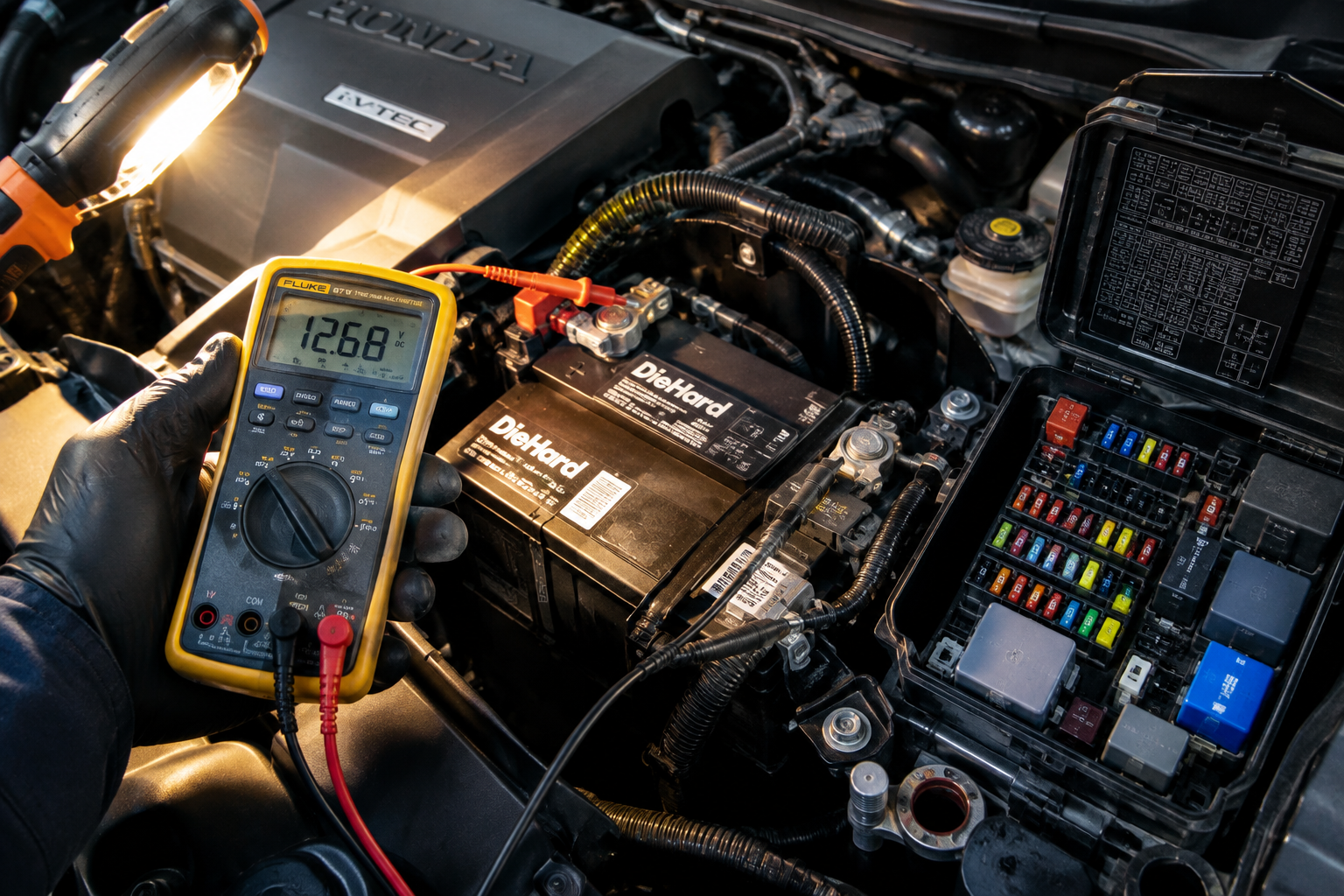
Power liftgates are voltage-hungry, and Honda’s system has a built-in cutoff that disables power operation if it detects the battery voltage is too low to safely run the motor without risking other electronics. If your Pilot has been sitting for a while, has an aging battery, or you’ve noticed slow cranking on startup, that’s a strong sign your liftgate issue is really a battery issue in disguise.
Test the battery with a multimeter or have it load-tested at any auto parts store. A healthy resting voltage should read close to 12.6 volts. If your Pilot’s battery is several years old and testing weak, this is a case where fixing the “liftgate problem” really means replacing the battery. Weak batteries also cause other strange electrical symptoms throughout the vehicle, similar to what we cover in our guide on diagnosing electrical issues after a vehicle sits overnight.
Next, check the fuses. The power liftgate typically pulls from a dedicated fuse in the under-hood fuse box, and a blown fuse will kill power liftgate function entirely while leaving manual operation intact. Consult your owner’s manual for the exact fuse location and amperage, since this varies by model year, and never substitute a higher-amp fuse than specified.
Key Fob, Interior Button, and Hands-Free Sensor Behavior
If the liftgate works from the interior switch but not the key fob, or vice versa, you’re likely dealing with a fob battery or a programming glitch rather than a motor problem. Swap in a fresh key fob battery first since it’s the cheapest and fastest fix. If a second fob works fine and the first doesn’t, the fob itself needs replacement or reprogramming.
Later Pilot trims, particularly Touring and Elite models from around 2019 onward, added a hands-free foot-sensor liftgate that opens with a kicking motion under the rear bumper when you’re carrying the key fob. These sensors are notoriously sensitive to dirt, road salt, and even aftermarket trailer hitches or bumper accessories that block the detection zone. Wipe down the sensor area under the bumper and make sure nothing is obstructing it before assuming the sensor has failed.
Hands-free sensitivity can sometimes be adjusted or disabled through the settings menu on the infotainment screen, and if the foot sensor is triggering false opens (like the gate popping open while you’re just walking behind the vehicle), reducing sensitivity or turning the feature off entirely can prevent unwanted activations. Owners who’ve dealt with other sensitive assist features on this same Pilot, like the lane-keeping system, will recognize the pattern. Our guide on turning off lane assist on the Honda Pilot covers a similar settings walkthrough if you’re not familiar with navigating the Pilot’s menu system.
Failing Liftgate Struts and Drive Motor Issues
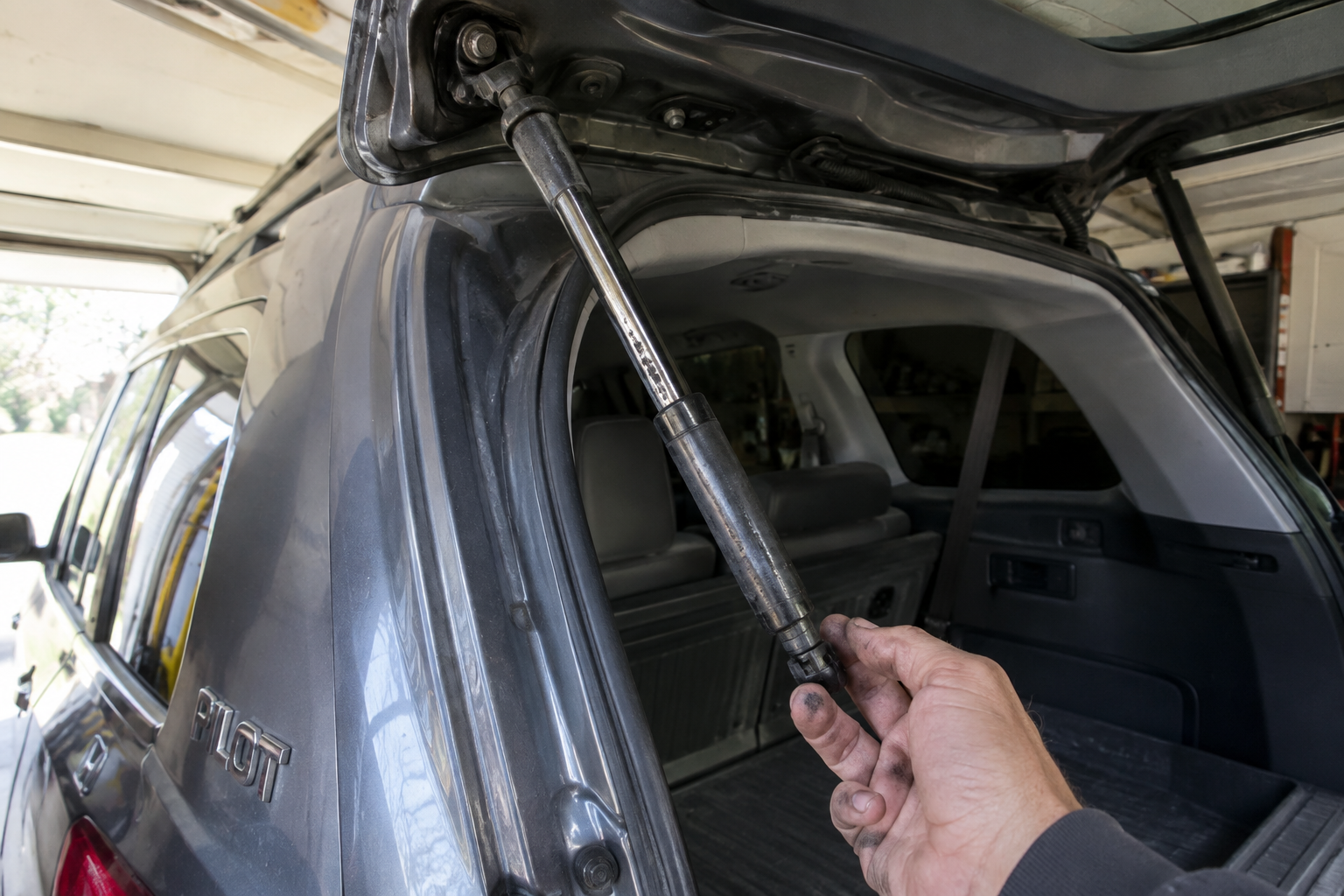
If the liftgate opens but sags or drifts closed on its own, or it strains and moves slowly with a labored motor sound, the gas struts (also called supports or dampers) are probably worn out. These struts lose their charge over time from age and temperature cycling, and once they’re weak, the power motor has to fight gravity on every single cycle, accelerating wear on the motor itself.
Replacing the struts is one of the more affordable fixes on this list and often resolves both the “won’t stay open” complaint and the “closes too slowly” complaint at the same time. You’ll typically need to replace both struts as a pair since one weak strut puts uneven load on the other.
Honda Pilot Power Liftgate Strut
A direct-fit replacement strut pair is the most common fix for a sagging or slow-closing power liftgate.
If you’ve replaced the struts and the latch checks out but the gate still won’t move under power, the drive motor or the control module itself may have failed. This is less common but does happen, especially on higher-mileage Pilots or vehicles that have been through repeated obstruction-reversal cycles that strain the motor’s internal gearing. At that point, a scan tool that can read body control module codes will save you a lot of guesswork.
OBD2 Scanner
A bidirectional scanner can pull body control module codes to confirm whether the fault is the latch, motor, or a wiring issue.
Manual Operation and Reset Procedures
Every power liftgate Pilot retains the ability to open and close by hand, which is useful both as a workaround and as a diagnostic step. If the gate closes smoothly and latches properly by hand but won’t do it under power, that isolates the problem to the motor, switch, or module rather than the mechanical latch itself.
To fully reset the system on most model years, disconnect the negative battery terminal for about a minute, or pull the liftgate fuse for the same amount of time, then reconnect and cycle the gate manually a few times before trying the power switch again. This forces the control module to relearn the gate’s full range of motion and open height. Some 2023 and newer Pilots with the redesigned liftgate switch layout may require an additional calibration step through the infotainment settings menu, so check your owner’s manual for the exact sequence if the basic reset doesn’t take.
Frequently Asked Questions
Why does my Honda Pilot liftgate open but not close all the way?
This is almost always a latch or obstruction-sensor issue. Check the striker alignment, clean the latch mechanism, and make sure nothing is blocking the sensor strip around the gate’s edge before assuming it’s an electrical fault.
Can a weak battery really stop the power liftgate from working?
Yes. The liftgate module monitors battery voltage and will disable power operation if voltage drops too low, since running the motor under those conditions could stall other electronics or damage the battery further. A load test is a quick way to rule this out.
Is the hands-free foot-sensor liftgate available on all Honda Pilot trims?
No. Hands-free access has generally been limited to upper trims like Touring and Elite starting around the 2019 model year, and availability varies by generation, so check your specific trim’s feature list if you’re not sure whether your Pilot has this option.

Leave a Reply