
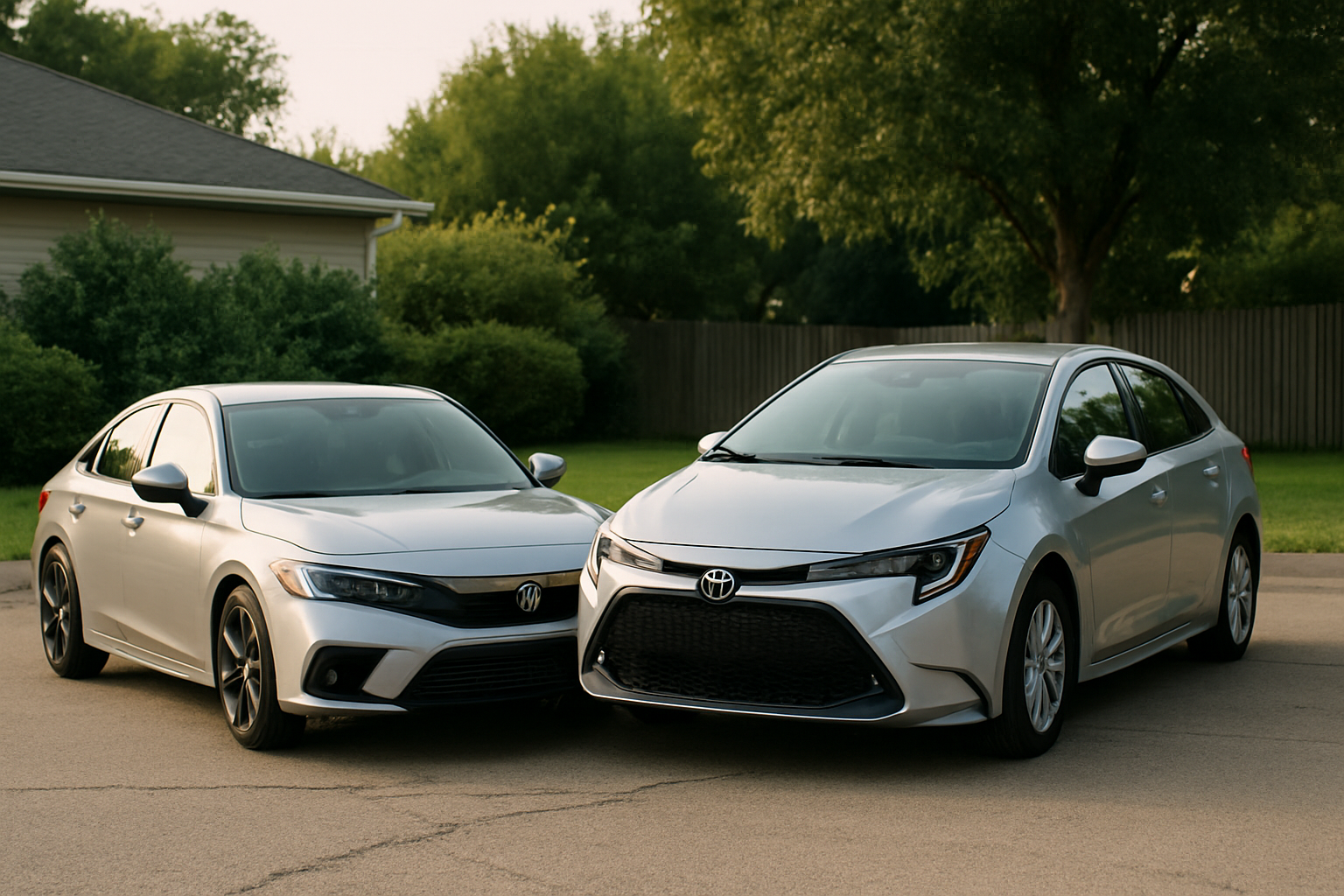
When you’re shopping for a reliable compact car that’ll serve you well beyond 100,000 miles, the Honda Civic and Toyota Corolla consistently top the list. Both vehicles have earned reputations for durability, but their long-term performance stories differ in some important ways that could influence your buying decision.
Overall Reliability Track Record
Both the Civic and Corolla have proven themselves as marathon runners in the automotive world. Consumer Reports and J.D. Power consistently rank both models above average for long-term reliability, with the Corolla historically holding a slight edge in overall dependability ratings.
The Corolla’s reputation for bulletproof reliability isn’t just marketing hype. Toyota’s conservative engineering approach means they often stick with proven technologies longer than competitors, resulting in fewer unexpected failures after the 100,000-mile mark.
Honda takes a more aggressive approach with technology integration and performance tuning. While this sometimes leads to more engaging driving experiences, it can also introduce additional complexity that may require attention as the vehicle ages.
Common Issues After 100,000 Miles
Honda Civic Problem Areas
The most significant concern across multiple Civic generations is the CVT (Continuously Variable Transmission). Models from 2014-2019 particularly show higher rates of CVT failure or performance degradation around the 80,000 to 120,000-mile range. Symptoms include shuddering during acceleration, delayed engagement, and in worst cases, complete failure requiring replacement.
Air conditioning compressor failures appear more frequently in Civics after 100,000 miles compared to the Corolla. The A/C compressor clutch tends to wear out, leading to intermittent cooling or complete system failure. Replacement typically costs between $1,200-$1,800.
Engine mount wear becomes noticeable in higher-mileage Civics, particularly the rear engine mount. You’ll feel increased vibration during idle and acceleration. While not catastrophic, it affects driving comfort and should be addressed to prevent additional wear on other components.
Power steering systems in 2006-2011 Civics develop leaks and pump failures more frequently after 100,000 miles. The electric power steering systems in newer models are generally more reliable but can experience sensor issues that trigger warning lights.
Toyota Corolla Weak Points
Oil consumption becomes a concern in certain Corolla engines, particularly the 1.8L 2ZR-FE found in 2009-2018 models. Some vehicles begin burning oil at rates exceeding one quart per 1,000 miles after 100,000 miles. This issue stems from piston ring design and requires careful monitoring to prevent engine damage.
The water pump in many Corolla models starts showing signs of wear around 100,000-120,000 miles. While not unique to Toyota, the timing of this failure often coincides with timing belt replacement, making it a predictable but expensive maintenance item.
Suspension components, particularly struts and strut mounts, tend to wear out around 100,000 miles in Corollas. The rear strut mounts are especially prone to failure, causing rattling noises over bumps and affecting handling.
Door lock actuators fail more frequently in Corollas after 100,000 miles compared to Civics. While this doesn’t affect drivability, it becomes an inconvenience and security concern that typically requires replacement of the entire door lock mechanism.
Maintenance Costs Comparison
Routine Maintenance
Both vehicles require similar basic maintenance intervals and costs through their first 100,000 miles. Oil changes, brake pads, and filters cost roughly the same regardless of which model you choose.
Where costs begin to diverge is in transmission service. The Civic’s CVT requires more frequent fluid changes (every 30,000 miles versus 60,000-100,000 miles for the Corolla’s conventional automatic). CVT fluid also costs more, typically $15-20 per quart compared to $8-12 for standard ATF.
Spark plug replacement intervals favor the Corolla slightly. Most Corolla engines use standard plugs that need replacement every 30,000-60,000 miles at $8-15 each, while some Civic engines require premium iridium plugs costing $25-40 each but lasting 100,000 miles.
Major Service Items
Timing belt replacement (in models that have them) costs roughly the same for both vehicles, typically $800-1,200. However, more recent Civic and Corolla models use timing chains that rarely need replacement, giving both vehicles an advantage in long-term maintenance costs.
Brake system maintenance shows little difference between the two. Both vehicles typically need brake pads every 40,000-60,000 miles and rotors every 80,000-100,000 miles, with parts costs within $50 of each other for equivalent quality components.
Cooling system maintenance differs slightly. The Civic’s more complex cooling system, particularly in turbocharged models, may require more frequent coolant changes and has more potential failure points like additional sensors and electronic thermostats.
Expected Repair Costs After 100k
CVT replacement represents the single largest potential expense for high-mileage Civic owners. A remanufactured CVT costs $3,500-4,500 installed, while a new unit can exceed $5,000. This repair alone can exceed the vehicle’s value on older models.
For Corollas, the oil consumption issue can lead to engine rebuild or replacement if not addressed properly. Engine rebuild costs typically range from $3,000-5,000, while a replacement engine runs $4,000-6,000 installed.
More common repairs fall into manageable ranges for both vehicles. AC compressor replacement costs $1,200-1,800, suspension work typically runs $600-1,200 depending on how many components need replacement, and electrical issues usually fall under $500 unless major wiring harnesses are involved.
Real-World Ownership Experiences
Long-term Civic owners report higher satisfaction with driving dynamics and interior features even as their vehicles age. The more powerful engines and better handling characteristics help the Civic feel less outdated after 100,000+ miles.
Corolla owners consistently praise their vehicles’ reliability but sometimes express frustration with road noise and driving refinement as the car ages. Interior materials tend to show wear more obviously, though mechanical components continue functioning well.
Fuel economy typically remains strong for both vehicles even after 100,000 miles, assuming proper maintenance. Both models commonly achieve their original EPA ratings or close to them even with high mileage, provided the engine and transmission remain in good condition.
Parts Availability and Cost
Both Honda and Toyota maintain excellent parts availability for vehicles well beyond 100,000 miles. OEM parts costs are comparable, with Toyota holding a slight advantage in some categories due to higher production volumes.
Aftermarket parts selection slightly favors the Civic, particularly for performance and appearance modifications. However, for basic maintenance and repair items, both vehicles have extensive aftermarket support with quality options from brands like Beck/Arnley, Denso, and Aisin.
Labor costs vary more by region and shop type than by vehicle brand. Both Honda and Toyota have extensive dealer networks and most independent shops can service either vehicle competently.
Which Offers Better Long-Term Value?
The Corolla edges out the Civic for pure reliability after 100,000 miles, primarily due to its simpler, more proven powertrain designs. If your priority is minimizing unexpected repairs and maximizing longevity, the Corolla’s conservative engineering approach pays dividends.
However, the Civic offers better driving satisfaction and typically holds resale value better due to its more engaging driving characteristics and newer technology features. If you plan to keep the car beyond 150,000 miles, this becomes less relevant, but it matters for shorter ownership periods.
For budget-conscious buyers, the Corolla’s lower potential for expensive repairs makes it the safer financial choice. The absence of CVT reliability concerns alone could save thousands in potential repair costs.
Performance-oriented drivers may find the Civic’s superior handling and acceleration worth the slightly higher maintenance costs and potential reliability risks.
Making Your Decision
Your choice between these two excellent vehicles should depend on your priorities and risk tolerance. If maximum reliability and minimal repair costs are your primary concerns, the Corolla’s proven track record makes it the better choice.
Choose the Civic if you want better driving dynamics and more advanced features, and you’re willing to accept slightly higher maintenance costs and the potential for CVT-related issues down the road.
Both vehicles can easily reach 200,000+ miles with proper maintenance. Your local dealer network, available maintenance facilities, and personal preferences for driving feel should influence your decision as much as pure reliability statistics.
Frequently Asked Questions
Which model is more expensive to maintain after 100k miles?
The Honda Civic typically costs 10-15% more to maintain after 100,000 miles, primarily due to more frequent CVT service requirements and potentially higher repair costs. However, both vehicles remain affordable to maintain compared to luxury competitors.
How long can I expect either car to last?
Both the Civic and Corolla regularly reach 200,000-250,000 miles with proper maintenance. The Corolla has a slight statistical advantage for reaching higher mileages without major repairs, but individual maintenance history matters more than brand choice at extreme mileages.
Are there specific model years to avoid?
For the Civic, be cautious with 2014-2016 models due to CVT reliability concerns. The 2006-2008 Civic models also had some engine and transmission issues. For the Corolla, 2009-2011 models show higher rates of oil consumption problems, though this affects only certain engines.
Which holds its value better at high mileage?
The Civic typically maintains slightly better resale value at high mileage due to stronger demand for its sportier driving characteristics. However, both vehicles depreciate predictably and hold value well compared to domestic competitors in the compact car segment.
This article contains affiliate links. If you purchase through these links, we may earn a small commission at no extra cost to you.

Leave a Reply