
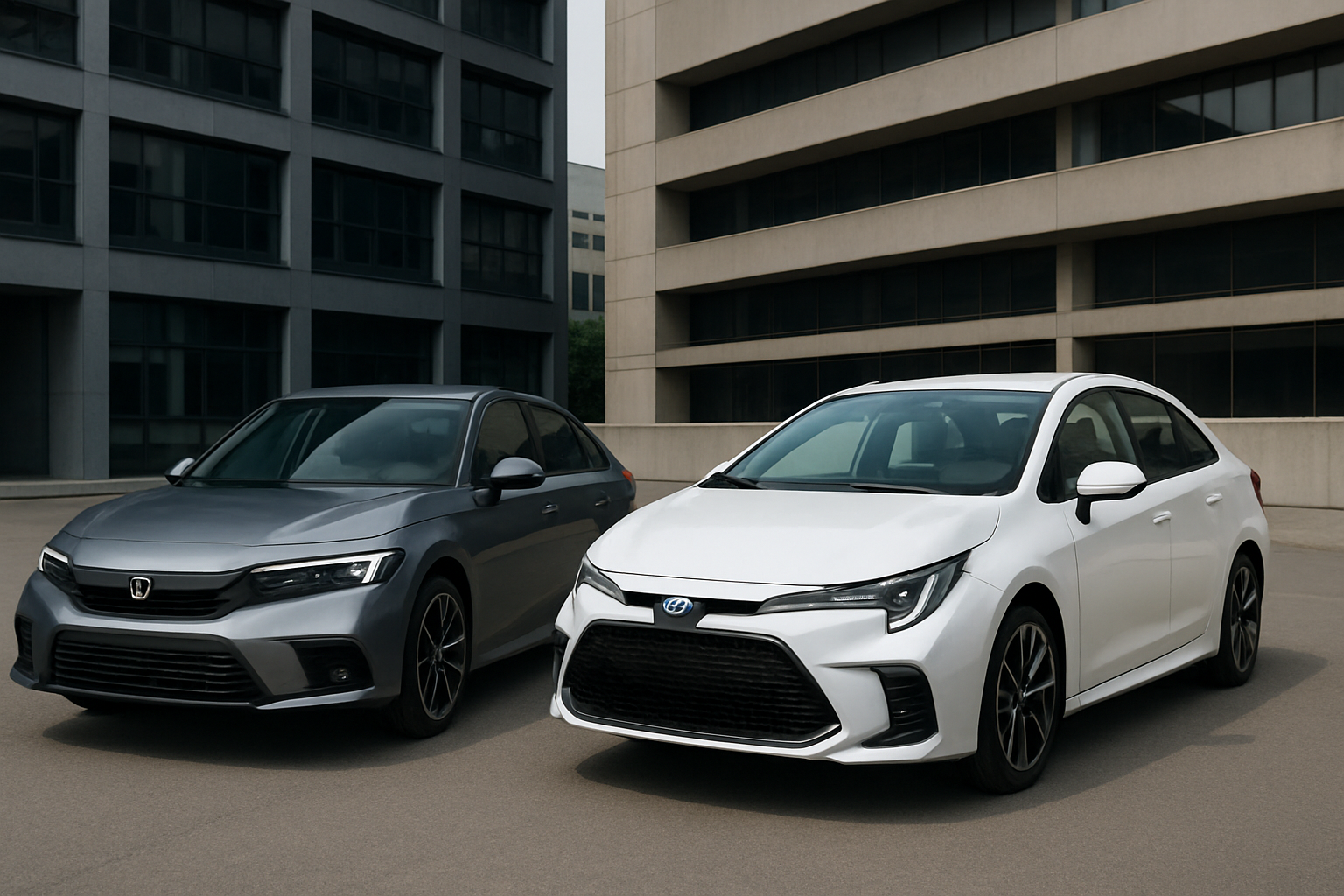
The Honda Civic and Toyota Corolla have been locked in automotive combat for decades, and 2025 brings fresh updates to both compact sedans. These two models consistently top sales charts and reliability rankings, making your choice between them more challenging than ever.
Both cars deliver exceptional value, but they take distinctly different approaches to winning your loyalty. Let’s break down how these rivals stack up across the categories that matter most to your wallet and daily driving experience.
Interior Quality: Where You’ll Spend Every Drive
Step inside the 2025 Civic, and you’ll notice Honda’s commitment to making plastic feel premium. The dashboard materials have improved significantly over the previous generation, with soft-touch surfaces covering high-contact areas. The seats offer excellent support for longer drives, particularly in the Sport trim where you get better bolstering.
The Corolla’s interior takes a more conservative approach but nails the fundamentals. Toyota’s SofTex synthetic leather feels surprisingly genuine, and the overall build quality inspires confidence. You won’t find any squeaks or rattles after 50,000 miles, which is more than you can say for some competitors.
Where the Civic pulls ahead is technology integration. The 12-inch touchscreen in higher trims responds quickly and includes wireless Apple CarPlay and Android Auto. The Corolla’s 8-inch screen works fine but feels a generation behind in terms of responsiveness and graphics quality.
Both cars offer adequate rear-seat space for their class, though taller passengers will prefer the Civic’s extra inch of legroom. The Corolla compensates with a more comfortable rear bench that doesn’t feel as firm during longer trips.
Driving Dynamics: Different Philosophies on Wheels
Honda engineers tuned the Civic for drivers who actually enjoy the act of driving. The steering provides genuine feedback, and the suspension strikes an impressive balance between comfort and control. You can push the Civic through corners with confidence, especially in the Sport trim with its limited-slip differential.
The Corolla prioritizes smoothness over sportiness, which isn’t necessarily a negative. Toyota’s suspension absorbs road imperfections better than the Civic’s setup, making it the superior choice for rough city streets or long highway stretches. The steering is lighter and requires less effort in parking lots.
Both cars offer surprisingly engaging manual transmissions if you prefer three pedals. The Civic’s 6-speed feels more precise, while the Corolla’s manual provides lighter clutch action that won’t fatigue your left leg in stop-and-go traffic.
The CVT automatics tell different stories. Honda’s unit includes preset ratios that mimic a traditional automatic, reducing the rubber-band effect that plagues many CVTs. Toyota’s CVT focuses purely on efficiency, which can feel sluggish when merging onto highways.
Engine Performance Comparison
The Civic’s turbocharged 1.5-liter engine produces 180 horsepower and delivers strong midrange punch. This engine really wakes up around 2,000 RPM and maintains power well into the rev range. You’ll appreciate this extra torque when passing slower traffic or climbing hills.
Toyota sticks with a naturally aspirated 2.0-liter that makes 169 horsepower. While it produces less peak power, the linear power delivery feels predictable and smooth. This engine requires more revs to access its power, but it’s also likely to prove more durable over 200,000 miles.
Fuel Economy: Every Drop Counts
Both cars deliver impressive fuel economy, but their approaches differ significantly. The Civic’s turbocharged engine achieves an EPA-estimated 35 mpg combined in most trims. Real-world testing typically yields 32-34 mpg with mixed driving, assuming you can resist using all that available torque.
The Corolla’s naturally aspirated engine consistently delivers on its EPA ratings of 34 mpg combined. More importantly, it’s nearly impossible to achieve poor fuel economy with this powertrain. Even aggressive driving rarely drops consumption below 28 mpg.
Both cars benefit from active grille shutters and other aerodynamic improvements for 2025. The Civic’s coefficient of drag improved to 0.27, while the Corolla maintains its slippery 0.29 rating. These numbers translate to better highway efficiency at sustained speeds above 65 mph.
Premium fuel isn’t required for either car, though the Civic’s turbo engine benefits from occasional tanks of 91 octane to prevent carbon buildup. The Corolla runs happily on regular 87 octane for its entire lifespan.
Hybrid Options: Electrification Done Right
The Corolla Hybrid remains one of the most compelling efficiency champions on the market. Its combination of the 1.8-liter Atkinson-cycle engine and electric motor produces 121 total system horsepower while achieving 54 mpg combined. This isn’t just an EPA fantasy number – real-world driving consistently delivers 50+ mpg.
Honda discontinued the Civic Hybrid after 2015, leaving efficiency-focused buyers with only the standard engine. This represents a significant advantage for Toyota, especially with gas prices remaining volatile. The Corolla Hybrid typically costs about $2,400 more than the base Corolla, but that premium pays for itself within two years of typical driving.
The hybrid system in the Corolla operates almost transparently. You’ll rarely notice the transitions between electric and gasoline power, and the regenerative braking feels natural compared to some competitors. The battery pack doesn’t significantly impact cargo space, maintaining the standard car’s practicality.
Toyota backs the hybrid system with an 8-year/100,000-mile warranty on major components. This coverage provides additional confidence for buyers concerned about long-term hybrid reliability and repair costs.
Resale Value: Protecting Your Investment
Toyota’s reputation for longevity translates directly to stronger resale values. The Corolla typically retains 58-62% of its original value after five years, compared to the Civic’s 52-58% retention rate. This 4-6 percentage point difference represents real money when you’re ready to trade up.
Several factors contribute to Toyota’s resale advantage. The brand’s reliability reputation attracts used car buyers who prioritize dependability over features. Additionally, Toyota’s more conservative styling tends to age better than Honda’s sportier design language.
The Corolla Hybrid commands even stronger resale values, often matching or exceeding the retention rates of entry-level luxury cars. High fuel prices consistently drive demand for efficient used cars, and the Corolla Hybrid delivers efficiency that remains competitive even against newer models.
Geographic location significantly impacts resale values for both cars. The Civic holds its value better in areas where driving enthusiasm is prized, while the Corolla dominates in regions where reliability and efficiency matter most.
Certified Pre-Owned Programs
Both manufacturers offer comprehensive certified pre-owned programs that enhance resale values. Toyota’s CPO program extends the powertrain warranty to 7 years/100,000 miles from the original in-service date. Honda’s program provides similar coverage but with slightly stricter mileage requirements for eligibility.
These programs particularly benefit Corolla owners, as Toyota dealers actively seek clean, low-mileage examples for their CPO inventory. The combination of strong demand and rigorous inspection standards helps maintain premium pricing for qualifying vehicles.
Insurance Costs: The Hidden Monthly Expense
Insurance premiums favor the Corolla by a significant margin, with average annual costs running $150-250 lower than comparable Civic coverage. This difference stems from the Corolla’s safety record, lower theft rates, and typically less expensive repairs.
The Insurance Institute for Highway Safety rates both cars as Top Safety Pick winners, but the Corolla edges ahead in real-world claim frequency and severity. Insurance companies track these statistics carefully and adjust premiums accordingly.
Civic Sport and Si variants face higher insurance costs due to their performance orientation and younger average buyer demographics. The additional horsepower and sport-tuned suspension don’t just affect your driving experience – they also impact your monthly insurance bill.
Shopping for insurance quotes before making your final decision makes sense, especially if you’re under 25 or have a less-than-perfect driving record. Some insurers offer significant discounts for hybrid vehicles, which could tip the scales toward the Corolla Hybrid.
Technology and Safety Features
Honda Sensing and Toyota Safety Sense 2.0 both come standard across all trim levels, providing comprehensive driver assistance features. The Civic’s system includes traffic jam assist that maintains proper following distance in stop-and-go conditions. The Corolla’s system focuses on intersection safety with an improved pre-collision system.
Both cars now offer over-the-air update capability for infotainment systems, though Honda’s implementation proves more comprehensive. The Civic can receive updates to its driver assistance systems, while the Corolla currently limits updates to entertainment and navigation functions.
The Civic’s available 12-speaker Bose audio system delivers genuinely impressive sound quality for the segment. Toyota partners with JBL for premium audio, but the system doesn’t quite match the Bose setup’s clarity and staging.
Maintenance and Long-Term Ownership
Toyota’s maintenance advantage becomes apparent after the warranty period expires. Corolla engines typically require their first major service around 100,000 miles, while the Civic’s turbo engine benefits from more frequent oil changes and occasional carbon cleaning services.
Both cars use timing chains instead of belts, eliminating a major maintenance expense around 60,000-90,000 miles. However, the Civic’s direct-injection system can develop carbon deposits that require professional cleaning services every 40,000-50,000 miles.
Parts availability strongly favors both vehicles due to their high sales volumes. Independent shops can service either car competently, though Toyota’s simpler naturally aspirated engine requires less specialized knowledge than Honda’s turbocharged unit.
Extended warranty options make sense for both cars if you plan to keep them beyond 100,000 miles. Honda’s extended warranties typically cost less upfront, while Toyota’s coverage includes more comprehensive roadside assistance benefits.
Final Verdict: Choosing Your Champion
The Civic appeals to drivers who prioritize engagement and technology. Its superior driving dynamics, more powerful engine, and advanced infotainment system create a more involving ownership experience. You’ll pay slightly more for insurance and maintenance, but the enhanced driving pleasure may justify these costs.
The Corolla targets buyers who value efficiency, reliability, and long-term value retention. The available hybrid powertrain, lower insurance costs, and stronger resale values contribute to superior total cost of ownership. The driving experience prioritizes comfort over excitement, which many buyers actually prefer.
Your decision ultimately depends on your priorities. Choose the Civic if you enjoy spirited driving and want the latest technology features. Pick the Corolla if maximum efficiency and long-term value matter most to your situation.
Frequently Asked Questions
Which car offers better reliability?
The Corolla maintains a slight reliability edge based on long-term data, particularly regarding engine and transmission durability. The Civic’s turbocharged engine adds complexity that can lead to more maintenance requirements after 100,000 miles. However, both cars rank among the most reliable in their segment.
Is the Civic worth the extra cost over the Corolla?
The value equation depends on your priorities. The Civic typically costs $500-1,500 more initially but provides superior performance and technology. However, the Corolla’s lower insurance costs and stronger resale value can offset this initial premium over several years of ownership.
How do the hybrid and non-hybrid Corollas compare to the Civic?
The standard Corolla closely matches the Civic in most areas while offering better reliability and resale value. The Corolla Hybrid significantly outperforms the Civic in fuel economy and environmental impact, achieving 54 mpg combined compared to the Civic’s 35 mpg rating.
Which car has lower total cost of ownership?
The Corolla typically wins the total cost of ownership comparison due to lower insurance premiums, reduced maintenance requirements, and stronger resale values. The Corolla Hybrid extends this advantage further through dramatically reduced fuel costs, often saving $400-600 annually in gas expenses.

Leave a Reply