

Ford is setting an unusually ambitious target for its upcoming affordable electric pickup.
The automaker is aiming to sell more than 100,000 examples of the new Ford Fathom during its first year of production, according to The Wall Street Journal, citing people familiar with the company’s plans.
The Fathom is expected to start at around $30,000 and reach customers in 2027. If Ford comes close to its sales target, the truck could become one of the first electric pickups in the United States to reach truly mainstream sales volumes.
Ford is aiming much lower on price this time
Price is arguably the most important part of the Fathom story.
Ford’s first wave of electric trucks focused largely on vehicles that could become expensive once buyers moved beyond the least costly configurations. The F-150 Lightning proved that Ford could build a capable electric pickup, but it did not produce the mass-market EV breakthrough the company had once hoped for.
The Fathom takes a very different approach. Ford has designed the truck and the manufacturing system behind it around reducing cost from the beginning.
Ford has said its new electric truck will target a starting price of around $30,000. That would put the Fathom in roughly the same price territory as many gasoline-powered compact cars, crossovers and Ford’s own Maverick pickup.
More than 100,000 sales in the first year
The Wall Street Journal reports that Ford wants to sell more than 100,000 Fathoms during the truck’s first year of production.
That figure has not been announced by Ford as formal public sales guidance. The Journal attributed the target to people familiar with the matter.
Still, the number gives a useful indication of just how important the Fathom has become to Ford’s electric vehicle plans. This is not being developed as a low-volume specialty EV. Ford is building the truck and the factory around the assumption that it can attract a much broader group of buyers.
Selling more than 100,000 units annually would put the Fathom in serious volume territory for an electric vehicle, particularly an electric pickup.
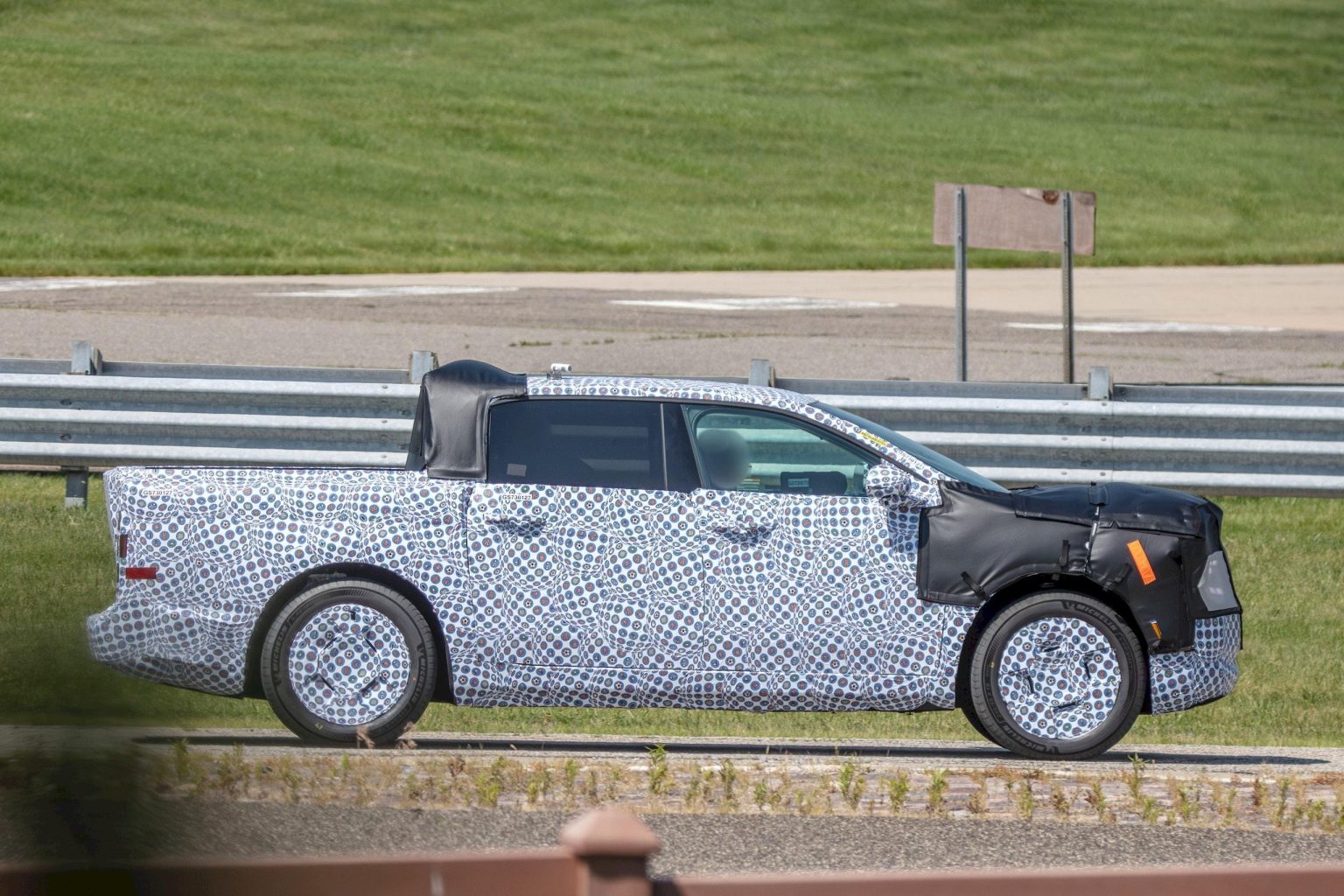
Preproduction Fathom spotted on the road
Ford is already testing preproduction examples of the truck on public roads. One camouflaged prototype was recently filmed driving in traffic, giving an early look at the Fathom’s proportions before Ford reveals the production truck in full.
Heavy camouflage hides most of the final styling, but the prototype gives a better sense of the truck’s size and stance. It appears considerably more compact than a full-size F-150 Lightning, consistent with Ford’s plan to build a smaller and less expensive electric pickup.
What is the Ford Fathom?
The Fathom is a five-passenger electric pickup and the first vehicle based on Ford’s new Universal EV Platform.
Ford describes it as a midsize truck, although its exterior dimensions are expected to make it much easier to maneuver than a traditional full-size pickup.
Ford has said the truck will offer a roomy passenger compartment while retaining a useful pickup bed and a front trunk for additional storage.
Several features have already been announced, including:
- Five-passenger seating
- A front trunk, or frunk
- Bidirectional power capability
- A digital vehicle key
- A large high-resolution touchscreen
- Apple CarPlay and Android Auto compatibility
- Ford BlueCruise capability
Important specifications such as EPA range, battery capacity, horsepower, payload and towing capacity have not yet been announced.
A new way of building a Ford
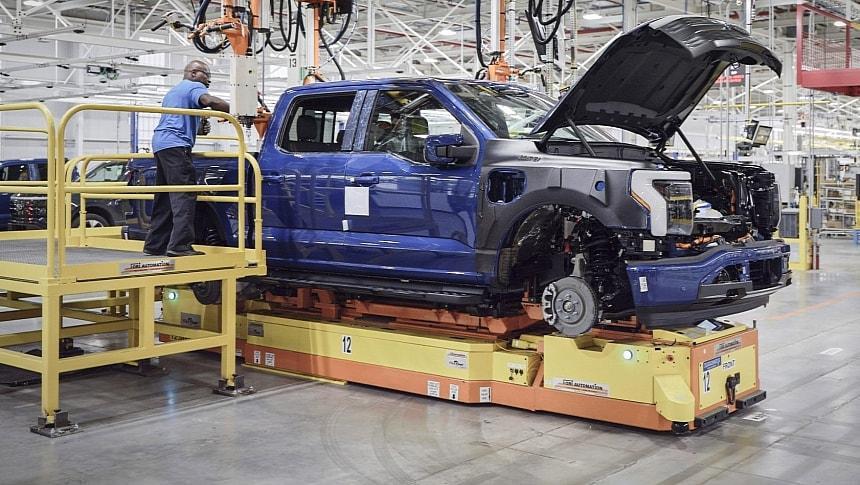
The Fathom is also serving as the first test of a major change to Ford’s manufacturing process.
Ford is spending about $2 billion to transform its Louisville Assembly Plant in Kentucky for production of the truck. The factory previously produced gasoline-powered vehicles.
Instead of moving a nearly complete vehicle down one traditional assembly line, Ford’s Universal EV Production System divides assembly into three main sections.
The front of the vehicle, rear of the vehicle and structural battery assembly are built on separate branches. The three sections are brought together later in the process.
Ford says large aluminum castings will also replace numerous smaller stamped and welded components. Reducing the number of individual parts is intended to lower manufacturing costs, shorten production time and simplify assembly.
Ford says the new system should make Fathom assembly about 15 percent faster than the plant’s previous production process.
The Louisville plant is scheduled to begin building Fathom prototypes with production-qualified parts during the first quarter of 2027. Customer vehicles are expected to follow later in the year.
Ford has changed its EV strategy
The Fathom arrives after Ford made major changes to its electric vehicle plans.
The company has backed away from some of the larger and more expensive battery-electric vehicles it previously planned to build. Ford has instead placed more emphasis on hybrids, extended-range electric vehicles and smaller battery-electric models that have a clearer path to profitability.
The current generation of the F-150 Lightning has also reached the end of its run. Ford’s future truck plans are moving toward a mix of battery-electric and extended-range electric designs rather than relying on one approach.
Pure battery-electric vehicles will remain part of Ford’s lineup, but the company’s Universal EV Platform is now central to that strategy.
The Fathom is the first vehicle from the platform, but Ford has designed the architecture to support a broader family of affordable electric vehicles.
The $30,000 price could matter more than huge range numbers
Ford appears to be making a calculated tradeoff with the Fathom.
Instead of starting with a huge battery and trying to justify a high vehicle price, Ford has focused heavily on efficiency, simpler manufacturing and lower battery costs.
The truck is expected to use lithium-iron-phosphate, or LFP, battery technology. LFP batteries can generally be produced at lower cost than the nickel-rich chemistries used in many longer-range electric vehicles.
That approach could allow Ford to offer a practical electric pickup without requiring customers to spend $50,000, $60,000 or more to get into one.
Range will still matter, particularly for truck buyers. Ford has not announced an EPA estimate yet, so it is too early to know whether the Fathom will have enough range to appeal to drivers who routinely travel long distances or tow.
But at roughly $30,000, the truck does not need to compete with expensive electric pickups on every specification. It needs enough range and capability for everyday buyers at a price they are actually willing to pay.
100,000 sales would be a major test
The Fathom may provide one of the clearest tests yet of whether price has been one of the biggest obstacles holding back electric vehicle adoption in the United States.
A roughly $30,000 electric pickup is a very different proposition from the expensive EVs that have dominated much of the market so far.
Ford also has an advantage that many EV startups do not: a huge existing dealer network, established truck customers and decades of experience building pickups in large numbers.
None of that guarantees 100,000 sales.
Ford still has to deliver the truck near its advertised starting price, provide useful real-world range and convince buyers that the Fathom is a practical alternative to gasoline and hybrid vehicles.
But Ford’s reported sales target shows how differently the company is approaching this vehicle. The Fathom is not supposed to be another expensive electric truck sold around the edges of the market. Ford wants it to sell in numbers normally associated with mainstream vehicles.
More details about the Fathom’s range, power, towing capacity and available configurations should emerge as the truck gets closer to production in 2027.
Leave a Reply