
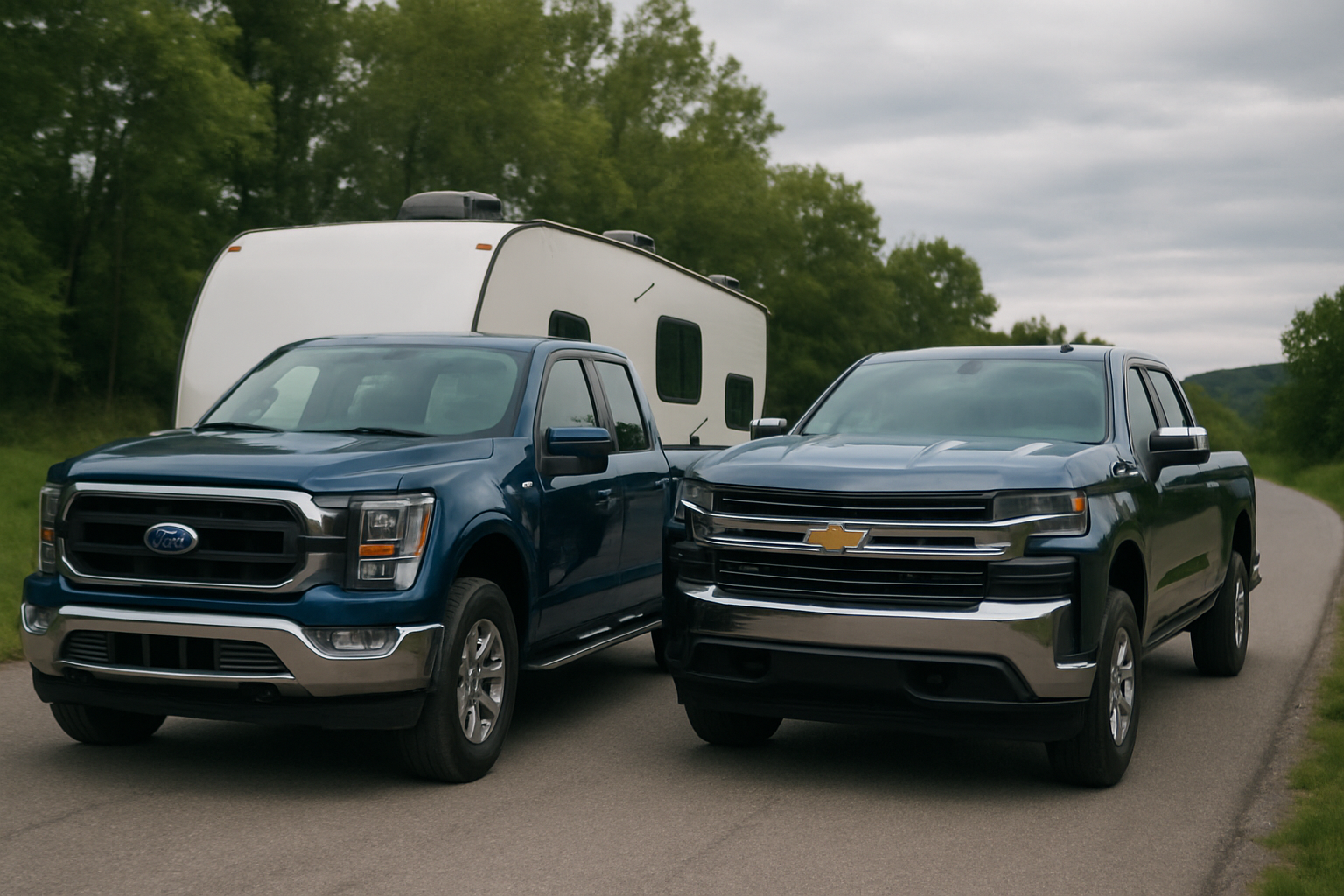
When you’re shopping for a truck to pull your travel trailer, the choice often comes down to two heavy hitters: the Ford F-150 and Chevrolet Silverado. Both trucks have loyal followings, and both offer serious towing capabilities that can handle everything from lightweight pop-ups to massive fifth wheels. The key is understanding which truck gives you the best combination of power, technology, and real-world towing performance for your specific needs.
Towing Capacity Showdown: Engines and Packages
The F-150’s towing numbers vary dramatically depending on which engine you choose. The base 3.3L V6 can pull up to 8,200 pounds when properly equipped, but most serious tower owners gravitate toward the more powerful options.
Ford’s 2.7L EcoBoost V6 bumps capacity to 10,100 pounds, while the 3.5L EcoBoost can haul up to 13,200 pounds with the Max Trailer Tow Package. The naturally aspirated 5.0L V8 sits in the middle at 11,600 pounds max capacity.
The Silverado takes a different approach with its engine lineup. The base 4.3L V6 handles 7,900 pounds, but the real workhorses are the V8 options. The 5.3L V8 can tow up to 11,600 pounds, while the range-topping 6.2L V8 with the Max Trailering Package pushes that number to 13,300 pounds.
Both trucks offer diesel options that change the game completely. Ford’s 3.0L Power Stroke diesel pulls up to 11,500 pounds while delivering significantly better fuel economy. Chevy’s 3.0L Duramax diesel matches that capability with similar efficiency gains.
Payload Capacity: The Often Overlooked Number
Towing capacity gets all the attention, but payload capacity determines how much weight you can carry in the truck bed and cab. This includes passengers, cargo, and most importantly, the tongue weight of your trailer.
F-150 payload varies wildly based on configuration, ranging from about 1,520 pounds on crew cab models up to 3,325 pounds on regular cab work trucks. Most popular configurations with the SuperCrew cab and popular options land somewhere between 1,800 and 2,200 pounds.
Silverado payload numbers follow a similar pattern. Base models can carry up to 2,280 pounds, while loaded crew cab trucks typically handle between 1,750 and 2,100 pounds of payload.
You need to calculate your trailer’s tongue weight (typically 10-15% of total trailer weight) plus passengers and gear to make sure you don’t exceed payload limits. A 8,000-pound trailer with 1,200 pounds of tongue weight doesn’t leave much room for passengers and camping gear.
Towing Technology: Ford vs Chevy Features
Both manufacturers pack their trucks with technology designed to make towing easier and safer. Ford’s approach centers around the available Pro Trailer Backup Assist, which lets you steer your trailer using a knob on the dashboard while the truck handles the steering wheel.
The F-150 also includes Trailer Coverage, which extends your blind spot monitoring to account for trailer width, and Dynamic Hitch Assist, which provides guidelines on your backup camera to help line up the hitch ball.
Chevy counters with its own suite of features on the Silverado. The available Invisible Trailer View uses camera feeds to create a see-through trailer view on your infotainment screen. Their hitch guidance system provides multiple camera angles and trajectory lines for easier hookup.
Both trucks offer integrated trailer brake controllers, though Ford’s system is standard on more trim levels. Chevy makes you step up to higher trims or add option packages to get the built-in controller.
Ford’s Trailer Tow Modes automatically adjust transmission shift points, throttle response, and cooling fan operation when you activate tow/haul mode. The Silverado offers similar programming with its Tow/Haul mode and available Auto Grade Braking that uses engine braking on steep descents.
Real-World Towing Performance and Ride Quality
Numbers on paper only tell part of the story. How these trucks actually perform while pulling a travel trailer makes the difference between a pleasant trip and white-knuckle driving.
The F-150’s turbocharged engines deliver strong low-end torque that makes merging with a heavy trailer much easier. The 3.5L EcoBoost in particular provides V8-like pulling power with better fuel economy. However, some owners report turbo lag during sudden acceleration needs.
Ford’s aluminum body construction reduces overall truck weight, which improves payload capacity and fuel economy. The trade-off comes in ride quality when towing, as the lighter truck can feel less planted compared to the heavier Silverado.
The Silverado’s steel construction and generally heavier curb weight provide excellent stability while towing. The truck feels more composed in crosswinds and doesn’t get pushed around as easily by larger trailers. The naturally aspirated V8 engines deliver predictable power delivery without turbo lag.
Chevy’s available Magnetic Ride Control suspension (on higher trims) adapts to towing loads and provides excellent ride quality both empty and loaded. Ford offers a similar system on select models, but it’s not as widely available across the lineup.
Fuel Economy While Towing
Don’t expect stellar fuel economy from either truck while towing a travel trailer, but there are meaningful differences between engines and configurations.
The F-150’s diesel engine provides the best towing fuel economy, typically delivering 12-14 mpg while pulling a moderately sized travel trailer. The 2.7L EcoBoost usually returns 10-12 mpg under similar conditions, while the 5.0L V8 drops to 8-11 mpg.
Silverado’s diesel also leads its lineup for towing efficiency, matching the Ford’s 12-14 mpg range. The 5.3L V8 typically delivers 9-12 mpg while towing, while the larger 6.2L V8 drops to 8-10 mpg with heavy loads.
Both trucks benefit from their 10-speed automatic transmissions, which help keep engines in their optimal power bands while maintaining reasonable fuel consumption. The extra gears make a noticeable difference compared to older 6-speed automatics.
Wind resistance from your travel trailer affects fuel economy more than truck choice. A tall, boxy trailer will hurt efficiency in either truck, while a lower, more aerodynamic trailer improves mileage significantly.
Recommended Towing Accessories and Equipment
Successful travel trailer towing requires more than just a capable truck. Both the F-150 and Silverado benefit from additional accessories that improve safety and convenience.
Weight distribution hitches help level your truck and trailer combination while improving stability and steering control. Both trucks can benefit from these systems, especially when pulling trailers over 5,000 pounds.
If you’re serious about towing, consider investing in quality trailer towing accessories that can make your trips safer and more enjoyable. Essential items include extended mirrors, tire pressure monitoring systems, and backup cameras specifically designed for trailer use.
Brake controllers are crucial for trailers equipped with electric brakes. While both trucks offer integrated controllers, aftermarket units often provide more precise control and adjustment options.
Which Truck Wins for Travel Trailer Towing?
Both trucks excel in different areas, making the choice dependent on your specific towing needs and preferences.
Choose the F-150 if you prioritize fuel economy, want the latest towing technology features, or need maximum payload capacity. The EcoBoost engines provide excellent power-to-efficiency ratios, and Ford’s aluminum construction helps with payload numbers.
The Silverado makes more sense if you value stability while towing, prefer naturally aspirated V8 power delivery, or want a truck that feels more planted on the highway. The steel construction and available Magnetic Ride Control create excellent towing composure.
For most travel trailer applications under 10,000 pounds, either truck will serve you well. The decision often comes down to brand preference, local dealer support, and which truck feels better during your test drive.
Frequently Asked Questions
Can both trucks handle a 30-foot travel trailer?
Yes, both the F-150 and Silverado can tow most 30-foot travel trailers, provided you choose appropriate engine packages and don’t exceed towing or payload limits. A typical 30-foot trailer weighs 7,000-9,000 pounds loaded, which falls within both trucks’ capabilities with mid-level engines.
Do I need a diesel engine for travel trailer towing?
Diesel engines aren’t necessary for most travel trailer towing, but they provide better fuel economy and torque delivery. Both trucks’ gasoline V8 engines offer plenty of power for typical travel trailers. Consider diesel if you plan extensive mountain driving or want maximum fuel efficiency.
Which truck has better resale value for towing configurations?
Both trucks hold their value well, but F-150s traditionally have slightly stronger resale values industry-wide. However, properly equipped towing packages and diesel engines tend to retain value better than base configurations in either truck.
How much does Max Towing Package cost on each truck?
Pricing varies by model year and trim level, but expect to pay $1,500-2,500 for maximum towing packages on either truck. These packages typically include upgraded cooling, stronger axles, integrated brake controllers, and specialized hitching equipment. The investment pays off in increased capability and convenience.
This article contains affiliate links. If you purchase through these links, we may earn a small commission at no extra cost to you.


Leave a Reply