
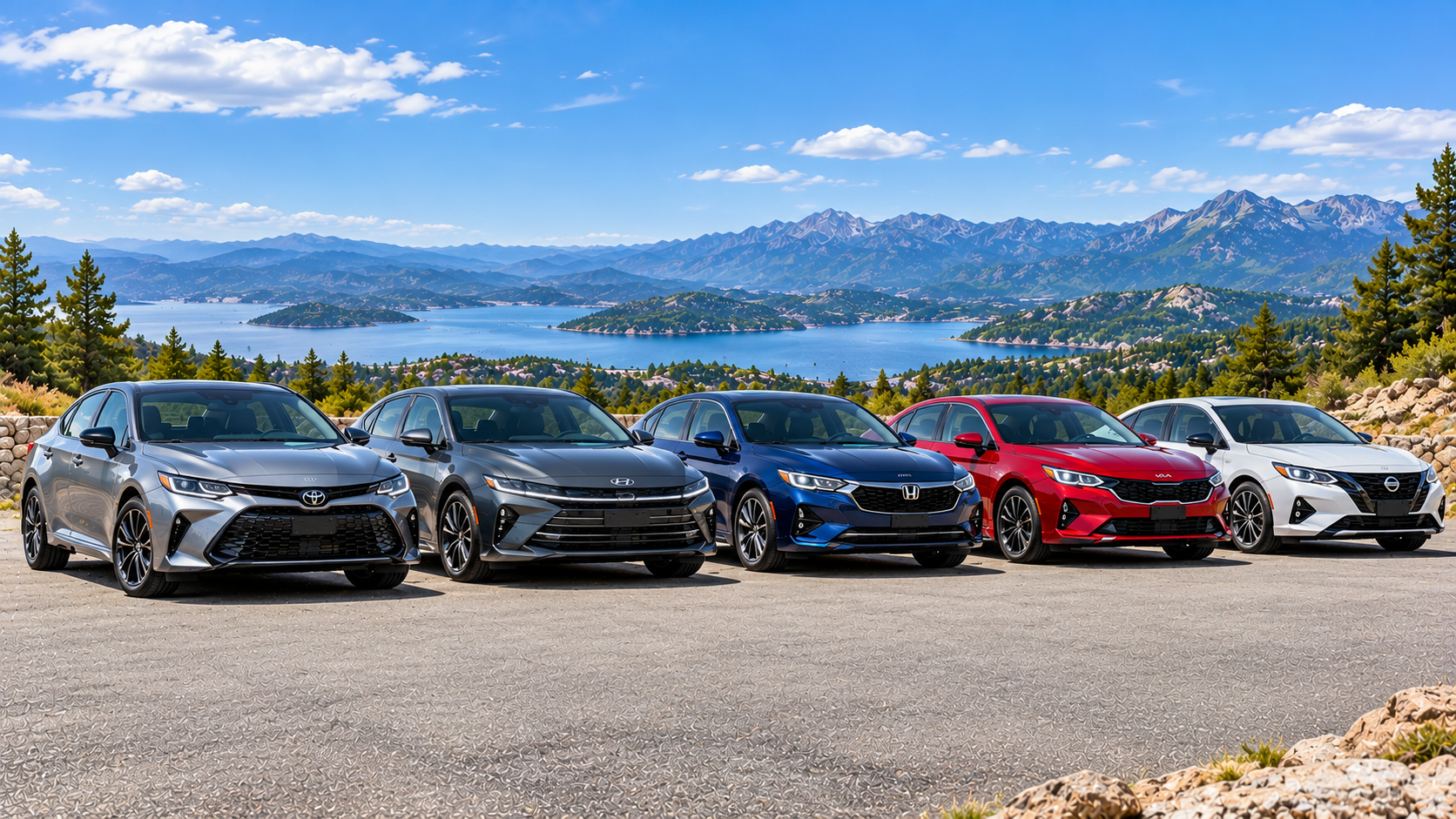
Buying a midsize sedan no longer means settling for mediocre fuel economy. The most efficient 2026–2027 models can travel more than 50 miles on a gallon of gasoline, while conventional gasoline sedans still offer respectable highway efficiency.
The Toyota Camry Hybrid and Hyundai Sonata Hybrid lead the mainstream midsize sedan segment at 51 MPG combined. The Honda Accord Hybrid follows at 48 MPG combined, while the gasoline-powered Honda Accord and Hyundai Sonata achieve up to 32 MPG combined.
Below, we rank the mainstream midsize sedans available in the United States for 2026 and 2027. We also compare gasoline-only models, available all-wheel drive, highway MPG, and annual fuel consumption.
Every Midsize Sedan Ranked by MPG (2026–2027)
The ranking uses the highest published EPA combined MPG for each model’s most efficient gasoline or conventional hybrid configuration. Each rating is tied to a specific model year rather than assuming 2026 figures automatically carry over to 2027.
| Rank | Midsize Sedan | Best Configuration | Model Year | Combined MPG |
|---|---|---|---|---|
| 1 (tie) | Toyota Camry | 2.5L hybrid, LE FWD | 2026–2027 | 51 |
| 1 (tie) | Hyundai Sonata | 2.0L hybrid, Blue FWD | 2026–2027 | 51 |
| 3 | Honda Accord | 2.0L hybrid, EX-L FWD | 2026 | 48 |
| 4 (tie) | Kia K5 | 2.5L gasoline, LXS FWD | 2026–2027 | 30 |
| 4 (tie) | Nissan Altima | 2.5L gasoline, FWD | 2026 | 30 |
Ratings refer to the most efficient listed configuration, not every trim. The 2027 Toyota Camry’s 51-MPG rating is published by Toyota, although its October 2026 press announcement describes the figure as manufacturer-estimated. The 2027 Hyundai Sonata Blue Hybrid and Kia K5 have published EPA ratings. No unconfirmed 2027 Accord or Altima rating is assumed.
Hybrid sedans dominate this ranking. The three models offering conventional hybrid powertrains achieve at least 48 MPG combined in their most efficient configurations.
The Kia K5 and Nissan Altima do not offer conventional hybrid powertrains in the U.S. configurations reviewed here, so their best combined ratings are considerably lower.
1. Toyota Camry Hybrid — 51 MPG Combined
Best configuration: 2.5-liter four-cylinder hybrid, LE front-wheel drive
2026 MPG: 52 city / 49 highway / 51 combined
2027 MPG: 52 city / 49 highway / 51 combined, as published by Toyota
The Toyota Camry is one of the most fuel-efficient midsize sedans available in the United States.
Unlike older Camry generations, the 2026 and 2027 models use hybrid powertrains throughout the lineup. There is no conventional gasoline-only Camry configuration.
The most efficient LE front-wheel-drive trim achieves 51 MPG combined. It also delivers 225 net combined horsepower, providing considerably more power than many economy-focused vehicles.
Buyers can choose electronic all-wheel drive, which increases combined output to 232 horsepower.
The 2026 Camry LE AWD achieves 50 MPG combined, only one MPG below the most efficient front-wheel-drive model.
However, not every Camry trim delivers the same efficiency. Larger wheels and sport-oriented equipment can reduce combined MPG into the mid-40s.
For buyers seeking maximum fuel economy, the LE is the clear choice.
Best for: Buyers wanting excellent fuel economy, hybrid power, and available AWD in a practical family sedan.
2. Hyundai Sonata Hybrid — 51 MPG Combined
Best configuration: 2.0-liter four-cylinder hybrid, Blue front-wheel drive
2026 MPG: 47 city / 56 highway / 51 combined
2027 MPG: 47 city / 56 highway / 51 combined
The Hyundai Sonata Hybrid matches the Toyota Camry’s best combined MPG rating while delivering even higher EPA highway fuel economy.
Its Blue Hybrid trim achieves 51 MPG combined and an impressive 56 MPG highway.
The hybrid system combines a 2.0-liter gasoline engine with an electric motor for 192 combined horsepower.
Hyundai uses a six-speed automatic transmission in the Sonata Hybrid, providing a different driving character from the electronically controlled continuously variable systems used by some competing hybrids.
Other Sonata Hybrid trims achieve 47 MPG combined, so the Blue trim is the strongest option for fuel-conscious buyers.
The Sonata also offers conventional gasoline engines, including a sportier N Line configuration.
Best for: Buyers who prioritize highway efficiency and want a comfortable, well-equipped hybrid sedan.
3. Honda Accord Hybrid — 48 MPG Combined
Best configuration: 2.0-liter four-cylinder hybrid, EX-L front-wheel drive
2026 MPG: 51 city / 44 highway / 48 combined
2027 MPG: Not independently verified for this comparison
The Honda Accord Hybrid is another strong choice for drivers who want a roomy midsize sedan with excellent fuel economy.
Its most efficient 2026 configuration is the EX-L Hybrid, which achieves 48 MPG combined.
That is slightly below the Camry and Sonata Hybrid, but the difference is modest compared with the gap between hybrid and gasoline-only models.
The Accord Hybrid produces 204 combined horsepower and uses Honda’s two-motor hybrid system.
Honda offers several hybrid trims, but their EPA ratings differ.
The Sport Hybrid, Sport-L Hybrid, and Touring Hybrid achieve 44 MPG combined, compared with 48 MPG for the EX-L Hybrid.
Buyers who prioritize efficiency should therefore compare specific trims rather than assuming every Accord Hybrid gets the same mileage.
The conventional gasoline Accord LX achieves 32 MPG combined, making it one of the most efficient non-hybrid midsize sedans.
Best for: Buyers who want a spacious, refined midsize sedan with strong hybrid efficiency and a choice of gasoline or hybrid powertrains.
4. Kia K5 — 30 MPG Combined
Best configuration: 2.5-liter four-cylinder gasoline engine, LXS front-wheel drive
2026 MPG: 26 city / 37 highway / 30 combined
2027 MPG: 26 city / 37 highway / 30 combined
The Kia K5 takes a different approach from the leading hybrids.
Its most efficient LXS trim uses a conventional 2.5-liter four-cylinder gasoline engine paired with an eight-speed automatic transmission.
The result is 30 MPG combined, with 37 MPG on the highway.
Other K5 configurations sacrifice some fuel economy for additional equipment, all-wheel drive, or performance.
The GT-Line front-wheel-drive model achieves 29 MPG combined, while the available AWD version returns 27 MPG combined for 2027.
The performance-oriented K5 GT uses a turbocharged 2.5-liter engine producing 290 horsepower and achieves 27 MPG combined.
The K5 is therefore better suited to buyers who prioritize styling, conventional gasoline power, or sportier performance rather than maximum fuel savings.
Best for: Buyers wanting a stylish midsize sedan with a conventional gasoline engine and available AWD.
5. Nissan Altima — 30 MPG Combined
Best configuration: 2.5-liter four-cylinder gasoline engine, front-wheel drive
2026 MPG: 26 city / 36 highway / 30 combined
2027 MPG: Not independently verified for this comparison
The Nissan Altima ties the Kia K5 for fourth place in the overall ranking.
For 2026, the Altima uses a naturally aspirated 2.5-liter four-cylinder gasoline engine.
Front-wheel-drive versions achieve 30 MPG combined, while all-wheel-drive models return 28 MPG combined.
The Altima’s main fuel-economy advantage is that it achieves its rating without a hybrid system.
However, the difference between the Altima and a 51-MPG hybrid sedan is substantial.
For drivers covering long distances every year, that difference can translate into hundreds of additional gallons of gasoline over the vehicle’s ownership period.
Best for: Buyers wanting a conventional gasoline midsize sedan with available AWD and reasonable fuel economy.
Gasoline-Only Midsize Sedans Ranked by MPG
Hybrid sedans lead the overall rankings, but several midsize cars remain available with conventional gasoline engines.
| Sedan | Best Gasoline Configuration | Combined MPG |
|---|---|---|
| Honda Accord | 2026 LX, 1.5L turbo FWD | 32 |
| Hyundai Sonata | 2026 SE, 2.5L FWD | 32 |
| Kia K5 | 2027 LXS, 2.5L FWD | 30 |
| Nissan Altima | 2026 SV/SR, 2.5L FWD | 30 |
The Honda Accord LX and Hyundai Sonata SE lead the gasoline-only comparison with 32 MPG combined.
The Toyota Camry does not appear in this table because its 2026–2027 lineup is exclusively hybrid.
Gasoline-only models can make sense for buyers who drive relatively few miles or find an attractive purchase price. However, the fuel-economy advantage of the leading hybrids becomes increasingly valuable as annual mileage rises.
Which Midsize Sedan Gets the Best Highway MPG?
The Hyundai Sonata Hybrid Blue is the highway fuel-economy leader among these mainstream midsize sedans.
| Sedan | City MPG | Highway MPG | Combined MPG |
|---|---|---|---|
| Hyundai Sonata Hybrid Blue | 47 | 56 | 51 |
| Toyota Camry Hybrid LE | 52 | 49 | 51 |
| Honda Accord Hybrid EX-L | 51 | 44 | 48 |
| Hyundai Sonata SE gasoline | 28 | 38 | 32 |
| Honda Accord LX gasoline | 29 | 37 | 32 |
| Kia K5 LXS gasoline | 26 | 37 | 30 |
| Nissan Altima gasoline FWD | 26 | 36 | 30 |
The Sonata Hybrid Blue achieves 56 MPG highway, seven MPG higher than the Camry Hybrid LE.
The Camry has the advantage in city driving, achieving 52 MPG city compared with the Sonata’s 47 MPG.
Both vehicles earn 51 MPG combined, illustrating why drivers should consider their typical driving conditions rather than relying exclusively on a single combined figure.
Which Midsize Sedan Gets the Best MPG With AWD?
All-wheel drive is relatively uncommon among mainstream midsize sedans, but three models in this comparison offer it.
| Sedan | AWD Configuration | Combined MPG |
|---|---|---|
| Toyota Camry | 2026 LE Hybrid AWD | 50 |
| Nissan Altima | 2026 2.5L gasoline AWD | 28 |
| Kia K5 | 2027 GT-Line AWD | 27 |
| Hyundai Sonata | 2026 SEL Sport gasoline AWD | 27 |
The Toyota Camry Hybrid is the clear AWD efficiency leader, with its LE AWD trim achieving 50 MPG combined for 2026.
That is only one MPG below the most efficient front-wheel-drive Camry.
The gasoline-powered Altima, K5, and Sonata AWD configurations return substantially lower combined MPG.
Buyers should also remember that AWD can improve traction during acceleration but does not replace suitable tires or improve braking traction on slippery roads.
How Much Fuel Does Each Midsize Sedan Use Per Year?
To put the MPG differences into perspective, the following table assumes 15,000 miles of driving per year.
| Sedan | Combined MPG | Gallons / Year |
|---|---|---|
| Toyota Camry Hybrid LE | 51 | 294 |
| Hyundai Sonata Hybrid Blue | 51 | 294 |
| Honda Accord Hybrid EX-L | 48 | 313 |
| Honda Accord LX gasoline | 32 | 469 |
| Hyundai Sonata SE gasoline | 32 | 469 |
| Kia K5 LXS gasoline | 30 | 500 |
| Nissan Altima gasoline FWD | 30 | 500 |
Annual gallons are calculated as 15,000 divided by EPA combined MPG and rounded to the nearest whole gallon. Figures are estimates, not guaranteed real-world consumption.
A 51-MPG hybrid uses approximately 206 fewer gallons annually than a 30-MPG gasoline sedan when both travel 15,000 miles.
At an illustrative gasoline price of $3.50 per gallon, that equals approximately $721 in annual fuel savings.
Over five years, the savings would total approximately $3,605, assuming the same driving distance, fuel price, and vehicle efficiency.
These calculations exclude differences in purchase price, financing, maintenance, insurance, and depreciation.
Is a Hybrid Midsize Sedan Worth It?
For drivers who accumulate substantial annual mileage, a hybrid midsize sedan can offer significant fuel savings.
For example, the 2026 Honda Accord LX gasoline model achieves 32 MPG combined, while the Accord EX-L Hybrid reaches 48 MPG.
At 15,000 miles per year, the hybrid consumes approximately 156 fewer gallons.
At $3.50 per gallon, that represents approximately $547 in annual fuel savings.
However, the hybrid EX-L costs more than the gasoline LX and includes additional equipment. That makes it an imperfect direct comparison for calculating a hybrid payback period.
Buyers should compare purchase prices for trims with similar features, then estimate their own annual fuel savings.
Conventional hybrids do not require plugging in. Their batteries recharge through regenerative braking and operation of the gasoline engine.
Why Do Some Hybrid Sedan Trims Get Worse MPG?
Even within the same model, different trims can have noticeably different fuel-economy ratings.
Wheel and Tire Size
Larger wheels and wider tires can increase rolling resistance and weight.
The 2026 Camry LE FWD achieves 51 MPG combined, while some sportier trims return ratings in the mid-40s.
Vehicle Weight
Additional equipment can increase vehicle weight and fuel consumption, particularly in city driving.
All-Wheel Drive
AWD adds components and may introduce additional mechanical losses, although the penalty depends on the system.
The Camry’s electronic AWD system has a relatively small efficiency penalty in its LE configuration.
Powertrain Tuning
Manufacturers may tune certain trims for stronger acceleration or a sportier driving character rather than maximum efficiency.
The Hyundai Sonata N Line and Kia K5 GT are examples of gasoline-powered performance variants that prioritize horsepower over MPG.
Why Aren’t the Chevrolet Malibu and Subaru Legacy Included?
Both were familiar competitors in the American midsize sedan market, but neither has a current 2026–2027 U.S. model in this comparison.
Chevrolet ended Malibu production with the 2025 model year. Subaru also discontinued the Legacy after the 2025 model year.
Because this article focuses on 2026 and 2027 vehicles, those discontinued models are excluded rather than ranked using older EPA figures.
Which Midsize Sedan Gets the Best MPG in 2026–2027?
- Best combined MPG: Toyota Camry Hybrid LE and Hyundai Sonata Hybrid Blue — 51 MPG combined.
- Best highway MPG: Hyundai Sonata Hybrid Blue — 56 MPG highway.
- Best city MPG: Toyota Camry Hybrid LE — 52 MPG city.
- Best Honda hybrid: 2026 Accord EX-L Hybrid — 48 MPG combined.
- Best gasoline-only MPG: 2026 Honda Accord LX and Hyundai Sonata SE — 32 MPG combined.
- Best AWD MPG: 2026 Toyota Camry Hybrid LE AWD — 50 MPG combined.
Bottom Line
The Toyota Camry Hybrid and Hyundai Sonata Hybrid are the fuel-economy leaders among mainstream midsize sedans, with their most efficient configurations achieving 51 MPG combined.
The Camry is particularly compelling for drivers who want AWD without sacrificing much efficiency. The Sonata Hybrid stands out for its exceptional 56-MPG highway rating.
The Honda Accord Hybrid remains competitive at 48 MPG combined and offers an especially roomy, practical sedan.
For buyers who prefer a conventional gasoline engine, the Honda Accord LX and Hyundai Sonata SE lead at 32 MPG combined, followed by the Kia K5 and Nissan Altima at 30 MPG.
Ultimately, the best choice depends on annual mileage, driving conditions, purchase price, and equipment preferences. But for buyers whose primary goal is minimizing fuel consumption, the leading hybrid sedans offer a substantial advantage.
Sources and Methodology
This comparison covers mainstream midsize four-door sedans sold in the United States for the 2026–2027 model years. Compact sedans, full-size luxury sedans, plug-in hybrids, and fully electric vehicles are excluded.
Ratings are based on published EPA city, highway, and combined fuel-economy figures for the specified model year and configuration. Manufacturer-estimated figures are identified where applicable. Actual MPG varies with weather, traffic, speed, tires, driving style, and vehicle condition.
- U.S. EPA and Department of Energy — Official Fuel Economy Ratings
- Toyota — 2026 Camry Fuel Economy
- Toyota — 2027 Camry Announcement and Specifications
- Hyundai — Sonata Gasoline and Hybrid EPA Ratings
- Honda — 2026 Accord EPA Ratings
- Kia — 2027 K5 Fuel Economy
- Nissan — 2026 Altima Specifications
- Chevrolet — Discontinued Malibu