
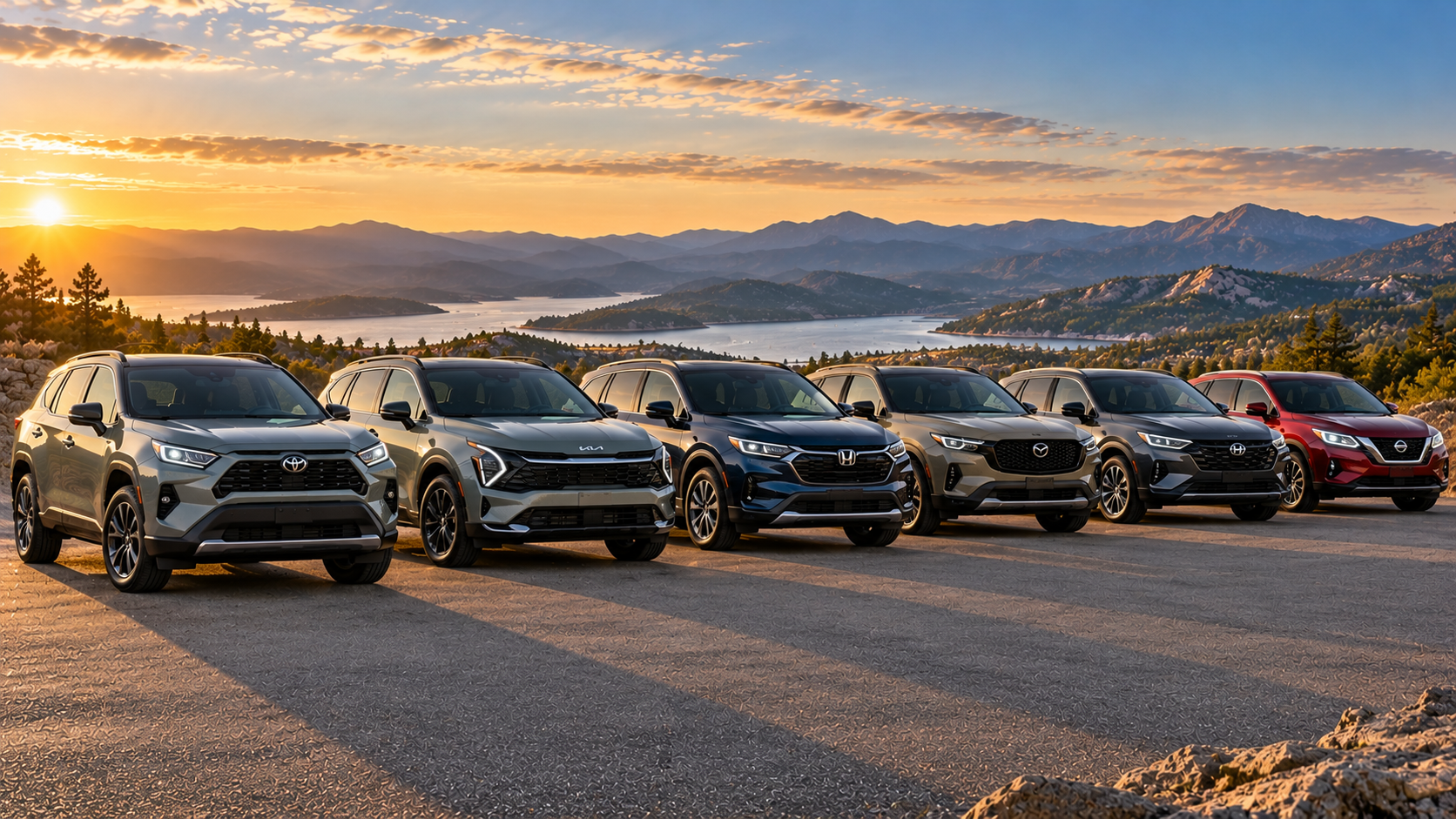
Compact SUVs are among the most popular vehicles in America, offering useful cargo space, comfortable seating, and better fuel economy than many larger SUVs. But the difference between the most efficient compact SUV and a conventional gasoline model can be substantial.
The 2026 Toyota RAV4 Hybrid leads the mainstream compact SUV segment with an EPA-estimated 43 MPG combined. The Kia Sportage Hybrid follows at 42 MPG for 2026, while the Honda CR-V Hybrid achieves 40 MPG combined. For 2027, the Kia Sportage Hybrid is rated at 41 MPG and the Honda CR-V Hybrid remains at 40 MPG.
Below, we rank the major compact SUVs by their most efficient available gasoline or conventional hybrid configuration. We also compare gasoline-only models, all-wheel-drive efficiency, and annual fuel consumption.
Every Compact SUV Ranked by MPG (2026–2027)
The rankings use the highest confirmed combined MPG for the specified model across the two model years. A 2026 figure is not automatically a 2027 rating; where the newer model year’s data has not been confirmed, the table identifies the older rating.
| Rank | Compact SUV | Best Powertrain | Model Year | Combined MPG |
|---|---|---|---|---|
| 1 | Toyota RAV4 | 2.5L hybrid, FWD | 2026 | 43 |
| 2 | Kia Sportage | 1.6L turbo hybrid, FWD | 2026 | 42 |
| 3 | Honda CR-V | 2.0L hybrid, FWD | 2026–2027 | 40 |
| 4 | Ford Escape | 2.5L hybrid, FWD | 2026 | 39 |
| 5 (tie) | Mazda CX-50 | 2.5L hybrid, AWD | 2026 | 38 |
| 5 (tie) | Hyundai Tucson | 1.6L turbo hybrid | 2026 | 38 |
| 7 | Subaru Forester | 2.5L hybrid, AWD | 2026 | 35 |
| 8 | Nissan Rogue | 1.5L turbo gasoline, FWD | 2026 | 32 |
| 9 | Volkswagen Tiguan | 2.0L turbo gasoline, FWD | 2026 | 29 |
| 10 | Chevrolet Equinox | 1.5L turbo gasoline, FWD | 2026 | 27 |
| 11 | GMC Terrain | 1.5L turbo gasoline, FWD | 2026 | 26 |
| 12 | Mazda CX-5 | 2.5L gasoline, AWD | 2026 | 26 |
Rankings use EPA combined MPG for the most efficient identified gasoline or conventional hybrid configuration. The 2027 Kia Sportage Hybrid is rated at 41 MPG combined, compared with 42 MPG for 2026. The 2027 Honda CR-V Hybrid retains its 40 MPG best rating. Some other 2027 figures remain unavailable or unconfirmed and are not assumed to match 2026.
The main takeaway is clear: hybrid powertrains dominate the top of the compact SUV segment. The seven most efficient models in this comparison all offer conventional hybrid powertrains.
Among non-hybrid gasoline SUVs, the Nissan Rogue stands out with 32 MPG combined in its most efficient configuration.
1. Toyota RAV4 — 43 MPG Combined
Best configuration: 2.5-liter four-cylinder hybrid, front-wheel drive
2026 MPG: 47 city / 40 highway / 43 combined
2027 MPG: Not yet confirmed for this comparison
The redesigned 2026 Toyota RAV4 is the most fuel-efficient mainstream compact SUV in this ranking.
Unlike previous generations, the 2026 RAV4 is offered exclusively with electrified powertrains. Buyers can choose between a conventional hybrid and a plug-in hybrid, although plug-in versions are excluded from this comparison.
The standard front-wheel-drive hybrid produces 226 combined horsepower and achieves 43 MPG combined.
All-wheel-drive versions produce 236 horsepower and can achieve up to 42 MPG combined, depending on trim.
This is particularly impressive because the RAV4 remains a practical family vehicle with substantial cargo space and a comfortable seating position.
The hybrid system operates automatically. There is no need to plug in the standard RAV4 Hybrid.
Best for: Buyers seeking the highest MPG from a mainstream compact SUV without giving up everyday practicality.
2. Kia Sportage — Up to 42 MPG Combined
Best configuration: 1.6-liter turbocharged four-cylinder hybrid, front-wheel drive
2026 MPG: 41 city / 44 highway / 42 combined
2027 MPG: 40 city / 42 highway / 41 combined
The Kia Sportage Hybrid is one of the strongest alternatives to the Toyota RAV4.
Its turbocharged hybrid powertrain produces 232 horsepower and uses a conventional six-speed automatic transmission rather than the electronically controlled continuously variable transmission found in several competing hybrids.
For 2026, the front-wheel-drive Sportage Hybrid achieves 42 MPG combined. The 2027 version is rated at 41 MPG combined.
All-wheel-drive Sportage Hybrid models return 35 MPG combined for 2027, a significant reduction compared with the front-wheel-drive version.
The Sportage also offers a conventional gasoline engine, which achieves up to 28 MPG combined for 2026.
That means choosing the most efficient 2026 hybrid instead of the gasoline model reduces fuel consumption per mile by approximately one-third.
Best for: Buyers seeking a roomy compact SUV with excellent highway fuel economy and a strong hybrid powertrain.
3. Honda CR-V — 40 MPG Combined
Best configuration: 2.0-liter four-cylinder hybrid, front-wheel drive
2026 MPG: 43 city / 36 highway / 40 combined
2027 MPG: 43 city / 36 highway / 40 combined
The Honda CR-V Hybrid combines strong fuel economy with one of the most practical interiors in the compact SUV class.
Front-wheel-drive hybrid models achieve 40 MPG combined, while conventional all-wheel-drive hybrid configurations return 37 MPG combined.
The 2027 TrailSport Hybrid, which emphasizes additional all-weather capability and rugged styling, returns 35 MPG combined.
Gasoline-powered CR-V models use a turbocharged 1.5-liter four-cylinder engine and achieve up to 30 MPG combined with front-wheel drive.
Honda has confirmed the 2027 CR-V’s EPA ratings, allowing a direct model-year comparison rather than relying on an assumption that the figures carried over.
The CR-V is a particularly appealing choice for buyers who value passenger room, cargo space, and straightforward daily operation.
Best for: Families wanting an efficient, spacious compact SUV with an established hybrid option.
4. Ford Escape — 39 MPG Combined
Best configuration: 2.5-liter four-cylinder hybrid, front-wheel drive
2026 MPG: Up to 39 combined
2027 MPG: No comparable 2027 model included
The Ford Escape Hybrid offers excellent fuel economy for buyers considering a 2026 model.
Its 2.5-liter hybrid powertrain achieves up to 39 MPG combined, placing it close to the Honda CR-V Hybrid.
The Escape is also available with conventional gasoline engines and, for 2026, a plug-in hybrid powertrain.
However, the Escape is being phased out, making it more relevant to buyers shopping remaining new 2026 inventory than to those waiting for a 2027 model.
That distinction matters when comparing purchase prices, incentives, and long-term availability.
Best for: Buyers shopping remaining 2026 inventory who want strong hybrid efficiency.
5. Mazda CX-50 — 38 MPG Combined
Best configuration: 2.5-liter four-cylinder hybrid, electronic all-wheel drive
2026 MPG: 39 city / 37 highway / 38 combined
2027 MPG: Not confirmed for this comparison
The Mazda CX-50 Hybrid stands out because it combines strong fuel economy with standard electronic all-wheel drive.
Its hybrid system produces 219 combined horsepower and achieves 38 MPG combined.
Unlike some competing compact SUVs, the CX-50 Hybrid does not require buyers to choose a less efficient all-wheel-drive version after selecting the hybrid powertrain. Electronic AWD is part of the standard hybrid configuration.
The CX-50 also offers conventional gasoline engines. The naturally aspirated 2.5-liter version achieves approximately 26 MPG combined for 2026.
The difference between the gasoline and hybrid configurations is substantial, especially for drivers who accumulate significant annual mileage.
Best for: Buyers who want standard AWD, strong hybrid efficiency, and Mazda’s more rugged crossover styling.
6. Hyundai Tucson — 38 MPG Combined
Best confirmed configuration: 2026 1.6-liter turbocharged hybrid
2026 MPG: Up to 38 combined
2027 MPG: Redesigned model; final EPA rating pending
The Hyundai Tucson Hybrid achieves up to 38 MPG combined for 2026.
It offers a spacious interior, a comfortable ride, and a turbocharged hybrid powertrain that balances efficiency with everyday performance.
The Tucson is available in gasoline and hybrid configurations, with the hybrid providing a meaningful efficiency advantage.
A redesigned 2027 Tucson Hybrid has been announced, with a manufacturer target of approximately 42 MPG combined for a front-wheel-drive configuration.
However, that figure is a target rather than a confirmed EPA rating and is therefore not used in this ranking.
The redesigned model may change the Tucson’s position once final EPA results are published.
Best for: Buyers who value comfort, technology, and efficient hybrid performance.
7. Subaru Forester — 35 MPG Combined
Best configuration: 2.5-liter four-cylinder hybrid, all-wheel drive
2026 MPG: Approximately 35 combined
2027 MPG: Not confirmed for this comparison
The Subaru Forester Hybrid combines the brand’s standard all-wheel-drive capability with improved fuel economy.
For 2026, the hybrid achieves approximately 35 MPG combined, compared with around 29 MPG for the conventional gasoline Forester.
That makes the hybrid an attractive choice for drivers who want an efficient vehicle for commuting but also value all-weather traction.
The Forester’s tall cabin, large windows, and practical cargo area distinguish it from lower, sportier compact crossovers.
Its MPG is lower than the Toyota RAV4 Hybrid and Mazda CX-50 Hybrid, but it remains substantially more efficient than many gasoline-only AWD SUVs.
Best for: Drivers who want standard AWD, visibility, and practical utility with improved fuel economy.
8. Nissan Rogue — 32 MPG Combined
Best configuration: 1.5-liter turbocharged three-cylinder gasoline engine, front-wheel drive
2026 MPG: 29 city / 36 highway / 32 combined
2027 MPG: Not confirmed for this comparison
The Nissan Rogue is the most fuel-efficient conventional gasoline compact SUV in this ranking.
Its turbocharged 1.5-liter three-cylinder engine achieves 32 MPG combined with front-wheel drive.
All-wheel-drive versions generally return 31 MPG combined, while certain rugged configurations are rated lower.
The Rogue’s advantage is that buyers can achieve relatively good fuel economy without purchasing a hybrid powertrain.
However, it still consumes considerably more fuel than the Toyota RAV4 Hybrid or Kia Sportage Hybrid.
Best for: Buyers who prefer a conventional gasoline engine but still want strong compact SUV fuel economy.
9. Volkswagen Tiguan — Up to 29 MPG Combined
Best configuration: 2.0-liter turbocharged gasoline engine, front-wheel drive
2026 MPG: Up to 29 combined
2027 MPG: Not confirmed for this comparison
The Volkswagen Tiguan offers a conventional turbocharged gasoline engine with a focus on interior space, road manners, and everyday comfort.
Its most efficient front-wheel-drive configuration achieves approximately 29 MPG combined for 2026.
All-wheel-drive versions generally consume more fuel.
Unlike the leading compact SUVs in this comparison, the Tiguan does not offer a conventional hybrid powertrain in the U.S. lineup considered here.
Best for: Buyers wanting a refined gasoline-powered compact SUV with a spacious interior.
10. Chevrolet Equinox — 27 MPG Combined
Best configuration: 1.5-liter turbocharged gasoline engine, front-wheel drive
2026 MPG: 26 city / 29 highway / 27 combined
2027 MPG: Not independently confirmed for this comparison
The Chevrolet Equinox is a practical compact SUV designed around everyday transportation and family use.
Its turbocharged 1.5-liter four-cylinder engine achieves 27 MPG combined with front-wheel drive.
All-wheel-drive models return approximately 26 MPG combined.
Although its fuel economy is lower than the hybrid leaders, the Equinox remains a useful alternative for buyers comparing purchase prices, equipment, and dealer availability.
Best for: Buyers seeking a conventional gasoline compact SUV with straightforward practicality.
11. GMC Terrain — 26 MPG Combined
Best configuration: 1.5-liter turbocharged gasoline engine, front-wheel drive
2026 MPG: Up to 26 combined
2027 MPG: Not independently confirmed for this comparison
The GMC Terrain shares important engineering with the Chevrolet Equinox but offers its own styling, equipment, and trim structure.
The most efficient 2026 Terrain configuration achieves approximately 26 MPG combined.
It is not among the fuel-economy leaders in this segment, particularly when compared with the RAV4 Hybrid or Sportage Hybrid.
However, buyers may prefer its styling, available equipment, or pricing.
Best for: Buyers who favor GMC styling and features over maximum fuel efficiency.
12. Mazda CX-5 — 26 MPG Combined
Best configuration: 2.5-liter gasoline engine, all-wheel drive
2026 MPG: Approximately 26 combined
2027 MPG: Not confirmed for this comparison
The redesigned 2026 Mazda CX-5 uses a naturally aspirated 2.5-liter four-cylinder engine with standard all-wheel drive.
Its combined fuel economy is approximately 26 MPG.
The CX-5 emphasizes driving feel, steering response, and interior design rather than maximum efficiency.
For Mazda shoppers who prioritize fuel consumption, the CX-50 Hybrid offers a substantially higher rating of 38 MPG combined.
Best for: Buyers wanting a gasoline-powered AWD compact SUV with a more driver-focused character.
Gasoline-Only Compact SUVs Ranked by MPG
Hybrid SUVs lead the overall rankings, but buyers who prefer conventional gasoline engines still have several options.
| Vehicle | Configuration | 2026 Combined MPG |
|---|---|---|
| Nissan Rogue | 1.5L turbo, FWD | 32 |
| Honda CR-V | 1.5L turbo, FWD | 30 |
| Ford Escape | 1.5L turbo, FWD | 30 |
| Volkswagen Tiguan | 2.0L turbo, FWD | 29 |
| Subaru Forester | 2.5L gasoline, AWD | 29 |
| Kia Sportage | 2.5L gasoline, FWD | 28 |
| Hyundai Tucson | 2.5L gasoline, FWD | 28 |
| Chevrolet Equinox | 1.5L turbo, FWD | 27 |
| GMC Terrain | 1.5L turbo, FWD | 26 |
| Mazda CX-5 | 2.5L gasoline, AWD | 26 |
| Mazda CX-50 | 2.5L gasoline, AWD | 26 |
Ratings represent the most efficient identified gasoline-only configurations for 2026. The 2026 Toyota RAV4 is not included because its U.S. lineup uses hybrid or plug-in hybrid powertrains.
The Nissan Rogue leads this gasoline-only comparison with 32 MPG combined.
However, the most efficient hybrid compact SUVs still offer a significant advantage. A 43-MPG RAV4 uses approximately 26% less fuel per mile than a 32-MPG Rogue under the EPA combined test cycle.
Which Compact SUV Gets the Best MPG With AWD?
All-wheel drive is important to many compact SUV buyers, particularly in regions with snow, frequent rain, or unpaved roads.
But AWD can reduce fuel economy, and the size of that reduction varies considerably.
| 2026 Compact SUV | Powertrain | Best AWD MPG |
|---|---|---|
| Toyota RAV4 | Hybrid | 42 |
| Hyundai Tucson | Hybrid | 38 |
| Mazda CX-50 | Hybrid | 38 |
| Honda CR-V | Hybrid | 37 |
| Kia Sportage | Hybrid | 35 |
| Subaru Forester | Hybrid | 35 |
| Nissan Rogue | Gasoline | 31 |
Figures represent the best identified AWD configurations for 2026; specific trims and tires may have different ratings.
The Toyota RAV4 Hybrid leads this AWD comparison with up to 42 MPG combined.
The Mazda CX-50 Hybrid is also noteworthy because it achieves 38 MPG combined with electronic AWD as standard equipment.
How Much Fuel Does Each Compact SUV Use Per Year?
To compare fuel consumption, assume each vehicle travels 15,000 miles per year.
| Vehicle | Combined MPG | Gallons / Year |
|---|---|---|
| Toyota RAV4 Hybrid | 43 | 349 |
| Kia Sportage Hybrid (2026) | 42 | 357 |
| Honda CR-V Hybrid | 40 | 375 |
| Ford Escape Hybrid | 39 | 385 |
| Mazda CX-50 Hybrid | 38 | 395 |
| Hyundai Tucson Hybrid | 38 | 395 |
| Subaru Forester Hybrid | 35 | 429 |
| Nissan Rogue gasoline | 32 | 469 |
| Volkswagen Tiguan gasoline | 29 | 517 |
| Chevrolet Equinox gasoline | 27 | 556 |
| GMC Terrain gasoline | 26 | 577 |
| Mazda CX-5 gasoline | 26 | 577 |
Annual gallons are calculated as 15,000 divided by combined MPG and rounded to the nearest whole gallon. The table uses the model-year ratings shown in the main ranking.
At 15,000 miles annually, the Toyota RAV4 Hybrid consumes approximately 228 fewer gallons than a compact SUV rated at 26 MPG combined.
At an illustrative gasoline price of $3.50 per gallon, that is approximately $798 in annual fuel savings.
Over five years, the difference would be roughly $3,990, assuming the same annual mileage, fuel prices, and EPA-rated efficiency.
These estimates do not include differences in purchase price, insurance, maintenance, or depreciation.
Is a Hybrid Compact SUV Worth Buying?
For many drivers, a hybrid compact SUV offers a compelling balance of efficiency and practicality.
Unlike plug-in hybrids, conventional hybrids do not require external charging. Their batteries recharge through regenerative braking and operation of the gasoline engine.
Hybrid efficiency is particularly valuable in stop-and-go driving, where the electric motor can reduce gasoline consumption.
However, whether a hybrid saves money overall depends on the price premium over a comparable gasoline model.
A buyer who drives 20,000 miles annually will generally recover a hybrid’s purchase-price premium more quickly than someone driving only 5,000 miles per year, assuming similar fuel costs and maintenance.
Buyers should compare specific trims rather than assuming that the least expensive gasoline SUV and the least expensive hybrid SUV offer identical equipment.
Which Compact SUV Has the Best Highway MPG?
The 2026 Kia Sportage Hybrid achieves an impressive 44 MPG highway in its most efficient front-wheel-drive configuration.
The Toyota RAV4 Hybrid achieves 40 MPG highway in its most efficient 2026 configuration, while the Honda CR-V Hybrid returns 36 MPG highway.
For buyers who spend most of their time on interstate highways, the city and highway figures may be more relevant than combined MPG alone.
Hybrid vehicles often achieve their greatest advantage in city driving, although the Sportage Hybrid demonstrates that a hybrid can also be extremely efficient on the highway.
Which Compact SUV Gets the Best MPG in 2026–2027?
- Best overall: 2026 Toyota RAV4 Hybrid — 43 MPG combined.
- Best highway MPG: 2026 Kia Sportage Hybrid — 44 MPG highway.
- Best confirmed 2027 hybrid: Kia Sportage Hybrid — 41 MPG combined.
- Best gasoline-only model: 2026 Nissan Rogue — 32 MPG combined.
- Best AWD fuel economy: 2026 Toyota RAV4 Hybrid — up to 42 MPG combined.
- Best standard-AWD hybrid alternative: 2026 Mazda CX-50 Hybrid — 38 MPG combined.
Bottom Line
The 2026 Toyota RAV4 Hybrid is the fuel-economy leader among mainstream compact SUVs, achieving 43 MPG combined in its most efficient configuration.
The Kia Sportage Hybrid is close behind, achieving 42 MPG combined for 2026 and 41 MPG for 2027. The Honda CR-V Hybrid remains competitive at 40 MPG combined for both model years.
For buyers who prefer a conventional gasoline engine, the Nissan Rogue stands out with 32 MPG combined.
The best choice ultimately depends on how much you drive, whether you need AWD, your budget, and which features matter most. But for drivers prioritizing fuel economy, the hybrid leaders offer a substantial advantage over gasoline-only compact SUVs.
Sources and Methodology
This comparison focuses on mainstream two-row compact SUVs sold in the United States for the 2026 and 2027 model years. Subcompact SUVs, three-row SUVs, luxury SUVs, plug-in hybrids, and fully electric models are excluded.
Vehicles are ranked by the highest confirmed EPA combined MPG for the specified model and model year. Where official 2027 figures remain unavailable, a verified 2026 rating is shown instead. Manufacturer-estimated future figures are not treated as final EPA ratings.
EPA ratings are standardized estimates intended for comparison. Real-world results vary with driving habits, road conditions, weather, tires, vehicle loading, and maintenance.