
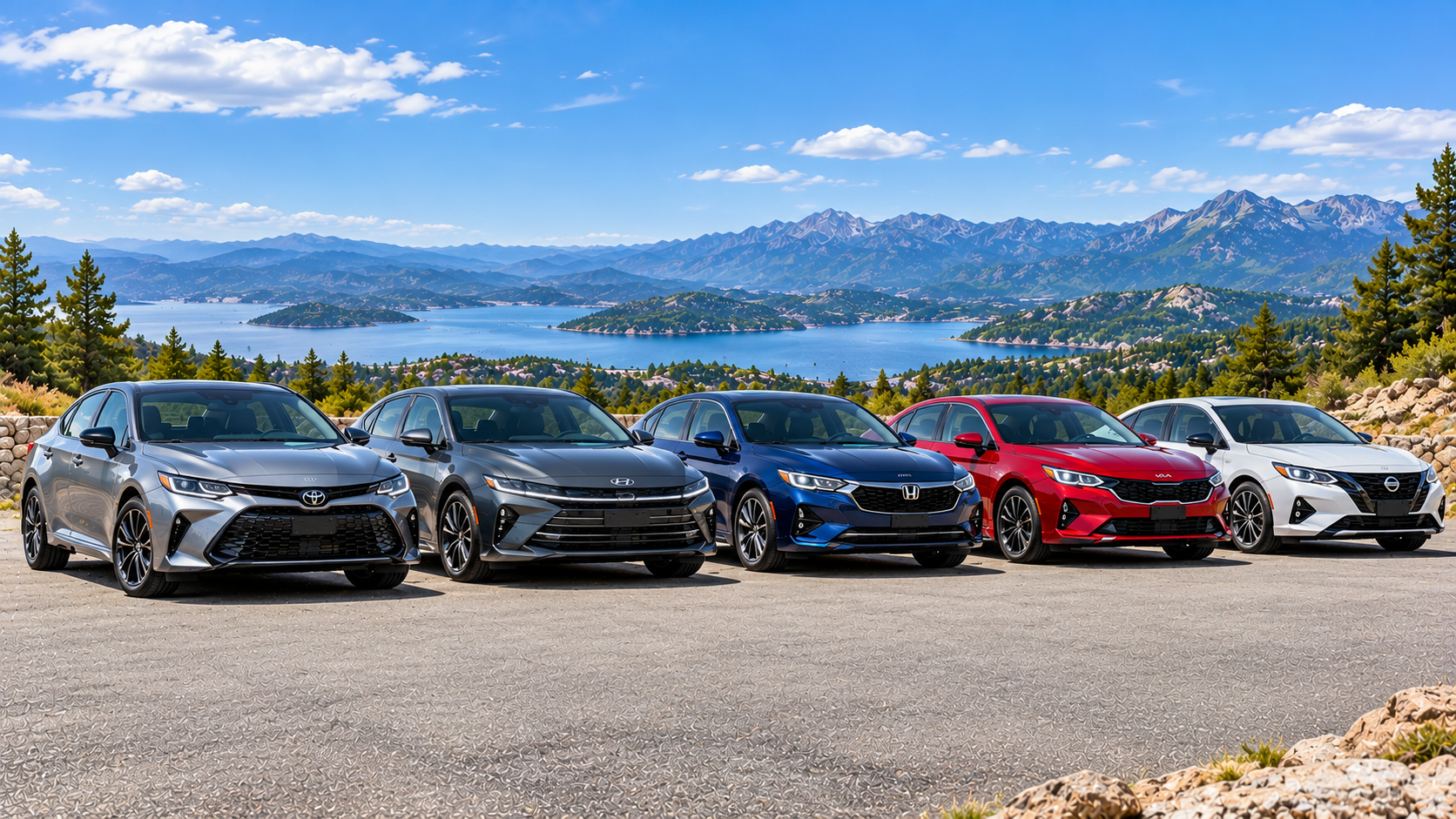
Compact sedans have become remarkably fuel-efficient. The best hybrid models can exceed 50 miles per gallon, while several conventional gasoline sedans achieve more than 35 MPG combined without requiring an electric motor.
The 2026 Hyundai Elantra Hybrid Blue is the most fuel-efficient compact sedan in this comparison, achieving an EPA-estimated 54 MPG combined. The Toyota Corolla Hybrid follows at 50 MPG combined, while the Honda Civic Hybrid achieves 49 MPG. Among gasoline-only models, the Honda Civic LX leads with 36 MPG combined.
Below, we rank mainstream compact sedans sold in the United States for the 2026 and 2027 model years. We also compare gasoline-only models, highway efficiency, all-wheel drive, and annual fuel costs.
Every Compact Sedan Ranked by MPG (2026–2027)
Vehicles are ranked using the most efficient verified gasoline or conventional hybrid configuration for each model. Ratings apply to the model years identified below. When a 2027 rating has not been confirmed, the table uses a published 2026 rating rather than assuming it carries over.
| Rank | Compact Sedan | Best Configuration | Model Year | Combined MPG |
|---|---|---|---|---|
| 1 | Hyundai Elantra Hybrid | Blue, 1.6L hybrid FWD | 2026 | 54 |
| 2 | Toyota Corolla Hybrid | LE/XLE, 1.8L hybrid FWD | 2026–2027 | 50 |
| 3 | Honda Civic Hybrid | Sport / Sport Touring, FWD | 2026–2027 | 49 |
| 4 | Honda Civic | LX, 2.0L gasoline FWD | 2026–2027 | 36 |
| 5 (tie) | Toyota Corolla | LE, 2.0L gasoline FWD | 2026–2027 | 35 |
| 5 (tie) | Hyundai Elantra | SE, 2.0L gasoline FWD | 2026 | 35 |
| 7 | Volkswagen Jetta | S, 1.5L turbo gasoline FWD | 2026 | 34 |
| 8 (tie) | Kia K4 | 2.0L gasoline FWD | 2026 | 33 |
| 8 (tie) | Nissan Sentra | S/SV, 2.0L gasoline FWD | 2026 | 33 |
| 10 | Mazda3 Sedan | 2.5 S, gasoline FWD | 2026 | 30 |
Conventional gasoline and hybrid versions of the same nameplate are listed separately to make their efficiency differences clear. The Mazda3 hatchback and Kia K4 hatchback are excluded because hatchbacks have their own comparison. Not all 2027 EPA ratings were available when this article was prepared.
The three most efficient compact sedans are hybrids. However, the Honda Civic LX, Toyota Corolla LE, and Hyundai Elantra SE demonstrate that a conventional gasoline sedan can still deliver strong fuel economy.
1. Hyundai Elantra Hybrid — 54 MPG Combined
Best configuration: 2026 Elantra Hybrid Blue, 1.6-liter hybrid, FWD
EPA MPG: 51 city / 58 highway / 54 combined
The Hyundai Elantra Hybrid Blue takes first place with an EPA-estimated 54 MPG combined, making it one of the most efficient gasoline-powered passenger vehicles available.
Its 1.6-liter gasoline engine works with an electric motor and a six-speed dual-clutch automatic transmission. Unlike a plug-in hybrid, the Elantra Hybrid does not require external charging.
The Blue trim is specifically optimized for fuel efficiency. The SEL Sport, SEL Sport Plus, and Limited Hybrid versions return 50 MPG combined, four MPG below the Blue.
The Elantra Hybrid is especially impressive on the highway, where its 58-MPG EPA rating exceeds every other compact sedan in this comparison.
At 15,000 miles annually, the Blue Hybrid uses approximately 278 gallons of gasoline.
Best for: Drivers seeking maximum fuel economy, especially those who spend substantial time on highways.
2. Toyota Corolla Hybrid — 50 MPG Combined
Best configuration: 2026–2027 Corolla Hybrid LE or XLE, FWD
EPA MPG: 53 city / 46 highway / 50 combined
The Toyota Corolla Hybrid offers excellent fuel economy in a familiar compact sedan.
Its 1.8-liter four-cylinder hybrid powertrain achieves 50 MPG combined in the most efficient front-wheel-drive configurations.
The Corolla Hybrid has a particularly strong city rating of 53 MPG, reflecting the advantages of electric assistance and regenerative braking in stop-and-go driving.
All-wheel drive is available, making the Corolla Hybrid unusual among economy-focused compact sedans.
The 2027 Corolla Hybrid LE AWD achieves 48 MPG combined, only two MPG below the most efficient FWD model.
Buyers should pay attention to trim selection. The 2027 Corolla Hybrid SE FWD returns 47 MPG combined, compared with 50 MPG for the LE and XLE FWD.
Best for: Drivers seeking a fuel-efficient compact sedan with available AWD and strong city mileage.
3. Honda Civic Hybrid — 49 MPG Combined
Best configuration: 2026–2027 Civic Sport Hybrid or Sport Touring Hybrid sedan
EPA MPG: 50 city / 47 highway / 49 combined
The Honda Civic Hybrid offers an appealing balance of efficiency and performance.
Its two-motor hybrid system produces 200 total system horsepower, considerably more than many conventional compact sedans.
Both the Sport Hybrid and Sport Touring Hybrid sedan achieve 49 MPG combined for 2026 and 2027.
Unlike some competitors, Honda’s two main Civic Hybrid sedan trims share the same EPA rating. Buyers can therefore choose additional comfort and technology features without sacrificing the published fuel-economy figure.
The Civic Hybrid also offers a spacious interior and a driving character that emphasizes responsive acceleration.
Best for: Buyers who want excellent MPG without giving up strong everyday performance.
4. Honda Civic Gasoline — 36 MPG Combined
Best configuration: 2026–2027 Civic LX sedan, 2.0-liter gasoline engine, FWD
EPA MPG: 32 city / 41 highway / 36 combined
The gasoline-powered Honda Civic LX is the most efficient non-hybrid compact sedan in this comparison.
Its naturally aspirated 2.0-liter four-cylinder engine produces 150 horsepower and is paired with a continuously variable transmission.
The Civic LX achieves 36 MPG combined and 41 MPG highway.
Those figures make it a compelling choice for buyers who want good fuel economy but do not necessarily need a hybrid.
The sportier Civic Sport and Sport-L gasoline trims return 34 MPG combined, so the LX is the better choice for maximum efficiency.
Compared with the 49-MPG Civic Hybrid, the gasoline LX consumes approximately 36% more fuel per mile.
Best for: Buyers seeking the best MPG from a conventional gasoline compact sedan.
5. Toyota Corolla Gasoline — 35 MPG Combined
Best configuration: 2026–2027 Corolla LE, 2.0-liter gasoline engine, FWD
EPA MPG: 32 city / 41 highway / 35 combined for 2026; 31 city / 41 highway / 35 combined for 2027
The gasoline Toyota Corolla LE is another efficient option for drivers who prefer a conventional engine.
Its 2.0-liter four-cylinder produces 169 horsepower and uses a continuously variable transmission.
Both the 2026 and 2027 Corolla LE achieve 35 MPG combined, although their published city ratings differ slightly.
The Corolla SE and XSE generally return lower MPG than the LE because of differences in trim and equipment.
For buyers considering a hybrid, the Corolla Hybrid LE increases combined efficiency from 35 to 50 MPG.
At 15,000 miles annually, that translates to approximately 129 fewer gallons of gasoline.
Best for: Drivers seeking an efficient, straightforward compact sedan with a conventional gasoline engine.
6. Hyundai Elantra Gasoline — 35 MPG Combined
Best configuration: 2026 Elantra SE, 2.0-liter gasoline engine, FWD
EPA MPG: 31 city / 40 highway / 35 combined
The conventional gasoline Hyundai Elantra SE matches the Toyota Corolla LE at 35 MPG combined.
It uses a naturally aspirated 2.0-liter four-cylinder engine paired with an intelligent variable transmission.
Other gasoline Elantra trims return approximately 34 MPG combined, while the sportier N Line sacrifices additional efficiency for stronger performance.
The difference between the standard Elantra SE and Elantra Hybrid Blue is substantial: 35 MPG versus 54 MPG combined.
For high-mileage drivers, the hybrid can provide meaningful fuel savings, although the purchase-price difference should also be considered.
Best for: Buyers seeking an efficient, well-equipped gasoline compact sedan.
7. Volkswagen Jetta — 34 MPG Combined
Best configuration: 2026 Jetta S, 1.5-liter turbocharged gasoline engine, FWD
EPA MPG: 29 city / 40 highway / 34 combined
The Volkswagen Jetta offers strong fuel economy without using a hybrid powertrain.
Its turbocharged 1.5-liter four-cylinder engine is paired with an eight-speed automatic transmission.
The most efficient 2026 Jetta S achieves 34 MPG combined, while several other trims return 33 MPG combined.
The Jetta is particularly competitive on the highway, where its 40-MPG rating is close to that of the gasoline Civic and Corolla.
Buyers who want a more performance-oriented Volkswagen sedan can consider the Jetta GLI, although it has a different engine and fuel-economy profile.
Best for: Drivers who want a turbocharged gasoline sedan with good highway efficiency.
8. Kia K4 — 33 MPG Combined
Best configuration: 2026 K4 2.0-liter gasoline sedan, FWD
EPA MPG: 29 city / 39 highway / 33 combined
The Kia K4 replaced the Forte in Kia’s compact sedan lineup.
Its standard 2.0-liter four-cylinder engine produces 147 horsepower and achieves 33 MPG combined in the most efficient published configurations.
The K4 emphasizes passenger space and modern technology, with an especially roomy rear seat for the segment.
A turbocharged 1.6-liter engine is available in the GT-Line Turbo, but its stronger performance comes with a lower combined rating of 28 MPG.
There is no conventional hybrid K4 sedan in the U.S. lineup reviewed here.
Best for: Buyers wanting a roomy compact sedan with modern equipment and reasonable gasoline efficiency.
9. Nissan Sentra — 33 MPG Combined
Best configuration: 2026 Sentra S or SV, 2.0-liter gasoline engine, FWD
EPA MPG: 30 city / 38 highway / 33 combined
The redesigned 2026 Nissan Sentra achieves 33 MPG combined in its S and SV trims.
It uses a naturally aspirated 2.0-liter four-cylinder engine producing 149 horsepower.
The sportier SR and more heavily equipped SL trims achieve 32 MPG combined.
Although the Sentra cannot match the leading hybrids, its 38-MPG highway rating makes it a reasonable option for drivers who want an affordable gasoline sedan.
The Sentra’s primary advantages are its straightforward powertrain, modernized interior, and competitive efficiency.
Best for: Buyers seeking a conventional gasoline compact sedan with comfortable everyday transportation.
10. Mazda3 Sedan — 30 MPG Combined
Best configuration: 2026 Mazda3 2.5 S sedan, FWD
EPA MPG: 27 city / 36 highway / 30 combined
The Mazda3 Sedan ranks below the other compact sedans for fuel economy, but it offers a different set of strengths.
Its naturally aspirated 2.5-liter four-cylinder engine uses a conventional six-speed automatic transmission.
Mazda emphasizes steering response, interior design, and driving feel rather than achieving the highest possible MPG.
The Mazda3 also offers available all-wheel drive and a more powerful turbocharged engine, although both configurations consume more fuel than the base front-wheel-drive sedan.
Buyers comparing the Mazda3 against hybrid competitors should consider the difference in gasoline consumption alongside the vehicle’s driving experience and equipment.
Best for: Drivers who prioritize handling, interior quality, and conventional automatic transmission behavior.
Gasoline-Only Compact Sedans Ranked by MPG
Hybrid sedans lead the overall rankings, but several conventional gasoline models remain efficient choices.
| Sedan | Best Gasoline Trim | Combined MPG |
|---|---|---|
| Honda Civic | 2026–2027 LX | 36 |
| Toyota Corolla | 2026–2027 LE | 35 |
| Hyundai Elantra | 2026 SE | 35 |
| Volkswagen Jetta | 2026 S | 34 |
| Kia K4 | 2026 2.0L | 33 |
| Nissan Sentra | 2026 S/SV | 33 |
| Mazda3 Sedan | 2026 2.5 S FWD | 30 |
The Honda Civic LX leads at 36 MPG combined, followed closely by the Toyota Corolla LE and Hyundai Elantra SE at 35 MPG.
For buyers who drive relatively few miles, a gasoline-only model may be financially attractive if its purchase price is sufficiently lower than a comparable hybrid.
Which Compact Sedan Gets the Best Highway MPG?
The 2026 Hyundai Elantra Hybrid Blue is the highway fuel-economy leader at 58 MPG.
| Sedan | City | Highway | Combined |
|---|---|---|---|
| Hyundai Elantra Hybrid Blue | 51 | 58 | 54 |
| Honda Civic Hybrid | 50 | 47 | 49 |
| Toyota Corolla Hybrid LE | 53 | 46 | 50 |
| Honda Civic LX gasoline | 32 | 41 | 36 |
| Toyota Corolla LE gasoline (2026) | 32 | 41 | 35 |
| Hyundai Elantra SE gasoline | 31 | 40 | 35 |
| Volkswagen Jetta S | 29 | 40 | 34 |
| Kia K4 2.0L | 29 | 39 | 33 |
| Nissan Sentra S | 30 | 38 | 33 |
| Mazda3 Sedan 2.5 S | 27 | 36 | 30 |
The Elantra Hybrid’s 58-MPG highway rating is unusually strong, even among hybrids.
Drivers who spend most of their time at sustained highway speeds should compare highway ratings rather than relying exclusively on combined MPG.
Which Compact Sedan Gets the Best MPG With AWD?
Most compact sedans are front-wheel drive, but a few offer all-wheel drive.
The Toyota Corolla Hybrid LE AWD is particularly efficient, achieving 48 MPG combined for 2027, with EPA estimates of 51 city and 44 highway.
The Mazda3 Sedan also offers AWD in selected trims, but it uses a conventional gasoline powertrain and achieves substantially lower fuel economy.
For buyers who need AWD while minimizing gasoline consumption, the Corolla Hybrid is the standout option in this comparison.
AWD can improve traction when accelerating on slippery surfaces, but it does not replace appropriate tires or reduce stopping distances by itself.
How Much Fuel Does Each Compact Sedan Use Per Year?
To compare fuel consumption, assume each sedan travels 15,000 miles annually.
| Sedan | Combined MPG | Gallons / Year |
|---|---|---|
| Hyundai Elantra Hybrid Blue | 54 | 278 |
| Toyota Corolla Hybrid | 50 | 300 |
| Honda Civic Hybrid | 49 | 306 |
| Honda Civic LX gasoline | 36 | 417 |
| Toyota Corolla LE gasoline | 35 | 429 |
| Hyundai Elantra SE gasoline | 35 | 429 |
| Volkswagen Jetta S | 34 | 441 |
| Kia K4 | 33 | 455 |
| Nissan Sentra | 33 | 455 |
| Mazda3 Sedan | 30 | 500 |
Annual gallons are calculated as 15,000 divided by EPA combined MPG and rounded to the nearest whole gallon. Actual fuel consumption will vary.
At 15,000 miles annually, the Elantra Hybrid Blue consumes approximately 222 fewer gallons than a Mazda3 Sedan rated at 30 MPG combined.
At an illustrative gasoline price of $3.50 per gallon, that difference represents approximately $778 in annual fuel savings.
Over five years, the potential fuel savings would be approximately $3,890, assuming unchanged mileage, fuel prices, and efficiency.
These estimates exclude differences in purchase price, insurance, maintenance, and depreciation.
Is a Hybrid Compact Sedan Worth the Extra Cost?
The financial case for a hybrid depends on how much more it costs than a comparable gasoline model and how many miles the owner drives.
Consider the 2026 Hyundai Elantra SE at 35 MPG combined and the Elantra Hybrid Blue at 54 MPG.
At 15,000 miles annually, the gasoline Elantra consumes approximately 429 gallons, compared with 278 gallons for the hybrid.
That is a difference of about 151 gallons per year.
At $3.50 per gallon, the hybrid saves approximately $529 annually.
If a comparable hybrid costs $2,000 more to purchase, the fuel savings alone would recover that difference in approximately 3.8 years under these assumptions.
However, actual purchase-price differences depend on trim equipment, dealer pricing, incentives, financing, and taxes. A buyer should compare real transaction prices rather than treating the illustrative $2,000 premium as universal.
Why Do Hybrid Compact Sedans Get Better MPG?
Conventional hybrids combine gasoline engines with electric motors and small battery packs.
They recover energy during braking, reduce engine idling, and use electric assistance when it is more efficient than relying entirely on the gasoline engine.
These advantages are especially useful in city traffic, where conventional gasoline vehicles waste more energy through repeated acceleration and braking.
However, hybrid efficiency also depends on aerodynamics, tires, vehicle weight, engine design, and transmission calibration.
The Elantra Hybrid Blue’s exceptionally strong highway rating shows that hybrid technology can also deliver substantial benefits outside urban driving.
Why Aren’t Hatchbacks Included?
This comparison focuses on four-door compact sedans with conventional trunks.
The Honda Civic Hatchback, Toyota Corolla Hatchback, Mazda3 Hatchback, and Kia K4 Hatchback have different body styles and sometimes different EPA ratings.
Those vehicles belong in a separate hatchback MPG comparison, preventing two HiRide articles from competing for the same primary search intent.
Which Compact Sedan Gets the Best MPG in 2026–2027?
- Best overall: 2026 Hyundai Elantra Hybrid Blue — 54 MPG combined.
- Best highway MPG: 2026 Hyundai Elantra Hybrid Blue — 58 MPG highway.
- Best city MPG: Toyota Corolla Hybrid LE/XLE FWD — 53 MPG city.
- Best hybrid performance: Honda Civic Hybrid — 200 total system horsepower and 49 MPG combined.
- Best gasoline-only MPG: Honda Civic LX — 36 MPG combined.
- Best AWD MPG: 2027 Toyota Corolla Hybrid LE AWD — 48 MPG combined.
Bottom Line
The Hyundai Elantra Hybrid Blue is the clear fuel-economy winner among mainstream compact sedans, achieving 54 MPG combined and 58 MPG highway for 2026.
The Toyota Corolla Hybrid is close behind at 50 MPG combined and offers an especially efficient AWD option.
The Honda Civic Hybrid combines 49 MPG with 200 horsepower, making it attractive to buyers who want both efficiency and performance.
For shoppers who prefer conventional gasoline engines, the Honda Civic LX leads at 36 MPG combined, followed by the Toyota Corolla LE and Hyundai Elantra SE at 35 MPG.
Drivers who cover substantial annual mileage should pay particular attention to the hybrid models. Their fuel savings can add up quickly, especially when gasoline prices are high.
Sources and Methodology
This article covers mainstream compact four-door sedans sold in the United States for the 2026–2027 model years. Hatchbacks, subcompact cars, luxury-brand models, plug-in hybrids, and fully electric vehicles are excluded.
Rankings use published EPA combined MPG for the specific model year and trim. Where 2027 ratings were unavailable, the most recent verified 2026 figures were used instead. Vehicle classification follows consumer-facing market segments rather than EPA size classifications alone.
Real-world fuel economy varies with speed, traffic, climate, tires, vehicle loading, and driving habits.
- U.S. EPA and Department of Energy — Official Fuel Economy Ratings
- Hyundai — 2026 Elantra Hybrid EPA Ratings
- Toyota — 2027 Corolla Specifications
- Honda — 2027 Civic Sedan EPA Ratings
- Kia — 2026 K4 EPA Ratings
- Nissan — 2026 Sentra Specifications
- Mazda — 2026 Mazda3 Sedan Specifications
- Edmunds — 2026 Volkswagen Jetta EPA Ratings
Leave a Reply