
A crossover toolbox and a wheel-well box solve different storage problems. One spans the front of the bed and gives you a substantial dedicated tool area; the other uses a smaller space beside a wheel housing. Choose around what you carry and how you reach it, not just which closed box looks tidier.
Start with a list of the tools that really stay in the truck. Include their cases and handles, then decide which items should come indoors after work. A storage box is useful when it simplifies that routine without occupying the bed space you need for other jobs.
A crossover box creates one main storage location
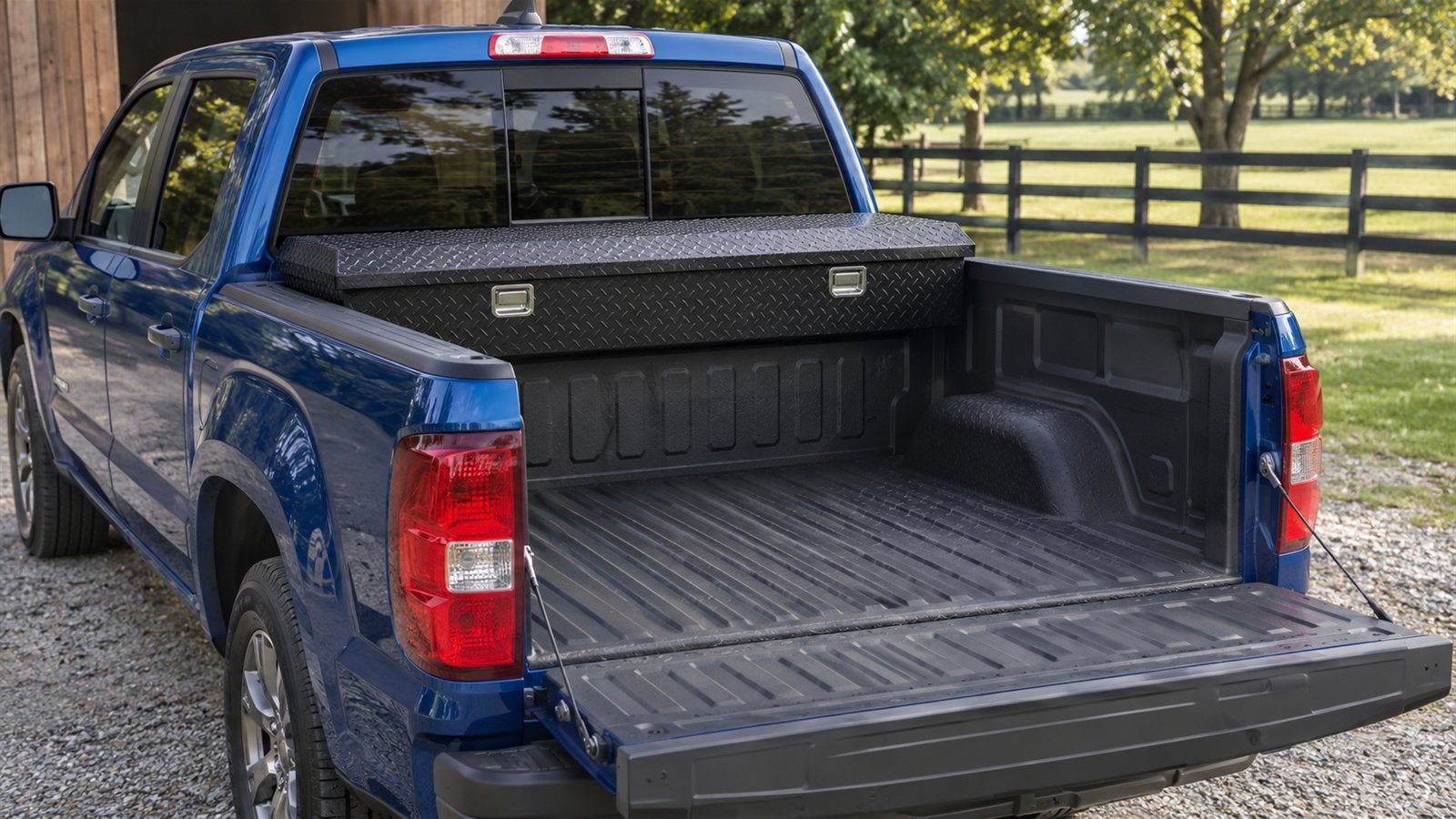
A crossover box sits across the bed near the cab, normally supported or attached at the rails according to its application. It can gather a working kit in one place while leaving an open area behind it. Measure usable internal space rather than treating the outer width as a description of what will fit inside.
The full-width position is the trade-off. It can shorten the uninterrupted loading area, and its lid has to clear the rear cab, installed equipment and anything above the rails. Compare the box’s depth and floor clearance with the long objects you actually carry. Space under a box is useful only if you can load and secure the object through it.
A wheel-well box preserves a different part of the bed
A box beside a wheel housing can leave more of the central floor available. A small kit may be easier to reach near the tailgate, especially if the design is intended to swing toward the rear. The capacity and opening arrangement remain product-specific; do not infer either from a photograph.
Check the complete movement, including the lid, hinge and latch. A swing-out box can need an empty arc that a cooler, cover bracket or other accessory already occupies. Decide whether the same items will always be in that space, or whether unloading them just to open the box would defeat the purpose of fitting it.
Compare the space that matters to your routine
| Question | Crossover box | Wheel-well box |
|---|---|---|
| Where is the storage? | Across the front of the box. | Beside a wheel housing, depending on application. |
| What movement needs checking? | Lid sweep and rear-cab clearance. | Lid, hinge and any swing-out path. |
| What cargo path may be affected? | Longitudinal space and loading beneath the box. | Side clearance and the area around the wheel housing. |
| What if you later add a cover? | Check the entire documented combination. | Check brackets, cover rails and operation. |
Use the same tool list when comparing products. A large box is not automatically more convenient if its useful contents form a small pile at the bottom. Likewise, several small compartments can become awkward if your longest tool case does not fit any of them. Measure actual items and allow room for your hands.
Think about reaching the contents as well as storing them. Look at opening direction, latch position and whether you need to climb into the bed. An arrangement that is easy to use while parked at home may be frustrating with another load in place or when space beside the vehicle is limited.
Treat mounting as a separate purchase criterion
A truck model name does not establish a universal mounting method. Confirm the box’s exact application and the required clamps or brackets. Liners, rail caps, composite beds and existing accessories can affect the approved attachment. Inspect an older truck’s mounting area before choosing around a new product.
Follow the maker’s instructions for load limits, latching and attachment checks. A box that keeps tools together still adds weight to the vehicle and does not make other bed cargo secure. Use the truck’s loading guidance for the complete combination of equipment, occupants and cargo.
Make room for the next likely change
If a cover or rack is likely, investigate that combination before ordering the toolbox. It is easier to choose a coordinated system now than to discover that two otherwise suitable products want the same rail space. Do not assume that low-profile automatically means compatible.
Our F-150 bed-organization guide places toolbox concepts beside simpler removable options. It is worth comparing those layouts if you are not certain the tools need permanent storage. A closed portable case might meet the actual requirement while leaving more flexibility for occasional larger loads.
Compare options on Amazon: Compare low-profile crossover toolboxes · Browse wheel-well storage applications · Compare removable tool cases
Choose the smallest arrangement that works reliably
Lay out the proposed footprint with cardboard or the cases you already own. Test lid access and your largest normal load before buying. Write down the truck, bed, liner and other fitted equipment, then ask the supplier about any uncertain clearance.
Choose the box that makes your ordinary work easier, not the one that occupies the most available space. Keep valuables and unattended-storage decisions separate from appearance: a lock and a closed lid are features to evaluate, not a blanket guarantee against theft or weather.
Leave a Reply