
Hyundai has revealed a larger Elantra with new cabin technology, while Toyota has shown its Corolla Deck pickup in Brazil. Genesis is adding hybrids, Honda has unveiled a three-row SUV, and Lamborghini has given the Temerario an electrically retractable roof.
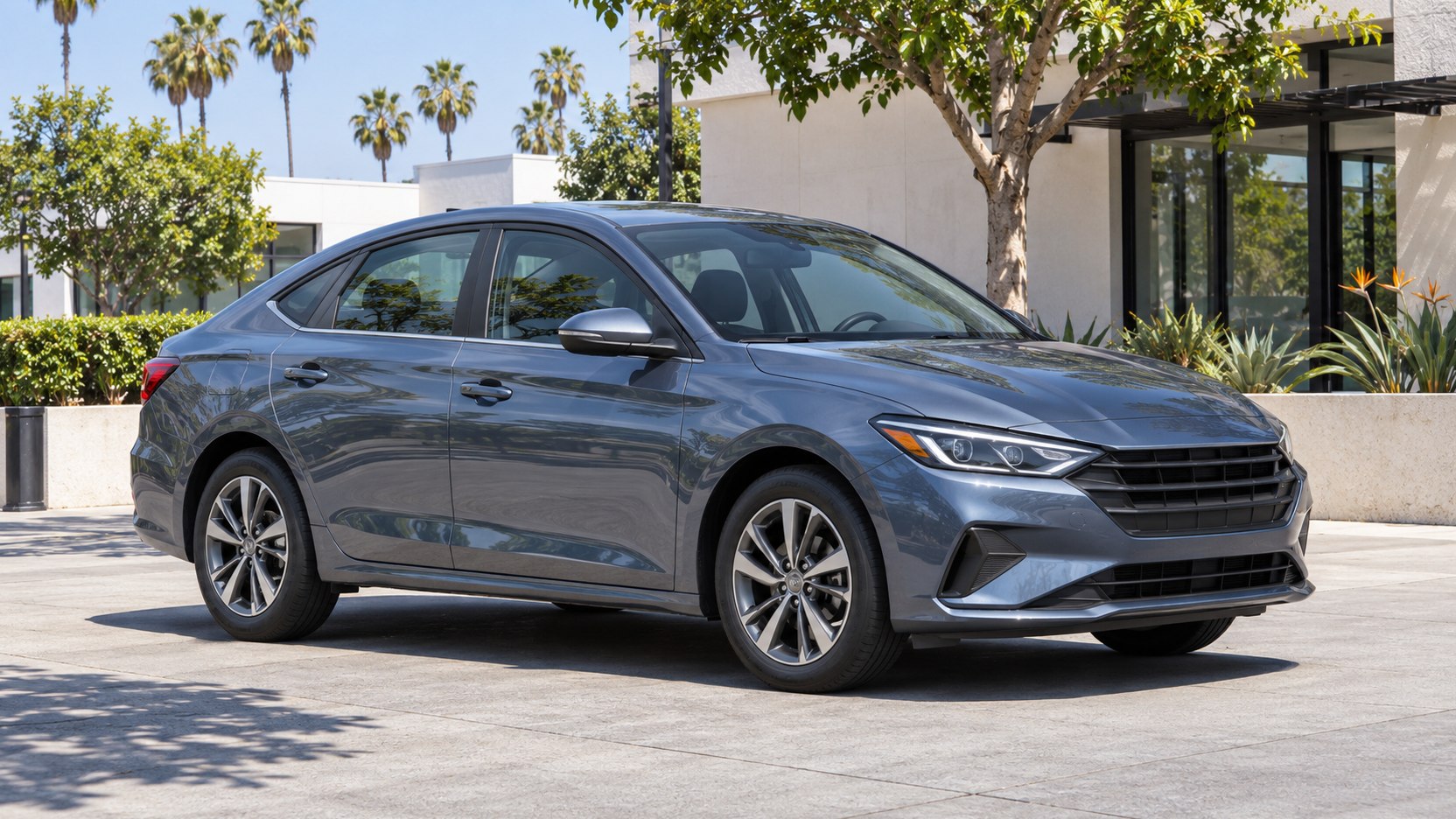
Coverage: November 14, 2026 at 8 a.m. Pacific through November 21 at 8 a.m. Pacific. Featured image: AI-generated illustration of a generic compact sedan, not a photograph of the newly revealed Hyundai Elantra.
Hyundai’s new Elantra separates gasoline and hybrid model years
Hyundai’s November 19 U.S. announcement identifies two versions of its eighth-generation sedan: the gasoline-powered 2027 Elantra and the 2028 Elantra Hybrid. They share the redesign, but their model-year badges should not be treated as interchangeable.
The gasoline car pairs a 2.0-liter engine with an Intelligent Variable Transmission. The hybrid uses a 1.6-liter engine, electric assistance and a six-speed dual-clutch transmission, with combined output rising to 155 horsepower. Hyundai targets up to 53 mpg combined for the hybrid; final EPA certification remains pending.
The sedan grows 3.4 inches in length and 1.2 inches in wheelbase, with 39.1 inches of rear legroom. A 12.9-inch Pleos Connect display brings Android Automotive OS, wireless smartphone integration and over-the-air updates, while frequently used functions retain physical controls.
U.S. prices and on-sale dates will follow closer to launch. HiRide’s compact-sedan fuel-economy comparison provides context on the outgoing 2026 Elantra Hybrid and its competitors; its ratings do not describe the new 2028 hybrid.
Toyota unveils the Corolla Deck as its Brazilian factory expands
Toyota has attached the Corolla name to a pickup. Motor1 Brasil reports that the Corolla Deck was presented on November 18 during the opening of Sorocaba 2, Toyota’s second vehicle factory at the Sorocaba complex in São Paulo state.
The pickup is derived from the Corolla Cross, with a hybrid flex-fuel configuration confirmed in the reporting. Motor1 says the intended export region is Latin America and the Caribbean, with production scheduled for the first half of 2027. A U.S. launch has not been announced in these reports.
Vrum independently reports the reveal and first-half-2027 timing. Both accounts describe a displayed hybrid vehicle, but the final powertrain range and detailed specifications remain incomplete. The published information does not establish a full engine lineup, final output figures or driven-wheel configurations.
The factory opening and pickup launch are separate milestones. Sorocaba 2 is already handling Corolla sedan production transferred from Indaiatuba, while Deck production is still ahead. The new pickup therefore represents a future addition to an operating manufacturing complex, rather than evidence that customer trucks are already rolling off the line.
Genesis brings hybrid power to the GV80 and G80
Genesis used a November 18 Los Angeles event for the GV80 Hybrid’s North American debut and the G80 Hybrid’s global debut. Its subsequent product announcement details a 2.5-liter turbocharged parallel-hybrid system producing 347 horsepower and 391 lb-ft of combined torque.
The system pairs a starter-generator and drive motor with the gasoline engine and a seven-speed automatic. Genesis says it is Hyundai Motor Group’s first hybrid system with a liquid-cooled battery, allowing more effective temperature management and greater use of available battery power.
Preliminary efficiency claims require care. Genesis estimates improvements of 24 percent for the GV80 and 30 percent for the G80, based on internal comparisons of 19-inch-wheel AWD versions with comparable gasoline models. It also estimates more than 500 miles of range. EPA fuel-economy and range certification are still pending.
Both vehicles add adjustable regenerative braking, route-based energy management and Stay Mode for selected cabin functions while parked. These are substantial powertrain additions across an SUV and sedan, with North American pricing, final specifications and availability still to be announced closer to launch.
Honda’s Avancier previews its next hybrid architecture
Honda revealed the new Avancier online on November 20. The three-row SUV is the first model with the company’s next-generation Honda Hybrid system, a newly developed platform and the new H emblem for its hybrid lineup.
The powertrain builds on Honda’s two-motor hybrid approach. Honda describes a wider high-efficiency engine operating range, a smaller drive unit and revised controls. DualPower eAWD uses separate motors to drive and control the front and rear wheels independently.
The platform is intended to support more than one model. Honda says common components can be used in areas such as the engine compartment and rear underbody, while other sections, including rear cabins, can be tailored. That makes the Avancier an engineering preview as well as a new vehicle reveal.
Inside, a large center display consolidates controls, a column shifter frees console space, and the panoramic roof reaches toward the third row. Honda identifies the initial market focus as Asia, including Thailand, Japan and China. The announcement does not establish a U.S. launch or justify assuming that another Honda SUV will receive identical equipment.
Lamborghini adds a retractable hardtop to the Temerario
Lamborghini’s November 19 Temerario Spyder reveal brings the brand’s first retractable hardtop on a Spyder. The roof uses ten electric actuators and stows vertically behind the seats, rather than relying on a conventional electro-hydraulic mechanism.
Its hybrid powertrain combines a 4.0-liter twin-turbo V8 with three electric motors, one at the rear and two at the front. Combined output is 920 CV, approximately 907 mechanical horsepower. The V8 reaches 10,000 rpm, extending the coupé’s high-revving character into an open-top model.
Lamborghini claims 0–100 km/h in 2.8 seconds and a top speed of 343 km/h. Those are manufacturer figures, and the acceleration claim should not be relabeled as a 0–60-mph time. The metric test finishes at approximately 62 mph.
The changes extend beyond roof operation. An adjustable rear window manages airflow and engine sound, while a three-level neck warmer supports open-air driving. Lamborghini also describes additional cabin room compared with the Huracán EVO Spyder. The unveiling supplies substantial engineering detail, but leaves U.S. pricing and delivery timing open.
Leave a Reply