
Toyota is bringing back the Scion name with a tiny utility truck aimed initially at fleets. Meanwhile, Honda, Scout and BMW made substantial moves in North American manufacturing, and Toyota outlined its next software and battery targets.
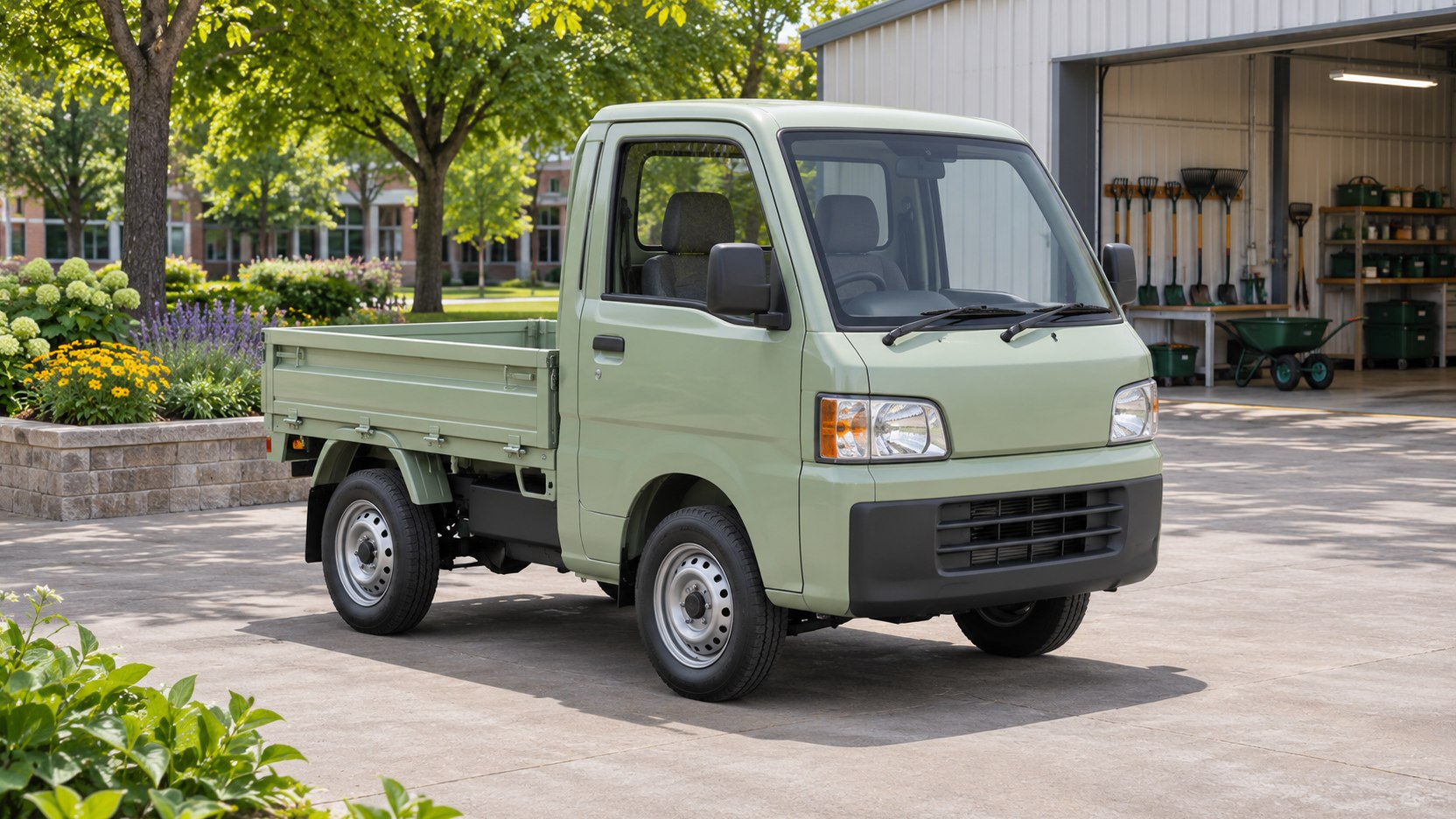
Coverage: November 7, 2026 at 8 a.m. Pacific through November 14 at 8 a.m. Pacific. Featured image: AI-generated illustration of a generic compact utility truck, not a photograph of the Scion KEI-01.
Scion returns with a small utility truck and a fleet-first launch
Toyota unveiled Scion by Toyota and its KEI-01 utility truck on November 9, with details published in its November 10 announcement. U.S. arrival is planned for the second half of 2027.
The truck combines a 660cc three-cylinder engine, continuously variable transmission and four-wheel drive. Toyota describes a three-way folding cargo bed and up to 600 pounds of bed payload. Its small footprint serves a different job from a conventional pickup: this right-hand-drive vehicle has a maximum speed of 25 mph and is designed around federal low-speed-vehicle requirements.
Toyota plans Indiana assembly, supported by a $34 million investment and approximately 50 additional jobs. Distribution starts with a limited fleet pilot through selected existing Toyota dealers operating as Scion by Toyota dealers. Later retail availability remains a possibility rather than a commitment.
The accompanying SxS and BKE vehicles are concepts. They should not be confused with the truck’s announced U.S. rollout.
Honda plans a $3 billion Ohio plant for its hybrid expansion
Honda’s November 9 U.S. investment announcement, published globally November 10, calls for a new assembly plant between its existing Marysville and East Liberty operations. Production is expected in 2029, subject to final government approvals.
The planned factory adds capacity for 240,000 vehicles annually and more than 2,000 jobs. Honda says the plant will be flexible enough for hybrid, gasoline and battery-electric vehicles. These are planned capabilities, not evidence that another operating factory has already joined the network.
Supporting work stretches beyond assembly. Alabama is being retooled for a new V6 hybrid engine, Anna in Ohio for a next-generation four-cylinder Atkinson-cycle engine, and transmission facilities in Ohio and Georgia for future hybrid systems. Honda expects Ohio hybrid-system capacity to increase by 250 percent in the coming years.
The company identifies multiple Honda and Acura vehicles under development without naming every assignment. For context on the existing Civic rather than those future products, HiRide’s compact-sedan gasoline and hybrid comparison explains today’s model-year and trim differences.
Scout starts validation builds in South Carolina
Scout’s Blythewood factory has reached vehicle-building work, although customer production remains ahead. EV Pulse reports Scout’s November 12 announcement that welding, painting and assembly of validation vehicles are underway for the Traveler SUV and Terra pickup.
TFLcar separately reports the milestone and describes the plant’s progression toward pre-production. The immediate work checks engineering, parts readiness and whether newly installed equipment functions correctly. It also gives manufacturing teams experience before output ramps up.
Scout says construction is in its final phase and most equipment is installed. Its body shop is designed for approximately 40 vehicles per hour at full capacity; that is a design rate, not the current pace of saleable vehicles leaving the plant.
The company expects validation work to continue into 2027 and customer deliveries in 2028. The more-than-$2-billion production center and projected workforce of over 4,000 therefore remain a manufacturing ramp-up story. The distinction matters: building test vehicles on factory equipment is meaningful progress, but it does not mean customers can take delivery now.
BMW opens Woodruff for production of electric-vehicle battery packs
BMW opened its Woodruff, South Carolina, plant on November 13 and announced the start of series production of sixth-generation high-voltage batteries. The packs supply nearby Spartanburg for the electric iX5 and future electric models.
This is battery-pack assembly rather than battery-cell manufacturing. Woodruff receives cells from suppliers, checks them and integrates them directly into packs using a cell-to-pack layout. Keeping those steps separate gives a clearer picture of the plant’s role in the regional supply chain.
BMW says more than 300 employees and around 250 robots work at the site. Production data is monitored throughout the process, and every battery receives an end-of-line inspection. Virtual-reality training lets employees rehearse operations before handling the corresponding factory equipment.
Woodruff is the fourth plant in BMW’s Gen6 network to begin series production, following facilities in Hungary, Germany and China. Its opening moves the project beyond earlier test and pre-series batteries. BMW’s broader aim is at least six fully electric models assembled at Spartanburg by 2030; that remains a future portfolio target.
Canada backs Honda’s next-generation Civic and CR-V production
A separate November 13 Canadian government announcement supports Honda’s existing Alliston, Ontario, operation. Federal funding of C$313 million backs a C$867 million retooling project, while Ontario is contributing C$156 million.
The project supports next-generation Civic and CR-V production, more electrified vehicles, updated manufacturing technology and workforce training. The government expects it to maintain over 4,000 jobs and support capacity of up to 400,000 vehicles annually.
Those figures describe retained employment and supported production capacity. They are not 4,000 newly created jobs or an extra 400,000 vehicles on top of existing output. The announcement also does not provide a detailed launch calendar or specifications for each future model.
Readers comparing the current CR-V with alternatives can use HiRide’s compact-SUV fuel-economy comparison. Its identified 2026–2027 configurations provide present-day context, not ratings for the next-generation vehicles covered by this investment.
Toyota sets new software and solid-state battery targets
Toyota’s November 11 technology update from its Michigan research operation combines a larger software rollout with new development milestones. The company plans to extend its Arene software platform from the RAV4 and Lexus ES to approximately 50 models and 10 million vehicles worldwide by 2030.
Toyota also aims to introduce what it calls L2++ driving assistance in selected retail vehicles beginning in 2028, followed by broader availability. The designation describes Toyota’s planned assistance technology; the announcement does not establish unrestricted autonomous driving.
On batteries, the company targets an all-solid-state battery in a future model by the end of 2028. It also describes more compact hybrid systems and a new prismatic lithium-ion battery layout intended to reduce battery height and improve efficiency.
These are engineering and deployment goals. The update does not name a U.S. solid-state production model, supply its price or establish its range. Keeping those unknowns separate from Toyota’s stated timetable avoids turning a research roadmap into an on-sale announcement.
Leave a Reply