
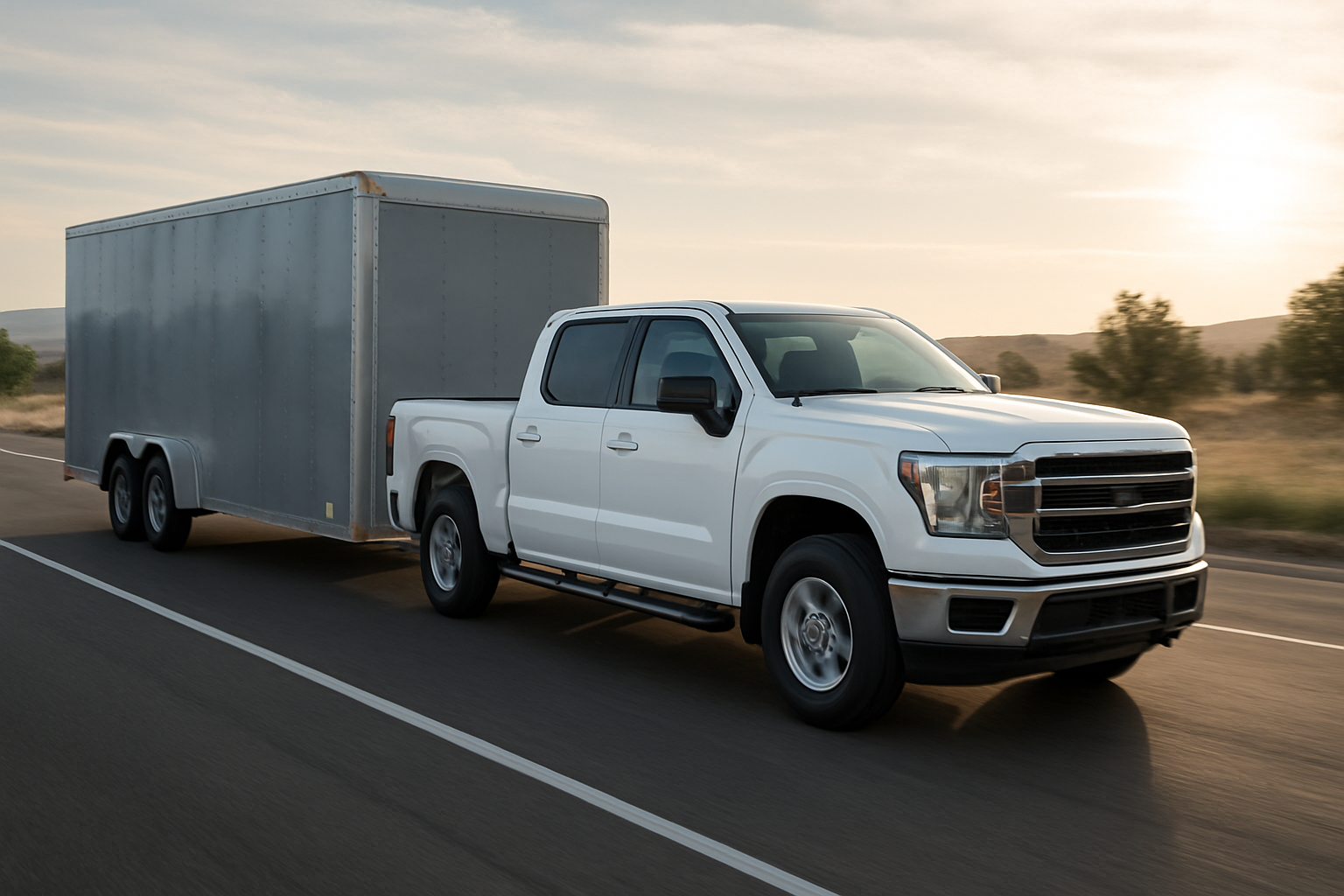
Most truck owners know their vehicle’s maximum towing capacity from the manufacturer specs, but few understand how passengers and cargo dramatically reduce what they can actually haul. This calculation error leads to overloaded trucks, dangerous driving conditions, and potential legal issues.
Why Your Truck’s Advertised Towing Capacity Is Misleading
When manufacturers advertise towing capacity, they base those numbers on a stripped-down truck with minimal fluids and a 150-pound driver. No passengers, no cargo, no camping gear, no toolbox in the bed. This creates a huge disconnect between marketing numbers and real-world capability.
Your truck’s actual towing capacity depends on its Gross Vehicle Weight Rating (GVWR) minus everything already loaded in the vehicle. Every pound of passenger weight, cargo, fuel, and accessories reduces your available towing capacity by exactly one pound.
This reality hits hardest during family trips. A family of four with luggage can easily add 800-1,000 pounds to your truck, cutting your towing capacity by the same amount. Many drivers discover this too late, after they’ve already purchased a trailer based on the advertised specs.
The Real Formula for Calculating Towing Capacity
The accurate formula is simple but requires knowing your truck’s actual weight when loaded:
GVWR – Curb Weight – Passengers – Cargo = Actual Remaining Tow Capacity
Your GVWR appears on a sticker inside the driver’s door frame. This number represents the maximum your truck can weigh when fully loaded, including the truck itself, occupants, cargo, and trailer tongue weight.
Curb weight is your truck’s weight with standard equipment and a full tank of fuel, but no passengers or cargo. You’ll find this in your owner’s manual or online specifications for your specific trim level.
Finding Your Truck’s GVWR and Curb Weight
The GVWR sticker on your door frame shows several weight ratings. Look for “GVWR” or “Gross Vehicle Weight Rating.” This same sticker often shows your truck’s actual curb weight, listed as “Vehicle Weight” or similar.
If the door sticker doesn’t show curb weight, check your owner’s manual specifications or the manufacturer’s website. Make sure you’re looking at your exact trim level and configuration, as curb weights vary significantly between Regular Cab, SuperCab, and Crew Cab models.
For the most accurate measurement, drive your empty truck to a truck stop or commercial scale. Weigh it with a full tank of fuel but no passengers or cargo. This gives you the real starting point for your calculations.
Calculating Passenger and Cargo Weight
Don’t estimate passenger weights. Use actual numbers. The average American adult weighs more than the 150 pounds manufacturers assume in their calculations. Add 200 pounds per adult for more realistic planning.
Cargo weight adds up faster than most people realize. A cooler full of food and drinks weighs 50-75 pounds. Camping gear for a family can hit 200-300 pounds easily. Tools, spare parts, and recovery gear in the bed can add another 100-200 pounds.
Remember to include tongue weight from your trailer in this calculation. Tongue weight typically runs 10-15% of total trailer weight and counts against your GVWR, not your towing capacity.
Common Weight Additions That Surprise Truck Owners
- Full fuel tank adds 150-200 pounds compared to manufacturer test conditions
- Aftermarket accessories like bed covers, running boards, and lift kits add 50-300 pounds
- Winter gear, chains, and emergency supplies can add 75-150 pounds
- Passengers’ luggage often weighs more than the passengers themselves
Real-World Example Calculations
Take a 2022 Ford F-150 SuperCrew with a 3.5L EcoBoost engine. Ford advertises 13,200 pounds maximum towing capacity for this configuration.
GVWR: 7,050 pounds
Curb weight: 4,650 pounds
Available payload capacity: 2,400 pounds
With four adults (800 pounds), luggage and gear (300 pounds), and trailer tongue weight (1,000 pounds for a 7,500-pound trailer), you’ve used 2,100 pounds of your 2,400-pound capacity. Your actual safe towing capacity drops to around 7,500 pounds, not the advertised 13,200.
This same principle applies across all truck brands and models. The advertised maximum only works if you’re towing alone with an empty truck bed.
Why Exceeding Your Calculated Capacity Is Dangerous
Overloading your truck affects more than just engine performance. Your brakes, suspension, and tires all operate beyond their designed limits when you exceed GVWR.
Stopping distances increase dramatically with overweight loads. Your truck’s brake system assumes maximum loads within the GVWR limit. Beyond that limit, you’re gambling with physics.
Tire failure becomes more likely as loads exceed ratings. An overloaded tire generates excessive heat, leading to blowouts. This risk multiplies when towing in hot weather or mountainous terrain.
Insurance and legal issues can arise from overweight operation. If an accident investigation reveals your truck exceeded its GVWR, liability questions may surface.
Tools and Apps for Weight Calculation
Several smartphone apps help track your truck’s weight and calculate remaining towing capacity. Apps like “Truck Weight Calculator” and “RV Trip Wizard” let you input your truck’s specifications and track loaded weights.
Portable scales designed for RV and truck use cost $200-500 and provide accurate weight measurements for each wheel position. These tools help you verify calculations and adjust loading as needed.
CAT Scale locations offer certified weights for $12-15 per weighing. Their smartphone app shows nearby locations and allows electronic record keeping for multiple weighings.
Strategies for Maximizing Your Real Towing Capacity
Choose your truck configuration carefully when buying. Regular cab trucks offer higher payload capacity than crew cabs, leaving more weight available for towing.
Minimize unnecessary weight in your truck. Remove tools and equipment you won’t need for your towing trip. Every pound you remove adds a pound to your towing capacity.
Consider a weight-distributing hitch system. While these hitches don’t increase your GVWR, they can improve handling and allow you to use more of your available capacity safely.
Pack strategically between your truck and trailer. Heavy items often fit better in the trailer than the truck bed, especially if your trailer has plenty of capacity remaining.
When You Need More Capacity
If your calculations show insufficient capacity for your intended trailer, you have several options. Moving up to a heavier-duty truck provides more GVWR and higher towing ratings.
Dual rear wheel (DRW) versions of 3/4-ton and 1-ton trucks offer significantly higher payload and towing capacities. The trade-off includes reduced fuel economy and daily drivability.
Consider a smaller or lighter trailer that fits your truck’s real capacity. Modern lightweight travel trailers offer many features of heavier units while staying within reasonable weight limits.
Frequently Asked Questions
Does adding a brake controller or hitch reduce my towing capacity?
The weight of these accessories (typically 20-50 pounds total) reduces your available payload by the same amount, which technically reduces towing capacity. However, the impact is minimal compared to passengers and cargo.
Can I exceed GVWR if my trailer has its own brakes?
No. Trailer brakes don’t change your truck’s GVWR limitations. Your truck’s frame, suspension, tires, and brakes are still limited to the GVWR regardless of trailer braking assistance.
How does altitude affect my towing calculations?
Altitude doesn’t change weight calculations, but it does affect engine power output. Naturally aspirated engines lose about 3% power per 1,000 feet of elevation, reducing effective towing performance even within weight limits.
Should I weigh my truck and trailer separately?
Yes, weigh them both loaded and hitched together. This confirms your truck stays within GVWR while verifying proper tongue weight distribution between truck and trailer axles.
Understanding your truck’s real towing capacity takes the guesswork out of trailer selection and loading. The few minutes spent on accurate calculations can prevent dangerous situations and expensive repairs down the road.
Leave a Reply