
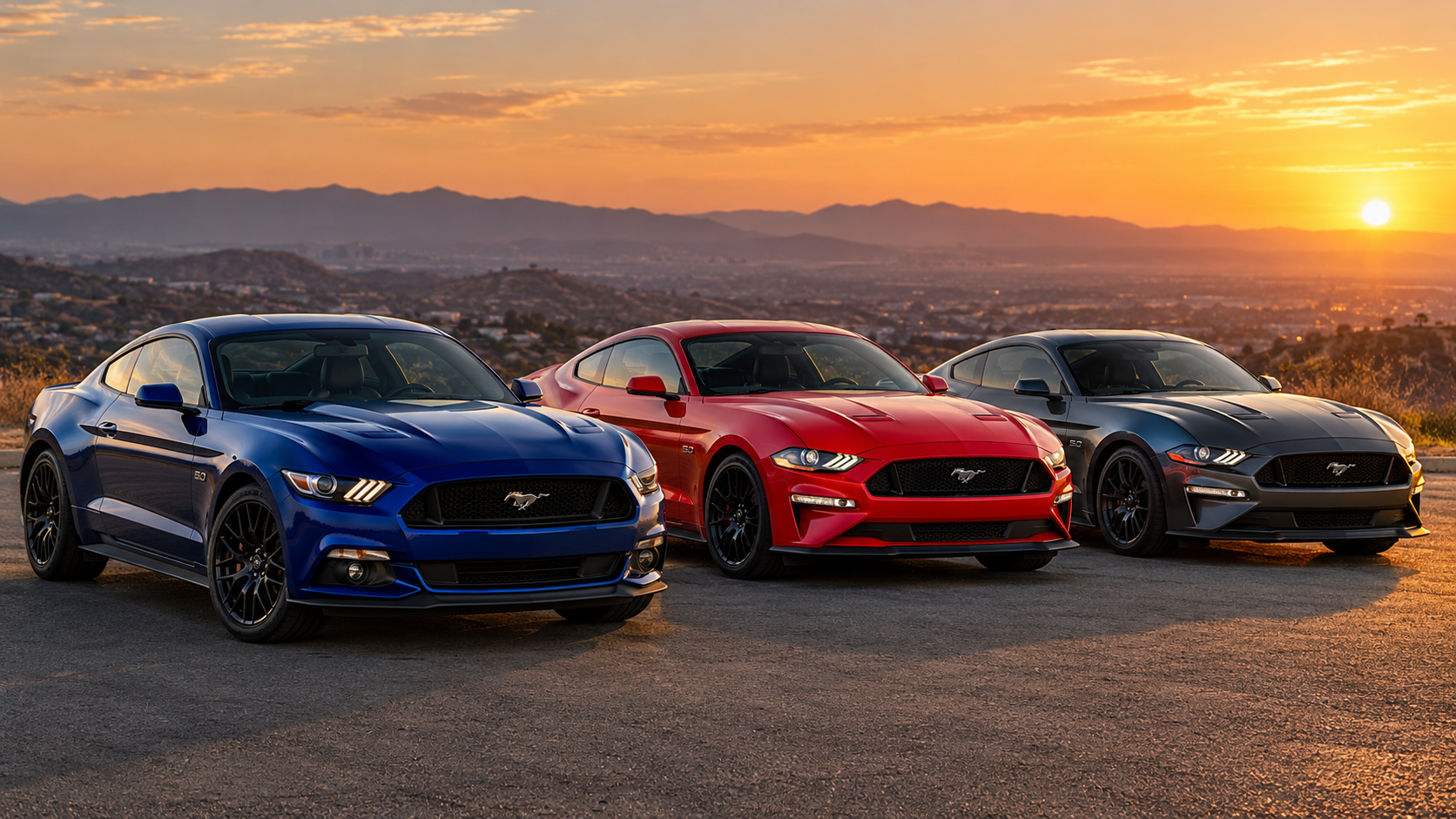
The best years for the sixth-generation Ford Mustang (S550) are generally 2019 through 2021, particularly for buyers interested in the Mustang GT with its 5.0-liter Coyote V8. These model years combine the major mechanical improvements introduced in 2018 with a wide selection of performance and technology options.
For buyers on a tighter budget, the 2016 and 2017 Mustangs are attractive alternatives. Meanwhile, the 2021–2023 Mach 1 stands out as one of the best S550 variants for enthusiasts who prioritize handling, track capability, and a manual transmission.
However, there is no single best year for everyone. The ideal S550 depends on whether you want an affordable daily driver, a powerful V8, a manual transmission, or a dedicated performance car. Understanding what Ford changed each year can help you make a better purchase.
S550 Mustang Model Years at a Glance
The S550 Mustang was produced for the 2015 through 2023 model years. Its biggest update arrived in 2018, dividing the generation into two distinct periods.
| Year | GT Horsepower | Major Changes |
|---|---|---|
| 2015 | 435 hp | New platform, independent rear suspension |
| 2016 | 435 hp | SYNC 3, GT350 joins lineup |
| 2017 | 435 hp | CarPlay and Android Auto support with SYNC 3 |
| 2018 | 460 hp | Major facelift, Gen 3 Coyote, 10-speed automatic |
| 2019 | 460 hp | Bullitt, revised GT350, continued refinements |
| 2020 | 460 hp | GT500, EcoBoost High Performance Package |
| 2021 | 460 hp | Mach 1, expanded standard driver-assistance features |
| 2022 | 450 hp | 10-hp reduction, new appearance packages |
| 2023 | 450 hp | Final S550 model year |
Horsepower figures refer to the standard U.S.-market Mustang GT, not the Bullitt, Mach 1, or Shelby models.
2015 Mustang: The Beginning of the S550
The 2015 Mustang represented one of the most significant changes in the nameplate’s history. Ford replaced the previous S197 platform with the new S550 architecture, bringing independent rear suspension to the entire Mustang lineup for the first time.
This substantially modernized the Mustang’s handling characteristics, particularly over uneven pavement and through corners. The S550 also featured a lower roofline, wider stance, revised interior, and more sophisticated chassis.
Three engines were available:
- 3.7-liter V6 producing 300 horsepower
- 2.3-liter turbocharged EcoBoost four-cylinder producing 310 horsepower
- 5.0-liter Gen 2 Coyote V8 producing 435 horsepower
The 2015 Mustang is an appealing budget option today, although its original infotainment system is noticeably dated compared with later models. As the first year of an entirely new platform, it also deserves careful inspection for early-production problems and previously completed repairs.
Verdict: Worth considering at the right price, but later pre-refresh models offer a more polished ownership experience.
2016 Mustang: Better Technology and the GT350
The 2016 Mustang retained the same basic mechanical configuration as the 2015 model, but introduced an important technology improvement: Ford’s SYNC 3 infotainment system replaced MyFord Touch on appropriately equipped models.
SYNC 3 offered a more responsive interface and improved usability. Ford subsequently made Apple CarPlay and Android Auto available to compatible 2016 SYNC 3 vehicles through software updates, although Apple CarPlay could also require a USB hub upgrade.
The 2016 model year also brought broader availability of the Shelby GT350 and GT350R, powered by Ford’s distinctive 5.2-liter flat-plane-crank V8 producing 526 horsepower.
Verdict: A strong budget choice, especially with SYNC 3 and the 5.0-liter V8.
2017 Mustang: The Best Pre-Refresh Year?
The 2017 Mustang was the final model year before Ford’s major 2018 facelift. Mechanically, the standard GT remained largely unchanged, retaining its 435-horsepower Gen 2 Coyote V8 and six-speed manual or automatic transmission options.
One advantage was the availability of Apple CarPlay and Android Auto on SYNC 3-equipped vehicles without the same retrofit considerations associated with some 2016 cars.
By 2017, Ford had also accumulated two model years of production experience with the S550 platform. That makes the 2017 particularly attractive to buyers who prefer the original exterior styling.
However, a later production year should not automatically be interpreted as proof of better reliability. Maintenance history and individual vehicle condition remain more important.
Verdict: Our preferred pre-refresh S550 model year, particularly for buyers seeking an affordable manual Mustang GT.
2018 Mustang: The Most Important Mid-Generation Update
The 2018 Mustang received the largest overhaul of the entire S550 production run. Ford redesigned the front fascia, headlights, hood, and rear styling while introducing substantial mechanical improvements.
Third-Generation Coyote V8
The Mustang GT received the Gen 3 5.0-liter Coyote V8, increasing output from 435 to 460 horsepower. The engine introduced both port and direct fuel injection, revised cylinder heads, and other improvements.
This was a meaningful mechanical upgrade rather than a simple engine tune.
New 10-Speed Automatic Transmission
Ford replaced the previous six-speed automatic with the 10R80 ten-speed automatic. Its wider selection of gear ratios helped improve acceleration and keep the engine within its power band.
The six-speed manual also received changes, including a revised gear-ratio arrangement. Some enthusiasts prefer the gearing and feel of the earlier manual transmission.
Additional Improvements
- Available 12-inch digital instrument cluster
- Available active-valve performance exhaust
- Available MagneRide adaptive suspension
- Revised exterior lighting and styling
- Available Performance Package Level 2
- Discontinuation of the naturally aspirated V6
The 2018 model is a major step forward in performance and equipment. Nevertheless, buyers should pay particular attention to transmission operation, engine noises, and service history. Complaints involving the 10R80 and MT82 transmissions are not exclusive to 2018, and a later model year does not guarantee immunity.
Verdict: One of the most significant S550 years and a good purchase when properly inspected. There is no reason to automatically avoid it simply because it introduced major updates.
2019 Mustang: One of the Best All-Around Years
The 2019 Mustang retained the upgraded Gen 3 Coyote engine and the major improvements introduced in 2018, making it an attractive choice for buyers who want the refreshed appearance and stronger performance.
The most notable addition was the return of the Mustang Bullitt, inspired by the famous 1968 film car. Its modified 5.0-liter V8 produced 480 horsepower, 20 more than the standard GT.
The Shelby GT350 also received substantial performance revisions for 2019, including revised aerodynamics, suspension calibration, and Michelin Pilot Sport Cup 2 tires.
For ordinary GT buyers, the 2019 model was largely a continuation of the 2018 mechanical package. Claims that Ford had resolved every early Gen 3 or 10-speed transmission issue by 2019 should be treated skeptically.
Verdict: One of the best overall S550 years because it combines the refreshed platform with strong performance and an appealing selection of trims.
2020 Mustang: A High Point for Performance Options
The 2020 model year offered one of the most diverse performance lineups in S550 history.
The standard Mustang GT continued with its 460-horsepower Coyote V8, while the Bullitt and Shelby GT350 remained available.
Ford also introduced the Shelby GT500, featuring a supercharged 5.2-liter V8 producing 760 horsepower. Unlike the standard Mustang GT, the GT500 used a seven-speed dual-clutch transmission.
EcoBoost buyers gained the available High Performance Package, increasing output to 330 horsepower and adding performance-oriented equipment.
The 2020 Mustang is particularly appealing because the GT350, GT500, and Bullitt were all offered during the same model year.
Verdict: Our favorite all-around S550 model year for its combination of mature styling, strong GT performance, and exceptional specialty models. That does not mean a 2020 GT is inherently more reliable than an otherwise comparable 2019 or 2021 GT.
2021 Mustang: The Mach 1 Arrives
For 2021, Ford discontinued the Bullitt and GT350 and introduced the new Mach 1.
The Mach 1 combined a 480-horsepower version of the 5.0-liter Coyote V8 with extensive performance upgrades inspired by Ford’s Shelby models.
Important Mach 1 features included:
- Tremec 3160 six-speed manual transmission
- Enhanced engine, transmission, and differential cooling
- Revised suspension and chassis tuning
- Standard MagneRide suspension
- Available Handling Package with additional track-oriented equipment
The Tremec manual is especially important because the regular Mustang GT continued using the Getrag MT82 family of transmissions.
Ford also made its Co-Pilot360 driver-assistance suite standard on regular EcoBoost and GT models, improving the everyday appeal of the 2021 Mustang.
Verdict: An excellent year for daily drivers and enthusiasts alike. The 2021 Mach 1 is one of the most compelling naturally aspirated S550 Mustangs.
2022 Mustang: Slightly Less Power, but Still Competitive
For 2022, Ford reduced the standard Mustang GT’s output from 460 to 450 horsepower and torque from 420 to 410 lb-ft. The Mach 1 also dropped from 480 to 470 horsepower.
These changes were associated with emissions-related revisions to the engine calibration and intake system.
Although the horsepower reduction is disappointing on paper, a difference of 10 horsepower is relatively small in everyday driving. Tire condition, transmission choice, vehicle weight, and driver skill can have a greater effect on real-world performance.
The 2022 model year also introduced additional appearance packages, including Ice White and Stealth options, while the Shelby GT500 continued for its final model year.
Verdict: A good Mustang, but the modest power reduction makes the 2019–2021 GT slightly more attractive when prices and conditions are comparable.
2023 Mustang: The Final S550
The 2023 Mustang marked the end of the S550 generation before the redesigned S650 arrived for the 2024 model year.
The standard GT retained its 450-horsepower Coyote V8, while the Mach 1 continued with 470 horsepower. The Shelby GT500 was no longer available.
Ford made relatively few significant mechanical changes for 2023, meaning buyers received a familiar and well-established design rather than another major overhaul.
Its biggest appeal is being the final model year of the sixth-generation Mustang, particularly for buyers who prefer the S550’s styling and interior over the newer S650.
Verdict: A solid choice for buyers seeking a late-production example, although it does not offer a substantial mechanical advantage over a comparable 2022 model.
Which S550 Mustang Years Are the Best?
Rather than choosing a model year based on age alone, it is more useful to consider what each version offers for its intended purpose.
Best Overall: 2019–2021 Mustang GT
These years combine the Gen 3 Coyote’s 460 horsepower with the updated exterior, available digital instruments, modern performance options, and 10-speed automatic transmission.
Our pick: A well-maintained 2020 Mustang GT with the Performance Package.
Best Budget Choice: 2016–2017 Mustang GT
The Gen 2 Coyote delivers strong performance, and these years offer the original S550 styling with improved infotainment options over the launch model.
Our pick: A 2017 Mustang GT with documented maintenance history.
Best Manual Performance Mustang: 2021–2023 Mach 1
The Tremec transmission, enhanced cooling, and track-oriented suspension make the Mach 1 particularly appealing for drivers who want more than straight-line acceleration.
Our pick: A 2021 Mach 1 with the Handling Package, provided the buyer is comfortable with its more aggressive tires and track-focused setup.
Gen 2 vs. Gen 3 Coyote: Which Engine Is Better?
One of the most important decisions when shopping for an S550 Mustang GT is whether to buy a 2015–2017 car with the second-generation Coyote or a 2018–2023 car with the third-generation engine.
| Specification | Gen 2 | Gen 3 |
|---|---|---|
| Model years | 2015–2017 | 2018–2023 |
| Displacement | 5.0L | 5.0L |
| GT horsepower | 435 | 450–460 |
| Fuel injection | Port injection | Port + direct injection |
| Automatic transmission | 6-speed | 10-speed |
The Gen 3 is generally the better choice for factory performance, particularly when paired with the 10-speed automatic. Its additional power and more advanced engine design are meaningful improvements.
However, the Gen 2 remains an excellent naturally aspirated V8. Buyers who value a simpler fuel-injection system, prefer the earlier exterior design, or find a substantially cheaper example may be better served by the 2015–2017 cars.
Neither engine generation should be considered universally more reliable without accounting for maintenance, modifications, mileage, and individual vehicle history.
Common S550 Mustang Problems to Check Before Buying
Even the most desirable S550 model years have potential weaknesses. A thorough pre-purchase inspection is more valuable than assuming a particular year is problem-free.
1. MT82 Manual Transmission Complaints
Some owners report notchy shifting, gear engagement problems, or lockout under aggressive driving with the MT82 manual transmission. These complaints span multiple model years, and their severity varies between vehicles.
During a test drive, check that the transmission engages every gear smoothly when cold and warm, without grinding or excessive resistance.
2. 10R80 Automatic Transmission Behavior
The 10-speed automatic introduced in 2018 has generated complaints involving harsh shifts, delayed engagement, and inconsistent operation.
Not every 10R80 exhibits these problems, and the underlying causes can differ. Some vehicles may benefit from calibration or adaptive-learning procedures, while others require mechanical diagnosis or repair.
Test the transmission during gentle acceleration, heavier acceleration, downshifts, and low-speed driving. Review service records for previous transmission complaints.
3. Engine Ticking and Unusual Noises
Some Coyote owners report ticking or tapping noises, particularly on Gen 3 engines. Not every ticking noise indicates engine damage, but it should not automatically be dismissed as normal either.
A qualified technician should investigate persistent or unusually loud noises, especially when accompanied by oil consumption, misfires, or drivability problems.
4. Modifications and Previous Abuse
Mustangs are frequently modified for additional power or track use. Engine tuning, forced-induction conversions, aggressive launches, and poorly installed suspension components can affect long-term durability.
A stock, well-maintained example is often a safer used-car purchase than a heavily modified vehicle with an uncertain history.
5. Recalls and Service History
Recall applicability depends on the vehicle’s exact build information, not simply its model year. Before purchasing, check the VIN using the NHTSA recall lookup and confirm that applicable repairs have been completed.
Should You Buy an S550 or an S650 Mustang?
The S650 Mustang arrived for the 2024 model year with updated exterior styling, a substantially redesigned digital interior, revised engines, and additional technology.
However, the S650 builds upon the architecture established by the S550 rather than representing the same degree of fundamental platform change seen between the S197 and S550 generations.
That makes the late S550 particularly interesting on the used market. A 2019–2023 Mustang GT still offers a modern independent-rear-suspension chassis, a powerful naturally aspirated V8, and many of the performance features buyers expect from a contemporary sports car.
The S650 is more attractive for drivers who prioritize newer infotainment technology, updated styling, and the latest factory equipment. The S550 may offer better value when a comparable used example costs significantly less.
Final Verdict: The Best S550 Mustang Years to Buy
For most buyers seeking a Mustang GT, 2019 through 2021 represent the sweet spot of the S550 generation. These cars benefit from the significant 2018 mechanical and styling updates without the modest factory horsepower reduction introduced in 2022.
Our preferred year is 2020, although there is no compelling reason to pay a substantial premium for a 2020 over an equivalent 2019 or 2021 GT.
Buyers seeking maximum affordability should consider the 2016–2017 GT, while manual-transmission enthusiasts who can afford a higher-performance model should seriously consider the 2021–2023 Mach 1.
Ultimately, vehicle condition matters more than a one- or two-year difference in model year. A carefully maintained 2018 or 2023 Mustang can be a much better purchase than a neglected 2020 example.
Leave a Reply