
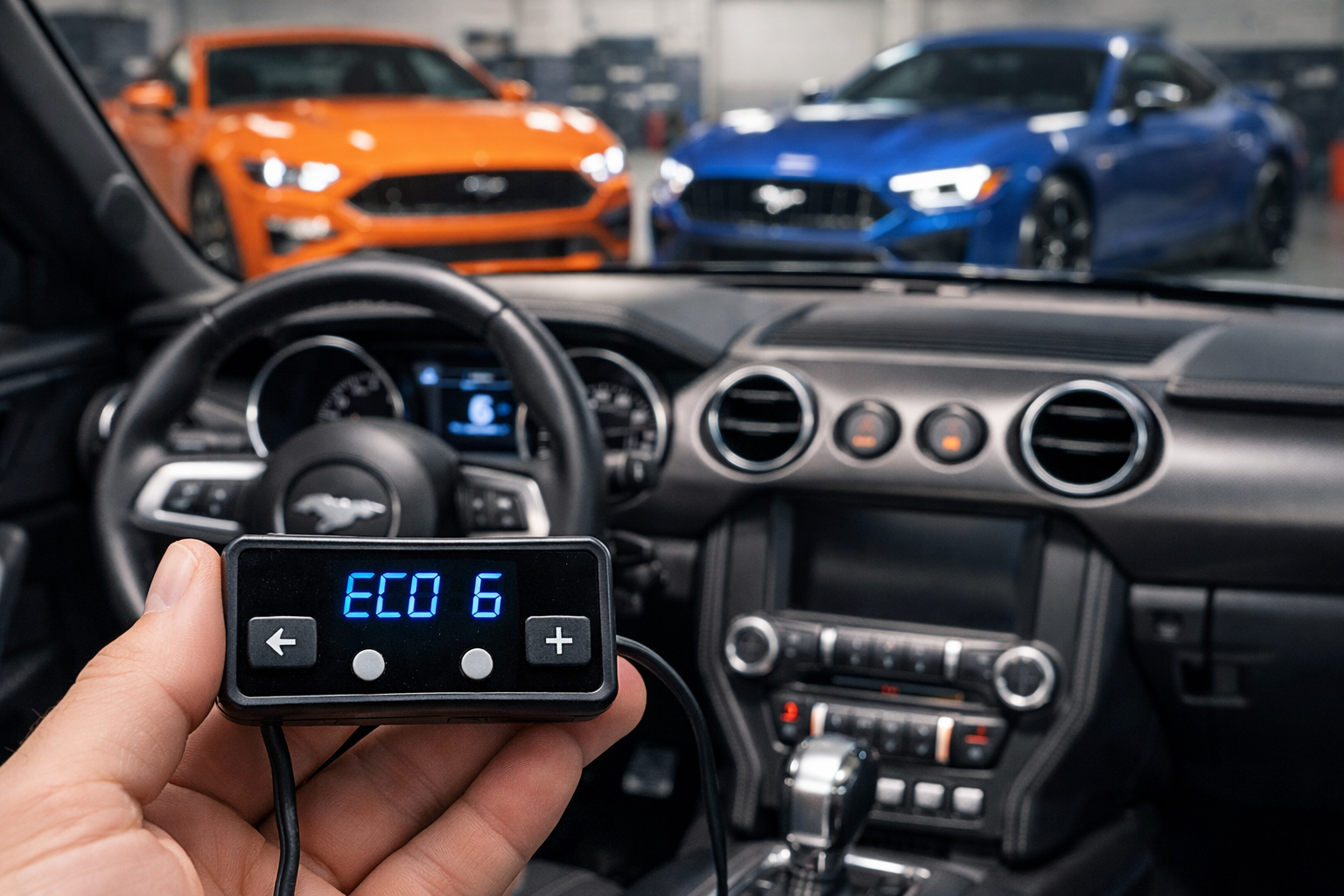
The Ford Mustang already has a factory Sport mode, but it bundles throttle changes with steering weight, exhaust sound, and transmission behavior into a single package. A dedicated throttle response controller gives you finer, independent control over just the pedal sensitivity, letting you dial in exactly the responsiveness you want without changing other driving dynamics. This level of granularity is what separates a controller from simply pressing the Sport mode button.
Both the S550 (2015-2023) and S650 (2024+) generations benefit from a controller, whether you’re driving the EcoBoost four-cylinder or the GT’s 5.0L Coyote V8.
EcoBoost vs. GT: Which Benefits More?
The 2.3L EcoBoost has both electronic throttle lag and turbo spool time working against immediate response. The electronic dead zone in the first 15% to 20% of pedal travel delays the turbo’s boost request, which means the turbo starts building pressure later than it should. A controller addresses the electronic half of the delay, and because the boost request reaches the turbo sooner, the overall time from pedal press to full power is noticeably shorter.
The improvement on the EcoBoost is substantial. Many owners describe it as the single modification that made them stop wishing they’d bought the GT. The engine’s 310 horsepower (330 on the High Performance Package) finally feels available from the first touch of the pedal rather than arriving a beat late.
The 5.0L Coyote V8 is naturally aspirated with no turbo lag to contend with, but the electronic throttle still dulls its response. The Coyote is a rev-happy, responsive engine that wants to deliver power immediately. Ford’s throttle mapping holds it back during the initial 20% of pedal travel, creating a disconnect between what the engine can do and what the driver feels.
A controller set to Sport mode lets the Coyote’s natural character come through unfiltered, and the improvement is immediately apparent. This is similar to how turbocharging changes an engine’s power delivery, but in reverse. Instead of adding forced induction, you’re removing the electronic restriction that masks the V8’s naturally responsive character.
Best Controllers for the Mustang
Pedal Commander
The Pedal Commander for Ford Mustang covers both S550 and S650 platforms with generation-specific harnesses. Sport mode at mid levels (4 to 6) makes the EcoBoost feel closer to the GT in perceived responsiveness, though it doesn’t bridge the 200+ horsepower gap. On the GT, City mode at moderate levels (4 to 6) is enough to eliminate the dead zone while keeping the car manageable for daily driving.
For track days and spirited backroad driving, Sport mode at higher levels (6 to 8) on the GT provides the immediate throttle response you want when pushing the car. The engine responds to every small pedal movement, which improves corner exit accuracy and makes the car feel more connected to the driver.
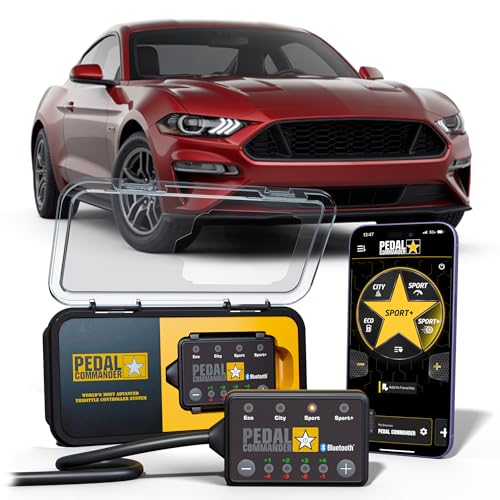
Pedal Commander for Ford Mustang
Sharpens both EcoBoost and GT throttle response with 36 adjustable settings
ShiftPower and Budget Options
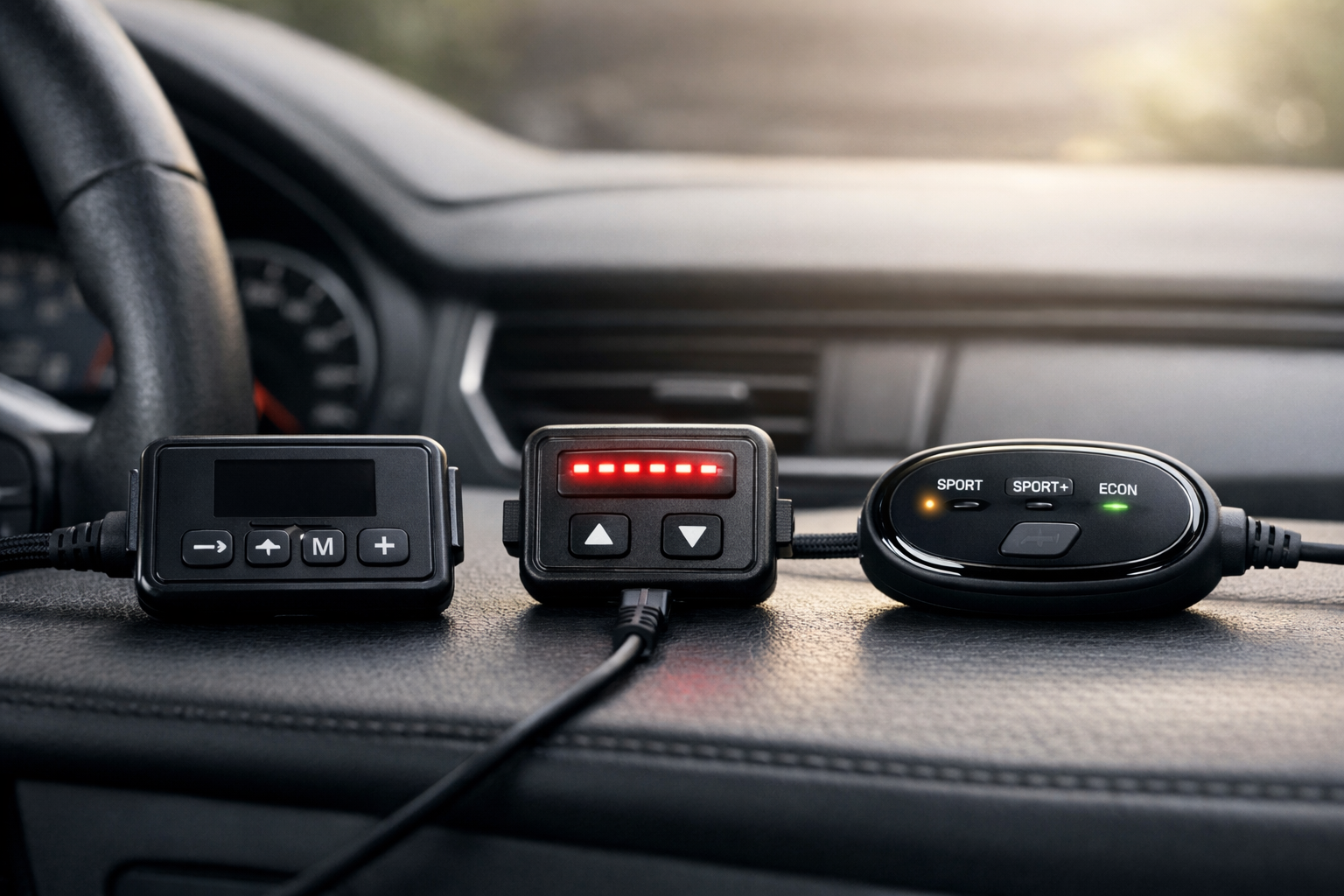
ShiftPower and budget controllers work with the Mustang’s pedal connector. The core improvement (faster pedal response) is present on all price points. Budget controllers are popular with EcoBoost owners who want to improve their car’s character without a significant investment.
Safety Consideration for a RWD Sports Car
The Mustang is a rear-wheel-drive car with significant power, especially in GT, Mach 1, and Dark Horse trims. Aggressive throttle settings in Sport+ mode make full power accessible much earlier in the pedal travel, which means the rear tires reach their traction limit faster than with the stock throttle curve. This is especially important in wet conditions, cold tires, or on cold pavement where grip is reduced.
Start with moderate settings (City mode at level 5 or Sport mode at level 3) and increase gradually as you learn how the car responds. Keep traction control enabled while exploring more aggressive settings. On the EcoBoost, the lower power output makes aggressive settings more manageable, but wet weather still warrants caution.
This is similar to the electronic systems that make driving safer in difficult conditions. Just as blind spot monitoring helps prevent accidents by watching your surroundings, traction control helps prevent loss of control when increased throttle sensitivity puts more power to the wheels.
Compatibility with Drive Modes
The controller stacks with the Mustang’s Normal, Sport, Track, Drag Strip, and (on equipped models) other drive modes. Each combination produces a different overall feel. Pairing the controller’s Sport mode with the car’s Track drive mode, for example, provides the most aggressive throttle response combined with the sportiest transmission, steering, and stability control settings.
Many Mustang owners find their favorite daily combination is the controller’s City mode with the car’s Sport drive mode. This provides improved throttle response with sportier shift timing and steering weight, without being as aggressive as the full Track mode setup.
The stacking of electronic systems is similar to how modern driver assistance features work together. Just as adaptive cruise control layers on top of regular cruise, your throttle controller layers on top of the Mustang’s factory drive modes to give you more precise control.
Performance Gains and Real-World Impact
A throttle controller doesn’t add horsepower or torque. What it changes is how quickly the engine responds to your input, which affects the perception of power delivery and makes the car feel more eager to accelerate. For most daily driving situations where you’re not at full throttle, this improved response is more noticeable than additional peak power would be.
On the EcoBoost, the combination of reduced electronic lag and faster boost onset makes the car feel substantially quicker in the 0 to 40 mph range where most street driving happens. On the GT, the improved throttle response makes the car feel more like a high-performance machine and less like a neutered daily driver.
Installation and Warranty Considerations
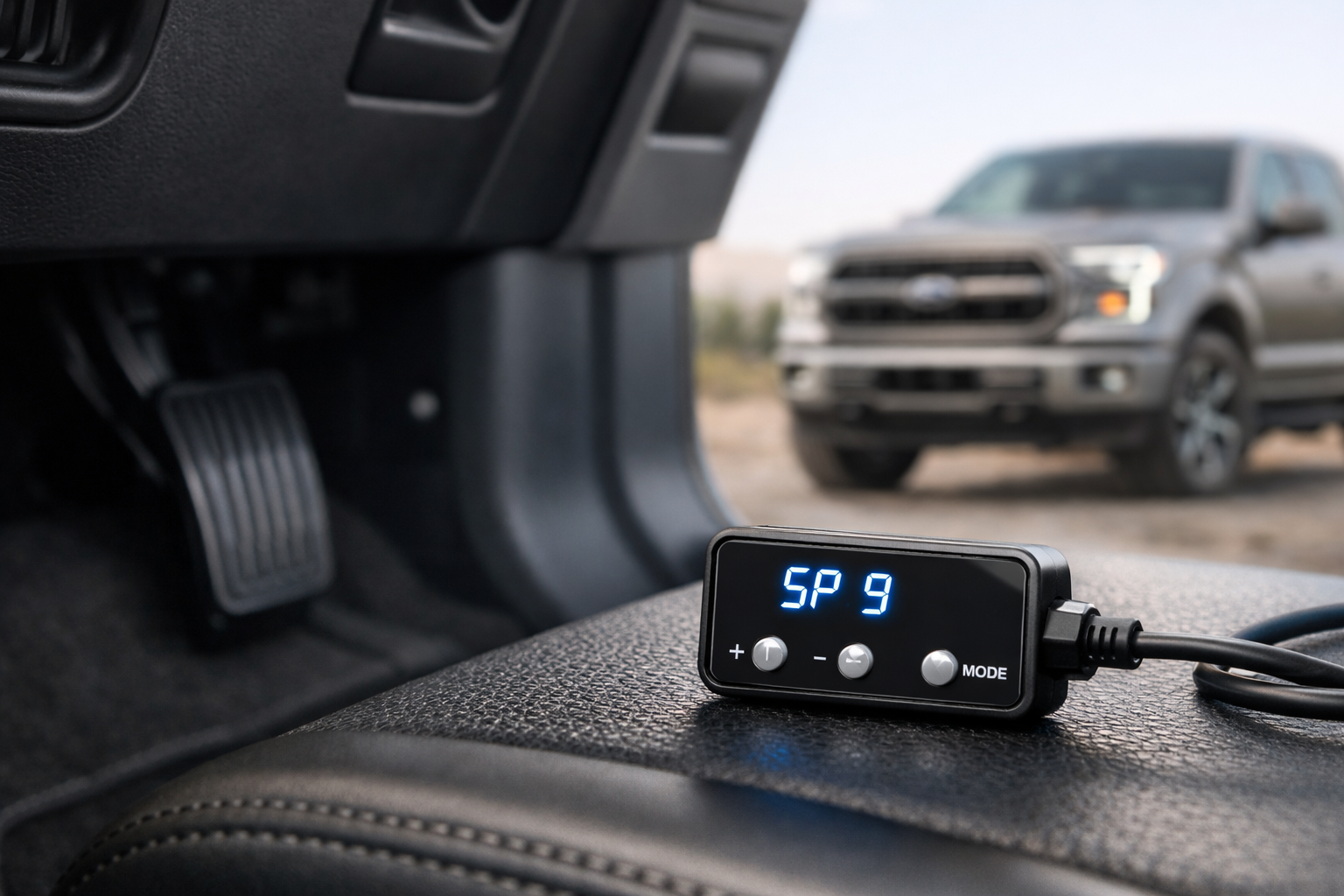
Installation is plug-and-play on both S550 and S650 Mustangs. You locate the accelerator pedal position sensor connector under the dash, unplug it, insert the controller’s harness between the factory connector and sensor, and mount the control unit somewhere accessible. The entire process takes 15 to 20 minutes with no tools required beyond possibly a zip tie to secure the wiring.
The controller is fully reversible and leaves no trace when removed. Because it doesn’t modify the ECU or flash any software, it doesn’t trigger warranty flags. It simply intercepts and modifies the pedal position signal before it reaches the ECU, operating entirely outside the vehicle’s computer system.
Frequently Asked Questions
Does the controller make the EcoBoost feel like a GT?
It narrows the perceived gap in initial responsiveness significantly, but it doesn’t add the 200+ horsepower difference between the engines. The EcoBoost will feel quicker to respond in the first few seconds of acceleration, which is where most everyday driving happens. At full throttle, the GT’s power advantage remains unchanged.
Can I use it at the drag strip?
Yes. Some owners set Sport+ for drag strip launches. Keep in mind that full throttle is full throttle regardless of the controller, so top-speed passes and standing-start times at full throttle are unchanged. The benefit at the strip is in how quickly you can reach full throttle from the starting line, which can help with consistent launch technique.
Does it work with the Mustang’s rev-matching feature?
Yes. The controller operates on the accelerator pedal signal only and doesn’t interfere with the automatic rev-matching feature on manual transmission models. Rev matching uses throttle blipping controlled by the ECU, which functions independently of the pedal position.
Will it affect my fuel economy?
The controller itself doesn’t change fuel consumption. However, because the car responds more eagerly to throttle input, you might find yourself accelerating harder more often, which can reduce fuel economy. If you maintain the same driving style, fuel consumption stays the same. This is different from modifications like making your truck more fuel efficient, which change actual consumption patterns.

Leave a Reply