
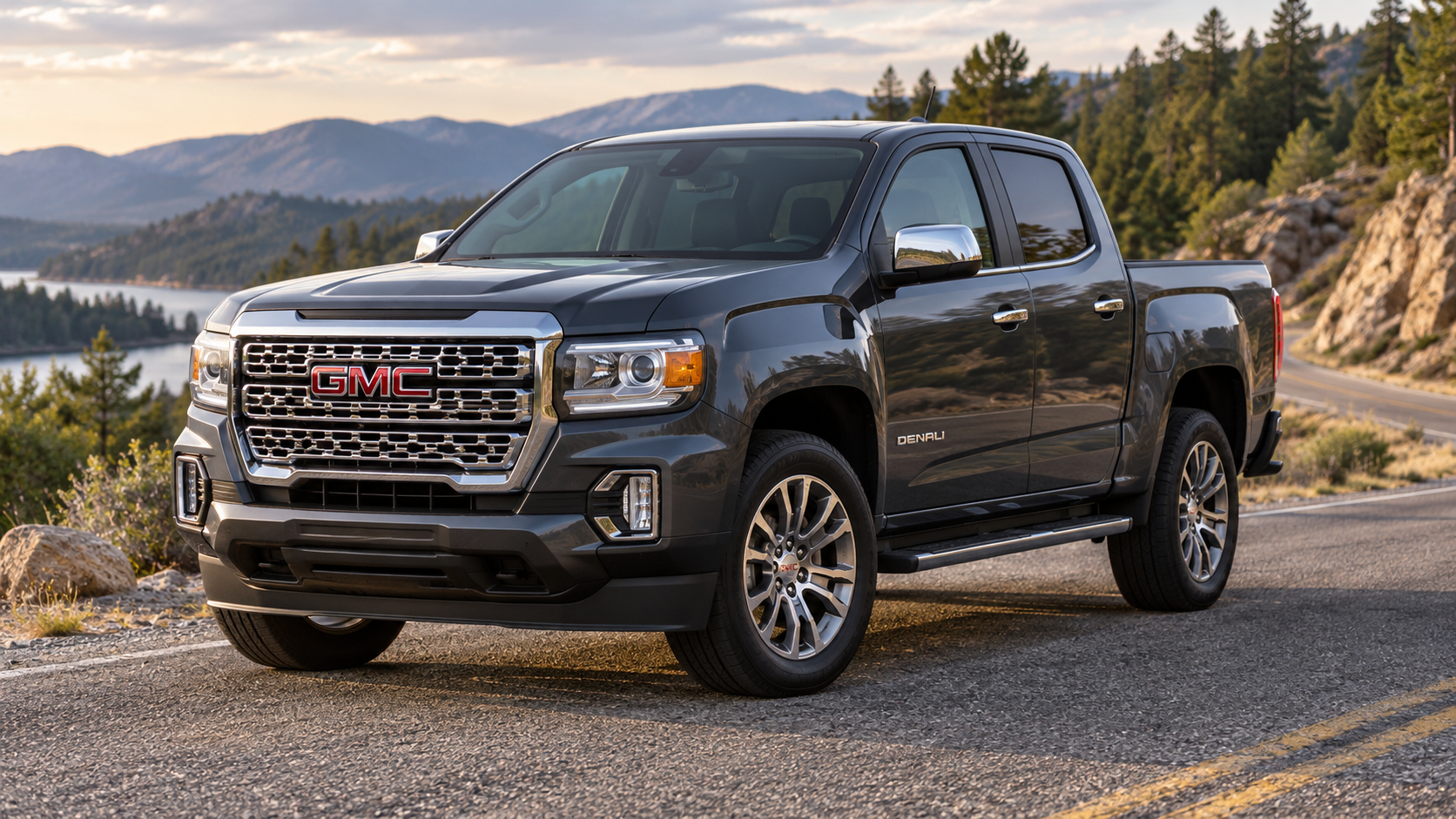
If you are shopping for a used GMC Canyon, the 2020–2022 models are the strongest place to start for modern reliability. By then, the second-generation Canyon had been in production for several years, and an important transmission-shudder problem associated with the 3.6-liter V6 and 8-speed automatic had been addressed in production.
The year that requires the most explanation is 2019. GM’s own technical bulletin gives the Canyon a March 1, 2019 production breakpoint for the well-known 8L45 torque-converter shudder issue. That means a later-built 2019 can be considerably more attractive than an early-production truck, even though both say “2019” on the title.
For buyers considering an older first-generation Canyon, 2009–2012 are generally the years we would shop first. Meanwhile, the redesigned 2023-and-newer Canyon offers substantially better performance and technology, but the generation is still relatively young and has already experienced several software and electronics-related issues.
GMC Canyon Reliability by Year
| Model Year | Reliability Outlook | What Changed? |
|---|---|---|
| 2004–2006 | Caution | Early first-generation trucks; age and early engine/electrical issues make condition especially important. |
| 2007–2008 | Average | More developed version of the original truck, but now old enough that maintenance and rust matter more than model year. |
| 2009–2012 | Best older Canyon years | Final years of the first generation; mature platform. The 5.3-liter V8 also became available beginning in 2009. |
| 2013–2014 | Not sold | There were no U.S.-market Canyon model years for 2013 or 2014. |
| 2015 | Caution | First year of the second generation. Certain trucks were recalled for possible loss of electric power-steering assist. |
| 2016 | Average to Good | Second year of the redesign and final year of the original V6/6-speed powertrain combination. |
| 2017 | Caution | New 3.6-liter V6 and 8-speed automatic introduced; beginning of the Canyon’s best-known transmission-shudder period. |
| 2018 | Caution | 8L45 torque-converter shudder remained an important concern. |
| 2019 | Good if late build | GM identifies March 1, 2019 as a production breakpoint in its 8-speed shudder bulletin. |
| 2020–2022 | Best modern used years | Mature second-generation platform produced after the major 8-speed fluid/shudder revision. |
| 2023 | Caution / Too New | Complete redesign with new 2.7-liter turbo powertrain and electrical architecture; first-year software issues and AEB recall. |
| 2024 | Improving, Limited Data | Second year of the redesign; GM documented a software condition that could leave the 12-volt battery dead. |
| 2025–2026 | Too New to Judge | Long-term powertrain reliability remains largely unknown. |
2004–2008 GMC Canyon: Early First-Generation Trucks
The original Canyon arrived for the 2004 model year as GMC’s counterpart to the Chevrolet Colorado. These trucks are mechanically much simpler than today’s Canyon, which can be appealing to someone looking for an inexpensive compact pickup.
However, the earliest examples are now more than two decades old. At this age, the individual truck matters far more than a small difference between model years.
Early Canyon engines included GM’s Atlas-family inline four- and five-cylinder engines. Older examples can experience misfires, sensor and electrical problems, cooling-system deterioration, oil leaks and the normal accumulation of age-related issues.
Rust is particularly important. A mechanically healthy Canyon with a badly corroded frame can be a much worse purchase than a higher-mileage truck that spent its life in a dry climate.
Verdict: Buy primarily on condition rather than year. If two trucks are otherwise similar, we would favor a later first-generation model.
2009–2012 GMC Canyon: The Best Years of the Original Canyon
The final four years of the first-generation Canyon are generally the most appealing older models.
By this point, GMC had been producing the basic truck for years, and these models avoided the usual uncertainty associated with the beginning of a new platform.
There was also a significant powertrain addition for 2009: GMC offered the 5.3-liter V8 in the Canyon. The V8 versions are comparatively rare today but are particularly interesting for buyers who want the simplicity and performance of GM’s small-block V8 in a compact pickup.
The four- and five-cylinder versions can also make dependable basic trucks when properly maintained.
Because even a 2012 Canyon is now well over a decade old, buyers should prioritize:
- Frame and body corrosion
- Cooling-system condition
- Transmission operation
- Oil and coolant leaks
- Suspension and steering wear
- Maintenance records
Verdict: If you want an inexpensive old-school Canyon, 2009–2012 is the range we would search first.
There Was No 2013 or 2014 GMC Canyon in the U.S.
One point that frequently causes confusion in used-truck reliability lists is the Canyon’s production gap.
The first-generation U.S. Canyon ended after the 2012 model year. GMC then brought the truck back for 2015 as a completely redesigned midsize pickup.
Therefore, a list describing 2013 or 2014 as especially reliable GMC Canyon model years is incorrect for the U.S. market.
2015 GMC Canyon: First Year of the Redesign
The Canyon returned for 2015 with a dramatically more modern platform, improved interior, better ride and much more contemporary safety and convenience equipment.
It was also the first model year of the new truck, and there is one particularly important issue to check.
GM recalled certain 2015 Canyons manufactured from January 6 through March 19, 2015 because a poor electrical connection within the steering gear could cause a loss of electric power-steering assist.
The truck could still be steered, but considerably more effort could be required, especially at low speeds. GM’s recall repair involved replacement of steering components.
The 2015 V6 was paired with a 6-speed automatic, so it does not have the same V6/8-speed combination responsible for the later 2017–2019 torque-converter shudder issue.
Verdict: Not necessarily a bad used truck, but the first model year deserves additional scrutiny. Check the VIN to confirm applicable recalls were completed.
2016 GMC Canyon: An Underrated Choice?
The 2016 Canyon occupies an interesting spot in the model’s history.
It was the second year of the new generation, so GMC had an additional year to work through launch problems. It also preceded the 2017 change to the newer V6 and 8-speed automatic.
If transmission shudder is your main concern, the 2016 V6 can therefore be worth considering because it uses the earlier 6-speed transmission rather than the 8L45 installed behind the redesigned V6 beginning in 2017.
The 2.8-liter Duramax turbodiesel also joined the Canyon lineup during this period. The diesel uses a different 6-speed automatic and is not the configuration involved in the V6 8L45 shudder bulletin.
That does not automatically make the diesel more reliable overall. Diesel emissions equipment adds its own complexity, particularly as mileage accumulates.
Verdict: The 2016 is worth a look, particularly for buyers who specifically want to avoid the V6/8-speed combination introduced the following year.
2017 GMC Canyon: The Big Powertrain Change
The 2017 model year is one of the most important dates in Canyon reliability history.
GMC introduced an updated 3.6-liter V6 along with the 8L45 8-speed automatic transmission. The combination improved performance and added two additional ratios, but it also introduced what became one of the best-known problems affecting the second-generation Canyon.
Owners could experience a vibration or shudder under light acceleration that felt similar to driving over rumble strips.
GM documented the condition in technical service bulletins covering the 8L45 and other members of its 8-speed transmission family.
The issue involved the operation of the torque-converter clutch and transmission fluid. GM subsequently developed revised diagnosis and fluid-exchange procedures.
Verdict: A 2017 Canyon can still be a good truck, but a V6 example should receive a particularly careful transmission test.
2018 GMC Canyon: Transmission Shudder Remained
The 2018 Canyon continued with the 3.6-liter V6 and 8L45 8-speed transmission, and it remains within GM’s documented shudder population.
GM’s service procedure for 2017–2018 Colorado and Canyon models called for draining the transmission, cleaning the pan and magnet, replacing the filter, removing old fluid from the cooler lines and refilling the transmission with the specified synthetic low-viscosity fluid.
That is useful information for used buyers because a service record showing that the transmission received the updated GM procedure can be a positive sign.
During a test drive, watch for:
- A rumble-strip-like vibration while cruising
- Shudder during light throttle between roughly 25 and 80 mph
- Harsh or inconsistent gear changes
- Delayed engagement into Drive or Reverse
- Transmission repairs without supporting documentation
Verdict: We would not automatically reject a 2018, but we would prefer a later truck if prices are similar.
2019 GMC Canyon: The Major Transmission Fix
This is arguably the most important year to understand if you are trying to determine when GMC fixed the Canyon’s major second-generation reliability problem.
GM’s Technical Service Bulletin 18-NA-355 covers the 2017–2019 Canyon equipped with the 3.6-liter V6 and 8L45 automatic.
For the Canyon, the bulletin specifies a production breakpoint of March 1, 2019.
GM’s updated repair involved exchanging the transmission fluid for a revised specification intended to correct torque-converter-clutch shudder.
If you are looking at an early 2019, ask whether the updated fluid-exchange procedure was performed. A documented repair followed by tens of thousands of trouble-free miles can be reassuring.
Verdict: Late-build 2019 trucks are among the more interesting Canyon values. Early trucks should be inspected similarly to a 2017 or 2018.
2020–2022 GMC Canyon: The Best Modern Used Years
If reliability is the priority and you still want a relatively modern Canyon, this is the range we would target.
The 2020, 2021 and 2022 models have several advantages:
- They are late in the second generation.
- They were produced after the important 2019 transmission-fluid production change.
- The basic chassis and major systems had already been in production for years.
- They avoid the all-new electrical architecture introduced for 2023.
- There is substantially more real-world history available than for the newest generation.
The 3.6-liter V6 still uses an 8-speed automatic, so a proper test drive remains worthwhile. No automatic transmission becomes immune to problems merely because a technical bulletin was revised.
However, if the goal is simply to identify the Canyon years with the best combination of refinement and established reliability, 2020–2022 are the sweet spot.
Which of the Three Is Best?
All else being equal, we would lean toward 2021 or 2022 simply because they are among the final examples of a platform GMC had been building since 2015.
That does not mean a 2020 with excellent maintenance is inferior to a neglected 2022. Once trucks reach the used market, history and condition should always override a one- or two-year model-year difference.
What About the 2.8 Duramax Diesel Canyon?
The 2.8-liter Duramax deserves to be considered separately from the gasoline V6 because it does not use the V6’s 8L45 transmission.
That means the widely discussed 2017–2019 V6 torque-converter shudder issue should not automatically be applied to diesel Canyons.
The diesel has its own tradeoffs. Modern diesel emissions equipment adds components such as exhaust aftertreatment systems that can become expensive as vehicles age. A diesel that has spent its life making longer highway trips is generally a more appealing proposition than one used primarily for repeated short trips.
The Duramax makes the most sense for someone who specifically values diesel torque, fuel economy or towing characteristics rather than someone simply searching for the least complicated Canyon possible.
2023 GMC Canyon: Complete Redesign, Complete Reset
The 2023 Canyon began an entirely new generation.
GMC replaced the previous engine lineup with a standard high-output 2.7-liter turbocharged four-cylinder producing 310 horsepower and 430 lb-ft of torque. It is paired with an 8-speed automatic transmission.
The redesign brought major improvements in capability and technology, including a wider track, factory suspension lift, larger digital displays, new driver-assistance systems and the introduction of the Canyon AT4X.
But from a reliability perspective, the 2023 model represents a reset. New engines, electronics, software and vehicle architecture mean the long track record of the 2020–2022 Canyon no longer applies.
One significant first-year problem involved the automatic emergency braking system.
GM recalled certain 2023 Canyon and Chevrolet Colorado trucks after the front camera system could incorrectly detect an obstacle and activate automatic emergency braking when no collision threat existed.
According to NHTSA recall documents, GM’s remedy was a software update to the front camera module.
Verdict: The 2023 is much more advanced than the old Canyon, but it is not our first recommendation for a reliability-first used buyer because it is the launch year of an entirely new generation.
2024 GMC Canyon: Some First-Year Problems Were Software-Related
The second year of a new generation is usually more interesting than the first, but 2024 Canyons have still had some issues worth knowing about.
GM issued Technical Service Bulletin 24-NA-228 covering 2024 Colorado and Canyon trucks that could suffer from a dead 12-volt battery.
GM identified software in the Vehicle Communication Unit as a possible cause. The module could fail to properly shut down after the vehicle was turned off, continuing to consume power and eventually discharging the battery.
The prescribed correction included installing available software updates and testing the battery.
This is a useful distinction: a software-controlled parasitic drain is frustrating, but it does not necessarily indicate a fundamental defect in the engine itself.
Verdict: Potentially preferable to a 2023, but there is still not enough long-term history to rank it ahead of the mature 2020–2022 trucks.
2025 and 2026 GMC Canyon: Too Early for a Reliability Verdict
The current Canyon continues to use GMC’s TurboMax 2.7-liter engine, rated at 310 horsepower and 430 lb-ft of torque, paired with an 8-speed automatic.
As of 2026, there simply is not enough long-term ownership data to confidently call a 2025 or 2026 Canyon more reliable than the previous generation.
GM has continued issuing service information for the platform. For example, a bulletin covering certain 2024–2025 Canyon transmissions provides diagnostic guidance for fluid leaks around the rear extension housing.
Certain 2024–2026 Canyon AT4X AEV models have also been recalled for software affecting passenger-airbag deployment.
These issues do not establish that the newest Canyon is fundamentally unreliable. They do demonstrate why it is premature to rank a nearly new truck alongside models that have accumulated years of real-world mileage.
When Were the GMC Canyon’s Major Problems Fixed?
| Problem | Main Years | Important Fix or Change |
|---|---|---|
| Early first-generation problems | 2004–2006 | Platform matured throughout the generation; 2009–2012 are preferable late-production years. |
| Electric power-steering loss | Certain 2015 trucks | Recall repair replaces affected steering components; verify by VIN. |
| 8-speed torque-converter shudder | 2017–early 2019 V6 | Revised fluid procedure and March 1, 2019 Canyon production breakpoint. |
| Unwanted automatic emergency braking | Certain 2023 trucks | Front-camera-module software recall update. |
| 12-volt battery drain | 2024 | Updated software for the Vehicle Communication Unit where applicable. |
Best GMC Canyon Years to Buy
If we were shopping today, these would be our preferred ranges:
- 2021–2022: Our favorite modern choices. Late examples of the proven second-generation platform.
- 2020: Very similar mechanically and also produced after the major 8-speed shudder revision.
- Late-build 2019: Potentially an excellent value, especially if produced after the relevant transmission production breakpoint.
- 2016: Interesting alternative for buyers who want the second-generation truck without the 2017–2019 V6/8-speed combination.
- 2009–2012: Best range to consider if shopping for the original compact Canyon.
GMC Canyon Years to Approach More Carefully
2004–2006
These trucks are old enough that condition dominates the buying decision, but they are also the early years of the original platform. Later examples are generally preferable when prices are close.
2015
It was the first year of a completely redesigned truck, and certain examples were affected by the power-steering recall.
2017–2018
These are the primary years we would scrutinize for 8L45 torque-converter shudder when equipped with the 3.6-liter V6.
Early-Build 2019
Do not assume that the 2019 badge means the transmission issue had already been addressed in production. Check the vehicle’s build information and maintenance records.
2023
The 2023 Canyon launched an entirely new platform and experienced some first-year software and driver-assistance issues. That makes it harder to recommend over a mature 2021 or 2022 for someone whose top priority is reliability.
How to Check a Used GMC Canyon Before Buying
1. Test the 8-Speed at Steady Highway Speeds
On a 2017–2019 V6 truck, don’t limit the test drive to city streets. Drive at steady speeds under light throttle. A torque-converter shudder can feel like driving over rumble strips even though the road is smooth.
2. Check the 2019 Build Date
If you are shopping for a 2019 V6 Canyon, determine when the truck was built. GM’s technical bulletin uses March 1, 2019 as the Canyon production breakpoint associated with the shudder procedure.
3. Ask Specifically About Transmission Fluid Service
A generic entry showing “transmission serviced” is less useful than documentation showing exactly what work was performed and which fluid was installed.
4. Drive It Cold and Warm
Start with a cold transmission if possible, then continue until everything reaches operating temperature. Some drivetrain symptoms change considerably as the fluid warms.
5. Check Every Electronic Feature on a 2023+ Canyon
Operate the cameras, infotainment system, digital instrument panel, driver-assistance features, wireless phone connectivity and other electronics. The newest Canyon relies much more heavily on software and networked modules than earlier trucks.
6. Run the VIN Through NHTSA
Recalls apply to specific vehicle populations, not automatically to every vehicle from a given year. Use the NHTSA recall lookup and enter the actual VIN before buying.
7. Get a Pre-Purchase Inspection
A model-year ranking cannot tell you how the previous owner treated one particular truck. A professional inspection is especially worthwhile for an older Canyon, a diesel or any truck with questionable transmission behavior.
What Is the Most Reliable GMC Canyon Year?
For most used-truck shoppers, the 2021 and 2022 GMC Canyon are the years we would target first. They represent the end of a mature generation, were built well after the major 2017–2019 V6 transmission-shudder issue was addressed in production, and avoid the first-year uncertainties of the redesigned 2023 Canyon.
A 2020 is nearly as compelling and may be a better value depending on mileage and price.
If you find a late-production 2019, don’t dismiss it. GM’s own documentation makes the build date unusually important for that particular model year.
For an older, inexpensive Canyon, the 2009–2012 trucks are the first-generation models we would shop before the earlier 2004–2008 examples.
Meanwhile, buyers considering a 2023-and-newer Canyon should recognize that they are buying a fundamentally different truck. The 2.7-liter TurboMax engine provides far more torque and the new platform is much more capable, but the generation has not yet accumulated the long-term history necessary to displace the late second-generation Canyon as the safer reliability bet.
Sources
- General Motors TSB 18-NA-355 — 8L45/8L90 Torque Converter Shudder
- General Motors TSB 16-NA-175 — 2017–2018 Colorado/Canyon Shudder Service Procedure
- NHTSA Recall 16V-054 — 2015 Canyon Loss of Power Steering Assist
- NHTSA Recall 24V-133 — 2023 Canyon Unwanted Automatic Emergency Braking
- GM TSB 24-NA-228 — 2024 Canyon Dead 12V Battery
- GM PIP6049 — 2024–2025 Canyon Transmission Extension Housing Leak Diagnosis
- GMC — Introduction of the Redesigned 2023 Canyon
- GMC — Current Canyon TurboMax Specifications
- NHTSA Vehicle Recall Lookup
Leave a Reply