
Having the right jack for your specific needs could literally save your life, whether you’re changing a flat tire on the highway or working on a weekend project in your garage.
Understanding Car Jack Types and Their Purpose
Every car jack serves the same basic function, lifting your vehicle off the ground. But the similarities end there. Each type excels in different situations, and using the wrong jack can be frustrating at best and catastrophic at worst.
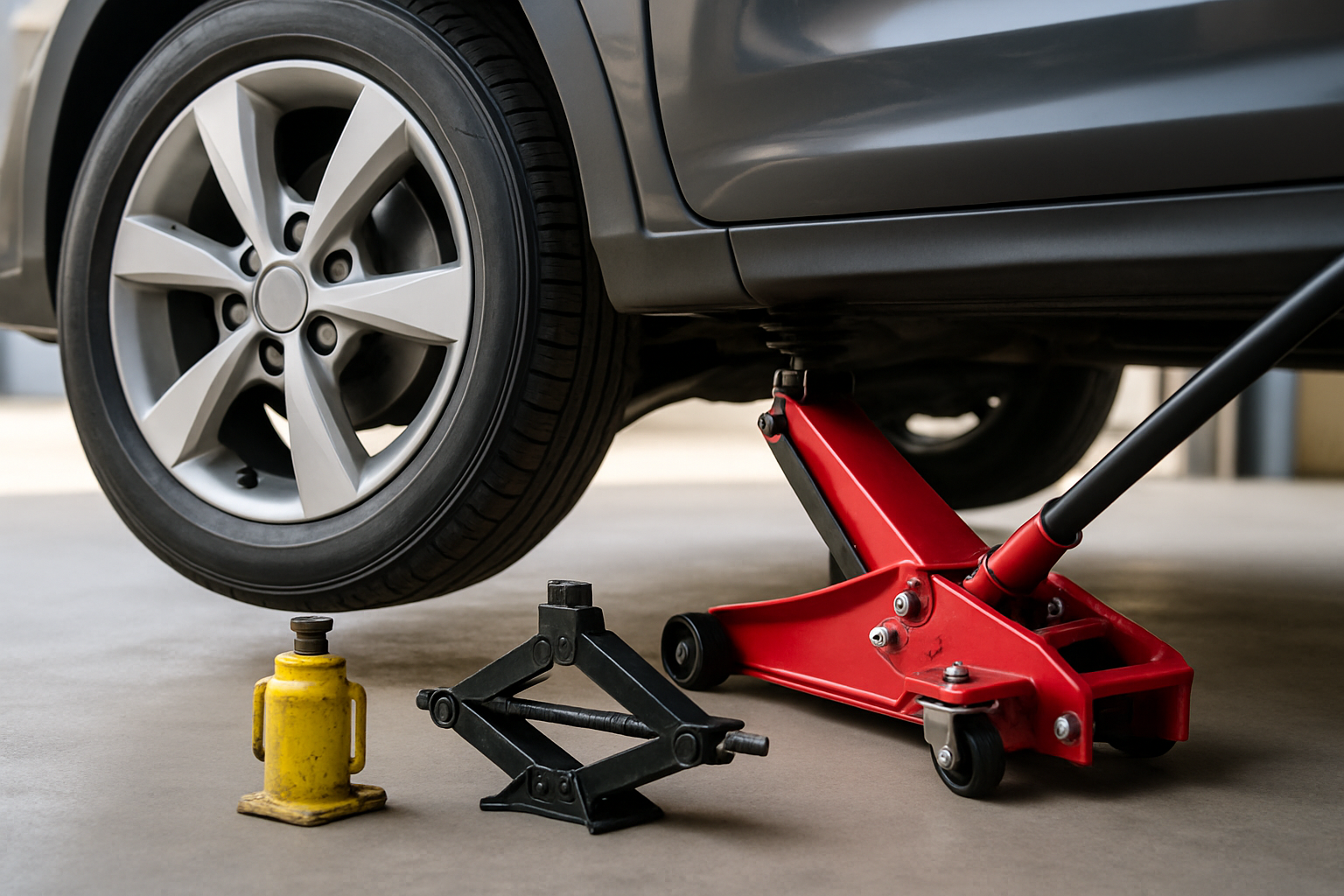
The four main types you’ll encounter are scissor jacks, hydraulic floor jacks, bottle jacks, and hi-lift jacks. Each has specific advantages and limitations that make them suitable for different applications.
Scissor Jacks: Your Emergency Roadside Companion
Your car came with a scissor jack tucked away in the trunk or under the spare tire. These compact, lightweight jacks use a threaded mechanism that expands the scissor assembly when you turn the handle.
Scissor jacks typically lift 1.5 to 3 tons, which covers most passenger cars and small SUVs. They’re incredibly portable and won’t take up much space in your trunk. The folded design makes them perfect for emergency tire changes.
However, these jacks have serious limitations. They’re slow to operate, requiring dozens of handle turns to lift your car. The narrow base makes them unstable on anything but perfectly flat, solid ground. Most importantly, they’re designed for emergency use only, not regular maintenance.
Never crawl under a car supported by just a scissor jack. These are strictly for tire changes where you’re working beside the vehicle, not underneath it.
Hydraulic Floor Jacks: The DIY Mechanic’s Best Friend
Floor jacks are the workhorses of home garages. These low-profile jacks roll under your car on wheels and use hydraulic pressure to lift heavy loads quickly and smoothly.
Most floor jacks range from 2 to 4 tons of lifting capacity. The wide wheelbase and long handle provide excellent stability and mechanical advantage. You can lift most cars with just a few pumps of the handle.
Floor jacks come in different profiles. Standard profile jacks work for most cars and trucks, while low-profile models (usually 2.5 to 3.5 inches minimum height) fit under lowered vehicles and sports cars. Racing jacks go even lower, sometimes starting at just 2 inches.
The main disadvantage is portability. Floor jacks typically weigh 30 to 80 pounds and take up significant space. They’re not practical for roadside emergencies but perfect for garage work.
Always use jack stands with floor jacks. The hydraulic seals can fail, and you should never trust your life to any single lifting device.
Bottle Jacks: Maximum Power in Minimal Space
Bottle jacks pack serious lifting power into a compact cylinder. These hydraulic jacks can handle anywhere from 2 to 50 tons, making them popular for heavy trucks, RVs, and industrial applications.
The vertical design takes up very little floor space, and they’re much more portable than floor jacks. Bottle jacks work well in tight spaces where a floor jack won’t fit, like under the differential of a lifted truck.
The trade-off is height. Bottle jacks typically need 7 to 10 inches of clearance to fit under the jack point. This makes them unsuitable for low cars. The small base also requires a stable, level surface for safe operation.
Extensions are available to increase the lifting height, but they also reduce stability. Use them carefully and always with jack stands.
Hi-Lift Jacks: The Off-Road Specialist
Hi-lift jacks, also called farm jacks or all-purpose jacks, use a mechanical ratcheting system to lift extremely high. They typically lift from 4 to 60 inches, making them perfect for off-road recovery and tire changes on vehicles with large tires.
These jacks can handle 3,500 to 7,000 pounds depending on the model. They’re incredibly versatile, functioning as a jack, winch, clamp, or spreader. Off-road enthusiasts love them for their ability to lift a vehicle completely out of mud or sand.
Hi-lift jacks require respect. The high lifting mechanism stores enormous potential energy, and the handle can kick back violently if the load shifts. They’re also slow to operate and require specific mounting points on your vehicle.
These aren’t practical for regular maintenance but are invaluable for off-road adventures and farm work.
Weight Ratings: Don’t Gamble With Capacity
Every jack has a weight rating, but understanding how to apply it correctly is crucial for safety. The rating refers to the maximum load the jack can lift, not your vehicle’s total weight.
When you lift one corner of your car, you’re only supporting about 25% of the vehicle’s weight. Lifting the front or rear supports roughly 40-60% depending on the weight distribution.
Always choose a jack rated for at least 1.5 times the weight you’re lifting. This safety margin accounts for uneven weight distribution, dynamic loading, and manufacturing tolerances.
For example, if your 4,000-pound car has 60% weight on the front axle, you’re lifting 2,400 pounds when jacking up the front. Choose a jack rated for at least 3,600 pounds (1.5 x 2,400).
Jack Stands: Your Life Insurance Policy
Jack stands aren’t optional equipment, they’re mandatory safety devices. Every hydraulic system can fail, and mechanical jacks can slip or collapse.
Jack stands use a mechanical ratcheting or pin system that can’t fail like hydraulics. Once properly positioned, they provide solid, reliable support that won’t slowly sink or suddenly drop.
Buy jack stands rated higher than your jack’s capacity. If you’re using a 3-ton jack, get 6-ton jack stands. The extra capacity costs very little but provides enormous peace of mind.
Always use jack stands in pairs for stability, even if you’re only working on one side of the car. Position them on solid jack points, never on body panels or suspension components.
Which Jack Should You Own?
Your needs determine the best jack for you. Most car owners benefit from owning multiple jacks for different situations.
For emergency roadside use, keep your scissor jack in good condition and know how to use it properly. Practice changing a tire in your driveway so you’re prepared when it happens on the road.
If you do any garage work, invest in a quality hydraulic floor jack. A 3-ton low-profile jack handles most cars and light trucks. Pair it with quality jack stands rated for 6 tons or higher.
Recommended Equipment for Different Needs
For most DIY mechanics, a good 3-ton hydraulic floor jack provides the best combination of lifting capacity, speed, and stability. Look for models with reinforced lifting arms and quality hydraulic components.
Low-car owners should specifically seek low-profile jacks that start around 3 inches. These cost more but are essential for modern sports cars and lowered vehicles.
Truck and SUV owners might prefer a combination approach: a bottle jack for field repairs and tight spaces, plus a floor jack for garage work.
Off-road enthusiasts should consider adding a hi-lift jack to their recovery gear, but only after proper training on safe operation.
Safety Tips for Any Jack
Never exceed the jack’s weight rating or maximum height. Both reduce stability and increase the risk of failure.
Always use jacks on level, solid ground. Asphalt is better than concrete, which can crack. Avoid gravel, dirt, or inclined surfaces.
Position the jack squarely under designated jack points. Your owner’s manual shows the correct locations. Jacking from the wrong spot can damage your car or cause the jack to slip.
Keep your body clear of the vehicle when lifting. Don’t put any part of yourself under the car until it’s supported by jack stands.
Maintenance Keeps Jacks Working
Hydraulic jacks need periodic maintenance to stay reliable. Check the hydraulic fluid level annually and top off with the manufacturer’s specified fluid. Clean dirt and debris from the lifting mechanism to prevent premature wear.
Scissor jacks benefit from occasional lubrication on the threads and pivot points. A light coating of white lithium grease keeps them operating smoothly.
Store all jacks in a dry location to prevent rust. Moisture is the enemy of both hydraulic seals and mechanical components.
Frequently Asked Questions
Can I use a floor jack for emergency roadside repairs?
While technically possible, floor jacks aren’t practical for roadside use. They’re heavy, require level ground, and most people don’t carry them in their car. Stick with your scissor jack for emergencies, but consider upgrading to a better-quality scissor jack if your OEM unit is particularly cheap.
How do I know if my jack is rated high enough?
Find your vehicle’s weight in the owner’s manual or on the door sticker. Multiply by 0.6 for front lifting or 0.4 for rear lifting (these are conservative estimates). Choose a jack rated for at least 1.5 times this calculated weight. When in doubt, go higher.
Do I really need jack stands for quick jobs?
Yes, absolutely. Hydraulic jacks can fail without warning, and even “quick” jobs can take longer than expected. Jack stands cost far less than medical bills or funeral expenses. Use them every time you go under the car, no exceptions.
Can I jack up my car anywhere on the frame?
No, only use designated jack points shown in your owner’s manual. Modern cars have specific reinforced areas designed to handle lifting loads. Jacking from the wrong location can cause expensive body damage or create an unstable lifting situation.
This article contains affiliate links. If you purchase through these links, we may earn a small commission at no extra cost to you.
Leave a Reply