
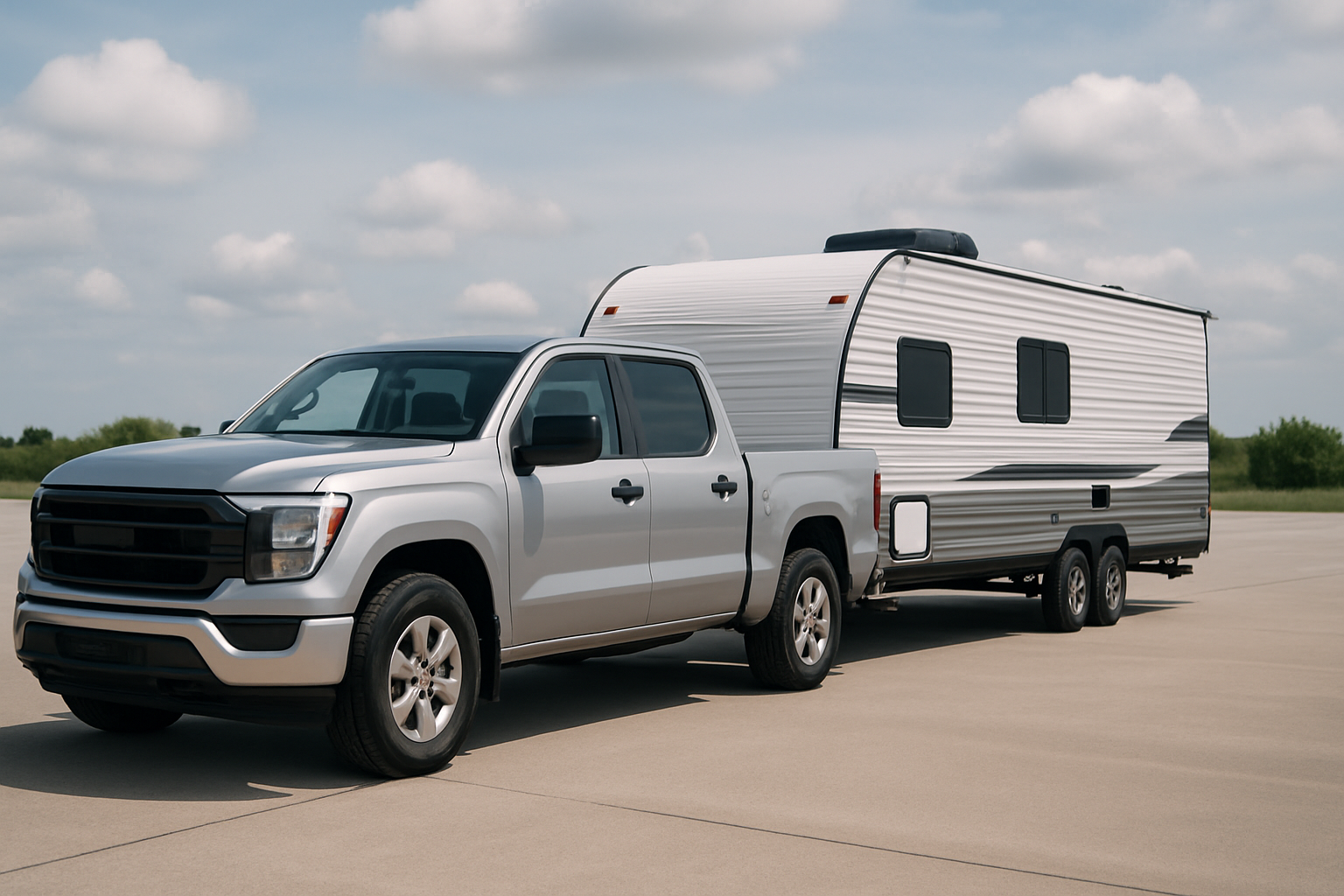
Half-ton trucks are incredibly popular for their versatility, but figuring out exactly what size trailer you can safely tow isn’t always clear. With towing capacities ranging from 5,000 to over 13,000 pounds depending on your specific truck and engine combination, there’s a big difference between what the manufacturer says you can tow and what you should actually pull in real-world conditions.
Understanding Half-Ton Truck Towing Capacities
The four main half-ton trucks on the market today are the Ford F-150, Chevrolet Silverado 1500, RAM 1500, and Toyota Tundra. Each offers multiple engine options and configurations that dramatically affect towing capacity.
Your F-150 might have a 3.3L V6 rated for around 5,000 pounds, or it could have the 3.5L EcoBoost V6 capable of pulling over 13,000 pounds when properly equipped. The Silverado 1500 ranges from about 6,600 pounds with the base four-cylinder up to 13,300 pounds with the 6.2L V8. The RAM 1500 spans from roughly 6,730 pounds to 12,750 pounds depending on engine choice, while the Tundra typically handles between 8,200 and 12,000 pounds.
These numbers represent maximum towing capacity under ideal conditions with the truck configured specifically for maximum towing capability. Your actual safe towing capacity will likely be lower once you factor in passengers, cargo, and real-world driving conditions.
Factors That Reduce Your Real-World Towing Capacity
Payload Considerations
Every person and item you put in your truck reduces your available payload, which directly impacts how much trailer tongue weight you can handle. Tongue weight should typically be 10-15% of your total trailer weight, and this counts against your truck’s payload capacity.
If your truck has a 1,500-pound payload capacity and you’re carrying 400 pounds of people and gear, you only have 1,100 pounds left for tongue weight. This effectively limits you to about a 7,000-8,000 pound trailer, even if your truck is rated to tow 12,000 pounds.
Environmental Factors
Wind resistance becomes a major factor when towing larger trailers. A 30-foot travel trailer acts like a giant sail, and crosswinds can make even a properly rated setup feel dangerous and unstable.
Hills and mountain grades are another reality check. Your truck might handle a 10,000-pound trailer fine on flat ground, but struggle significantly on a 6% grade in hot weather. Engine and transmission temperatures can become problematic, and you’ll find yourself crawling up hills at 35 mph with your hazards on.
Altitude also reduces engine power. If you’re towing at elevation, expect to lose roughly 3% of your engine’s power for every 1,000 feet above sea level.
Choosing the Right Trailer Size
Conservative Approach for New Towers
If you’re new to towing, consider staying well below your truck’s maximum capacity. A good rule of thumb is to use about 80% of your truck’s rated capacity for your first trailer. This gives you a safety margin and makes the learning process less stressful.
For most half-ton trucks, this means staying in the 6,000-8,000 pound range for your first trailer, even if your truck can theoretically handle more. This covers most smaller travel trailers, boat and trailer combinations, and utility trailers loaded with ATVs or equipment.
Travel Trailers
Travel trailers are tricky because their size and wind resistance often become the limiting factor before weight does. A 28-foot travel trailer might only weigh 6,000 pounds, but its wind resistance and handling characteristics can make it feel much heavier to tow.
Most half-ton truck owners find their sweet spot with travel trailers in the 24-28 foot range weighing between 5,000-8,000 pounds when loaded. This provides a good balance of livability and towability without pushing your truck to its limits.
Equipment and Utility Trailers
Equipment trailers are typically more forgiving than travel trailers because they’re lower profile and create less wind resistance. You can often get closer to your truck’s rated capacity when towing dense, heavy items like cars, construction equipment, or machinery.
A dual-axle equipment trailer carrying a car might weigh 8,000-10,000 pounds total, but it’ll tow much more predictably than a similarly weighted travel trailer.
Essential Towing Equipment
Proper equipment makes a huge difference in safety and towing experience. Don’t rely solely on your truck’s towing capacity without having the right setup.
Weight Distribution Hitches
For trailers over 5,000 pounds, a weight distribution hitch becomes essential. These systems transfer some of the tongue weight back to your truck’s front axle and the trailer’s axles, improving handling and reducing rear squat.
You’ll want to invest in a quality weight distribution hitch system that matches your trailer weight. Popular brands include Equal-i-zer, Blue Ox, and Reese, with prices ranging from around $300 to over $600 depending on capacity and features.
Brake Controllers
Electric brake controllers are required for most trailers over 3,000 pounds and highly recommended for smaller trailers with electric brakes. Your truck may have a factory brake controller, or you might need to install an aftermarket unit.
Integrated brake controllers that work with your truck’s existing systems are becoming more common and offer smoother operation than traditional aftermarket controllers.
Truck-Specific Towing Capabilities
Ford F-150
The F-150 offers the widest range of towing capacities among half-tons. The base 3.3L V6 is adequate for lighter duties, but the 3.5L EcoBoost V6 and 5.0L V8 are the sweet spots for serious towing. The PowerBoost hybrid system also offers excellent towing capability with improved fuel economy.
F-150s equipped with the Max Trailer Tow Package get upgraded cooling, bigger alternators, and integrated brake controllers. These features make a significant difference when towing near the truck’s limits.
Chevrolet Silverado 1500
The Silverado’s 5.3L and 6.2L V8 engines provide strong, predictable towing performance. The 6.2L V8 is particularly impressive for maintaining speed on grades, though fuel economy suffers accordingly.
GM’s Magnetic Ride Control, available on higher trim levels, significantly improves ride quality and handling when towing heavy trailers.
RAM 1500
The RAM’s available air suspension system gives it an advantage for towing by automatically leveling the truck and providing multiple ride height settings. The 5.7L HEMI V8 provides good towing performance, while the EcoDiesel V6 offers excellent fuel economy when towing lighter loads.
RAM’s trailer brake gain and sway control systems are among the most sophisticated in the segment.
Toyota Tundra
The Tundra’s twin-turbo V6 provides strong towing performance, and Toyota’s reputation for reliability makes it appealing for heavy-duty use. However, fuel economy when towing is typically worse than comparable domestic trucks.
The Tundra’s towing features are comprehensive, including integrated brake controllers and trailer backup guides on equipped models.
Real-World Towing Tips
Experience matters more than specifications when it comes to safe towing. Start with shorter trips close to home to get familiar with how your truck and trailer combination handles.
Monitor your truck’s vital signs while towing, especially transmission and coolant temperatures. Most trucks have gauge displays that show these temperatures, and staying aware of them can prevent expensive damage.
Plan your routes to avoid steep grades when possible, especially when you’re learning. Apps like Mountain Directory can help identify truck-friendly routes that avoid problematic grades.
Leave extra following distance and plan for longer stopping distances. Even with trailer brakes, your stopping distance increases significantly when towing.
When to Consider a Three-Quarter Ton Truck
If you’re consistently wanting to tow trailers over 9,000-10,000 pounds, or if you’re towing in mountainous terrain regularly, consider moving up to a three-quarter ton truck. The improved cooling systems, stronger frames, and more robust drivetrains make a significant difference in capability and peace of mind.
Heavy fifth-wheel trailers almost always require three-quarter ton or larger trucks due to their high pin weights, even if the total trailer weight might technically be within a half-ton’s capacity.
Frequently Asked Questions
Can I tow more than my truck’s rated capacity occasionally?
Never exceed your truck’s rated towing capacity. These limits exist for safety reasons and exceeding them can damage your truck, void your warranty, and create dangerous driving conditions. The ratings already include safety margins, so exceeding them puts you in genuinely dangerous territory.
How much does towing affect fuel economy?
Expect your fuel economy to drop by 30-50% or more when towing, depending on trailer size and terrain. A truck that normally gets 25 mpg might only achieve 10-12 mpg when towing a large travel trailer. Smaller, more aerodynamic trailers have less impact than tall, boxy ones.
Do I need a special driver’s license to tow with a half-ton truck?
In most states, you don’t need a special license to tow with a half-ton truck as long as your combined vehicle and trailer weight stays under 26,000 pounds, which is virtually impossible with a half-ton truck. However, some states have different rules, so check your local regulations.
Should I buy the truck or trailer first?
Buy the truck first and make sure you understand its actual towing capabilities before shopping for trailers. This prevents you from falling in love with a trailer that’s too large for your truck to handle safely. Your truck choice should be based on what you want to tow, not the other way around.


Leave a Reply