
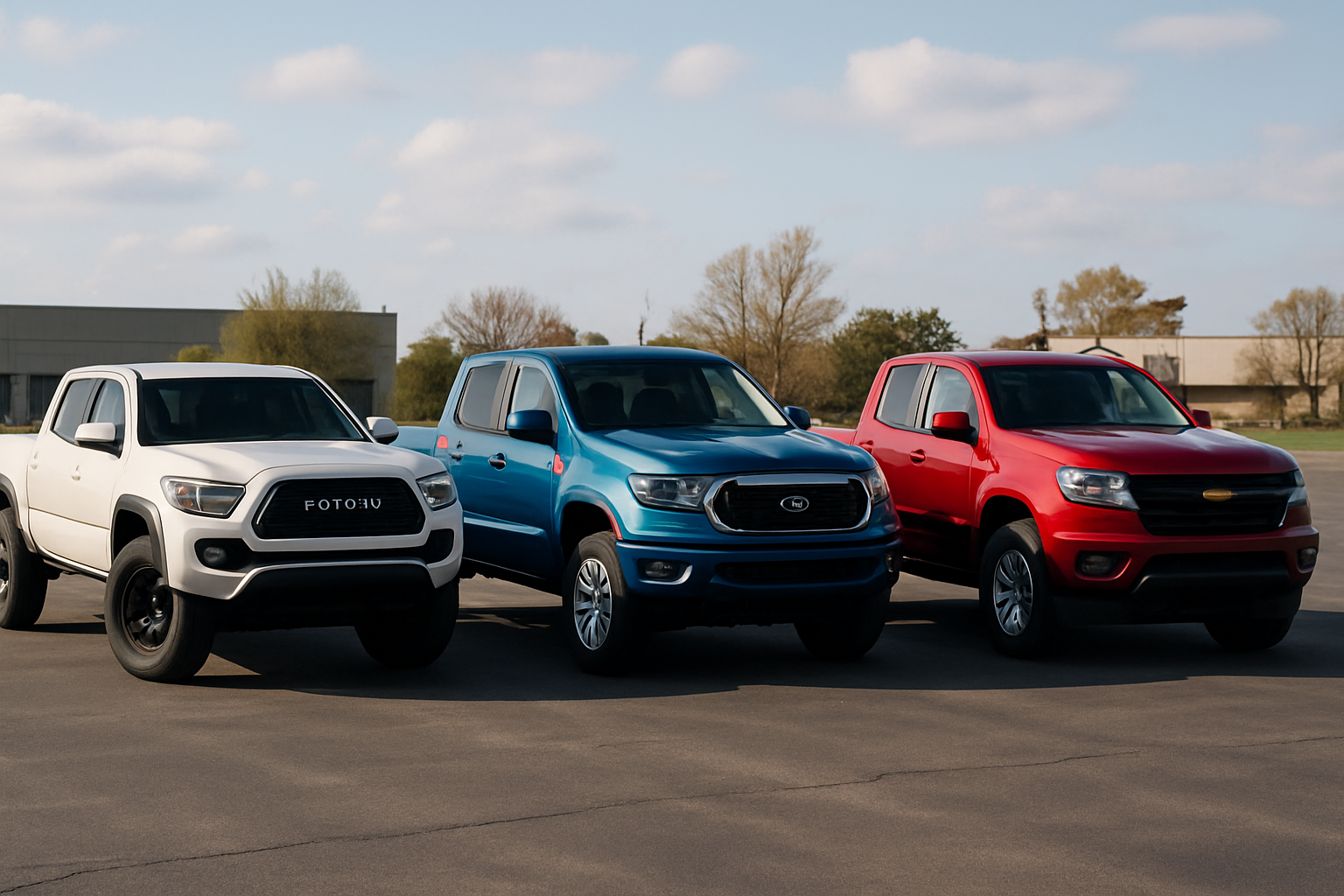
The midsize truck market has exploded in recent years, with three standout contenders leading the charge. The Toyota Tacoma, Ford Ranger, and Chevrolet Colorado each bring their own strengths to the table, making the choice between them more challenging than ever for truck buyers.
Current Generation Overview
All three trucks have entered new generations recently, bringing fresh designs and updated capabilities. The Tacoma received its latest redesign for the 2024 model year, while the Ranger returned to the US market in 2019 with significant updates continuing through 2023. The Colorado got its most recent overhaul for the 2023 model year.
Each manufacturer has focused on different priorities with these updates. Toyota emphasized ruggedness and off-road capability, Ford concentrated on refinement and technology, and Chevrolet went all-in on work truck functionality.
Engine Options and Performance
The Toyota Tacoma offers two engine choices for 2024. The base 2.7-liter four-cylinder produces 159 horsepower and 180 lb-ft of torque, paired with a six-speed automatic transmission. The optional 3.5-liter V6 delivers 278 horsepower and 265 lb-ft of torque, available with either a six-speed manual or six-speed automatic.
Ford keeps things simpler with the Ranger, offering a single 2.3-liter EcoBoost turbocharged four-cylinder. This engine generates 270 horsepower and 310 lb-ft of torque, connected to a 10-speed automatic transmission across all trim levels.
Chevrolet also streamlined the Colorado’s powertrain lineup. The sole engine is a 2.7-liter turbocharged four-cylinder producing 310 horsepower and 430 lb-ft of torque. This engine pairs with an eight-speed automatic transmission.
Towing and Payload Capacity
When properly equipped, the Colorado leads the towing race with a maximum capacity of 7,700 pounds. The Ranger follows closely at 7,500 pounds, while the Tacoma trails at 6,800 pounds with the V6 engine and proper towing package.
Payload numbers tell a similar story. The Colorado tops the charts with up to 1,550 pounds of payload capacity. The Ranger offers up to 1,860 pounds, making it the payload champion of this group. The Tacoma provides up to 1,440 pounds, depending on configuration.
These numbers can vary significantly based on cab configuration, bed length, and drivetrain choice. Extended cab models typically offer higher payload ratings than crew cabs due to their lighter weight.
Fuel Economy Comparison
Fuel efficiency varies considerably between these trucks. The Tacoma’s four-cylinder engine delivers the best EPA ratings at 23 mpg city and 30 mpg highway in two-wheel-drive configuration. The V6 model drops to 19 mpg city and 24 mpg highway.
The Ranger’s EcoBoost engine achieves 21 mpg city and 26 mpg highway in rear-wheel-drive form. Four-wheel-drive models see a slight decrease to 20 mpg city and 24 mpg highway.
The Colorado’s powerful turbo engine returns 20 mpg city and 28 mpg highway with rear-wheel drive. All-wheel-drive versions get 19 mpg city and 26 mpg highway according to EPA estimates.
Real-world fuel economy often differs from EPA ratings, especially for truck owners who frequently haul or tow heavy loads.
Bed Size and Cargo Features
Bed dimensions vary significantly between these trucks. The Tacoma offers a 5-foot bed on Double Cab models and a 6.1-foot bed on Access Cab versions. The longer bed provides 61.5 cubic feet of cargo space.
Ford provides the Ranger with a single 6-foot bed across all cab configurations, offering 54.4 cubic feet of cargo volume. The bed includes four tie-down cleats and an available spray-in bedliner.
The Colorado comes with either a 5.2-foot bed on Crew Cab models or a 6.2-foot bed on Extended Cab trucks. The longer bed offers the most cargo space in this comparison at 62.7 cubic feet.
All three trucks offer various bed accessories and organizational systems. The Tacoma features an available deck rail system, while the Ranger offers Ford’s SYNC 4 system integration for cargo management apps.
Off-Road Capability and Trims
Off-road performance sets these trucks apart dramatically. The Tacoma offers the TRD Off-Road and TRD Pro trims, with the Pro model featuring Fox shocks, skid plates, and aggressive all-terrain tires. Ground clearance reaches 9.4 inches on TRD Pro models.
Ford’s Ranger Tremor package includes terrain management modes, skid plates, and 32-inch all-terrain tires. The Tremor adds rock rails and upgraded shocks for improved off-road capability.
Chevrolet’s Colorado ZR2 takes off-roading seriously with Multimatic DSSV dampers, front and rear electronic locking differentials, and 8.9 inches of ground clearance. The ZR2 also features aggressive approach and departure angles.
Each manufacturer includes different terrain management systems. Toyota’s Multi-Terrain Select offers multiple drive modes, Ford provides selectable 4WD modes, and Chevrolet includes terrain-specific settings.
Interior Space and Comfort
Crew cab models provide the most passenger space across all three trucks. The Tacoma offers 42.9 inches of front headroom and 38.6 inches of rear headroom. Legroom measures 42.9 inches front and 32.6 inches rear.
The Ranger SuperCrew provides 39.8 inches of front headroom and 37.8 inches rear. Front legroom measures 43.1 inches, while rear passengers get 34.5 inches.
Colorado crew cab models offer 41.4 inches of front headroom and 39.0 inches rear. Front legroom reaches 45.0 inches, with rear passengers receiving 35.8 inches.
Material quality and seat comfort vary between models and trim levels. Higher trim versions include leather seating, heated seats, and premium audio systems.
Technology and Infotainment
Modern infotainment systems come standard across all three trucks. The Tacoma includes an 8-inch touchscreen with Toyota’s Audio Multimedia system, Apple CarPlay, and Android Auto compatibility.
Ford equips the Ranger with SYNC 4 technology on an 8-inch touchscreen, expandable to 12 inches on higher trims. The system includes wireless Apple CarPlay and Android Auto.
The Colorado features Chevrolet’s Infotainment 3 system on an 11.3-inch touchscreen. The system supports wireless smartphone integration and includes built-in Google services.
Available features across these trucks include premium audio systems, navigation, and smartphone app integration for remote start and vehicle monitoring.
Safety Features and Ratings
All three manufacturers include comprehensive safety suites as standard equipment. Toyota Safety Sense 2.0 comes with every Tacoma, including automatic emergency braking, lane departure alert, and adaptive cruise control.
Ford Co-Pilot360 provides similar features for the Ranger, including blind spot monitoring, rear cross-traffic alert, and automatic high beams.
Chevrolet Safety Assist includes automatic emergency braking, forward collision alert, and lane keep assist with lane departure warning.
IIHS and NHTSA ratings vary between models, with newer generation trucks generally achieving higher scores than their predecessors.
Reliability and Maintenance
Long-term reliability data for these newest generations remains limited due to their recent introduction. However, each manufacturer’s historical performance provides some insight.
Toyota has traditionally led in reliability surveys, with previous Tacoma generations showing strong durability records. The truck’s simple mechanical systems and proven powertrains contribute to its reputation.
Ford’s Ranger benefits from global development and testing, having been sold worldwide before returning to the US market. The EcoBoost engine family has shown good reliability in other Ford applications.
Chevrolet’s Colorado represents a complete redesign with new powertrain technology. Early reports suggest improved quality compared to the previous generation, but long-term data isn’t yet available.
Maintenance costs and intervals vary between manufacturers, with Toyota typically offering competitive service costs and parts availability.
Pricing and Value
Base pricing starts lowest with the Tacoma SR, followed closely by the Ranger XL and Colorado Work Truck. However, feature content varies significantly at entry-level pricing.
Mid-level trim comparisons show the Colorado offering strong value with its powerful standard engine and generous equipment levels. The Ranger Lariat provides luxury features competitive with premium truck segments.
Top-tier off-road models command premium pricing, with the Tacoma TRD Pro, Ranger Tremor, and Colorado ZR2 all exceeding $45,000 when fully equipped.
Resale value projections favor the Tacoma based on historical performance, though the Colorado and Ranger may close this gap with their improved capabilities.
Which Truck Wins?
Your ideal choice depends on specific priorities and usage patterns. The Tacoma excels for buyers prioritizing proven reliability and maximum off-road capability, particularly those planning serious trail adventures.
The Ranger appeals to drivers wanting a refined daily driver with solid towing capacity and modern technology. Its single engine choice simplifies the decision process while providing good all-around capability.
The Colorado targets buyers needing maximum towing and payload capacity for work applications, while still providing comfortable transportation for family use.
Test driving all three trucks in your intended configuration provides the best way to determine which suits your specific needs and preferences.
Frequently Asked Questions
Which midsize truck has the best warranty coverage?
All three manufacturers offer competitive warranty packages. Toyota provides 3 years/36,000 miles basic and 5 years/60,000 miles powertrain coverage. Ford matches these terms, while Chevrolet offers 3 years/36,000 miles basic and 5 years/60,000 miles powertrain, plus 2 years/24,000 miles complimentary maintenance.
Can these trucks handle regular towing of a travel trailer?
All three trucks can tow travel trailers within their rated capacities. The Colorado’s 7,700-pound rating leads the group, but all can handle most travel trailers under 7,000 pounds. Consider trailer weight, tongue weight, and payload capacity when making your selection.
Which truck offers the best fuel economy while towing?
Fuel economy drops significantly when towing for all three trucks. The Colorado’s torquey turbo engine may provide the best efficiency under load, while the Tacoma’s V6 offers proven reliability. Real-world towing economy typically ranges from 12-16 mpg depending on trailer weight and driving conditions.
Are manual transmissions still available in midsize trucks?
Only the Toyota Tacoma offers a manual transmission option, available exclusively with the V6 engine in certain trim levels. Ford and Chevrolet have moved to automatic-only lineups for improved fuel economy and capability.
Leave a Reply