
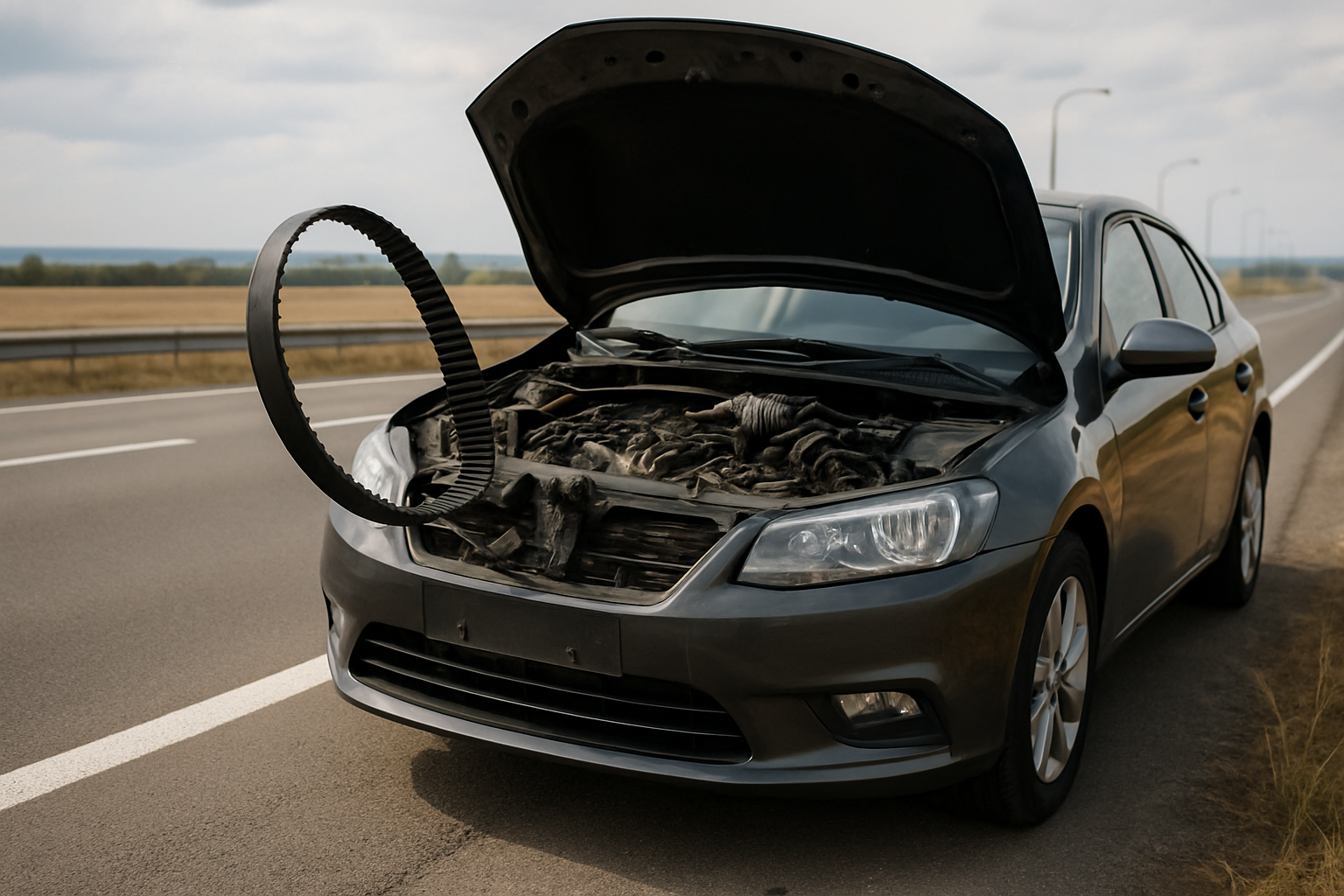
A snapped timing belt ranks among the most catastrophic mechanical failures your car can experience while driving. The consequences range from minor inconvenience to complete engine destruction, depending on your specific engine type and driving conditions when it happens.
Your timing belt keeps your engine’s pistons and valves moving in perfect synchronization. When it breaks, this coordination disappears instantly, often causing internal components to collide with devastating results.
What Actually Happens When Your Timing Belt Breaks
The moment your timing belt snaps, your engine stops running immediately. You’ll lose power steering and power brakes within seconds, making the vehicle much harder to control. Most drivers describe hearing a loud bang or thudding noise right before the engine dies.
Your dashboard will light up like a Christmas tree with warning lights. The engine simply won’t restart, no matter how many times you turn the key. You’re looking at an immediate tow to the nearest repair shop.
The severity of internal damage depends entirely on whether you have an interference or non-interference engine. This distinction determines whether you face a simple timing belt replacement or a complete engine rebuild.
Interference vs Non-Interference Engines
Non-Interference Engines (The Lucky Scenario)
Non-interference engines have enough clearance between pistons and valves that they won’t collide when timing is lost. When your timing belt breaks on these engines, you’ll need a new timing belt, tensioner, and water pump, but the internal components remain undamaged.
Common non-interference engines include many Honda VTEC motors, some Toyota 4-cylinder engines, and various domestic V6 engines from the 1990s and early 2000s. Your repair bill typically stays between $800 and $1,500.
Interference Engines (The Expensive Reality)
Most modern engines are interference designs, meaning pistons and valves occupy the same space at different times. When timing belt failure occurs, pistons smash into open valves at thousands of RPMs.
This collision bends or breaks valves, damages pistons, and often cracks cylinder heads. You’re looking at bent valves ($200-400 each), damaged pistons ($150-300 each), possible head resurfacing ($300-600), and complete engine teardown labor.
Popular interference engines include most Volkswagen and Audi motors, many Subaru boxer engines, Honda non-VTEC designs, and virtually all modern turbocharged engines.
The Immediate Driving Experience
When your timing belt snaps while driving, you’ll experience several dangerous conditions simultaneously. Your engine dies instantly, eliminating power steering assist and vacuum-assisted braking. The steering wheel becomes much heavier, and you’ll need significantly more foot pressure to stop.
If you’re on the highway, safely coast to the shoulder using your remaining momentum. Don’t attempt to restart the engine, as this can cause additional damage on interference engines. Turn on your hazard lights and call for roadside assistance.
Many drivers panic and try cranking the engine repeatedly. This grinding sound you hear is internal components colliding, potentially turning a $2,000 repair into a $6,000 nightmare.
Why Timing Belts Fail
Timing belts are wear items designed to last between 60,000 and 100,000 miles, depending on your vehicle. The rubber deteriorates over time, developing cracks and losing teeth. Heat, oil contamination, and improper tension accelerate this process.
Most failures occur due to age rather than mileage. A 10-year-old timing belt with 40,000 miles is more likely to fail than a 5-year-old belt with 80,000 miles. Extreme temperatures, both hot and cold, break down the rubber compounds faster.
Warning signs include squealing noises from the front of the engine, visible cracking on the belt (if accessible), and metallic rattling during startup. Unfortunately, many timing belts fail without warning.
The True Cost of Timing Belt Failure
Prevention Costs
Preventive timing belt replacement typically costs between $500 and $1,000, depending on your vehicle. This includes the timing belt, tensioner, idler pulleys, and water pump. Labor accounts for 60-70% of this cost due to the extensive disassembly required.
European vehicles (BMW, Mercedes, Volkswagen) tend toward the higher end due to tighter engine bay packaging. Japanese vehicles often fall in the middle range, while domestic vehicles vary widely by engine design.
Failure Costs
Timing belt failure on interference engines creates repair bills between $3,000 and $7,000. You’ll pay for complete engine disassembly, valve replacement, possible piston replacement, head work, and reassembly.
A typical interference engine repair includes 8-16 bent valves ($1,600-3,200 in parts), valve guide work ($400-800), head resurfacing ($300-600), timing components ($200-400), and 20-30 hours of labor ($2,000-3,600).
High-performance engines, turbocharged motors, and luxury vehicle engines push costs toward the upper end. Many owners discover their vehicle isn’t worth the repair cost.
Specific Engine Examples and Damage Patterns
Subaru EJ25 engines (found in Outback, Legacy, and Forester models) are notorious for expensive timing belt failures. These interference engines typically bend all 16 valves and damage pistons when belts snap. Repair costs commonly exceed $4,000.
Volkswagen 2.0T engines suffer similar fates, with additional complexity from turbocharger integration. The confined engine bay increases labor time significantly.
Honda J35 V6 engines (Pilot, Ridgeline, Odyssey) are interference designs despite Honda’s reputation for non-interference motors. Timing belt failure usually requires complete head removal and valve replacement.
Emergency Response and Damage Limitation
If your timing belt breaks while driving, your immediate response affects the final repair bill. Pull over safely and turn off the engine immediately. Don’t attempt to restart or “limp” to a repair shop.
Call your insurance company to verify towing coverage before calling a tow truck. Many policies include roadside assistance that covers timing belt failures.
When the tow truck arrives, ensure they’re not attempting to start your engine. Explain that you suspect timing belt failure and that starting attempts will cause additional damage.
Prevention and Maintenance Strategies
Replace your timing belt according to the manufacturer’s schedule, even if it looks fine. Most schedules specify both mileage and time intervals (such as 100,000 miles or 10 years). Follow whichever comes first.
Replace the water pump simultaneously with timing belt service. Both components require similar disassembly, and water pump failure can contaminate and destroy a new timing belt.
Keep records of timing belt replacement for resale purposes. Many used car buyers specifically ask about timing belt service history, especially on high-mileage vehicles.
When to Replace vs. When to Walk Away
Calculate your vehicle’s value before authorizing expensive timing belt failure repairs. If repair costs exceed 75% of the vehicle’s value, consider replacement instead.
Factors supporting repair include recent major maintenance (transmission, air conditioning), good body condition, and sentimental value. Factors against repair include high mileage, multiple pending repairs, and poor overall condition.
Get quotes from independent shops specializing in your vehicle brand. Dealership prices for timing belt failure repairs often exceed independent shop pricing by 30-50%.
Frequently Asked Questions
Can I drive with a broken timing belt?
No, you cannot drive with a broken timing belt. The engine will not run, and attempting to start it can cause additional damage on interference engines. Your only option is towing to a repair facility.
How can I tell if my engine is interference or non-interference?
Check your owner’s manual or search online using your specific engine code. Generally, most modern engines (2000 and newer) are interference designs. When in doubt, assume interference to avoid expensive mistakes.
Will my insurance cover timing belt failure?
Standard auto insurance doesn’t cover timing belt failure, as it’s considered normal wear and tear. However, some extended warranty policies or mechanical breakdown insurance may provide coverage.
How often should I inspect my timing belt?
Most timing belts aren’t easily visible without removing engine covers. Instead, follow the manufacturer’s replacement schedule religiously. If you hear unusual noises from the front of the engine, have it inspected immediately.
This article contains affiliate links. If you purchase through these links, we may earn a small commission at no extra cost to you.
Leave a Reply