
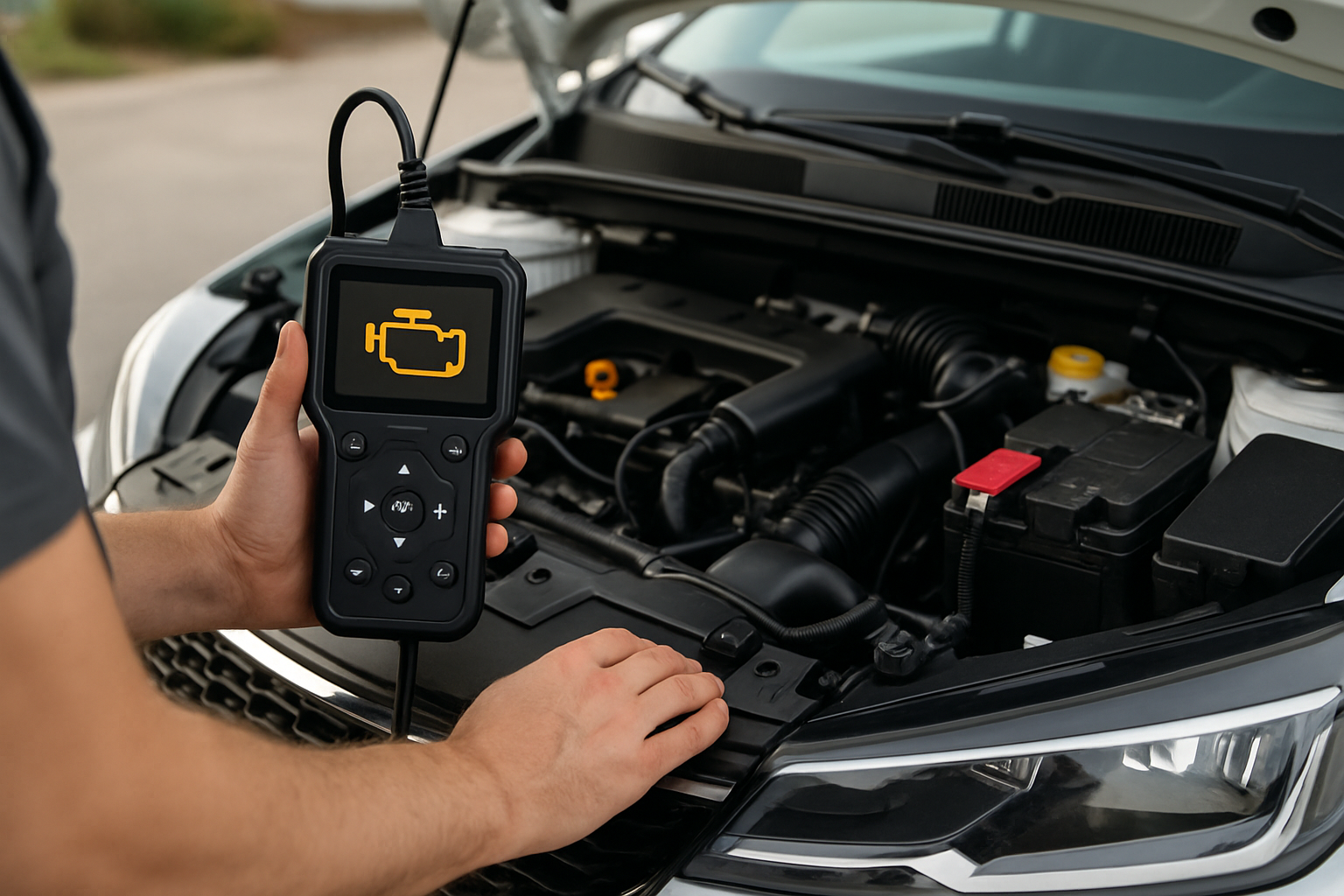
When that check engine light pops on your dashboard, you don’t have to panic and immediately drive to the mechanic. You can actually read these diagnostic codes yourself and understand what your car is trying to tell you. Modern vehicles store specific error codes that pinpoint exactly what’s wrong, and accessing them is easier than most people think.
Understanding OBD-II and Check Engine Codes
Every car built after 1996 uses something called OBD-II (On-Board Diagnostics, version 2). This system constantly monitors your engine and emissions components, storing trouble codes whenever it detects a problem. These codes follow a specific format that makes them universal across all vehicle brands.
All diagnostic trouble codes start with a letter followed by four numbers. The letter tells you which system has the problem: P for powertrain (engine and transmission), B for body, C for chassis, and U for network communication issues. Most check engine lights involve P-codes since they cover your engine’s core systems.
The first number after the P tells you whether it’s a generic code (0) or manufacturer-specific (1). Generic P0xxx codes work the same way across all brands, while P1xxx codes are specific to each automaker’s unique systems.
How to Read Your Codes Without Special Tools
Before you buy anything, check if your local auto parts stores offer free code reading. Most AutoZone, O’Reilly Auto Parts, and Advance Auto Parts locations will scan your codes for free. Just drive up, ask an employee to check your codes, and they’ll plug their scanner into your OBD-II port.
The OBD-II port is usually located under your dashboard on the driver’s side, often near the steering column or under the center console. It’s a trapezoid-shaped connector with 16 pins. Some vehicles hide it behind small covers or panels.
If you want to read codes yourself, you’ll need an OBD-II scanner. Basic code readers cost around $20-30 and simply display the codes. More advanced scanners show live data, clear codes, and provide detailed explanations.
Recommended Code Reading Tools
For DIY mechanics, OBD2 Bluetooth scanners offer the best value. These devices plug into your OBD-II port and connect wirelessly to your smartphone. Popular apps like Torque Pro or BlueDriver turn your phone into a professional-grade diagnostic tool.
Bluetooth scanners typically cost $15-50 and work with multiple vehicles. You can read codes, clear them, and monitor live engine data. Some apps even provide repair suggestions and estimate costs for common fixes.
The Four Most Common Check Engine Codes
P0420: Catalyst System Efficiency Below Threshold
This code means your catalytic converter isn’t working efficiently. The catalytic converter cleans your exhaust gases, and your car monitors its performance using oxygen sensors before and after the converter. When the downstream sensor readings are too similar to the upstream sensor, it triggers P0420.
Common causes include a failing catalytic converter, faulty oxygen sensors, exhaust leaks, or engine misfires that damage the converter over time. Sometimes using low-quality fuel or oil can trigger this code temporarily.
You can often drive with P0420 for a while, but your emissions will be higher and fuel economy may suffer. Eventually, you’ll need to replace the catalytic converter, which typically costs $500-2000 depending on your vehicle.
P0171: System Too Lean (Bank 1)
Your engine runs on a precise mixture of air and fuel. P0171 means your engine is getting too much air or not enough fuel on bank 1 (the side of the engine containing cylinder #1). This creates a “lean” condition that can damage your engine if left unfixed.
Common causes include vacuum leaks, dirty or faulty mass airflow sensors, clogged fuel injectors, weak fuel pumps, or intake manifold gasket leaks. Sometimes a dirty air filter can contribute to this code.
Lean conditions can cause rough idling, poor acceleration, and engine knock. The engine may run hotter than normal, potentially causing serious damage. Address P0171 quickly to prevent expensive repairs.
P0300: Random/Multiple Cylinder Misfire Detected
Engine misfires occur when fuel doesn’t burn properly in one or more cylinders. P0300 indicates misfires happening across multiple cylinders or randomly throughout the engine. You’ll usually feel this as rough running, shaking, or loss of power.
Misfires can stem from worn spark plugs, bad ignition coils, fuel delivery problems, or internal engine issues like low compression. Sometimes carbon buildup on intake valves causes misfires, especially in direct-injection engines.
Don’t ignore misfire codes. Unburned fuel from misfiring cylinders can damage your catalytic converter, turning a $100 spark plug problem into a $1500+ repair. If your car is shaking or running roughly, stop driving and diagnose the problem immediately.
P0442: Evaporative Emission Control System Leak Detected (Small Leak)
Your car’s EVAP system captures fuel vapors from the gas tank and burns them in the engine instead of releasing them into the atmosphere. P0442 indicates a small leak somewhere in this system, usually in hoses, the gas cap, or the charcoal canister.
The most common cause is a loose or damaged gas cap. Always try tightening or replacing your gas cap first when you see P0442. Other causes include cracked EVAP hoses, a faulty purge valve, or a damaged charcoal canister.
This code won’t hurt your engine’s performance, but it increases emissions and may prevent you from passing state inspections. The fix is usually inexpensive unless the charcoal canister needs replacement.
Reading Codes Step-by-Step
Turn your ignition to the “on” position without starting the engine. Connect your code reader to the OBD-II port and turn on the device. Most scanners will automatically communicate with your car’s computer.
Select “Read Codes” or “Diagnostic Trouble Codes” from your scanner’s menu. The device will display any stored codes along with their descriptions. Write down all the codes before clearing them or starting repairs.
Many scanners also show “pending codes” or “freeze frame data.” Pending codes are problems the computer detected but hasn’t confirmed yet. Freeze frame data shows exactly what your engine was doing when the code was set, including RPM, temperature, and sensor readings.
What to Do After Reading Codes
Don’t immediately clear the codes. Research each code online to understand the potential causes and typical repair costs. Some codes indicate simple fixes like replacing a gas cap, while others suggest major problems requiring professional diagnosis.
Check for technical service bulletins (TSBs) for your specific vehicle and the codes you’re seeing. Manufacturers sometimes issue bulletins describing known problems and recommended fixes for certain model years.
If you’re comfortable with basic repairs, start with the simplest and least expensive solutions first. For P0442, try a new gas cap. For P0300, check your spark plugs. For P0420, try using a catalytic converter cleaner additive.
Only clear codes after you’ve made repairs. Clearing codes without fixing the underlying problem will just make the check engine light come back, often within a few drive cycles.
When to See a Professional
Some codes indicate complex problems requiring professional diagnosis. Codes related to transmission control, ABS systems, or internal engine damage usually need expert attention. If you see multiple codes appearing simultaneously, there might be a single root cause affecting several systems.
Intermittent problems can be particularly tricky to diagnose. If codes come and go, or if you can’t reproduce the problem consistently, a shop with advanced diagnostic equipment may be your best option.
Don’t let shops charge you just to read codes if you’ve already done this yourself. Instead, ask them to focus on diagnosis and repair recommendations based on the specific codes you’ve identified.
Frequently Asked Questions
Will clearing codes make my check engine light go away permanently?
Clearing codes only turns off the light temporarily. If the underlying problem still exists, the codes will return and the light will come back on, usually within a few days of driving. Only fix the actual problem to permanently turn off the light.
Can I drive with the check engine light on?
This depends on the specific code and symptoms. A solid check engine light usually indicates a problem that won’t cause immediate damage, but should be addressed soon. A flashing check engine light indicates active misfires that can damage your catalytic converter and should be fixed immediately.
Why do some codes come back even after repairs?
Some problems have multiple potential causes, and you might have fixed one cause while another remains. For example, P0171 (lean condition) could be caused by both a vacuum leak and a dirty mass airflow sensor. Other times, one failing component damages related parts, requiring additional repairs.
Are code readers worth buying for occasional use?
If you own multiple vehicles or do regular maintenance, a basic code reader pays for itself quickly. Even simple models save you trips to parts stores and help you avoid unnecessary towing. Bluetooth OBD2 scanners are especially useful because they work with smartphone apps that provide detailed code explanations and repair guidance.
This article contains affiliate links. If you purchase through these links, we may earn a small commission at no extra cost to you.


Leave a Reply