
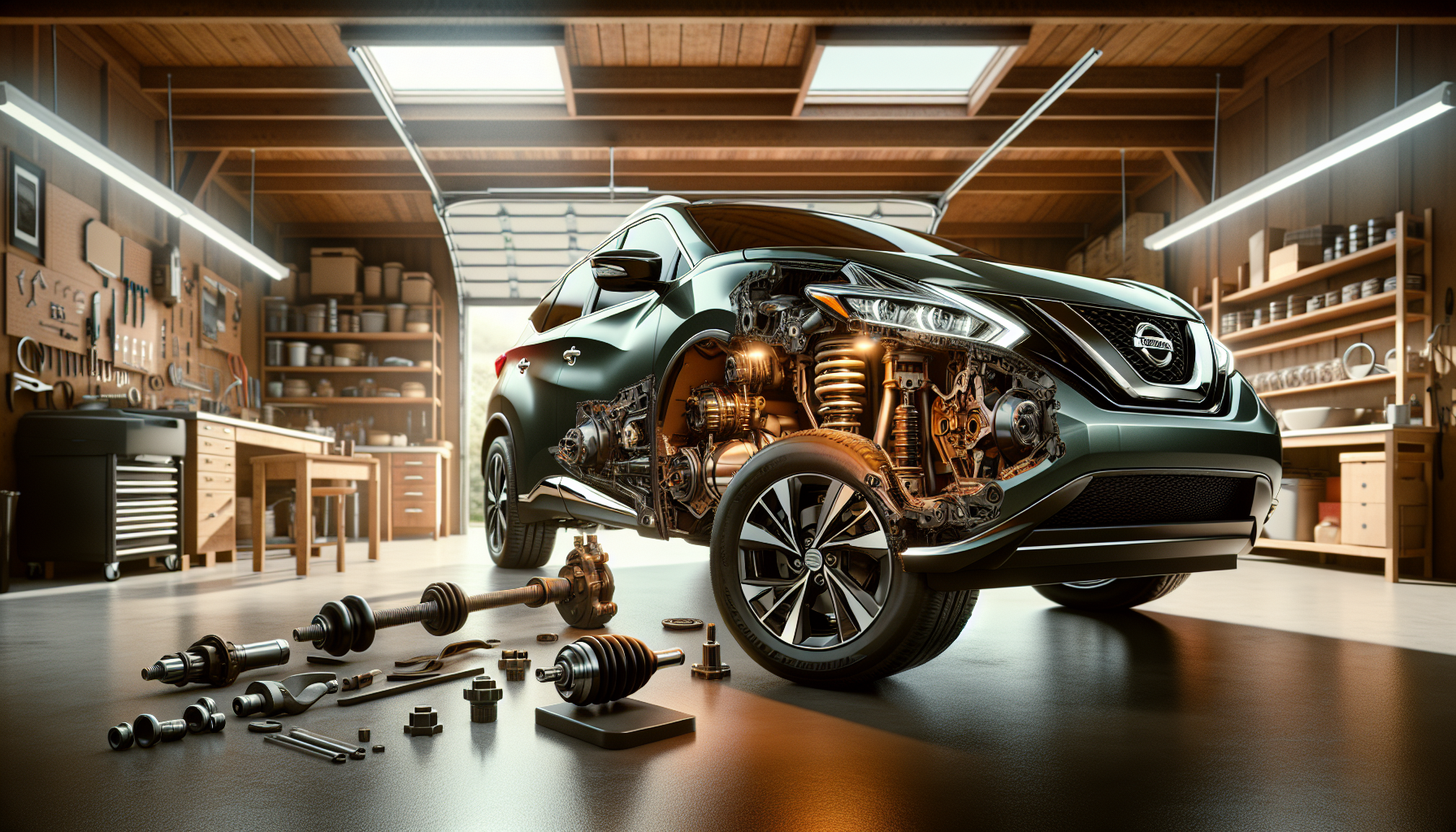
That clicking noise coming from your Nissan Murano every time you turn the steering wheel isn’t just annoying. It’s your car trying to tell you something needs attention. The sound usually happens when you’re parking, making tight turns, or navigating through a parking lot at low speeds. Sometimes it’s a sharp tick-tick-tick, other times it sounds more like a clunk or pop.
Most Murano owners hear this clicking from the front end, and the frequency often matches how fast you’re turning the wheel. The noise can come from several different components in your steering and suspension system. Some causes are minor and cheap to fix. Others signal worn parts that need replacement soon.
Common Causes
The CV joints top the list of culprits. These joints connect your axles to the wheels and allow power transfer while the suspension moves up and down. When the rubber boot protecting a CV joint tears, grease leaks out and contaminants get in. The joint starts wearing down, and that creates the clicking sound during turns. You’ll typically hear it more on sharp turns because that’s when the joint angles most severely.
Strut mounts cause clicking too. The bearing inside the strut mount sits right where your strut connects to the body of your Murano. When this bearing wears out or the mount itself deteriorates, you get a clicking or popping noise as you turn. This happens because the strut needs to rotate when you steer, and a bad bearing resists that movement.
Tie rod ends connect your steering rack to the wheels. When the ball joint inside a tie rod end wears out, it develops play. That play means metal components shift and knock against each other when you turn, creating clicking sounds. Worn tie rod ends also make your steering feel loose or imprecise.
Some Muranos develop clicking from the intermediate steering shaft. This shaft connects your steering wheel to the steering rack and has universal joints that can wear out or need lubrication. Nissan actually issued a service bulletin for some Murano model years addressing this exact issue.
Power steering fluid issues sometimes contribute. Low fluid or contaminated fluid can cause the pump to make noise, though this usually sounds more like whining than clicking. Still worth checking if you hear any unusual sounds from the front end.
How to Diagnose the Problem
Start with a visual inspection of your CV axles. Get your Murano up on jack stands safely, or just turn the wheels all the way to one side while parked. Look at the rubber boots covering the CV joints near both wheels. You’re checking for tears, cracks, or grease splattered around the area. A torn boot almost always means the CV joint is compromised. Check both the inner and outer boots on each side.
Test the strut mounts next. Open your hood and have someone turn the steering wheel back and forth while you watch the top of the strut towers. You should see smooth rotation. If you hear clicking or see jerky movement, the strut mount bearing is likely shot. You can also press down on each corner of the car and listen for noises as it rebounds.
Check tie rod ends by grabbing each front wheel at 3 and 9 o’clock and trying to wiggle it side to side. Any looseness or clunking indicates worn tie rod ends or other steering components. Then grab at 12 and 6 o’clock and wiggle to check ball joints and wheel bearings.
Drive test the car and pay attention to when exactly the clicking happens. If it only clicks during sharp turns and gets faster as you turn more, that points to CV joints. If it clicks when you first start turning the wheel from center, suspect the intermediate shaft or steering column components. Clicking that happens going over bumps while turning suggests strut mounts or suspension bushings.
This video demonstrates how to diagnose CV joint and axle problems:
Check your power steering fluid level. Pop the hood and locate the power steering reservoir. The fluid should be between the min and max lines. Dark or burnt-smelling fluid means it’s overdue for a change.
How to Fix It
Replacing a CV axle is the most common fix for clicking during turns. You can tackle this yourself if you’re comfortable with basic mechanical work. You’ll need jack stands, a socket set, a torque wrench, and a new CV axle assembly. Most auto parts stores sell complete axle assemblies for $80 to $150 each, which is easier than trying to rebuild the joint itself.
Remove the wheel, disconnect the lower ball joint or tie rod end to get clearance, and unbolt the axle from the hub. Then you’ll need to pry or pull the inner CV joint out of the transmission. The new axle slides back in, and you reverse the process. Apply fresh grease to the splines and torque everything to spec. This job takes 2-3 hours per side if you’ve never done it before.
Strut mount replacement requires removing the entire strut assembly. You can rent spring compressors from most auto parts stores. Compress the spring carefully, remove the top nut holding the strut mount, and swap in the new mount. This repair is doable at home but requires attention to safety. Those springs hold tremendous force. If you’re not confident, this is one to let a shop handle.
Tie rod ends are straightforward to replace. You’ll need a tie rod separator tool or pickle fork to pop the tapered joint loose from the steering knuckle. Loosen the jam nut on the tie rod, count how many turns it takes to remove the old end, and install the new one with the same number of turns. This gets your alignment close, but you’ll still need a proper alignment afterward.
Here’s a detailed video on diagnosing and fixing various clicking noises:
For intermediate steering shaft issues, some mechanics just clean and lubricate the joints. Nissan sells a service kit for affected models. You disconnect the shaft, clean the joints thoroughly, apply special grease, and reassemble. Takes about an hour and costs maybe $30 in parts.
Power steering fluid is easy. Drain the old fluid using a turkey baster or fluid pump, refill with fresh fluid, and turn the wheel lock to lock several times with the engine running to work out air bubbles. Use the fluid type specified in your owner’s manual.
When to See a Mechanic
Take your Murano to a shop if you’re not comfortable working under a car on jack stands. CV axle replacement isn’t technically difficult, but you need proper safety equipment and some mechanical aptitude. One mistake could damage your transmission or leave you stranded.
If you find loose tie rod ends, get them replaced quickly and have the alignment checked. Worn tie rods compromise your steering control and can fail suddenly. Not something to postpone.
Strut replacement with spring compression carries real injury risk if done incorrectly. Unless you have experience with spring compressors and proper tools, let professionals handle this one.
When you hear clicking combined with other symptoms like vibration, steering pull, or unusual tire wear, get a full front end inspection. Multiple worn components often fail around the same time, especially on higher mileage Muranos. A shop can identify everything that needs attention at once.
Any clicking accompanied by grinding, loss of power, or difficulty steering requires immediate professional attention. These indicate severe component failure that could leave you unable to control the vehicle.
Estimated Repair Costs
| Repair | DIY Cost | Shop Cost |
|---|---|---|
| CV Axle Replacement (one side) | $80-$150 | $250-$400 |
| Both CV Axles | $160-$300 | $450-$700 |
| Strut Mount (one) | $40-$80 | $150-$250 |
| Both Front Strut Mounts | $80-$160 | $300-$450 |
| Tie Rod End (one) | $25-$60 | $120-$200 |
| Both Outer Tie Rod Ends | $50-$120 | $220-$350 |
| Intermediate Shaft Service | $20-$40 | $100-$180 |
| Power Steering Fluid Change | $10-$20 | $80-$120 |
Shop costs include labor and typically a one-year warranty on parts and work. Prices vary by location and specific Murano model year. Add alignment costs ($75-$150) if you replace tie rod ends or other steering components.
Prevention Tips
Inspect CV axle boots during every oil change or tire rotation. Catching a torn boot early means you can just replace the boot instead of the entire axle. Once the boot tears and the grease escapes, you’re on borrowed time before the joint fails.
Avoid sharp turns at full lock when possible. This puts maximum stress on CV joints. If you’re parking or maneuvering in tight spaces, make your turns a bit less severe when you can.
Replace strut mounts when you replace struts. The mounts usually cost $40 each, and you already have everything apart. Installing old mounts on new struts means you’ll likely hear clicking within a year or two anyway.
Keep your power steering system maintained. Change the fluid every 60,000 miles or per your maintenance schedule. Clean fluid helps all the steering components last longer and operate smoothly.
Address unusual noises early. That slight tick you barely notice will turn into a loud click that happens constantly. Worn components damage other parts. A $150 CV axle replacement now beats a $400 repair later plus the risk of getting stranded.
Check your tire pressure monthly and rotate tires regularly. Proper tire maintenance reduces stress on suspension and steering components. Uneven tire wear can also create or amplify clicking noises.
Clicking noises when turning your Murano’s steering wheel usually mean worn CV joints, bad strut mounts, or loose steering components. Most causes are fixable with moderate DIY skills and reasonable parts costs. Catching problems early saves money and prevents being stuck with a car that won’t move. Start with visual inspections and simple tests, replace what’s worn, and your Murano should go back to turning silently.

Leave a Reply