
Yes, a bed rack can work with a tonneau cover, but ‘fits my truck’ is only one part of the answer. The rack has to fit the truck, the cover has to fit the truck, and the two mounting arrangements must be approved to work together. A good-looking picture does not establish that third connection.
Start with the exact cover name, rack name and truck configuration. If one part is already installed, record its model and part number before shopping for the other. This guide explains what to check and gives a manufacturer-documented example; it does not treat a generic rack illustration as proof of compatibility.
Why two compatible-with-the-truck products can conflict
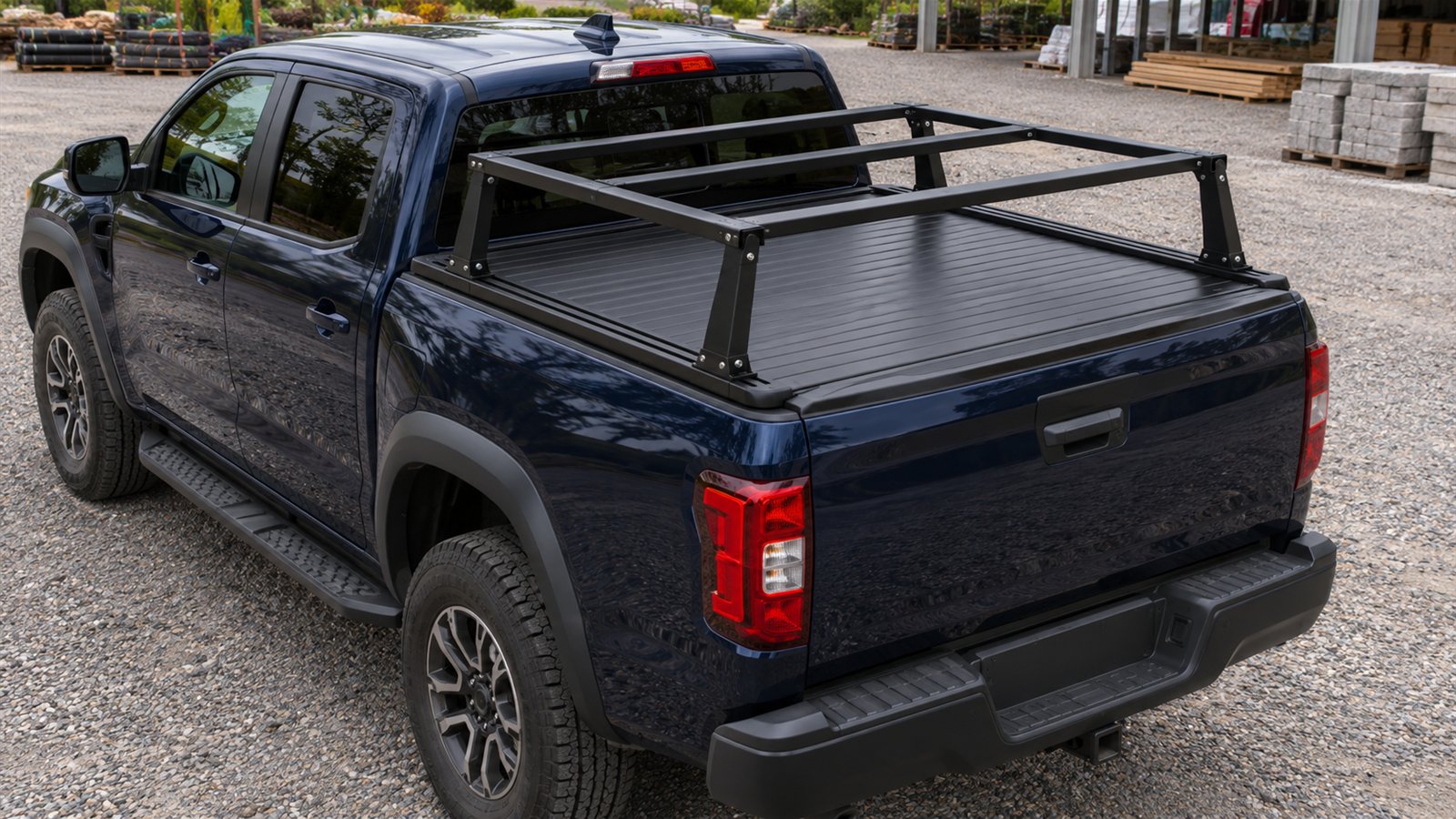
A cover and rack may both want the same space along the inside of the bed rail. Their clamps, brackets or seals can occupy that space differently. Even if both can be attached, the cover may no longer open, a latch may be blocked or a seal may be compressed in a way the maker did not intend.
Look at the full movement of the equipment. A folding panel needs clearance through its arc and in its stored position. A roll-up cover needs room for its rolled bundle and supports. A retractable cover needs room for its canister and any maintenance or drain access.
Do not solve an undocumented interference problem by omitting clamps, trimming structural parts or improvising spacers. Ask the manufacturers whether there is an approved kit or choose a different combination. A seller calling a product ‘universal’ is not the same as a documented complete system.
Three arrangements you may encounter
| Arrangement | What needs verification |
|---|---|
| Rack attached to approved cover tracks | Exact track profile, feet, adapter kit, cover and vehicle application; complete-system ratings. |
| Rack using bed-mounted brackets around a cover | Approved brackets, clamp clearance, weather seals and the cover’s full opening movement. |
| One purpose-designed combined system | The exact truck/bed application, all required components and the maker’s installation instructions. |
These are descriptions of possible architectures, not interchangeable shopping categories. Two track systems can look similar and still require different hardware. A mounting kit may also exclude a particular truck or model year even when it works with the same cover family on other vehicles.
Ask for the current fit list and installation documents. Product names can persist through revisions, so a forum photo or an older parts list may not describe what you are about to buy. If the instructions do not cover your configuration, obtain confirmation before ordering.
A documented example: Yakima’s tonneau-specific system
Yakima describes its OverHaul HD Tonneau Set as a system for selected covers with T-slot tracks, using its Tonneau Kit 1 hardware. Its published compatibility list names particular cover families and includes a vehicle-specific exception for one family. That is a useful example of why ‘has tracks’ is not a sufficient buying rule.
The same product page says the HD Bar crossbars are sold separately. Towers and an adapter bundle are therefore not necessarily a complete carrying setup. Read the component list before comparing prices or ordering accessories.
This example is not an endorsement of an untested installation on your truck. Check Yakima’s current vehicle fit information and the cover maker’s confirmation for the precise application. Do not transfer a rating from a rack’s ordinary bed-clamp version to a tonneau-mounted version.
Compare options on Amazon: Search for Yakima tonneau mounting components · Compare track-equipped covers
Use the rating for the complete combination
The rack, mounting feet, adapters, cover tracks, truck and carried equipment can each impose a limit. Use the restrictions for the documented combination and operating conditions, rather than selecting the largest number from separate product descriptions.
On-road, off-road and parked-use figures describe different situations. A parked load figure is not a driving allowance. A tent, crossbars, mounting hardware and carried equipment also have their own masses and instructions. Get the complete limits from the manufacturers before choosing a load.
This guide deliberately does not assign a universal capacity. A generic illustration cannot show bracket strength, installation quality or how load travels through a cover rail. Keep the manufacturer’s instructions with your vehicle records and recheck hardware as directed.
Check the ordinary features you still need to use
- Can the tailgate and every cover latch open normally?
- Can folded panels, the rolled cover or the retractable mechanism move fully?
- Are drain tubes, bed outlets and factory access panels available?
- Does the setup preserve rear-window, camera and lamp operation?
- Can you reach approved tie-down points and secure the cargo?
- Can either accessory be removed without damaging the other?
Measure with the equipment in the positions you will actually use. A rack that clears a closed cover may interfere as soon as a panel rises. Keep a drawing or photographs of the proposed combination and ask the supplier about the specific clearance in question.
Decide whether you need both
For some owners, a removable rack over an open bed is simpler than combining systems. For others, covered storage below and long equipment above is the whole reason to fit a rack. Make that decision around your actual cargo rather than around the appearance of an adventure build.
The open-bed rack concept in our 2016–2023 Tacoma styling gallery is useful for comparing the silhouette. That gallery does not show a cover underneath or establish a rack-and-cover application. Treat it as a visual starting point, then verify the hardware combination separately.
Before purchasing, write down the truck year and bed, exact cover, exact rack, adapter kit, crossbars and intended load. If one line still says ‘probably fits,’ the plan is not ready to order.
Leave a Reply