
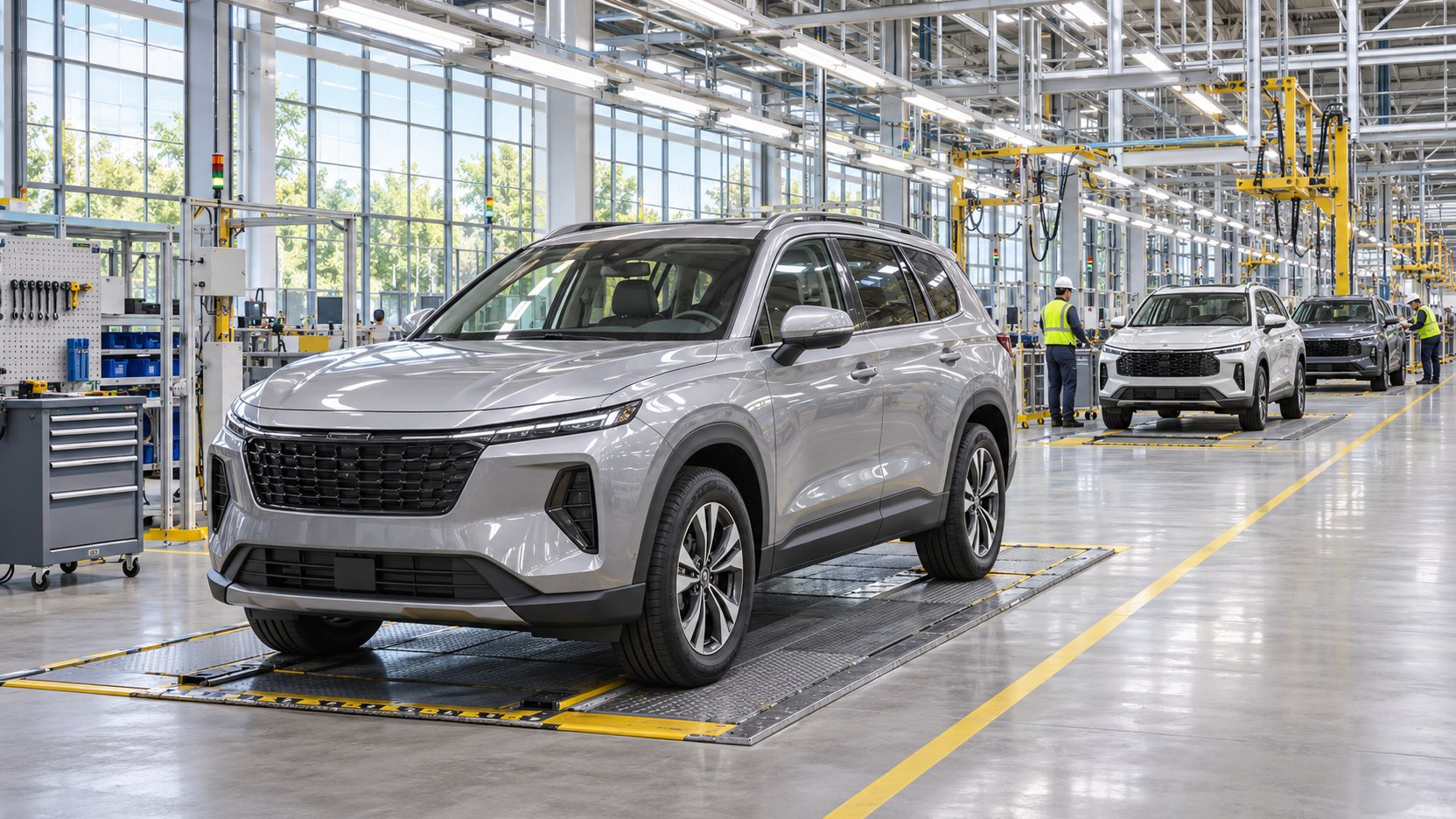
Hyundai is preparing its Alabama factory for more hybrids and extended-range EV technology, Mazda is folding the CX-70 into the CX-90 lineup, and Ford has detailed a less expensive approach to powering a house from an electric pickup. Here are the automotive developments worth following for the week ending November 2, 2026.
Coverage: October 26 at 4 p.m. Pacific through November 2 at 4 p.m. Pacific. Featured image: AI-generated illustration of a generic assembly facility, not Hyundai’s Alabama plant.
Hyundai commits roughly $450 million to its Alabama factory
Hyundai’s next round of U.S. manufacturing investment is aimed at expanding the powertrains its Montgomery, Alabama, plant can build. At an October 28 announcement, state officials said Hyundai Motor Manufacturing Alabama would invest nearly $450 million in the existing facility.
According to the Alabama governor’s announcement, the work will expand engine production for hybrid and extended-range electric vehicle technologies. The plant will also be prepared for future production of a refreshed Santa Fe and an all-new Tucson.
That is a factory preparation plan, rather than confirmation that those future models or powertrains are already rolling off the line. The announcement does not give a firm production-start date for the new applications.
The investment ties future SUV development to an established U.S. manufacturing operation. For readers sorting out the broader powertrain choices, our comparison of plug-in hybrids and fully electric vehicles explains how charging needs differ; Hyundai has not disclosed the final specifications of these future Alabama-built products.
The 2027 Mazda CX-90 absorbs the CX-70’s two-row role
Mazda is simplifying its large-SUV offering in the United States. Its October 27 announcement for the 2027 CX-90 confirms that a new two-row version replaces the CX-70 in this market.
The two-row configuration will be offered on the 3.3 Turbo Premium Sport and 3.3 Turbo S Premium Sport trims. The change brings two- and three-row choices under one nameplate, so the badge alone will no longer tell you how many rows are inside.
There are mechanical changes beyond the naming decision. Mazda says every 2027 CX-90 gets a revised rear suspension crossmember intended to improve comfort over rough surfaces. Plug-in hybrid versions also gain external insulation around the electric drive motor for quieter operation at low speeds.
The regular 3.3 Turbo engine is rated at 280 horsepower and 332 lb-ft on 87-octane gasoline; that specification should not be confused with the separate Turbo S version. An eight-speed automatic and all-wheel drive remain standard. This is a U.S. lineup announcement, not confirmation that Mazda is eliminating the CX-70 name everywhere.
Ford Fathom’s home-power system moves the inverter into the truck
Ford’s October 27 update concerns what the forthcoming Fathom can do while parked. The company says the electric pickup will offer available bidirectional AC power, delivering more than a projected 10 kW to a home without a separate wall-mounted inverter.
In its home-power announcement, Ford describes two uses: shifting electricity consumption away from expensive hours and providing backup during an outage. The first requires a Home Power Station, utility approval, and an active Ford trial or plan. Backup power also requires a Home Backup Power Panel and may require utility notice or approval.
Ford expects the charging hardware to cost about half as much as its first-generation bidirectional charger, and the backup hardware at least 60% less than its earlier equivalent. Those are company estimates, not installed-price quotes.
A companion technical explanation places the inverter inside the vehicle’s E-box. Ford still points to 2027 availability; this week’s development is the system detail, not a newly announced truck.
For a different use of stored vehicle energy, HiRide’s Ioniq 5 vehicle-to-load guide covers powering individual devices. Its instructions do not apply to connecting a Fathom to a house.
Stellantis puts its next Jeep and Durango launches on the 2027 calendar
Stellantis’s quarterly results discussion produced a product announcement more useful than the financial totals: CEO Antonio Filosa said new versions of the Jeep Grand Cherokee, Wrangler, and Gladiator are planned for the second half of calendar 2027, alongside a new Dodge Durango.
The transcript of the October 28 results call records those launch targets. Filosa also said the three Jeeps would cost less than the current vehicles, but did not supply sticker prices or explain the trim-by-trim comparison.
These statements establish management’s intended timing, not completed launches. They do not settle model-year designations, reveal dates, engines, or U.S. on-sale details for each vehicle.
For Ram, Filosa put the returning ProMaster City van at the beginning of 2027 and said midsize and compact pickups would follow later, without firm dates. Together, the plans point to a broader product range, but there is still a substantial gap between an executive’s launch calendar and a fully specified vehicle ready for an order sheet.
McLaren confirms the McL 820 name and 820 PS output
McLaren has attached a name and a power figure to its next series-production supercar: McL 820. The company confirmed the announcement on October 30, with the car planned for 2027.
As MotorWeek reports, the number refers to 820 metric horsepower, or approximately 809 mechanical horsepower. The distinction matters: an 820 PS claim is not the same as an 820-hp U.S. rating.
The reveal was deliberately limited to a name teased on a camouflaged kiwi sculpture in London. Car and Driver independently reports the confirmation and the new McL naming direction.
Neither the spectacle nor the power figure establishes the car’s final design, engine configuration, price, or delivery schedule. Those details remain for subsequent announcements. For now, it is a confirmed future product, with more substance than a trademark filing but considerably less information than a full vehicle unveiling.
Mazda adds Gemini to the new CX-5’s Google built-in system
A separate Mazda announcement brings a software change to a production vehicle. On October 27, the company said the all-new CX-5 with Google built-in now supports Google’s Gemini assistant in U.S., Canadian, European, and Japanese specifications.
The manufacturer’s release says the update is free through Google Play. Supported uses include conversational navigation searches, certain climate-control adjustments, and media requests. Instead of memorizing a fixed command, a driver can describe a destination or cabin condition in ordinary language.
Availability and compatibility vary, some connected applications require setup, and only certain vehicle functions are supported. Mazda also identifies Gemini Live as a beta feature. The announcement applies to the new CX-5’s Google built-in system; it does not promise the same upgrade for every older Mazda infotainment unit.
That makes this a defined software expansion for a particular vehicle platform. Whether the more conversational controls prove convenient in everyday driving will require experience beyond the manufacturer’s feature description.
Leave a Reply