
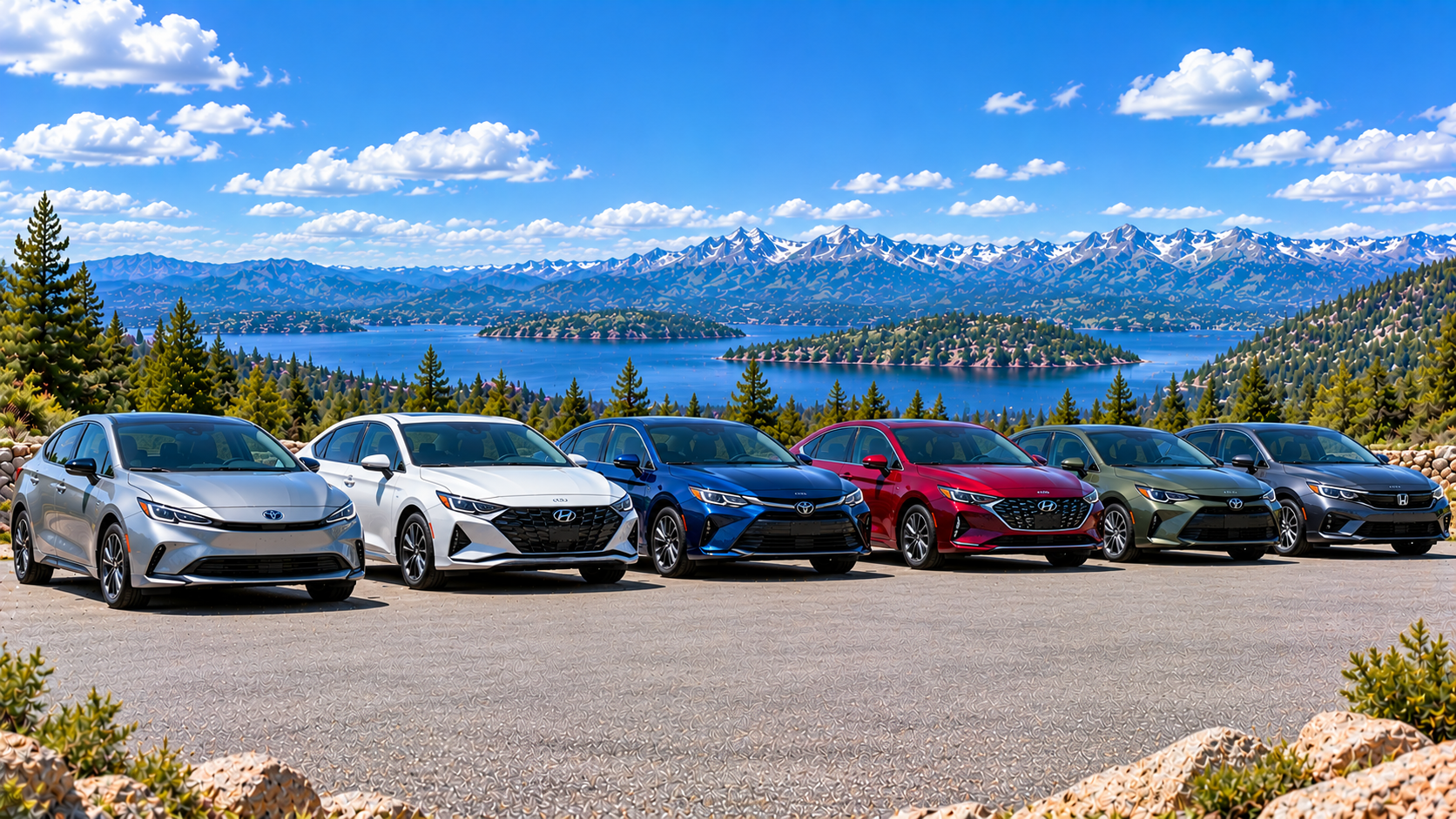
Hybrid cars have become remarkably efficient. The best models now travel more than 50 miles on a gallon of gasoline, and buyers can choose from compact hatchbacks, affordable sedans, family cars, and even sporty coupes.
The 2026 Toyota Prius leads this comparison with an EPA-estimated 57 MPG combined. The Hyundai Elantra Hybrid follows at 54 MPG, while the Toyota Camry Hybrid and Hyundai Sonata Hybrid both reach 51 MPG.
Unlike plug-in hybrids, conventional hybrids never need to be connected to a charger. Their gasoline engines and electric motors work together, with regenerative braking recovering energy that would otherwise be wasted.
Below, we rank the leading conventional hybrid cars sold in the United States for 2026–2027, examine their city and highway fuel economy, and calculate what they cost to fuel over 15,000 miles.
Hybrid Cars Ranked by MPG (2026–2027)
The table uses each model’s most fuel-efficient published configuration. Most entries are 2026 models, with confirmed 2027 ratings included where relevant. A model’s most efficient trim may have smaller wheels, front-wheel drive, or different equipment from more expensive versions.
| Rank | Hybrid Car | Year | City | Highway | Combined |
|---|---|---|---|---|---|
| 1 | Toyota Prius LE FWD | 2026 | 57 | 56 | 57 |
| 2 | Hyundai Elantra Hybrid Blue | 2026 | 51 | 58 | 54 |
| 3 (tie) | Toyota Camry LE FWD | 2026–27 | 52 | 49 | 51 |
| 3 (tie) | Hyundai Sonata Hybrid Blue | 2026 | 47 | 56 | 51 |
| 5 | Toyota Corolla Hybrid LE FWD | 2026–27 | 53 | 46 | 50 |
| 6 | Honda Civic Sedan Hybrid | 2026–27 | 50 | 47 | 49 |
| 7 | Honda Accord Hybrid EX-L | 2026 | 51 | 44 | 48 |
| 8 | Lexus ES 300h | 2026 | See configuration | 44 | |
| 9 | Honda Prelude Hybrid | 2026 | 46 | 41 | 44 |
| 10 | Toyota Crown Hybrid | 2026 | Varies by trim | 41 | |
EPA combined MPG is the primary ranking measure. The list covers leading conventional hybrid passenger cars, not every luxury, performance, or mild-hybrid model. The Lexus ES figure refers to the 2026 ES 300h; newer ES hybrid powertrains should be compared separately. Plug-in hybrids, SUVs, and minivans are excluded.
1. Toyota Prius — 57 MPG Combined
Best configuration: 2026 Prius LE FWD
EPA MPG: 57 city / 56 highway / 57 combined
The Toyota Prius remains the benchmark for conventional hybrid fuel economy. Its 2026 LE front-wheel-drive configuration achieves 57 MPG combined, making it the most efficient car in this comparison.
Its 2.0-liter hybrid powertrain produces 194 combined horsepower in front-wheel-drive form. That gives the Prius considerably more acceleration than the economy-focused hybrids of earlier generations.
The Prius also has a hatchback cargo opening, making it more versatile than a conventional compact sedan for loading luggage, groceries, or bulky items.
There are several important trim differences. Larger wheels and AWD reduce fuel economy, and the 2027 Prius LE is rated at 55 MPG combined rather than 57.
Best for: Drivers who want maximum fuel economy, useful hatchback cargo access, and reasonably strong performance.
2. Hyundai Elantra Hybrid — 54 MPG Combined
Best configuration: 2026 Elantra Hybrid Blue FWD
EPA MPG: 51 city / 58 highway / 54 combined
The Hyundai Elantra Hybrid is the most efficient conventional hybrid sedan in this comparison.
Its Blue trim achieves an exceptional 58 MPG on the highway, exceeding even the Prius’s highway rating.
The Elantra Hybrid uses a 1.6-liter gasoline engine and electric motor producing 139 combined horsepower. Unlike many hybrids, it uses a six-speed dual-clutch automatic transmission rather than an electronically controlled continuously variable transmission.
The Elantra also offers a roomy cabin for a compact sedan, making it attractive to commuters who occasionally carry passengers.
Higher Elantra Hybrid trims have different fuel-economy ratings, so buyers seeking the maximum 54 MPG should pay attention to the Blue configuration.
Best for: Highway commuters who want exceptional MPG in a traditional four-door sedan.
3. Toyota Camry Hybrid — 51 MPG Combined
Best configuration: 2026 or 2027 Camry LE FWD
EPA MPG: 52 city / 49 highway / 51 combined
The Toyota Camry is now an all-hybrid model in the United States. There is no conventional gasoline-only Camry in the current generation.
The most efficient LE front-wheel-drive configuration achieves 51 MPG combined, an impressive figure for a midsize sedan.
The Camry’s 2.5-liter hybrid powertrain produces 225 combined horsepower with FWD, while AWD models produce 232 horsepower.
AWD is a notable advantage over some competing hybrid sedans, although it reduces MPG compared with the most efficient front-wheel-drive version.
The Camry also offers a spacious rear seat, a conventional trunk, and enough power for comfortable highway travel.
Best for: Drivers who want midsize-sedan comfort, strong acceleration, and fuel economy comparable to smaller cars.
4. Hyundai Sonata Hybrid — 51 MPG Combined
Best configuration: 2026 Sonata Hybrid Blue FWD
EPA MPG: 47 city / 56 highway / 51 combined
The Hyundai Sonata Hybrid matches the Toyota Camry’s best combined fuel-economy rating at 51 MPG.
Its particularly strong 56-MPG highway rating makes it attractive to drivers who spend much of their time on freeways.
The Sonata Hybrid uses a 2.0-liter gasoline engine and an electric motor, paired with a conventional-style six-speed automatic transmission.
Compared with compact hybrids, the Sonata provides a larger cabin and a more substantial driving feel.
Buyers should verify the exact trim and model year, since the Blue trim is more efficient than some better-equipped versions.
Best for: Drivers who want an efficient midsize sedan with excellent highway mileage.
5. Toyota Corolla Hybrid — 50 MPG Combined
Best configuration: 2026–2027 Corolla Hybrid LE FWD
EPA MPG: 53 city / 46 highway / 50 combined
The Toyota Corolla Hybrid delivers 50 MPG combined while remaining one of the more affordable conventional hybrid sedans.
Its 1.8-liter hybrid powertrain produces 138 combined horsepower, prioritizing efficiency rather than acceleration.
The Corolla is smaller than the Camry and Accord, making it easy to maneuver and park in crowded areas.
AWD is available on selected Corolla Hybrid configurations, although those versions have lower fuel-economy ratings.
For drivers who want straightforward transportation with low fuel consumption, the Corolla Hybrid remains a compelling choice.
Best for: Budget-conscious commuters who want excellent city MPG and a compact sedan.
6. Honda Civic Hybrid — 49 MPG Combined
Best configuration: 2026–2027 Civic Sedan Sport Hybrid or Sport Touring Hybrid
EPA MPG: 50 city / 47 highway / 49 combined
The Honda Civic Hybrid combines excellent fuel economy with unusually strong performance for an economy-oriented compact sedan.
Its two-motor hybrid system produces 200 horsepower, making it considerably more powerful than the Corolla Hybrid and Elantra Hybrid.
The Civic Hybrid also offers responsive handling and a well-designed interior.
The sedan achieves 49 MPG combined, while hatchback versions have slightly different ratings.
Honda’s published 2027 Civic sedan ratings confirm that the Sport Hybrid and Sport Touring Hybrid continue to achieve 49 MPG combined.
Best for: Drivers who want a fuel-efficient compact car without sacrificing acceleration or handling.
7. Honda Accord Hybrid — 48 MPG Combined
Best configuration: 2026 Accord Hybrid EX-L
EPA MPG: 51 city / 44 highway / 48 combined
The Honda Accord Hybrid offers a spacious interior, comfortable ride, and strong fuel economy.
Its 2.0-liter two-motor hybrid powertrain produces 204 horsepower.
The most efficient EX-L Hybrid achieves 48 MPG combined, while other hybrid trims return slightly lower ratings.
The Accord has one of the roomiest cabins among mainstream midsize sedans, making it a good choice for families who do not need an SUV.
Although the Camry and Sonata have higher maximum combined MPG, the Accord remains competitive when comfort and interior space matter.
Best for: Families and commuters seeking a roomy, refined hybrid sedan.
8. Lexus ES 300h — 44 MPG Combined
Configuration: 2026 Lexus ES 300h FWD
EPA combined MPG: 44
The Lexus ES 300h brings hybrid efficiency to a comfortable luxury sedan.
Its gasoline-electric powertrain emphasizes smooth operation, quiet cruising, and low fuel consumption rather than outright performance.
At 44 MPG combined, it is less efficient than the leading mainstream hybrids but still economical for a midsize luxury car.
The ES is particularly appealing to drivers who prioritize seat comfort, cabin quietness, and relaxed highway travel.
Buyers comparing 2026 and 2027 models should check the exact powertrain, since the ES lineup is undergoing significant changes.
Best for: Drivers seeking a quiet, comfortable luxury sedan with conventional hybrid efficiency.
9. Honda Prelude Hybrid — 44 MPG Combined
Configuration: 2026 Prelude Hybrid FWD
EPA MPG: 46 city / 41 highway / 44 combined
The revived Honda Prelude is an unusual entry in the hybrid market because it combines a sporty coupe body with a conventional hybrid powertrain.
It uses a version of Honda’s two-motor hybrid system, paired with technology designed to give the driver a more engaging acceleration experience.
Its 44-MPG combined rating is impressive for a car positioned around driving enjoyment rather than maximum efficiency.
The trade-offs include a higher purchase price and less rear-seat practicality than a Civic or Accord.
Best for: Drivers who want a distinctive, sporty hybrid without the fuel consumption of a traditional performance coupe.
10. Toyota Crown Hybrid — 41 MPG Combined
Best configuration: 2026 Crown with standard hybrid powertrain
EPA combined MPG: Up to 41
The Toyota Crown is a larger, higher-riding sedan with standard AWD.
Its standard hybrid powertrain prioritizes smooth performance and efficiency, while the available Hybrid MAX powertrain delivers substantially more power at the expense of MPG.
The most efficient Crown configurations achieve approximately 41 MPG combined.
The Crown’s unusual combination of sedan styling, elevated seating position, and AWD makes it different from conventional midsize hybrid cars.
Best for: Drivers who want a comfortable, upscale hybrid sedan with standard AWD.
Which Hybrid Car Gets the Best Highway MPG?
The Hyundai Elantra Hybrid Blue is the highway winner among these leading models, with an EPA-estimated 58 MPG.
| Hybrid Car | Highway MPG |
|---|---|
| Hyundai Elantra Hybrid Blue | 58 |
| Toyota Prius LE FWD (2026) | 56 |
| Hyundai Sonata Hybrid Blue | 56 |
| Toyota Camry LE FWD | 49 |
| Honda Civic Sedan Hybrid | 47 |
| Toyota Corolla Hybrid LE FWD | 46 |
| Honda Accord Hybrid EX-L | 44 |
Highway MPG is especially important for drivers who regularly travel long distances at steady speeds. However, real-world fuel economy can change significantly with speed, wind, temperature, tire choice, and driving habits.
Which Hybrid Car Gets the Best City MPG?
The Toyota Prius LE achieves 57 MPG in the city for 2026, making it especially economical in stop-and-go traffic.
The Corolla Hybrid, Camry Hybrid, and Accord Hybrid also perform well in city driving because their electric motors assist during acceleration and their regenerative braking systems recover energy during deceleration.
Hybrid systems generally provide a greater efficiency advantage in city driving than on uninterrupted highways, although some models are remarkably efficient in both environments.
Which Hybrid Cars Offer All-Wheel Drive?
AWD is available on several hybrid cars, but it often comes with a modest fuel-economy penalty.
- Toyota Prius: Electronic AWD is available, although the most efficient Prius is FWD.
- Toyota Corolla Hybrid: Available electronic AWD on selected trims.
- Toyota Camry: Available electronic AWD across the hybrid lineup.
- Toyota Crown: AWD is standard.
For buyers who encounter snow or slippery roads, these models provide alternatives to purchasing a larger SUV solely to obtain AWD.
Remember that AWD helps with acceleration traction but does not replace appropriate tires or shorten stopping distances on ice.
Annual Gas Costs: Hybrid Cars Compared
To estimate annual fuel costs, assume 15,000 miles of driving and gasoline priced at $3.50 per gallon.
| Hybrid Car | Combined MPG | Gallons / Year | Annual Fuel Cost |
|---|---|---|---|
| Toyota Prius | 57 | 263 | $921 |
| Hyundai Elantra Hybrid | 54 | 278 | $972 |
| Toyota Camry Hybrid | 51 | 294 | $1,029 |
| Hyundai Sonata Hybrid | 51 | 294 | $1,029 |
| Toyota Corolla Hybrid | 50 | 300 | $1,050 |
| Honda Civic Hybrid | 49 | 306 | $1,071 |
| Honda Accord Hybrid | 48 | 313 | $1,094 |
| Lexus ES 300h | 44 | 341 | $1,193 |
| Honda Prelude | 44 | 341 | $1,193 |
| Toyota Crown Hybrid | 41 | 366 | $1,280 |
Annual costs are calculated using 15,000 miles divided by combined MPG, multiplied by $3.50. Gallons and costs are rounded for display. The figures are illustrative and do not include differences in local fuel prices or any premium-fuel recommendations.
Under these assumptions, the Prius costs approximately $921 per year to fuel, while the 41-MPG Toyota Crown costs approximately $1,280.
That is a difference of about $359 annually, or approximately $1,795 over five years.
Is a Hybrid Worth Buying Over a Gasoline Car?
A hybrid’s financial advantage depends on the purchase-price difference, annual mileage, gasoline prices, and how long the owner keeps the vehicle.
Consider a hypothetical comparison between a 35-MPG gasoline car and a 50-MPG hybrid.
At 15,000 miles per year and $3.50 per gallon:
- The 35-MPG car uses approximately 429 gallons annually, costing $1,500.
- The 50-MPG hybrid uses 300 gallons annually, costing $1,050.
- The hybrid saves approximately $450 in gasoline each year.
If the hybrid costs $2,000 more to purchase, it would take approximately 4.4 years to recover that difference through fuel savings alone.
That calculation does not include maintenance, insurance, financing, resale value, or differences in equipment.
Buyers should compare actual transaction prices rather than assuming every hybrid has the same price premium.
Do Hybrid Cars Need to Be Plugged In?
No. Conventional hybrid cars recharge their batteries while driving.
Regenerative braking converts some of the vehicle’s kinetic energy into electricity, while the gasoline engine can also generate electricity when needed.
Plug-in hybrids are different. They use larger batteries that can be charged from an external power source and can travel longer distances on electricity alone.
Because plug-in hybrids use both electricity and gasoline, they have separate MPGe and gasoline MPG ratings. Those figures should not be mixed into a conventional hybrid ranking.
Frequently Asked Questions
What is the most fuel-efficient hybrid car in 2026?
The 2026 Toyota Prius LE FWD achieves 57 MPG combined, making it the most efficient conventional hybrid passenger car in this comparison.
What is the most efficient hybrid sedan?
The 2026 Hyundai Elantra Hybrid Blue achieves 54 MPG combined, making it the most efficient conventional four-door hybrid sedan among the models ranked here.
Which hybrid midsize sedan gets the best MPG?
The Toyota Camry LE Hybrid and Hyundai Sonata Hybrid Blue both achieve up to 51 MPG combined.
What hybrid car is best for highway driving?
The Hyundai Elantra Hybrid Blue achieves an EPA-estimated 58 MPG highway, the highest highway rating among the cars in this comparison.
Which hybrid car offers AWD?
The Toyota Prius, Toyota Corolla Hybrid, and Toyota Camry offer AWD configurations. The Toyota Crown includes AWD as standard equipment.
Is the 2027 Prius more efficient than the 2026 Prius?
No. The 2026 Prius LE FWD achieves 57 MPG combined, while Toyota rates the 2027 Prius LE at 55 MPG combined.
Bottom Line
The 2026 Toyota Prius is the overall fuel-economy champion at 57 MPG combined. It combines outstanding efficiency with hatchback practicality and strong performance for a conventional hybrid.
The Hyundai Elantra Hybrid Blue is the best choice for maximum sedan efficiency, achieving 54 MPG combined and 58 MPG highway.
For families, the Toyota Camry Hybrid and Hyundai Sonata Hybrid offer an excellent combination of space and efficiency at up to 51 MPG combined.
The Toyota Corolla Hybrid is an attractive affordable commuter at 50 MPG, while the Honda Civic Hybrid offers stronger performance with 49 MPG combined.
Buyers who need AWD can consider the Prius, Corolla, Camry, or Crown, although the most efficient configurations generally use front-wheel drive.
Whichever model you choose, today’s conventional hybrids demonstrate that extremely low gasoline consumption no longer requires giving up comfort, power, or everyday practicality.
Sources and Methodology
This comparison uses published EPA fuel-economy ratings for U.S.-market conventional hybrid passenger cars. Each model is ranked by its most efficient qualifying configuration, primarily for 2026, with verified 2027 figures where available.
The ranking excludes plug-in hybrids, fully electric vehicles, SUVs, minivans, and mild-hybrid systems that do not function as full hybrids. Fuel costs are illustrative estimates using 15,000 miles per year and $3.50 per gallon.