
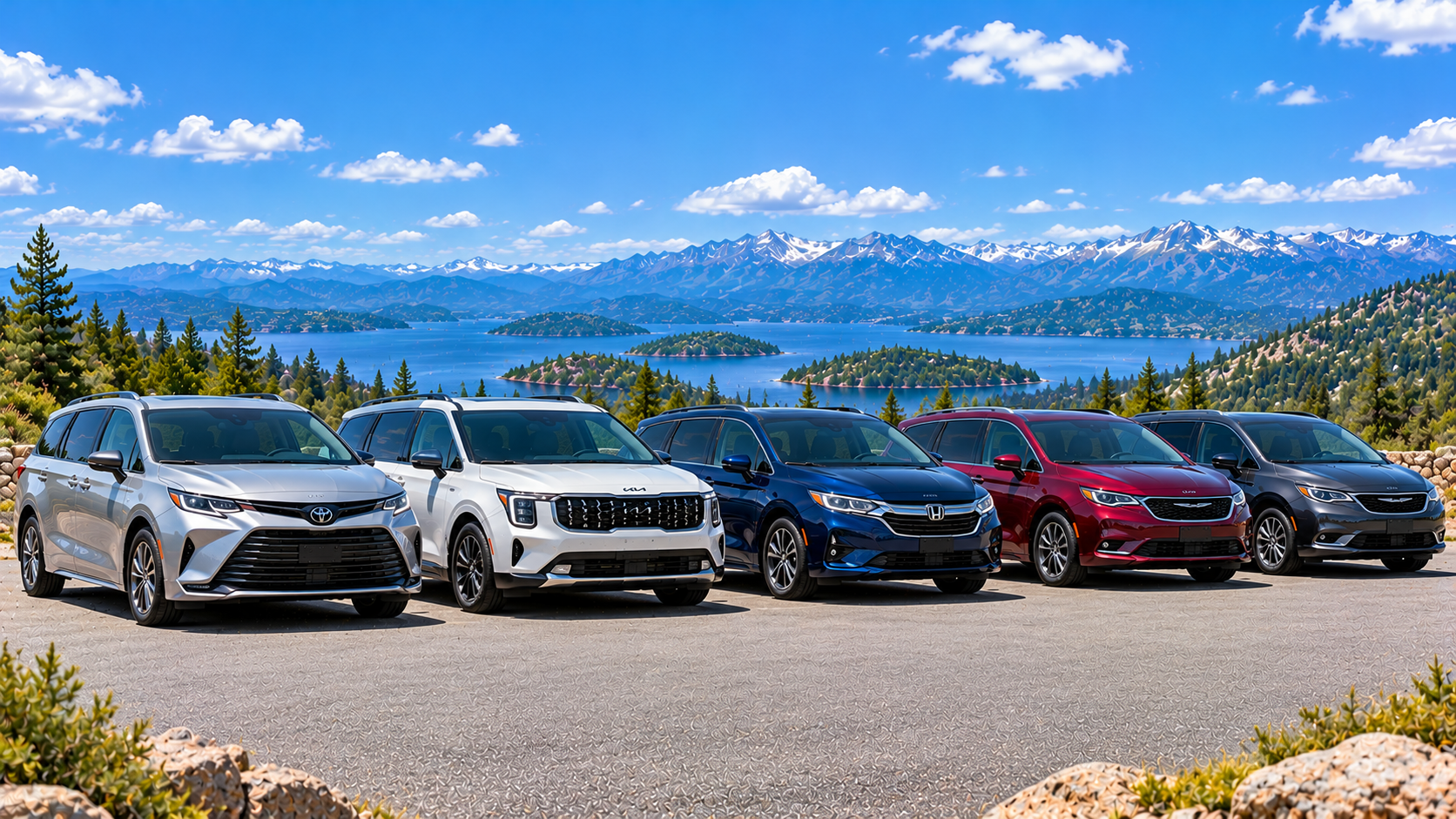
Minivans are some of the most practical vehicles for families, offering spacious third rows, sliding doors, and cargo capacity that many SUVs struggle to match. But their fuel economy varies considerably depending on whether they use a gasoline engine, conventional hybrid, or plug-in hybrid.
The Toyota Sienna is the most fuel-efficient conventional minivan in the United States for 2026, achieving up to 36 MPG combined. The Kia Carnival Hybrid follows at 32 MPG combined in Kia’s published 2026 and 2027 specifications. Gasoline-powered alternatives typically achieve 21–22 MPG combined.
Below, we rank the minivans available for the 2026–2027 model years, compare their city and highway ratings, and calculate how much families can save on gasoline by choosing a hybrid.
Every Minivan Ranked by MPG (2026–2027)
The main ranking uses EPA combined MPG for conventional gasoline and non-plug-in hybrid vehicles. The Chrysler Pacifica Plug-In Hybrid is discussed separately because it can also operate on electricity.
| Rank | Minivan | Powertrain | Year | Combined MPG |
|---|---|---|---|---|
| 1 | Toyota Sienna | 2.5L Hybrid FWD | 2026 | 36 |
| 2 | Kia Carnival Hybrid | 1.6L Turbo Hybrid FWD | 2026–2027 | 32 |
| 3 (tie) | Honda Odyssey | 3.5L V6 FWD | 2026–2027 | 22 |
| 3 (tie) | Chrysler Pacifica | 3.6L V6 FWD | 2026 | 22 |
| 3 (tie) | Chrysler Voyager | 3.6L V6 FWD | 2026 | 22 |
| 6 | Kia Carnival | 3.5L V6 FWD | 2026–2027 | 21 |
Ratings are for the specified model years and configurations. Toyota Sienna and Kia Carnival Hybrid figures are from published manufacturer and EPA information. The Chrysler Pacifica Plug-In Hybrid is excluded from the main ranking to avoid mixing electricity-inclusive MPGe with conventional MPG.
The difference between first and last place is substantial. At 15,000 miles per year, a 36-MPG Sienna uses approximately 298 fewer gallons of gasoline than a 21-MPG Carnival.
1. Toyota Sienna Hybrid — 36 MPG Combined
Best configuration: 2026 Sienna Hybrid FWD
EPA MPG: 36 city / 36 highway / 36 combined
The Toyota Sienna takes first place because every 2026 Sienna uses a conventional hybrid powertrain.
Its 2.5-liter four-cylinder hybrid system produces 245 combined horsepower and achieves 36 MPG combined with front-wheel drive.
Unlike a plug-in hybrid, the Sienna never needs to be connected to an electrical outlet. Its battery is charged through regenerative braking and operation of the gasoline engine.
The Sienna’s efficiency is particularly impressive because it offers seating for seven or eight passengers, power sliding doors, and substantial cargo capacity.
All-wheel drive is also available. The 2026 Sienna AWD achieves 35 MPG combined, just one MPG below the FWD version.
That makes the Sienna an especially attractive choice for families living in areas with snow or frequently traveling to mountain destinations.
Best for: Families who want the lowest gasoline consumption and available AWD without giving up minivan practicality.
2. Kia Carnival Hybrid — 32 MPG Combined
Best configuration: 2026–2027 Carnival Hybrid FWD
Published MPG: 34 city / 31 highway / 32 combined
The Kia Carnival Hybrid is the second most fuel-efficient conventional minivan in this comparison.
It combines a turbocharged 1.6-liter gasoline engine with an electric motor, producing 242 combined horsepower and 271 lb-ft of torque.
The Carnival Hybrid uses a six-speed automatic transmission rather than the electronically controlled continuously variable transmission found in the Sienna.
Kia publishes a 32-MPG combined rating for its 2026 and 2027 Carnival Hybrid models.
Although the Carnival Hybrid trails the Sienna by four MPG, it offers a substantial improvement over the gasoline Carnival’s 21-MPG rating.
At 15,000 miles annually, the hybrid consumes approximately 246 fewer gallons than the gasoline version.
The Carnival Hybrid is front-wheel drive only, so buyers who require AWD should consider the Toyota Sienna or Chrysler Pacifica.
Best for: Families wanting a roomy minivan with strong hybrid efficiency, conventional automatic transmission behavior, and modern interior features.
3. Honda Odyssey — 22 MPG Combined
Configuration: 2026–2027 Odyssey 3.5-liter V6 FWD
EPA MPG: 19 city / 28 highway / 22 combined
The Honda Odyssey remains one of the most recognizable family minivans in the United States.
Its 3.5-liter naturally aspirated V6 produces 280 horsepower and is paired with a 10-speed automatic transmission.
Every 2026 and 2027 Odyssey trim achieves the same EPA-estimated 22 MPG combined.
Unlike the Sienna and Carnival, the Odyssey does not offer a conventional hybrid option.
However, it has several practical advantages, including Honda’s Magic Slide second-row seating system, which allows the seats to move laterally to improve access and flexibility.
The Odyssey is also known for its spacious third row and useful cargo area.
For drivers covering 15,000 miles annually, the Odyssey consumes approximately 265 more gallons than the Sienna FWD.
Best for: Families prioritizing flexible seating, a conventional V6 engine, and passenger comfort.
4. Chrysler Pacifica Gasoline — 22 MPG Combined
Best configuration: 2026 Pacifica 3.6-liter V6 FWD
EPA MPG: 19 city / 28 highway / 22 combined
The gasoline-powered Chrysler Pacifica ties the Honda Odyssey at 22 MPG combined.
It uses a 3.6-liter Pentastar V6 producing 287 horsepower, paired with a nine-speed automatic transmission.
One of the Pacifica’s most useful features is available second-row Stow ‘n Go seating, which allows the seats to fold into compartments beneath the floor.
That makes it easier to switch between carrying passengers and transporting bulky cargo without removing the second-row seats.
The Pacifica also offers AWD, although its fuel economy is lower than that of the front-wheel-drive model.
The 2026 AWD Pacifica achieves approximately 20 MPG combined, compared with 22 MPG for FWD.
Best for: Families who want flexible cargo arrangements, a V6 engine, and available AWD.
5. Chrysler Voyager — 22 MPG Combined
Configuration: 2026 Voyager LX, 3.6-liter V6 FWD
EPA MPG: 19 city / 28 highway / 22 combined
The Chrysler Voyager shares much of its mechanical design with the gasoline Pacifica.
Its 3.6-liter V6 produces 287 horsepower and is paired with a nine-speed automatic transmission.
The Voyager achieves the same 22-MPG combined rating as the front-wheel-drive Pacifica and Honda Odyssey.
Its main distinction is its simpler equipment lineup and focus on practical family transportation.
The 2026 Voyager LX provides seven-passenger seating and a spacious cargo area without the broader range of premium trim choices found in the Pacifica.
Best for: Buyers seeking straightforward V6-powered minivan transportation with fewer trim and equipment decisions.
6. Kia Carnival Gasoline — 21 MPG Combined
Configuration: 2026–2027 Carnival 3.5-liter V6 FWD
EPA MPG: 18 city / 26 highway / 21 combined for 2027
The conventional gasoline Kia Carnival ranks last in this comparison at 21 MPG combined.
Its 3.5-liter V6 produces 287 horsepower and is paired with an eight-speed automatic transmission.
The Carnival emphasizes passenger comfort and SUV-inspired styling, with available seating for eight passengers.
Although the gasoline model offers strong power and a spacious interior, its fuel consumption is considerably higher than that of the Carnival Hybrid.
At 15,000 miles annually, the gasoline Carnival uses approximately 714 gallons of gasoline, compared with approximately 469 gallons for the hybrid.
Best for: Buyers who prefer a conventional V6 and prioritize passenger space, features, and purchase price over maximum fuel efficiency.
Minivan MPG Comparison: City, Highway, and Combined
Combined MPG is useful for an overall ranking, but city and highway figures can reveal important differences.
| Minivan | City MPG | Highway MPG | Combined MPG |
|---|---|---|---|
| Toyota Sienna FWD | 36 | 36 | 36 |
| Toyota Sienna AWD | 34 | 36 | 35 |
| Kia Carnival Hybrid | 34 | 31 | 32 |
| Honda Odyssey | 19 | 28 | 22 |
| Chrysler Pacifica FWD | 19 | 28 | 22 |
| Chrysler Voyager | 19 | 28 | 22 |
| Kia Carnival gasoline | 18 | 26 | 21 |
The Toyota Sienna leads both city and highway efficiency, achieving 36 MPG in each category.
One particularly interesting result is that the Sienna’s city rating is nearly twice that of the gasoline-powered Odyssey, Pacifica, and Voyager.
Hybrid technology is especially effective in city traffic because it recovers energy during braking and reduces gasoline-engine operation at low speeds.
Which Minivan Gets the Best MPG With AWD?
Only two minivans in the main comparison offer AWD: the Toyota Sienna and gasoline-powered Chrysler Pacifica.
| AWD Minivan | Combined MPG |
|---|---|
| 2026 Toyota Sienna Hybrid AWD | 35 |
| 2026 Chrysler Pacifica V6 AWD | 20 |
The Toyota Sienna is the clear AWD fuel-economy winner.
At 15,000 miles annually, a 35-MPG Sienna AWD uses approximately 321 fewer gallons of gasoline than a 20-MPG Pacifica AWD.
AWD can improve traction when accelerating on slippery roads, but winter tires remain important for braking and cornering performance in snow and ice.
What About the Chrysler Pacifica Plug-In Hybrid?
The Chrysler Pacifica Plug-In Hybrid deserves special attention because it offers a different approach to fuel efficiency.
For 2026, the Pacifica Plug-In Hybrid has published EPA ratings of:
- 82 MPGe when accounting for electricity and gasoline.
- 32 miles of estimated electric driving range on a full charge.
- 30 MPG combined when operating on gasoline after the usable battery charge is depleted.
The distinction between MPG and MPGe matters.
MPGe converts electricity consumption into an equivalent amount of gasoline energy. It is not the same as saying the vehicle achieves 82 miles per gallon while operating exclusively on gasoline.
A family that drives 20 miles per day and charges the Pacifica every night might complete most of its routine trips using electricity.
However, a family that rarely charges the battery will rely much more heavily on the gasoline engine and should focus on the 30-MPG gasoline-only rating.
The Pacifica Plug-In Hybrid is therefore most attractive to buyers who have convenient charging access and regularly drive distances within its electric range.
Electricity prices and charging losses also affect the total operating cost.
How Much Does Each Minivan Cost in Gas Per Year?
To compare annual fuel costs, assume:
- 15,000 miles driven annually.
- Gasoline priced at $3.50 per gallon.
- Fuel consumption based on EPA combined MPG.
| Minivan | Combined MPG | Gallons / Year | Annual Gas Cost |
|---|---|---|---|
| Toyota Sienna Hybrid FWD | 36 | 417 | $1,458 |
| Toyota Sienna Hybrid AWD | 35 | 429 | $1,500 |
| Kia Carnival Hybrid | 32 | 469 | $1,641 |
| Honda Odyssey | 22 | 682 | $2,386 |
| Chrysler Pacifica FWD | 22 | 682 | $2,386 |
| Chrysler Voyager | 22 | 682 | $2,386 |
| Kia Carnival gasoline | 21 | 714 | $2,500 |
Costs are calculated using unrounded fuel consumption and rounded to the nearest dollar. These are illustrative estimates, not current gasoline-price forecasts. Plug-in hybrid electricity costs are excluded.
The difference between a Toyota Sienna Hybrid FWD and gasoline Kia Carnival is approximately $1,042 per year.
Over five years, that amounts to roughly $5,208 in gasoline savings under the same assumptions.
Even the difference between the Carnival Hybrid and gasoline Carnival is substantial, at approximately $859 annually.
Is a Hybrid Minivan Worth the Extra Money?
For families that drive 15,000 miles annually or more, the fuel savings from a hybrid minivan can be significant.
Consider the Kia Carnival gasoline model at 21 MPG and the Carnival Hybrid at 32 MPG.
At 15,000 miles annually and $3.50 per gallon, the hybrid saves approximately $859 in gasoline every year.
If the hybrid costs $3,000 more than a comparably equipped gasoline model, fuel savings alone could recover that difference in about 3.5 years.
That is only an example. Actual payback depends on transaction prices, trim differences, financing, insurance, maintenance, annual mileage, and fuel prices.
The Toyota Sienna is a different case because it is hybrid-only. Buyers cannot choose a lower-priced conventional gasoline Sienna for the same model year.
Which Minivan Is Best for a Large Family?
Fuel economy is important, but families should also consider seating flexibility, cargo space, and how frequently they use the third row.
Best for Maximum Fuel Economy: Toyota Sienna
The Sienna delivers the best conventional MPG and offers AWD. It is an excellent choice for families that accumulate substantial mileage.
Best Alternative Hybrid: Kia Carnival Hybrid
The Carnival Hybrid combines strong efficiency with a spacious interior and modern technology. Its main disadvantage compared with the Sienna is the lack of AWD.
Best for Flexible Second-Row Seating: Honda Odyssey
The Odyssey’s Magic Slide seating system makes it especially useful for families managing child seats and frequent third-row access.
Best for Cargo Flexibility: Chrysler Pacifica
The gasoline Pacifica’s available Stow ‘n Go second-row seats allow families to create a large, flat cargo area without removing heavy seats from the vehicle.
Best for Short Daily Trips With Charging: Pacifica Plug-In Hybrid
The plug-in hybrid can cover many shorter trips on electricity, potentially reducing gasoline consumption substantially for households that charge regularly.
Frequently Asked Questions
What is the most fuel-efficient minivan in 2026?
The Toyota Sienna Hybrid FWD leads conventional gasoline and hybrid minivans with 36 MPG combined. The AWD version achieves 35 MPG combined.
Which minivan gets the best highway MPG?
The Toyota Sienna Hybrid achieves 36 MPG highway in both FWD and AWD configurations for 2026.
Are there any hybrid minivans?
Yes. The Toyota Sienna and Kia Carnival Hybrid use conventional hybrid systems that do not require plugging in. The Chrysler Pacifica Plug-In Hybrid can also drive on electricity when charged.
Does Honda make a hybrid Odyssey?
No. The 2026 and 2027 Honda Odyssey use a 3.5-liter V6 gasoline engine, rated at 22 MPG combined.
Which minivan gets the best MPG with AWD?
The 2026 Toyota Sienna Hybrid AWD leads at 35 MPG combined.
Is a minivan more fuel-efficient than a three-row SUV?
It depends on the models being compared. The Toyota Sienna achieves 36 MPG combined, matching some of the most efficient three-row hybrid SUVs. Many conventional gasoline three-row SUVs and minivans return MPG in the low 20s.
Bottom Line
The Toyota Sienna Hybrid is the fuel-economy winner among conventional 2026 minivans, achieving up to 36 MPG combined. It also offers an unusually efficient AWD configuration rated at 35 MPG.
The Kia Carnival Hybrid follows at 32 MPG combined in Kia’s published specifications, delivering meaningful savings over the gasoline Carnival.
The Honda Odyssey, Chrysler Pacifica, and Chrysler Voyager tie at 22 MPG combined, while the gasoline Kia Carnival achieves 21 MPG.
For families with convenient home charging, the Chrysler Pacifica Plug-In Hybrid offers another approach, with 32 miles of electric range and 30 MPG on gasoline alone.
For drivers whose priority is reducing gasoline consumption without plugging in, the Toyota Sienna remains the strongest choice.
Sources and Methodology
This comparison covers U.S.-market minivans available for the 2026 and 2027 model years. Rankings use published EPA combined MPG for the specified configurations. Where a 2027 figure is not confirmed, a 2026 rating is identified instead of assuming it carries over.
Plug-in hybrid MPGe ratings are reported separately because they include electricity consumption. Actual MPG varies with driving habits, traffic, temperature, tires, passenger load, and vehicle condition.
- EPA and U.S. Department of Energy — Official Fuel Economy Ratings
- Toyota — Sienna Hybrid Specifications
- Kia — 2026 Carnival Hybrid EPA Ratings
- Kia — 2027 Carnival Gasoline Specifications
- Honda — 2027 Odyssey EPA Ratings
- Chrysler — 2026 Pacifica Fuel Economy and AWD
- Chrysler — 2026 Voyager Specifications