
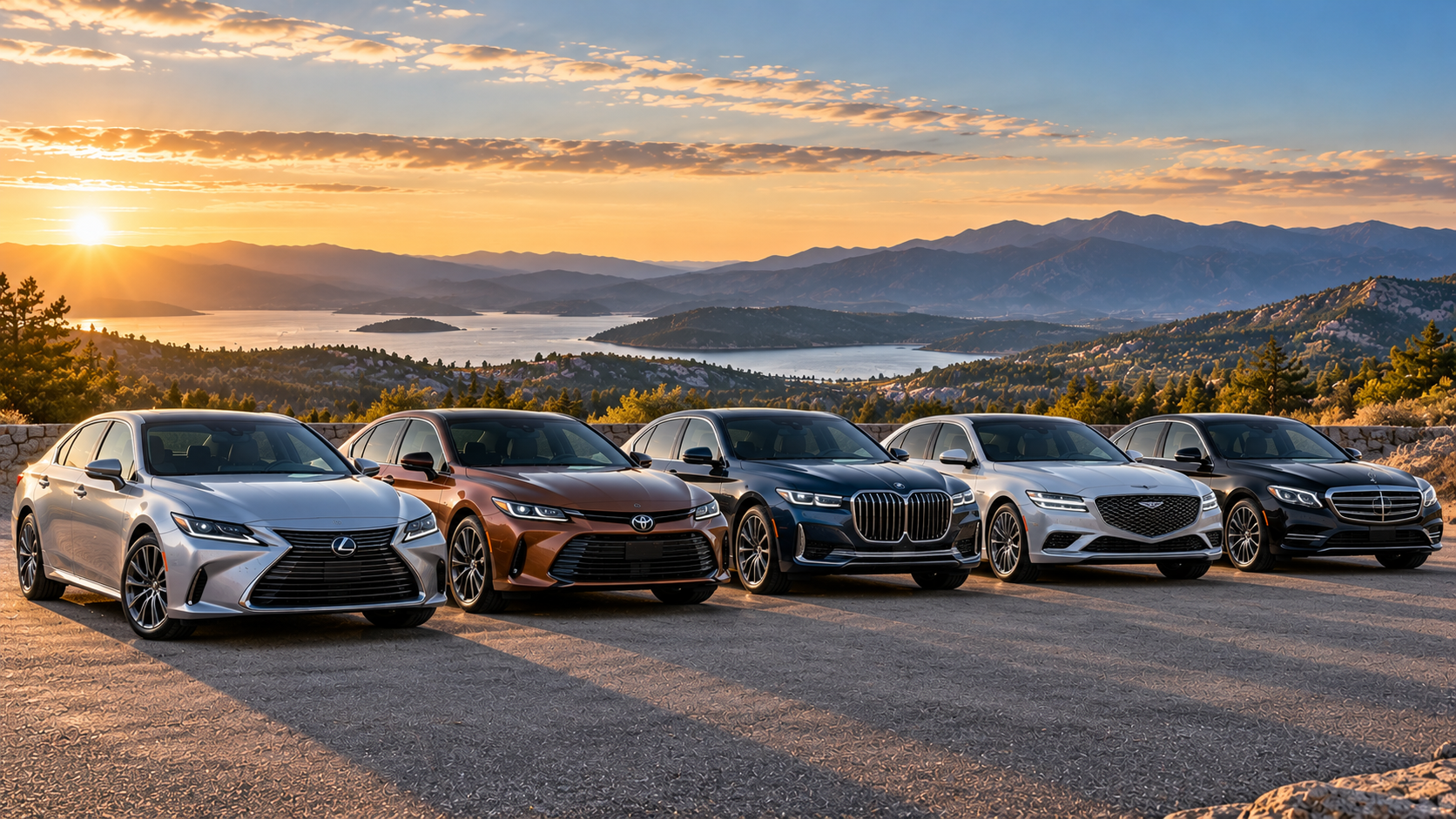
Full-size sedans have become a smaller part of the American car market, but they still offer something many buyers prefer over an SUV: a spacious cabin, a comfortable ride, and potentially much better fuel economy.
For 2026 and 2027, the most efficient large sedans are hybrids. The Lexus ES 350h leads the broader large-sedan comparison with an EPA-estimated 46 MPG combined, while the Toyota Crown delivers up to 41 MPG for 2026 and 40 MPG for 2027. Conventional gasoline luxury sedans generally return between 20 and 28 MPG combined.
Below, we compare the major full-size and large luxury sedans available in the United States, including their most efficient gasoline or hybrid configurations, annual fuel consumption, and the differences between model years.
Every Full-Size Sedan Ranked by MPG (2026–2027)
These rankings include large mainstream sedans and full-size luxury sedans. The Lexus ES is included as a spacious near-luxury alternative, even though some classification systems place it in the midsize category. The Dodge Charger is included as a large four-door performance sedan.
Each model is ranked using its highest verified combined MPG for either model year. Ratings from different years are not interchangeable; where 2027 data is unavailable or not independently confirmed, the table identifies the model year used.
| Rank | Sedan | Best Powertrain | Model Year | Combined MPG |
|---|---|---|---|---|
| 1 | Lexus ES 350h | 2.5L hybrid, FWD | 2026–2027 | 46 |
| 2 | Toyota Crown | 2.5L hybrid, AWD | 2026 | 41 |
| 3 | BMW 7 Series | 740i gasoline / mild hybrid | 2026 | 28 |
| 4 | BMW 8 Series Gran Coupe | 840i gasoline | 2026 | 24 |
| 5 | Mercedes-Benz S-Class | Gasoline / mild hybrid | 2026 | 23 |
| 6 | Audi A8 | 3.0L turbo V6, AWD | 2026 | 22 |
| 7 | Genesis G90 | 3.5L twin-turbo V6, AWD | 2026 | 21 |
| 8 | Porsche Panamera | Gasoline | 2027 | 21 |
| 9 | Dodge Charger Four-Door | 3.0L twin-turbo I6, AWD | 2027 | 20 |
MPG values reflect the best identified gasoline or non-plug-in hybrid configuration for the stated model year. The BMW, Mercedes-Benz, Audi, Genesis, Porsche, and Dodge figures should be checked against the exact EPA configuration before purchase. The 2026 Toyota Crown’s best combined rating is 41 MPG; Toyota lists 40 MPG combined for the 2027 Crown. Plug-in hybrids and fully electric sedans are excluded.
The difference between the leaders and the traditional luxury sedans is substantial. At 15,000 miles per year, a sedan rated at 46 MPG uses less than half as much fuel as one rated at 21 MPG.
1. Lexus ES 350h — 46 MPG Combined
Best configuration: 2.5-liter four-cylinder hybrid, front-wheel drive
2026 MPG: 48 city / 44 highway / 46 combined
2027 MPG: 48 city / 44 highway / 46 combined
The redesigned Lexus ES 350h is the efficiency leader in this comparison. Its sixth-generation hybrid system produces 244 combined horsepower while delivering 46 MPG combined in front-wheel-drive form.
The all-wheel-drive ES 350h is slightly less efficient, at 44 MPG combined.
The latest ES is larger than its predecessor and offers a higher seating position. It combines a spacious cabin, quiet operation, and a traditional sedan body style with fuel consumption more commonly associated with compact hybrid cars.
The 2027 ES carries over the redesigned 2026 model’s hybrid powertrain and EPA fuel-economy ratings.
For buyers who want a large, comfortable sedan but expect to drive substantial annual mileage, the ES 350h is an especially strong choice.
Best for: Buyers prioritizing maximum fuel economy, comfort, and a premium interior.
2. Toyota Crown — Up to 41 MPG Combined
Best configuration: 2.5-liter four-cylinder hybrid, all-wheel drive
2026 MPG: Up to 41 combined
2027 MPG: 42 city / 38 highway / 40 combined
The Toyota Crown is Toyota’s flagship sedan in the United States and the company’s only current model explicitly marketed as a full-size car.
Its standard hybrid powertrain combines a 2.5-liter four-cylinder engine with electric assistance and all-wheel drive. The 2027 model produces 236 combined horsepower and achieves 40 MPG combined.
That makes the Crown substantially more efficient than most conventional gasoline-powered luxury sedans.
Unlike the Lexus ES, which offers front-wheel drive, the Crown includes all-wheel drive as standard equipment.
Toyota also offers a more powerful Hybrid MAX system in the Platinum trim. This powertrain produces 340 horsepower but returns approximately 30 MPG combined for 2027.
The Crown therefore offers two distinct choices: an efficiency-focused hybrid or a considerably more powerful performance-oriented hybrid.
Best for: Buyers seeking a spacious hybrid sedan with standard all-wheel drive and relatively low fuel consumption.
3. BMW 7 Series — Up to 28 MPG Combined
Best configuration: 740i gasoline with mild-hybrid assistance
Best verified model year: 2026
The BMW 7 Series is one of the largest and most luxurious sedans sold in the United States.
Its most efficient conventional gasoline configuration is the 740i, which combines a turbocharged inline-six engine with mild-hybrid technology.
With a best combined rating of approximately 28 MPG for 2026, the 740i is relatively efficient for a vehicle of its size, weight, and performance.
More powerful versions, including the V8-powered 760i, consume substantially more fuel.
The 7 Series also offers an exceptionally spacious rear cabin and numerous comfort and technology features. It is designed primarily for luxury and refinement rather than minimum ownership costs.
Best for: Buyers wanting flagship luxury, strong performance, and relatively good efficiency for a large gasoline sedan.
4. BMW 8 Series Gran Coupe — Up to 24 MPG Combined
Best configuration: 840i gasoline
Best verified model year: 2026
The BMW 8 Series Gran Coupe combines four-door practicality with a lower, sportier body than a traditional luxury flagship sedan.
The six-cylinder 840i is the efficiency-focused choice, achieving approximately 24 MPG combined for 2026.
More powerful V8 configurations sacrifice fuel economy in exchange for additional acceleration and performance.
The Gran Coupe’s sloping roofline and sport-oriented design distinguish it from the taller and more rear-passenger-focused 7 Series.
It is best viewed as a performance-oriented luxury sedan rather than a direct substitute for a traditional large family car.
Best for: Buyers who want four doors, premium features, and a sportier driving experience.
5. Mercedes-Benz S-Class — Up to 23 MPG Combined
Best configuration: Gasoline engine with mild-hybrid assistance
Best verified model year: 2026
The Mercedes-Benz S-Class is designed around passenger comfort, refinement, and advanced technology.
Its gasoline lineup includes six-cylinder and V8 engines, with mild-hybrid assistance on selected versions.
The most efficient conventional gasoline configuration achieves approximately 23 MPG combined for 2026.
That places the S-Class behind the BMW 740i and far behind the Toyota and Lexus full hybrids, but the Mercedes emphasizes a different set of priorities.
Buyers choose the S-Class for its quiet cabin, ride comfort, available rear-seat amenities, and luxury features.
Best for: Buyers prioritizing luxury, comfort, and refinement over fuel economy.
6. Audi A8 — 22 MPG Combined
Best configuration: 3.0-liter turbocharged V6, quattro all-wheel drive
Best verified model year: 2026
The Audi A8 offers a traditional full-size luxury sedan experience with understated styling and standard all-wheel-drive capability.
The 2026 A8’s turbocharged V6 configuration is rated at 22 MPG combined, with 19 MPG city and 27 MPG highway.
Unlike the Toyota Crown or Lexus ES 350h, the A8 does not use a full hybrid system designed to provide substantial electric-only propulsion during normal driving.
Its mild-hybrid technology primarily supports the gasoline engine and certain vehicle electrical functions.
The A8’s strengths are cabin refinement, available technology, and comfortable long-distance travel.
Best for: Buyers wanting a conventional full-size luxury sedan with standard all-wheel drive.
7. Genesis G90 — Up to 21 MPG Combined
Best configuration: 3.5-liter twin-turbocharged V6, all-wheel drive
Best verified model year: 2026
The Genesis G90 is the Korean luxury brand’s flagship sedan.
Its standard 3.5-liter twin-turbo V6 produces 375 horsepower and achieves approximately 21 MPG combined. Genesis lists city and highway ratings of 18 and 26 MPG for this configuration.
A more powerful version with an electric supercharger and 48-volt mild-hybrid system produces 409 horsepower but consumes more fuel.
At more than 207 inches long, the G90 offers substantial rear-seat space and a comfort-focused driving experience.
Its fuel economy is modest, but buyers considering the G90 are likely to place greater emphasis on cabin appointments, quietness, and value relative to other flagship luxury sedans.
Best for: Buyers seeking flagship luxury and generous passenger space.
8. Porsche Panamera — Up to 21 MPG Combined
Best configuration: Conventional gasoline powertrain
Best verified model year: 2027
The Porsche Panamera combines a four-door body with sports-car-oriented performance.
The most efficient conventional gasoline configuration achieves approximately 21 MPG combined for 2027.
The Panamera also offers plug-in hybrid variants, but those are excluded from this ranking because their efficiency depends partly on how frequently they are charged and driven on electricity.
Compared with the traditional flagship sedans in this article, the Panamera emphasizes handling, acceleration, and driver engagement.
Its hatch-style rear opening also provides a different cargo arrangement from a conventional sedan trunk.
Best for: Buyers seeking a performance-oriented luxury four-door rather than maximum MPG.
9. Dodge Charger Four-Door — Up to 20 MPG Combined
Best configuration: 3.0-liter twin-turbocharged inline-six, all-wheel drive
Best verified model year: 2027
The four-door Dodge Charger brings traditional American performance-car character to the large-sedan segment.
Its gasoline-powered twin-turbocharged inline-six delivers considerably more emphasis on acceleration than fuel economy.
For 2027, the gasoline four-door Charger is rated at approximately 19–20 MPG combined, depending on configuration.
That places it near the bottom of this comparison, although its performance-oriented mission makes the result unsurprising.
The Charger also uses a large rear opening that improves cargo access compared with a traditional sedan trunk.
Best for: Buyers wanting a spacious four-door performance car with strong acceleration and distinctive styling.
How Much Fuel Does Each Full-Size Sedan Use Per Year?
Fuel economy becomes easier to compare when converted into annual fuel consumption.
Assuming 15,000 miles per year, the following table estimates the amount of gasoline consumed by each model at its best listed combined MPG rating.
| Sedan | Combined MPG | Gallons / Year |
|---|---|---|
| Lexus ES 350h | 46 | 326 |
| Toyota Crown (2026) | 41 | 366 |
| Toyota Crown (2027) | 40 | 375 |
| BMW 7 Series | 28 | 536 |
| BMW 8 Series Gran Coupe | 24 | 625 |
| Mercedes-Benz S-Class | 23 | 652 |
| Audi A8 | 22 | 682 |
| Genesis G90 | 21 | 714 |
| Porsche Panamera | 21 | 714 |
| Dodge Charger Four-Door | 20 | 750 |
Annual fuel consumption is calculated as 15,000 divided by combined MPG and rounded to the nearest gallon. Figures are estimates, not measured real-world consumption.
The difference is significant. A Lexus ES 350h rated at 46 MPG consumes approximately 424 fewer gallons annually than a large performance sedan rated at 20 MPG.
At an illustrative gasoline price of $3.50 per gallon, that represents approximately $1,484 in annual fuel savings.
Actual savings will depend on fuel prices, premium-fuel requirements, driving conditions, and annual mileage.
Hybrid vs. Gasoline: Which Full-Size Sedan Is More Economical?
Full Hybrids: Best for Fuel Economy
The Lexus ES 350h and Toyota Crown demonstrate the efficiency advantage of full hybrid systems.
Both can recover energy during braking and use electric assistance to reduce gasoline consumption.
The Lexus leads with 46 MPG combined, while the Crown delivers up to 41 MPG for 2026 and 40 MPG for 2027.
Mild Hybrids: Primarily Gasoline-Powered
Several luxury sedans use 48-volt mild-hybrid systems.
These systems can improve engine operation and efficiency, but they generally do not provide the same fuel-economy benefits as the full hybrid systems used by Lexus and Toyota.
The BMW 740i, Mercedes-Benz S-Class, and Audi A8 are examples of luxury sedans that use mild-hybrid technology in certain configurations.
Performance Gasoline Engines: More Power, More Fuel
Large performance sedans such as the Dodge Charger and Porsche Panamera prioritize acceleration, handling, and engine output.
They may appeal to buyers who place relatively little weight on fuel costs, particularly when annual mileage is low.
Are Full-Size Sedans More Fuel-Efficient Than Full-Size SUVs?
Generally, yes.
Sedans usually have lower ride heights, less frontal area, and lower curb weights than comparable full-size SUVs. These characteristics can reduce aerodynamic drag and fuel consumption.
For example, the 2026 Lexus ES 350h achieves 46 MPG combined, compared with 22 MPG for the 2026 Toyota Sequoia hybrid.
The vehicles serve different purposes, but the difference illustrates how body design and vehicle size can affect efficiency.
For a direct comparison of larger SUVs, see our 2026–2027 full-size SUV MPG rankings.
Which Full-Size Sedan Gets the Best MPG?
- Best overall in this comparison: Lexus ES 350h — 46 MPG combined.
- Best mainstream full-size sedan: Toyota Crown — up to 41 MPG combined for 2026.
- Best conventional luxury gasoline sedan: BMW 740i — up to approximately 28 MPG combined for 2026.
- Best for performance-focused buyers: The Porsche Panamera and Dodge Charger offer different driving priorities, although their fuel economy is considerably lower.
The Lexus ES 350h and Toyota Crown stand out because they combine generous passenger space with fuel economy that is unusual among large sedans.
Bottom Line
The Lexus ES 350h is the fuel-economy leader in this broader large-sedan comparison, achieving 46 MPG combined for both 2026 and 2027.
The Toyota Crown is the leading mainstream full-size sedan, returning up to 41 MPG for 2026 and 40 MPG for 2027 with its standard hybrid powertrain.
Buyers interested in traditional flagship luxury sedans will find lower MPG figures, generally ranging from the low 20s to the upper 20s. Those vehicles place greater emphasis on performance, comfort, and equipment.
For drivers who prioritize operating costs, the Lexus ES 350h and Toyota Crown are the strongest choices. For those prioritizing luxury or performance, the BMW 7 Series, Mercedes-Benz S-Class, Genesis G90, and other large sedans offer alternatives with different strengths.
Sources and Methodology
This comparison covers selected large mainstream, near-luxury, flagship luxury, and large performance sedans offered in the United States for the 2026–2027 model years. Because manufacturers and automotive classification systems do not always agree on what qualifies as a full-size sedan, the scope is broader than a single EPA size class.
Rankings use the highest identified combined MPG for a conventional gasoline or non-plug-in hybrid configuration. Where a 2027 rating was not verified, the table uses a clearly identified 2026 figure. Plug-in hybrids and fully electric sedans are excluded.
EPA estimates are standardized laboratory-based comparisons. Actual fuel economy depends on driving habits, weather, tires, traffic, and vehicle condition.
Leave a Reply