
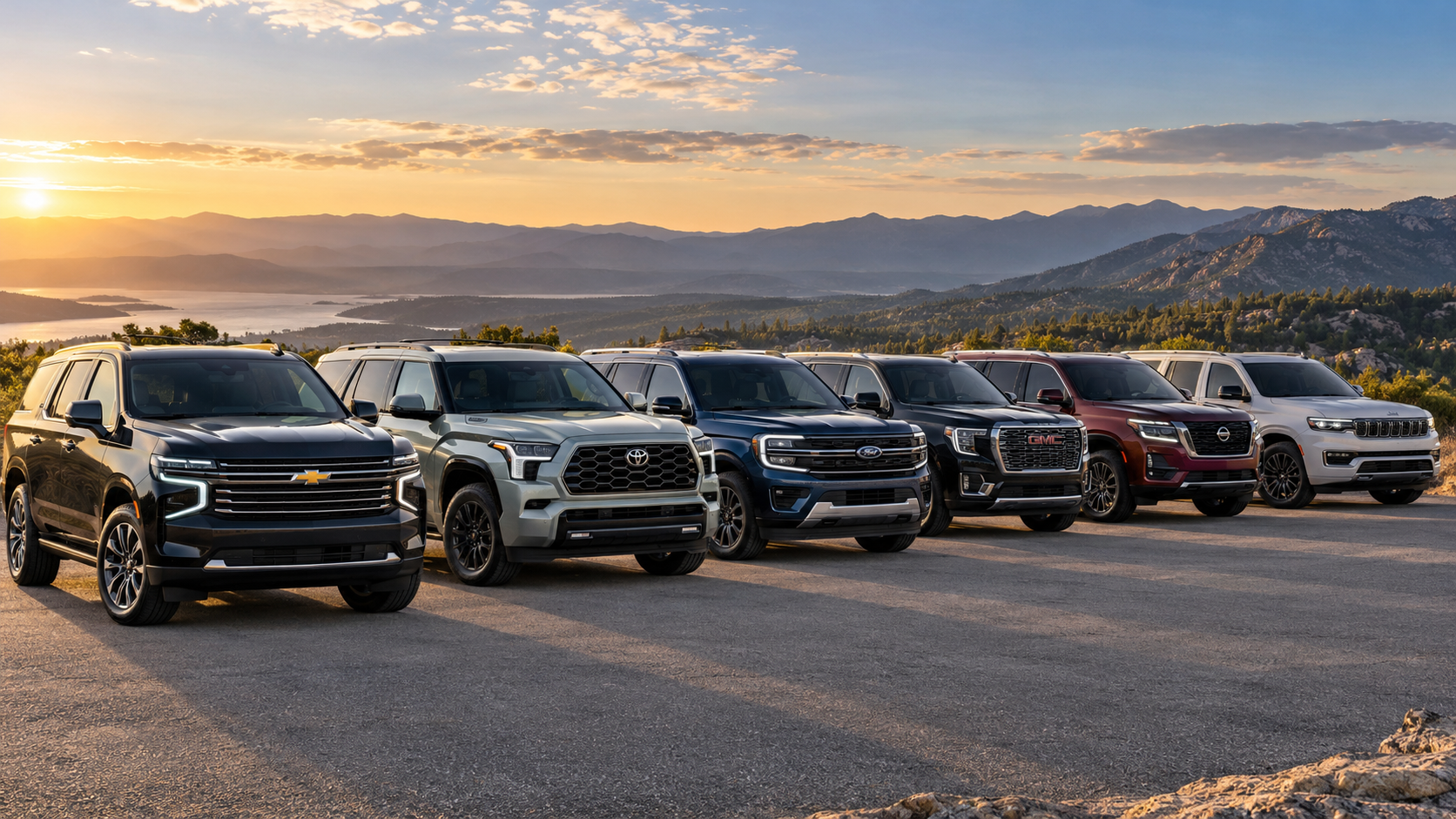
Full-size SUVs offer three-row seating, substantial cargo capacity, and the towing capability that many families need. The trade-off is fuel consumption. Fortunately, there is a meaningful difference between the most efficient full-size SUVs and their thirstier competitors.
The Chevrolet Tahoe with the 3.0-liter Duramax diesel is the most fuel-efficient mainstream full-size SUV for 2026–2027, achieving an EPA-estimated 24 MPG combined. The Chevrolet Suburban, GMC Yukon, and Yukon XL follow at 23 MPG combined. Among gasoline-powered models, the 2026 Toyota Sequoia hybrid leads with 22 MPG combined.
Below, we compare the major full-size SUVs available in the United States, including gasoline, diesel, and hybrid models. The rankings use the most fuel-efficient available configuration for each vehicle, and distinguish confirmed 2027 ratings from 2026 figures where necessary.
Every Full-Size SUV Ranked by MPG (2026–2027)
The table ranks vehicles by their best verified 2026 or 2027 EPA combined fuel economy rating. Where both model years have confirmed ratings, they are shown separately. Two-wheel-drive configurations generally achieve the highest MPG, although results vary by model.
| Rank | Full-Size SUV | Engine / Drivetrain | 2026 MPG | 2027 MPG |
|---|---|---|---|---|
| 1 | Chevrolet Tahoe | 3.0L diesel, 2WD | 24 | 24 |
| 2 (tie) | Chevrolet Suburban | 3.0L diesel, 2WD | 23 | 23 |
| 2 (tie) | GMC Yukon | 3.0L diesel, 2WD | 23 | 23 |
| 2 (tie) | GMC Yukon XL | 3.0L diesel, 2WD | 23 | 23 |
| 5 | Toyota Sequoia | 3.4L V6 hybrid, 2WD | 22 | Pending |
| 6 (tie) | Ford Expedition | 3.5L turbo V6, 2WD | 19 | 18 |
| 6 (tie) | Ford Expedition MAX | 3.5L turbo V6, 2WD | 19 | 18 |
| 6 (tie) | Jeep Grand Wagoneer | 3.0L turbo I6, 2WD | 19 | 19 |
| 6 (tie) | Jeep Grand Wagoneer L | 3.0L turbo I6, 2WD | 19 | 19 |
| 10 | Nissan Armada | 3.5L turbo V6, 2WD | 18 | 18 |
Figures are EPA combined MPG for the most efficient listed configuration. Rankings use the highest confirmed rating across the two model years; vehicles with equal ratings share a position. The 2027 Sequoia’s final rating is not yet confirmed in the manufacturer specifications reviewed. Sources: EPA FuelEconomy.gov, Ford, Nissan, and Toyota.
The biggest advantage belongs to GM’s optional 3.0-liter diesel engine. The Tahoe, Suburban, Yukon, and Yukon XL all achieve at least 23 MPG combined in their most efficient configurations.
The Toyota Sequoia is the standout gasoline-powered choice. Its hybrid powertrain achieves 22 MPG combined for 2026 without requiring diesel fuel or external charging.
The Ford Expedition, Jeep Grand Wagoneer, and Nissan Armada offer conventional gasoline engines, but generally consume more fuel.
1. Chevrolet Tahoe — 24 MPG Combined
Best configuration: 3.0L Duramax turbo-diesel inline-six, 2WD
2026 MPG: 22 city / 26 highway / 24 combined
2027 MPG: 22 city / 26 highway / 24 combined
The Chevrolet Tahoe is the fuel-economy leader among the mainstream full-size SUVs in this comparison. Its optional 3.0-liter Duramax diesel produces 305 horsepower and 495 lb-ft of torque while delivering 24 MPG combined in rear-wheel-drive form.
The diesel is particularly well suited to highway travel. Its 26 MPG highway rating is impressive for a vehicle of this size, and the engine’s substantial low-speed torque is useful when carrying passengers or towing.
The Tahoe also offers two gasoline V8 engines: a 5.3-liter producing 355 horsepower and a 6.2-liter producing 420 horsepower. Both return considerably lower fuel economy than the diesel.
The rear-wheel-drive 5.3-liter V8 is rated at 17 MPG combined. Compared with that configuration, the diesel uses approximately 29% less fuel per mile under the EPA combined test cycle.
Four-wheel drive reduces the diesel Tahoe’s combined rating to 22 MPG, which remains competitive with the gasoline-powered alternatives.
Best for: Buyers seeking maximum MPG from a traditional full-size SUV, especially for frequent highway driving.
2. Chevrolet Suburban — 23 MPG Combined
Best configuration: 3.0L Duramax turbo-diesel inline-six, 2WD
2026 MPG: 21 city / 26 highway / 23 combined
2027 MPG: 21 city / 26 highway / 23 combined
The Chevrolet Suburban shares its platform and powertrain choices with the Tahoe but offers a longer wheelbase and substantially more cargo room.
Despite its larger dimensions, the diesel-powered Suburban achieves 23 MPG combined, just one MPG behind the shorter Tahoe.
That makes the Suburban especially appealing to families who need three usable rows of seating and substantial luggage capacity. It is also a practical choice for long-distance road trips where highway efficiency matters.
Gasoline-powered Suburbans are considerably less efficient. The rear-wheel-drive 5.3-liter V8 returns 17 MPG combined, while the 6.2-liter V8 returns 16 MPG combined.
Best for: Large families needing maximum passenger and cargo capacity with strong diesel fuel economy.
3. GMC Yukon — 23 MPG Combined
Best configuration: 3.0L Duramax turbo-diesel inline-six, 2WD
2026 MPG: 21 city / 26 highway / 23 combined
2027 MPG: 21 city / 26 highway / 23 combined
The GMC Yukon is closely related to the Chevrolet Tahoe but offers different styling, interior appointments, and available equipment.
Its optional Duramax diesel provides the same 305 horsepower and 495 lb-ft of torque found in the Tahoe and Suburban.
In rear-wheel-drive form, the Yukon diesel achieves 23 MPG combined. Four-wheel-drive versions are rated at 22 MPG combined.
Gasoline-powered Yukon models offer either a 5.3-liter or 6.2-liter V8. The rear-wheel-drive versions achieve up to 17 MPG combined.
For buyers choosing between a Tahoe and Yukon, fuel economy alone is unlikely to settle the decision. Interior preferences, pricing, equipment, and availability may matter more.
Best for: Buyers wanting an upscale full-size SUV with efficient diesel power.
4. GMC Yukon XL — 23 MPG Combined
Best configuration: 3.0L Duramax turbo-diesel inline-six, 2WD
2026 MPG: 21 city / 26 highway / 23 combined
2027 MPG: 21 city / 26 highway / 23 combined
The Yukon XL is GMC’s extended-length full-size SUV, comparable in size and purpose to the Chevrolet Suburban.
Its diesel-powered rear-wheel-drive configuration achieves the same 23 MPG combined rating as the shorter Yukon.
This is an important advantage for families considering the larger body. Choosing the Yukon XL does not necessarily mean sacrificing combined fuel economy compared with the standard Yukon.
Gasoline versions return lower figures. The rear-wheel-drive 5.3-liter V8 achieves 17 MPG combined, while the 6.2-liter V8 achieves 16 MPG combined.
Best for: Families needing extended cargo space and three-row seating without a major fuel-economy penalty.
5. Toyota Sequoia — 22 MPG Combined
Best confirmed configuration: 2026 3.4L twin-turbo V6 hybrid, 2WD
2026 MPG: 21 city / 24 highway / 22 combined
2027 MPG: Final EPA figures pending confirmation
The Toyota Sequoia is the most fuel-efficient gasoline-powered full-size SUV in this comparison, based on confirmed 2026 ratings.
Every 2026 Sequoia uses Toyota’s i-FORCE MAX hybrid powertrain, combining a twin-turbocharged 3.4-liter V6 with an electric motor. The system produces 437 horsepower and 583 lb-ft of torque.
Rear-wheel-drive versions achieve 22 MPG combined, while four-wheel-drive models return 20 MPG combined.
The Sequoia’s hybrid system operates automatically. Owners do not need to plug it in, and the vehicle uses conventional gasoline rather than diesel.
For 2027, Toyota has announced styling and technology updates, including a newly available Trailhunter package. The manufacturer has not yet supplied final MPG figures in the specifications reviewed for this comparison.
The 2026 rating therefore remains the reference point until confirmed 2027 fuel-economy data becomes available. It should not be treated as a certified 2027 rating.
The Sequoia’s advantage is particularly noticeable against conventional gasoline-powered SUVs. Its combination of horsepower, torque, and efficiency makes it a strong alternative to a diesel model.
Best for: Buyers who want strong performance and relatively low fuel consumption without diesel ownership.
6. Ford Expedition — Up to 19 MPG Combined
Best configuration: 3.5L twin-turbo EcoBoost V6, 2WD
2026 MPG: 16 city / 24 highway / 19 combined
2027 MPG: 16 city / 23 highway / 18 combined
The Ford Expedition uses a twin-turbocharged 3.5-liter V6 instead of a conventional V8.
The standard-output engine produces 400 horsepower and 480 lb-ft of torque, providing substantial performance for a large SUV.
For 2026, the most efficient rear-wheel-drive Expedition achieves 19 MPG combined. The corresponding 2027 EPA rating is 18 MPG combined, with highway efficiency decreasing from 24 to 23 MPG.
Although the difference is only one combined MPG, it is worth checking the exact model year when comparing vehicles on a dealership lot.
Four-wheel-drive and higher-output configurations can have different fuel-economy ratings.
The Expedition remains a competitive choice for buyers who want a conventional gasoline SUV with strong towing capability and substantial interior space.
Best for: Buyers seeking a powerful gasoline SUV with good highway comfort and versatile passenger capacity.
7. Ford Expedition MAX — Up to 19 MPG Combined
Best configuration: 3.5L twin-turbo EcoBoost V6, 2WD
2026 MPG: 16 city / 24 highway / 19 combined
2027 MPG: 16 city / 23 highway / 18 combined
The Expedition MAX is the extended-length version of Ford’s full-size SUV.
It offers more cargo space than the standard Expedition while retaining the same best combined fuel-economy ratings for the configurations compared here.
For 2026, the rear-wheel-drive Expedition MAX achieves 19 MPG combined. The comparable 2027 configuration is rated at 18 MPG combined.
The MAX is especially useful for buyers who regularly carry passengers in all three rows and still need room for luggage, sports equipment, or other cargo.
Its fuel economy trails the diesel-powered GM SUVs and Toyota’s hybrid Sequoia, but it remains competitive among conventional gasoline-powered full-size SUVs.
Best for: Families needing additional cargo space without choosing a diesel engine.
8. Jeep Grand Wagoneer — 19 MPG Combined
Best configuration: 3.0L twin-turbo inline-six, 2WD
2026 MPG: 19 combined
2027 MPG: 17 city / 22 highway / 19 combined
The Jeep Grand Wagoneer brings a different engine configuration to the full-size SUV segment: a turbocharged 3.0-liter inline-six.
The standard-output engine produces 420 horsepower and 468 lb-ft of torque. In its most efficient rear-wheel-drive configuration, the 2027 Grand Wagoneer achieves 19 MPG combined.
The Grand Wagoneer is positioned toward the premium end of the market, but it remains relevant to buyers comparing large gasoline-powered SUVs.
Its fuel economy is similar to the best 2026 Expedition rating, although it trails the Sequoia hybrid and the GM diesel models.
Four-wheel-drive versions generally return 18 MPG combined, depending on configuration.
Best for: Buyers wanting a powerful, spacious SUV with upscale features and a conventional gasoline engine.
9. Jeep Grand Wagoneer L — 19 MPG Combined
Best configuration: 3.0L twin-turbo inline-six, 2WD
2026 MPG: 19 combined
2027 MPG: 17 city / 22 highway / 19 combined
The Grand Wagoneer L extends the standard model’s wheelbase and overall length, providing more cargo room for larger families and frequent travelers.
Despite the additional size, the most efficient rear-wheel-drive version achieves 19 MPG combined.
This makes the Grand Wagoneer L an alternative to the Chevrolet Suburban, GMC Yukon XL, and Ford Expedition MAX for buyers who prioritize interior space.
Its gasoline engine is less efficient than the diesel-powered GM alternatives, but buyers may prefer its equipment, driving characteristics, or purchase price.
Best for: Buyers seeking an extended-length SUV with substantial power and premium interior appointments.
10. Nissan Armada — 18 MPG Combined
Best configuration: 3.5L twin-turbo V6, 2WD
2026 MPG: 16 city / 20 highway / 18 combined
2027 MPG: 16 city / 20 highway / 18 combined
The Nissan Armada uses a twin-turbocharged 3.5-liter V6 in place of the naturally aspirated V8 found in its previous generation.
The standard engine produces 425 horsepower and 516 lb-ft of torque, providing strong acceleration and towing capability.
Rear-wheel-drive versions achieve 18 MPG combined. Standard four-wheel-drive models return 17 MPG combined, while the off-road-oriented PRO-4X is rated at 16 MPG combined.
Nissan’s published 2027 specifications confirm the same best combined MPG rating as the 2026 model.
The Armada does not lead the segment in fuel economy, but it offers substantial power and capability. Buyers should compare its equipment and purchase price against the higher fuel consumption.
Best for: Buyers prioritizing power, equipment, and capability over maximum fuel efficiency.
Gasoline-Only Full-Size SUV MPG Comparison
Diesel-powered GM SUVs dominate the overall rankings, but many shoppers prefer gasoline engines. The following table compares gasoline and hybrid configurations without including diesel models.
| Vehicle | Powertrain | 2026 MPG | 2027 MPG |
|---|---|---|---|
| Toyota Sequoia | 3.4L V6 hybrid, 2WD | 22 | Pending |
| Ford Expedition / MAX | 3.5L V6, 2WD | 19 | 18 |
| Jeep Grand Wagoneer / L | 3.0L I6, 2WD | 19 | 19 |
| Nissan Armada | 3.5L V6, 2WD | 18 | 18 |
| Chevrolet Tahoe | 5.3L V8, 2WD | 17 | 17 |
| Chevrolet Suburban | 5.3L V8, 2WD | 17 | 17 |
| GMC Yukon | 5.3L V8, 2WD | 17 | 17 |
| GMC Yukon XL | 5.3L V8, 2WD | 17 | 17 |
All figures are EPA combined MPG for the specified configurations. The Sequoia is a conventional hybrid that uses gasoline and does not require plugging in.
The Toyota Sequoia leads the gasoline-only comparison with 22 MPG combined for 2026. Among non-hybrid gasoline SUVs, the Expedition and Grand Wagoneer achieve up to 19 MPG combined in their most efficient configurations.
How Much Fuel Does Each Full-Size SUV Use Per Year?
MPG differences become more meaningful when converted into annual fuel consumption.
Assuming 15,000 miles per year, the following table estimates the amount of fuel each vehicle would consume using its best confirmed 2026–2027 combined rating.
| Vehicle | Combined MPG | Gallons / Year |
|---|---|---|
| Chevrolet Tahoe diesel | 24 | 625 |
| Chevrolet Suburban diesel | 23 | 652 |
| GMC Yukon diesel | 23 | 652 |
| GMC Yukon XL diesel | 23 | 652 |
| Toyota Sequoia hybrid (2026) | 22 | 682 |
| Ford Expedition / MAX (2026) | 19 | 789 |
| Jeep Grand Wagoneer / L | 19 | 789 |
| Ford Expedition / MAX (2027) | 18 | 833 |
| Nissan Armada | 18 | 833 |
| Chevrolet Tahoe 5.3L gasoline | 17 | 882 |
Annual gallons are calculated as 15,000 divided by combined MPG and rounded to the nearest whole gallon. Real-world fuel consumption will vary.
At 15,000 miles annually, the diesel Tahoe uses approximately 257 fewer gallons than the gasoline 5.3-liter Tahoe.
However, fewer gallons do not automatically mean lower fuel expenses. Diesel prices can be higher than regular gasoline, and the purchase price of the diesel-equipped vehicle may also differ.
Gas vs. Diesel vs. Hybrid: Which Is Most Economical?
Diesel: Lowest Fuel Consumption
The GM 3.0-liter Duramax diesel achieves the highest MPG ratings in this comparison.
It is particularly attractive for buyers who accumulate substantial highway mileage or value the engine’s low-speed torque. Diesel fuel prices, diesel exhaust fluid, emissions equipment, and maintenance requirements should also factor into the decision.
Hybrid: Strong Gasoline Efficiency
The Toyota Sequoia hybrid combines 437 horsepower with an EPA-estimated 22 MPG combined for 2026.
Its advantage is straightforward: it uses conventional gasoline, requires no external charging, and consumes less fuel than most gasoline-powered full-size SUVs.
Conventional Gasoline: Familiar and Widely Available
Gasoline-powered models such as the Ford Expedition, Nissan Armada, and Jeep Grand Wagoneer offer substantial power and familiar refueling requirements.
They generally use more fuel than the diesel and hybrid leaders, but differences in purchase price, equipment, maintenance, and long-term ownership expectations can change the overall value calculation.
Does Four-Wheel Drive Reduce Full-Size SUV MPG?
In many cases, yes. Four-wheel-drive systems add mechanical components and weight, and certain trims include tires or equipment that further reduce fuel efficiency.
For example, the 2026 Toyota Sequoia drops from 22 MPG combined with rear-wheel drive to 20 MPG with four-wheel drive.
The Chevrolet Tahoe diesel achieves 24 MPG combined with rear-wheel drive and 22 MPG with four-wheel drive.
The Nissan Armada returns 18 MPG combined in its rear-wheel-drive configuration and 17 MPG with standard four-wheel drive.
Drivers who regularly encounter snow, difficult terrain, or unpaved roads may find the additional capability worthwhile. Buyers who primarily drive on paved roads should consider whether they need four-wheel drive.
Which Full-Size SUV Gets the Best MPG in 2026–2027?
- Best overall: Chevrolet Tahoe diesel — 24 MPG combined.
- Best extended-length model: Chevrolet Suburban diesel and GMC Yukon XL diesel — 23 MPG combined.
- Best gasoline-powered model: Toyota Sequoia hybrid — 22 MPG combined for 2026.
- Best non-hybrid gasoline models: Ford Expedition and Jeep Grand Wagoneer — up to 19 MPG combined in their most efficient verified configurations.
- Best conventional gasoline highway MPG: Ford Expedition and Expedition MAX — up to 24 MPG highway for 2026.
The most important consideration is the exact powertrain. A Tahoe with the Duramax diesel and a Tahoe with a gasoline V8 can have very different fuel economy despite sharing the same body and much of the same equipment.
Bottom Line
The 2026–2027 Chevrolet Tahoe diesel is the fuel-economy leader among the mainstream full-size SUVs compared here, with an EPA-estimated 24 MPG combined.
The Chevrolet Suburban, GMC Yukon, and Yukon XL follow closely at 23 MPG combined, providing excellent efficiency for vehicles of their size.
For buyers who prefer gasoline, the 2026 Toyota Sequoia hybrid stands out at 22 MPG combined. The Ford Expedition and Jeep Grand Wagoneer offer competitive conventional gasoline alternatives, while the Nissan Armada emphasizes power and capability.
When comparing vehicles, check the EPA rating for the exact model year, engine, drivetrain, and trim. Even a one-MPG difference can add up over years of ownership, and fuel prices may affect which model is cheapest to operate.
Sources and Methodology
This comparison covers mainstream and near-premium full-size SUVs sold in the United States for the 2026 and 2027 model years. Extended-length models are listed separately. Dedicated luxury-brand SUVs and fully electric vehicles are excluded.
Rankings use the highest confirmed EPA combined MPG available for each model across the two model years. Where 2027 information remains incomplete, confirmed 2026 ratings are identified rather than presented as 2027 results.
Fuel economy is based on standardized EPA testing. Actual results depend on driving conditions, speed, weather, tires, load, towing, and other factors.
- U.S. EPA and Department of Energy — Fuel Economy Ratings
- GM-Trucks — 2027 Tahoe, Suburban, and Yukon EPA MPG Ratings
- Ford — 2027 Expedition Specifications
- Toyota — 2026 Sequoia Fuel Economy
- Toyota Newsroom — 2027 Sequoia Updates
- Nissan — 2027 Armada Specifications and EPA Ratings
- Jeep — Model Comparison and Fuel Economy
Leave a Reply