
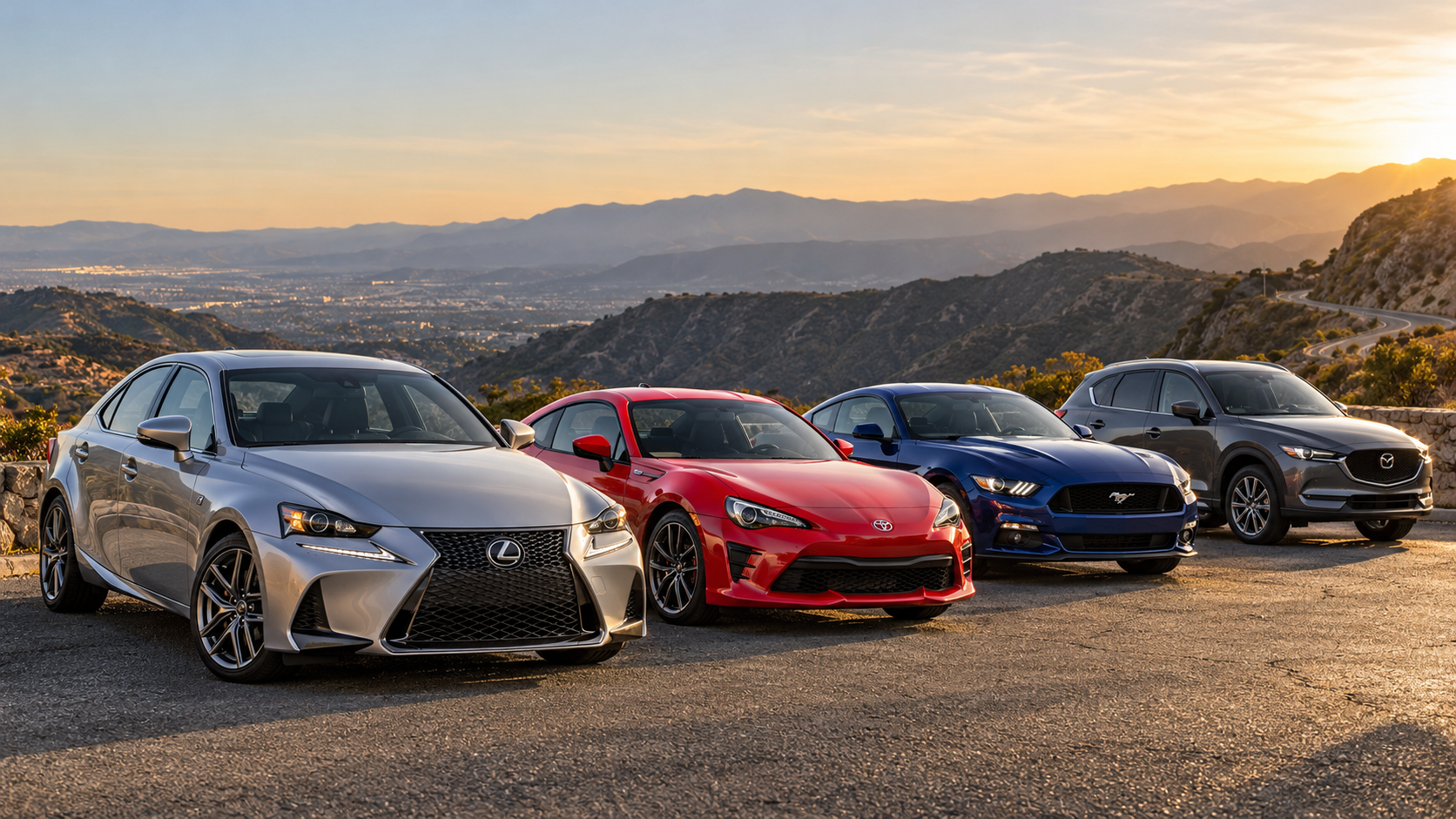
Buying a sporty used car doesn’t have to mean accepting constant repairs. With a budget of $20,000 to $25,000, shoppers can find rear-wheel-drive luxury sedans, lightweight sports coupes, powerful American muscle cars, and even SUVs that are genuinely enjoyable to drive.
The challenge is choosing a vehicle that remains dependable after 80,000 or 100,000 miles. A car that was impressive when new may become expensive to maintain a decade later, particularly if it has a complicated powertrain or a history of aggressive driving.
We’ve ranked ten used vehicles based on their combination of driving enjoyment, expected long-term reliability, repair exposure, practicality, and value. The focus is on approximately 2013–2020 models that may fit a $20,000–$25,000 purchase budget, depending on mileage, condition, and dealer pricing.
Bottom line: The Lexus IS 350 is our best overall choice, the Toyota 86 is the most engaging affordable sports coupe, and the Mazda CX-5 is an appealing choice for buyers who need an SUV. The Lexus GS 350 is particularly attractive for drivers who want comfort without giving up rear-wheel-drive dynamics.
Best Used Sporty Cars Under $25,000: Quick Rankings
| Rank | Vehicle | Target Years | Best Attribute |
|---|---|---|---|
| 1 | Lexus IS 350 | 2014–2018 | Best overall balance |
| 2 | Lexus GS 350 | 2013–2018 | Comfort and durability |
| 3 | Toyota 86 / Scion FR-S | 2014–2020 | Pure driving enjoyment |
| 4 | Lexus RC 350 | 2015–2018 | Luxury coupe |
| 5 | Infiniti G37 / Q50 3.7 | 2013–2015 | Affordable V6 performance |
| 6 | Mazda CX-5 | 2017–2020 | Best practical SUV |
| 7 | Ford Mustang EcoBoost | 2016–2020 | Acceleration and style |
| 8 | Cadillac ATS | 2015–2018 | Sharp sedan handling |
| 9 | Dodge Charger | 2015–2020 | Large RWD sedan |
| 10 | Toyota Camry V6 / TRD | 2018–2020 | Reliable everyday speed |
These are editorial rankings, not statistically calculated reliability scores. Model availability and asking prices vary, and a clean, well-maintained lower-ranked vehicle can be a better purchase than a neglected higher-ranked example. The Camry TRD debuted for 2020; earlier cars in this range are conventional V6 trims.
1. Lexus IS 350 — Best Overall Sporty Used Car
The Lexus IS 350 combines several qualities that rarely appear together in an affordable used vehicle: a powerful naturally aspirated V6, rear-wheel-drive-based architecture, a relatively compact body, and a reputation for durable engineering.
The 2016 IS 350 produces 306 horsepower from its 3.5-liter V6. Rear-wheel-drive models use an eight-speed automatic transmission, while all-wheel-drive versions use a six-speed automatic.
Unlike a lightweight sports coupe, the IS 350 doesn’t constantly demand attention. It is quiet and comfortable during normal driving, but responds eagerly when the road becomes more interesting.
The F Sport package adds sportier suspension tuning and appearance upgrades. Depending on model year and configuration, it can also include adaptive suspension. However, F Sport does not turn the IS 350 into a separate high-performance model.
Reliability considerations
The naturally aspirated V6 avoids the additional turbocharging hardware found in many competing luxury sedans. At higher mileage, inspect the cooling system, suspension bushings, water pump, fluid leaks, and maintenance records. The engine’s reputation is a strength, but no ten-year-old vehicle should be treated as maintenance-free.
Best for: Drivers who want one car that is enjoyable, comfortable, and reasonably dependable for daily use.
Source: Lexus 2016 IS specifications.
2. Lexus GS 350 — Best Sporty Luxury Sedan for Comfort
The GS 350 shares much of the IS 350’s appeal but packages it in a larger, more refined sedan.
Its 3.5-liter V6 produces 306 horsepower in 2015 and 311 horsepower in 2016. Rear-wheel-drive versions deliver the classic balance of a longitudinal-engine sport sedan, while all-wheel drive was also available.
The GS is less eager to change direction than the smaller IS, but it is composed through corners and especially comfortable on long highway drives. Its larger cabin and more substantial feel make it an excellent daily driver.
Reliability considerations
The V6 is a major reason to consider this model. Still, buyers should budget for aging suspension components, tires, brakes, cooling-system maintenance, and potentially expensive luxury electronics.
Best for: Buyers who prioritize highway comfort, interior quality, and long-term ownership over maximum agility.
Source: Lexus 2016 GS specifications.
3. Toyota 86 / Scion FR-S — Most Engaging Driving Experience
For drivers who value steering response, chassis balance, and the sensation of controlling a car, the original Toyota 86 is one of the strongest choices in this price range.
The first-generation model was sold as the Scion FR-S before becoming the Toyota 86 for 2017. The closely related Subaru BRZ is also worth considering.
The 2017 Toyota 86 uses a 2.0-liter naturally aspirated flat-four engine producing 205 horsepower with the manual transmission or 200 horsepower with the automatic. Its modest output is offset by a curb weight of roughly 2,800 pounds and an exceptionally low center of gravity.
The result is a car that changes direction eagerly and communicates its behavior clearly. Its steering and handling make ordinary winding roads entertaining without requiring enormous horsepower.
Reliability considerations
Although the Toyota badge inspires confidence, the 86 uses a Subaru-developed boxer engine and has different maintenance characteristics from Toyota’s conventional inline-four and V6 engines.
Check for oil leaks, abnormal engine noises, clutch wear, previous collision damage, and evidence of track use. Earlier FR-S and BRZ examples may also have relevant recall histories, so verify the VIN before purchase.
Best for: Driving enthusiasts willing to sacrifice ride comfort, cabin quietness, and rear-seat practicality.
Source: Toyota 86 technical overview.
4. Lexus RC 350 — Best Reliable Luxury Coupe
The Lexus RC 350 offers much of the IS 350’s mechanical appeal in a more dramatic two-door body.
Its naturally aspirated 3.5-liter V6 produces approximately 306 horsepower in early examples, with output varying by model year. It is smooth, responsive, and well suited to the RC’s grand-touring personality.
The RC feels substantial and refined rather than lightweight and playful. Compared with the Toyota 86, it provides greater sound insulation, more comfortable highway travel, and a richer interior. However, its weight limits its agility.
Reliability considerations
The RC 350 benefits from established Lexus V6 engineering. Check for suspension wear, fluid leaks, cooling-system issues, and proper maintenance. The rear seats are tight, and some body and interior components may be expensive to replace.
Best for: Buyers who want a sporty-looking coupe that is pleasant to drive every day without the maintenance exposure of many European luxury coupes.
5. Infiniti G37 / Q50 3.7 — Best Affordable V6 Performance
The Infiniti G37 and early Q50 3.7 offer an appealing alternative to Lexus. Their naturally aspirated 3.7-liter V6 engines produce roughly 328–330 horsepower, depending on model and year.
The G37 feels more mechanical and aggressive than the Lexus GS, with a prominent engine note and strong acceleration. The Q50 provides a newer cabin and more modern styling, although its steering characteristics differ from the earlier G37.
Rear-wheel drive and all-wheel drive were offered, depending on configuration.
Reliability considerations
The VQ37VHR V6 has a substantial ownership history, but buyers should inspect for oil leaks, cooling-system issues, transmission behavior, and deferred maintenance. Some earlier VQ37 applications have experienced oil-gallery gasket problems.
Modified or aggressively driven examples deserve additional scrutiny.
Best for: Drivers seeking strong naturally aspirated performance at a lower purchase price than many comparable Lexus models.
6. Mazda CX-5 — Best Sporty SUV for Everyday Driving
Not every buyer can live with a low-slung coupe or compact sedan. The Mazda CX-5 is a compelling alternative because it emphasizes steering precision, body control, and a well-finished interior.
The 2017–2020 CX-5 uses a 2.5-liter four-cylinder engine in its mainstream configurations. A more powerful turbocharged version became available for the 2019 model year.
Neither version handles like a sports car, but the CX-5 feels more responsive and controlled than many comfort-oriented compact crossovers. Its driving position, visibility, cargo capacity, and everyday versatility are major advantages.
Reliability considerations
The naturally aspirated 2.5-liter engine is the simpler choice for a reliability-focused buyer. Check maintenance records, cooling-system condition, suspension wear, and any engine-specific service issues. Certain Mazda 2.5-liter applications have documented cylinder-head or coolant-leak concerns, so the exact engine and model year matter.
Best for: Buyers who need SUV practicality but still care about how a vehicle steers and handles.
7. Ford Mustang EcoBoost — Best Turbocharged Coupe
The sixth-generation Mustang EcoBoost offers one of the strongest combinations of acceleration, appearance, and everyday usability in this price range.
Early models produce 310 horsepower from a turbocharged 2.3-liter four-cylinder engine. The engine delivers substantially more low-end torque than the Toyota 86, making the Mustang feel faster in ordinary driving.
Its rear-wheel-drive platform and independent rear suspension provide respectable handling, particularly with appropriate tires and performance-oriented equipment. However, the Mustang is larger and heavier than the Toyota 86, with less immediate steering response.
Earlier EcoBoost Mustangs were available with manual or automatic transmissions. The ten-speed automatic arrived for the 2018 model year.
Reliability considerations
The EcoBoost deserves careful inspection at higher mileage. Coolant loss, engine overheating, turbocharger condition, oil leaks, and transmission operation should all be evaluated. Coolant intrusion and related engine concerns have been reported in some 2.3-liter EcoBoost applications, but the risk should not be assumed identical across every Mustang model year.
Best for: Drivers who want strong acceleration and Mustang styling while accepting more powertrain complexity than a naturally aspirated Lexus.
8. Cadillac ATS — Best American Sport Sedan for Handling
The Cadillac ATS is one of the most overlooked enthusiast sedans of its generation.
Built on a rear-wheel-drive-based platform, it was engineered with steering precision, chassis balance, and cornering performance in mind. Some versions offer steering and suspension characteristics that compete convincingly with established European sport sedans.
Engine choices include a turbocharged 2.0-liter four-cylinder and a naturally aspirated 3.6-liter V6. The V6 provides strong acceleration without turbocharger hardware, although that does not automatically make it trouble-free.
Reliability considerations
Potential ownership concerns include transmission shudder on certain automatic-equipped vehicles, infotainment-system failures, cooling-system problems, and engine-specific repairs. Maintenance history and evidence of completed service procedures are particularly important.
Best for: Drivers who value sharp handling and are comfortable accepting higher potential repair costs than with a Lexus.
9. Dodge Charger — Best Large American Performance Sedan
The Dodge Charger is an appealing choice for buyers who want a spacious sedan with rear-wheel-drive character.
The commonly available 3.6-liter Pentastar V6 produces approximately 292–300 horsepower, depending on trim. Its eight-speed automatic transmission makes good use of the engine’s power.
V8-powered R/T models deliver substantially more character and acceleration, but purchase price, fuel consumption, insurance, and previous ownership become especially important considerations.
The Charger is enjoyable on open highways and broad corners, but its size and weight prevent it from feeling as nimble as the Cadillac ATS or Lexus IS.
Reliability considerations
Inspect V6 examples for oil-filter housing leaks, cooling-system problems, and abnormal valvetrain noise. Suspension wear and electrical issues also deserve attention. On V8 models, verify maintenance history and investigate unusual engine ticking rather than assuming every noise is harmless.
Best for: Buyers who want a roomy, distinctive American sedan with good acceleration and rear-wheel-drive dynamics.
10. Toyota Camry V6 / TRD — Best Reliable Daily Driver With Extra Power
The Toyota Camry V6 is a sensible choice for buyers who want strong acceleration without committing to a traditional rear-wheel-drive sport sedan.
The eighth-generation Camry’s 3.5-liter V6 produces 301 horsepower and drives the front wheels through an eight-speed automatic transmission.
The TRD trim, introduced for 2020, adds a sport-tuned suspension, additional chassis bracing, larger front brakes, and distinctive styling. However, its front-wheel-drive architecture and comfort-oriented foundations remain apparent.
It is quick and capable, but less engaging than a Toyota 86 or Lexus IS 350 when driven on winding roads.
Reliability considerations
The V6 is a strong reason to consider the Camry, but inspect the cooling system, transmission operation, and maintenance history. Some early eighth-generation Camrys received transmission calibration updates, so verify that applicable service work has been performed.
Best for: Buyers who prioritize dependable transportation and strong passing power over rear-wheel-drive handling.
What About the Dodge Durango and Other Performance SUVs?
The Dodge Durango is worth considering if towing capacity, passenger space, and a powerful engine matter more than precise handling.
Its available 5.7-liter HEMI V8 delivers strong acceleration and a distinctive exhaust note. However, the Durango is substantially heavier and taller than the sedans in this ranking. It is better described as a muscular SUV than a genuinely agile sports vehicle.
Higher fuel consumption, large tires, brakes, and potential V8 maintenance expenses also affect its value at 100,000 miles.
For buyers who primarily want an SUV that feels responsive on everyday roads, the Mazda CX-5 is generally the more sensible choice. For those who want V8 sound, towing ability, and three-row practicality, the Durango offers a different kind of enjoyment.
Which Cars Are the Most Reliable at 100,000 Miles?
At this mileage, the most important distinction is not simply Japanese versus American or naturally aspirated versus turbocharged. It is the combination of proven engineering, maintenance history, mechanical condition, and previous use.
The Lexus IS 350, GS 350, and RC 350 are particularly attractive because their naturally aspirated V6 engines have established service histories. The Camry V6 also deserves consideration for buyers prioritizing long-term transportation.
The Toyota 86 can be dependable, but its Subaru-derived boxer engine, compact packaging, and enthusiast ownership patterns create a different risk profile. The Mustang EcoBoost and Cadillac ATS offer strong performance but require careful attention to powertrain and transmission condition.
No model is guaranteed to reach 200,000 miles. A vehicle’s actual condition is more useful than a generalized lifespan prediction.
What to Inspect Before Buying a Used Sports Car
When shopping for a sporty vehicle approaching 100,000 miles, the following checks can help avoid expensive surprises:
- Maintenance records: Look for regular oil changes, cooling-system service, transmission maintenance where applicable, and evidence that known issues were addressed.
- Engine condition: Inspect for coolant loss, oil leaks, unusual noises, overheating, and warning lights.
- Transmission behavior: Test the vehicle cold and warm, checking for slipping, shuddering, harsh shifts, or clutch wear.
- Suspension and steering: Listen for clunks and inspect bushings, dampers, ball joints, wheel bearings, and alignment.
- Previous modifications: Investigate engine tunes, suspension changes, aftermarket turbo components, and signs of track use.
- Accident and title history: Check vehicle history reports and look for inconsistent panel gaps, paintwork, and structural repairs.
- Recalls: Check the vehicle’s VIN using the NHTSA recall lookup.
- Independent inspection: Arrange a pre-purchase inspection with a qualified mechanic, even when purchasing from a large dealership.
Dealer inspection programs and optional service contracts are not substitutes for evaluating the condition of the actual vehicle.
Should You Spend $20,000 or Stretch to $25,000?
Spending another $5,000 does not necessarily produce a more reliable vehicle. The better purchase may be an older, carefully maintained Lexus rather than a newer performance car with an uncertain history.
When comparing vehicles, consider the total out-the-door price, including taxes and dealer fees. Also account for tires, brakes, insurance, fuel, and maintenance immediately after purchase.
For a vehicle near 100,000 miles, keeping a separate repair reserve is wise. A budget of approximately $1,500–$3,000 for initial maintenance and unexpected repairs provides a useful planning cushion, although major failures can exceed that amount.
Final Verdict: Which Used Sporty Car Should You Buy?
Best overall: Lexus IS 350. It offers the most convincing blend of strong V6 performance, rear-wheel-drive handling, everyday comfort, and long-term ownership appeal.
Best comfortable sedan: Lexus GS 350. Its spacious interior, refined ride, and proven V6 make it particularly appealing for commuting and highway travel.
Best pure driver’s car: Toyota 86. It cannot match the Lexus sedans for refinement or the Mustang for torque, but its low weight, precise handling, and available manual transmission make it especially rewarding.
Best sporty SUV: Mazda CX-5. It provides responsive handling and useful cargo space without the fuel and maintenance demands of a large performance SUV.
Best American performance value: Ford Mustang EcoBoost. Its acceleration, rear-wheel-drive layout, and distinctive styling make it attractive, provided the individual vehicle passes a thorough inspection.
For most buyers seeking a sporty used vehicle under $25,000 that they can comfortably keep for several years, the Lexus IS 350 and GS 350 deserve to be at the top of the shopping list. But the best used car is ultimately the well-maintained example with a clean history, a sound mechanical inspection, and a purchase price that leaves room for future maintenance.
Leave a Reply