
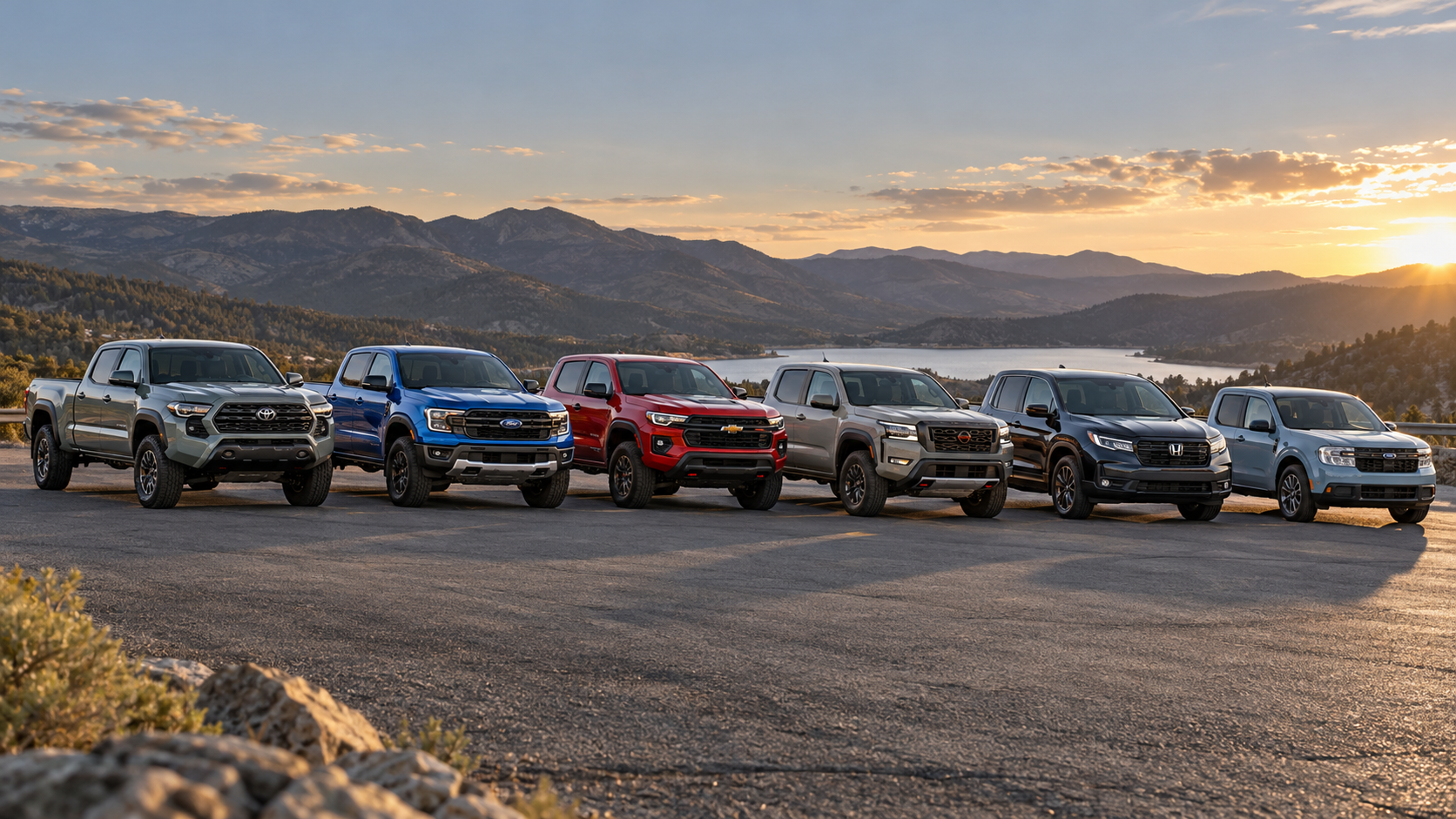
If you’re shopping for a smaller pickup in 2026, horsepower and fuel economy vary dramatically depending on the truck and powertrain. At one extreme, the Ford Maverick Hybrid delivers 191 horsepower and an EPA-rated 38 mpg combined. At the other, the Ford Ranger Raptor makes 405 horsepower but returns just 17 mpg combined.
This comparison covers every mainstream midsize pickup sold in the U.S. for the 2026 model year. The Ford Maverick is technically a compact pickup, but it is included because its price, four-door layout, and everyday usability make it a realistic alternative for many midsize-truck shoppers. For the same reason, the Hyundai Santa Cruz is included as an additional cross-shop.
2026 Small and Midsize Pickup MPG and Horsepower Compared
| Truck | Engine | Horsepower | EPA City / Hwy | Combined MPG |
|---|---|---|---|---|
| Ford Maverick Hybrid FWD | 2.5L hybrid I4 | 191 hp | 42 / 35 | 38 |
| Ford Maverick Hybrid AWD | 2.5L hybrid I4 | 191 hp | 40 / 34* | 37* |
| Ford Maverick EcoBoost FWD | 2.0L turbo I4 | 250 hp | 23 / 32 | 26 |
| Ford Maverick EcoBoost AWD | 2.0L turbo I4 | 250 hp | 22 / 30 | 25 |
| Hyundai Santa Cruz FWD | 2.5L I4 | 191 hp | 22 / 30 | 25 |
| Hyundai Santa Cruz AWD | 2.5L I4 | 191 hp | 21 / 29 | 24 |
| Hyundai Santa Cruz Turbo AWD | 2.5L turbo I4 | 281 hp | 18 / 25 | 20 |
| Toyota Tacoma i-FORCE | 2.4L turbo I4 | Up to 278 hp | Up to 21 / 26 | Up to 23 |
| Toyota Tacoma i-FORCE MAX | 2.4L turbo hybrid I4 | 326 hp | Up to 23 / 24 | 23 |
| Ford Ranger 2.3L | 2.3L turbo I4 | 270 hp | 21 / 25 2WD | About 23 |
| Ford Ranger 2.7L | 2.7L twin-turbo V6 | 315 hp | 18 / 23 4WD | About 20 |
| Ford Ranger Raptor | 3.0L twin-turbo V6 | 405 hp | 16 / 18 | 17 |
| Chevrolet Colorado | 2.7L turbo I4 | 310 hp | Up to 19 / 23-24 | Up to 21 |
| GMC Canyon | 2.7L turbo I4 | 310 hp | 19 / 23 2WD | 20 |
| Nissan Frontier | 3.8L V6 | 310 hp | 19 / 24 2WD | 21 |
| Honda Ridgeline | 3.5L V6 | 280 hp | 18 / 24 | 21 |
| Jeep Gladiator | 3.6L V6 | 285 hp | 17 / 22 | 19 |
*Maverick Hybrid AWD ratings vary slightly by trim. For example, some Lariat Hybrid AWD configurations are rated 39 city, 32 highway, and 36 combined mpg. Fuel economy can also change with drivetrain, tires, trim, and off-road equipment on the other trucks.
Which Small or Midsize Pickup Gets the Best MPG?
The Ford Maverick Hybrid wins by a huge margin. In front-wheel-drive form, it is EPA-rated at 42 mpg city, 35 mpg highway, and 38 mpg combined.
That is roughly 15 mpg better in combined driving than the most efficient traditional body-on-frame midsize pickups.
The tradeoff is power and capability. The Maverick Hybrid makes 191 horsepower, while most midsize trucks now produce somewhere between about 270 and 326 horsepower.
The 250-horsepower Maverick EcoBoost is an interesting middle ground. A front-wheel-drive version can reach approximately 32 mpg highway, while still providing significantly more power than the hybrid.
Best MPG Among True Midsize Pickups
If you want a conventional midsize truck rather than a compact unibody pickup, the Toyota Tacoma and Ford Ranger are among the fuel-economy leaders.
A 2026 Tacoma SR5 can be rated as high as 21 mpg city and 26 mpg highway. Toyota’s more powerful i-FORCE MAX hybrid is rated as high as 23 mpg combined while producing 326 horsepower and 465 lb-ft of torque.
That combination makes the Tacoma hybrid particularly unusual. Unlike the Maverick Hybrid, Toyota’s hybrid system is primarily designed to add torque and performance rather than maximize fuel savings.
The regular Ford Ranger with the 2.3-liter EcoBoost is also competitive, returning 21 city and 25 highway mpg with rear-wheel drive.
Which Midsize Pickup Has the Most Horsepower?
The 2026 Ford Ranger Raptor is comfortably the most powerful truck in this group. Its 3.0-liter twin-turbocharged EcoBoost V6 produces 405 horsepower and 430 lb-ft of torque.
That performance comes with a fuel-economy penalty. The Raptor is rated at approximately 16 mpg city and 18 mpg highway.
The horsepower ranking looks like this:
- Ford Ranger Raptor — 405 hp
- Toyota Tacoma i-FORCE MAX — 326 hp
- Ford Ranger 2.7L — 315 hp
- Chevrolet Colorado — 310 hp
- GMC Canyon — 310 hp
- Nissan Frontier — 310 hp
- Jeep Gladiator — 285 hp
- Hyundai Santa Cruz Turbo — 281 hp
- Honda Ridgeline — 280 hp
- Toyota Tacoma i-FORCE — up to 278 hp
- Ford Ranger 2.3L — 270 hp
- Ford Maverick EcoBoost — 250 hp
- Ford Maverick Hybrid — 191 hp
- Hyundai Santa Cruz 2.5L — 191 hp
Toyota Tacoma: 278 or 326 Horsepower
The Tacoma has one of the more complicated powertrain lineups.
Most versions of the regular 2.4-liter turbocharged i-FORCE engine make 278 horsepower and 317 lb-ft of torque with the eight-speed automatic. Manual-transmission versions make 270 horsepower and 310 lb-ft.
The entry-level SR can use a lower-output version producing 228 horsepower.
The i-FORCE MAX hybrid combines the turbo four-cylinder with an electric motor for 326 horsepower and 465 lb-ft. Toyota rates the hybrid powertrain at up to 23 mpg combined.
The result is arguably the strongest combination of horsepower and MPG among the traditional body-on-frame midsize pickups.
Ford Ranger: Three Very Different Power Levels
The Ranger gives buyers three distinct engines.
- 2.3L EcoBoost: 270 hp and 310 lb-ft
- 2.7L EcoBoost V6: 315 hp and 400 lb-ft
- 3.0L EcoBoost V6 Raptor: 405 hp and 430 lb-ft
The 2.3-liter is the economy choice. Ford’s 2026 order guide lists the rear-wheel-drive version at 21 city and 25 highway mpg, while the 4WD version drops to 19/24.
The 315-horsepower 2.7-liter V6 is available with 4WD and is rated at 18/23 mpg. That engine is a compelling compromise for buyers who want substantially more power without moving all the way to the expensive, fuel-hungry Raptor.
Chevrolet Colorado and GMC Canyon: 310 HP Standard
Chevrolet simplified the Colorado lineup by making the 2.7-liter TurboMax four-cylinder standard across the range. It produces 310 horsepower and 430 lb-ft of torque.
The closely related GMC Canyon uses the same output.
The impressive number here is actually torque rather than horsepower. At 430 lb-ft, the Colorado and Canyon produce considerably more torque than several naturally aspirated V6 competitors.
Fuel economy varies sharply with configuration. A basic two-wheel-drive truck can manage around 19 city and 23 to 24 highway mpg, while aggressive off-road versions consume much more fuel.
For example, the Canyon AT4X is rated at just 17/17/17 mpg. The even more extreme AT4X AEV Edition falls to approximately 16 mpg city, highway, and combined.
Nissan Frontier: The Old-School V6 Option
The Frontier stands apart from most competitors because Nissan still gives every 2026 Frontier a naturally aspirated 3.8-liter V6.
It produces 310 horsepower and 281 lb-ft of torque. There is no turbocharger and no hybrid system.
Rear-wheel-drive models are rated at 19 city, 24 highway, and 21 combined mpg. Regular four-wheel-drive versions are rated 17/21/19, while the PRO-4X falls to 16/20/18.
For buyers who prefer a relatively straightforward naturally aspirated engine, the Frontier is now one of the few choices left in this segment.
Honda Ridgeline: 280 HP and 21 MPG Combined
The Ridgeline uses a 280-horsepower 3.5-liter V6 and standard all-wheel drive.
Most trims are rated at 18 city, 24 highway, and 21 combined mpg. TrailSport configurations with their more aggressive tires are rated slightly lower at 18/23/20.
The Ridgeline is also different from the Tacoma, Ranger, Colorado, Canyon, Frontier, and Gladiator because it uses unibody construction rather than a traditional body-on-frame truck platform.
That contributes to its more car-like road manners, although buyers needing serious off-road hardware or maximum towing capability may prefer one of the conventional midsize trucks.
Jeep Gladiator: 285 HP, but Fuel Economy Is a Weak Point
The Gladiator keeps Jeep’s familiar 3.6-liter Pentastar V6, producing 285 horsepower and 260 lb-ft of torque.
EPA ratings are approximately 17 mpg city, 22 mpg highway, and 19 combined.
Those figures aren’t especially impressive next to a Ranger or Tacoma, but fuel economy isn’t really the Gladiator’s reason for existing. Its removable roof and doors, solid axles, low-range four-wheel-drive systems, and Wrangler-based design make it one of the most specialized trucks in the segment.
Don’t Overlook the Ford Maverick
Although the Maverick is officially a compact pickup, it deserves to be part of this comparison because many buyers simply want a four-door truck with a usable bed rather than a specific vehicle classification.
Its strongest argument is efficiency.
| Truck | Horsepower | Best Combined MPG |
|---|---|---|
| Ford Maverick Hybrid | 191 hp | 38 mpg |
| Ford Maverick EcoBoost | 250 hp | 26 mpg |
| Toyota Tacoma Hybrid | 326 hp | 23 mpg |
| Ford Ranger 2.3L | 270 hp | About 23 mpg |
| Chevy Colorado | 310 hp | About 21 mpg |
| Nissan Frontier | 310 hp | 21 mpg |
| Honda Ridgeline | 280 hp | 21 mpg |
The Maverick gives up capability compared with a traditional midsize truck. Maximum towing is 4,000 pounds when properly equipped, and its bed is only about 4.5 feet long.
However, its payload can reach approximately 1,500 pounds. For a driver who mainly commutes but needs a bed for home-improvement supplies, bikes, camping gear, furniture, or occasional hauling, the Maverick can make more sense than buying a larger truck simply because it belongs to the midsize class.
What About the Hyundai Santa Cruz?
The Santa Cruz is technically another compact unibody pickup, so it is not a direct Tacoma or Ranger competitor. But like the Maverick, it may appear on the same shopping list.
The standard naturally aspirated 2.5-liter engine makes 191 horsepower and can return up to 22 city, 30 highway, and 25 combined mpg.
The turbocharged version jumps to 281 horsepower and 311 lb-ft of torque, but fuel economy falls to about 18 city, 25 highway, and 20 combined.
The turbo Santa Cruz therefore offers horsepower similar to a Tacoma or Ridgeline while retaining a smaller footprint, although it cannot match the towing and off-road capabilities of the strongest body-on-frame midsize trucks.
Which Truck Has the Best Combination of MPG and Horsepower?
There isn’t one answer because these trucks serve very different buyers.
For maximum fuel economy: the Ford Maverick Hybrid is the clear winner at up to 38 mpg combined.
For fuel economy without giving up much performance: the 250-horsepower Maverick EcoBoost is especially compelling, reaching as high as 32 mpg highway in front-wheel-drive form.
For a traditional midsize truck: the Tacoma i-FORCE MAX stands out with 326 horsepower, 465 lb-ft of torque, and approximately 23 mpg combined.
For strong conventional gas-engine performance: the Ranger 2.7L, Colorado, Canyon, and Frontier all offer at least 310 horsepower.
For maximum performance: nothing else here approaches the 405-horsepower Ranger Raptor.
Bottom Line
The 2026 small and midsize pickup market spans a much wider range than the term “midsize truck” might suggest.
A Maverick Hybrid can deliver nearly 40 mpg while still carrying a useful payload. A Tacoma Hybrid produces 326 horsepower without giving up the fuel economy of a normal midsize truck. A Colorado or Canyon provides 430 lb-ft of torque from a turbo four-cylinder. And the Ranger Raptor offers sports-car levels of power in an off-road pickup.
For buyers who do not regularly tow more than 4,000 pounds or need serious off-road hardware, the Maverick deserves to be cross-shopped with the larger trucks. For buyers who actually need traditional truck capability, the Tacoma, Ranger, Colorado, Canyon, Frontier, Ridgeline, and Gladiator each make different compromises between power, efficiency, towing, and off-road ability.
Sources
- Ford: 2026 Maverick specifications
- Ford: 2026 Ranger specifications
- Toyota: 2026 Tacoma specifications
- Toyota USA Newsroom: 2026 Tacoma powertrain and fuel economy
- Chevrolet: 2026 Colorado specifications
- GMC: 2026 Canyon specifications
- Nissan: 2026 Frontier specifications
- Honda: 2026 Ridgeline specifications and MPG
- Jeep: 2026 Gladiator specifications and MPG
- Hyundai: 2026 Santa Cruz specifications and MPG
EPA fuel-economy estimates vary by drivetrain, trim, tires, and equipment. Figures shown are for representative or most-efficient configurations unless a specific trim is identified.
Leave a Reply