
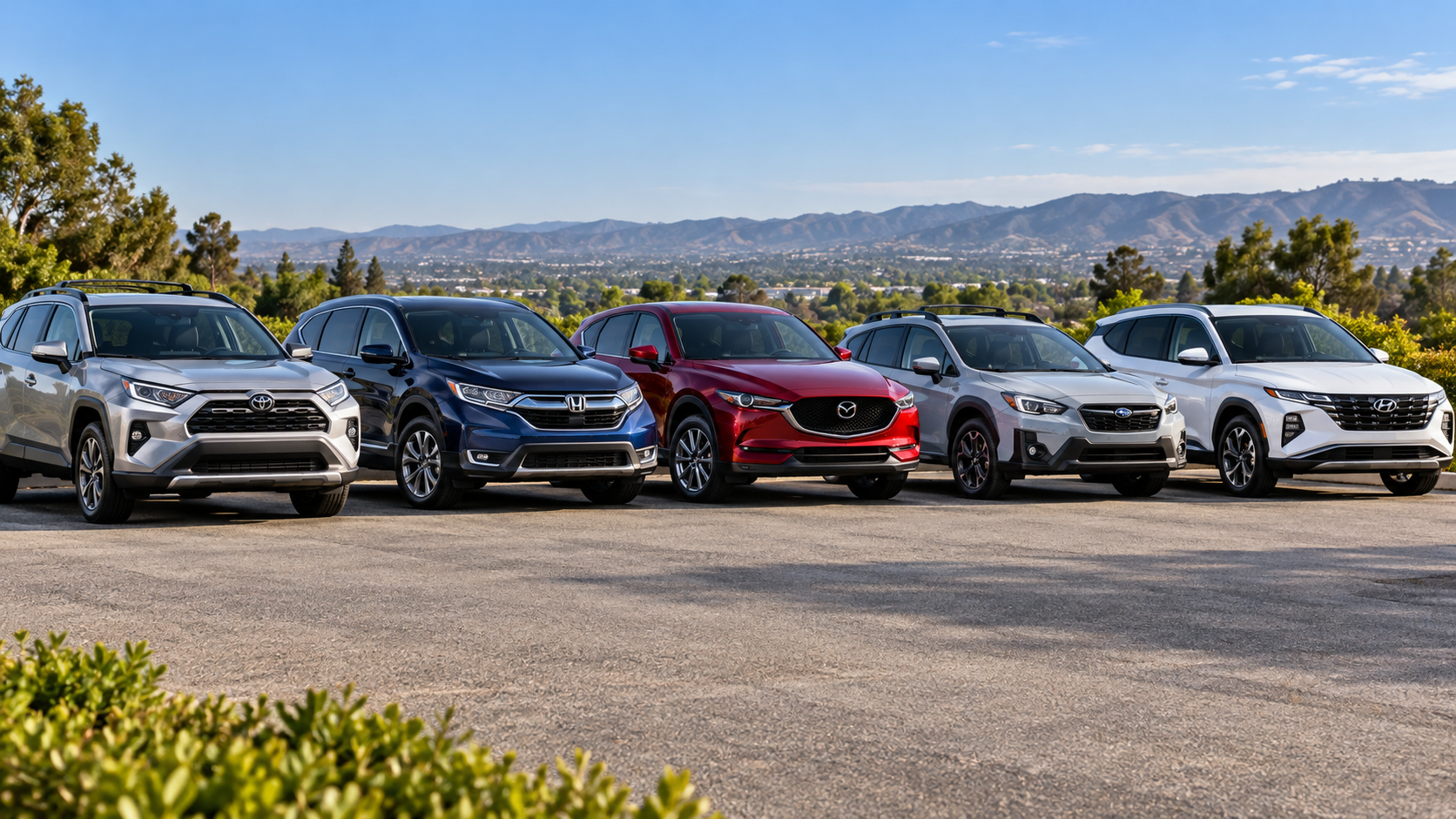
Buying a five-year-old small SUV or crossover can be a smart way to get modern safety features, practical cargo space, and good fuel economy without paying new-car prices. But not every used SUV offers the same balance of price, efficiency, space, and long-term value.
For buyers shopping in 2026, the 2021 Toyota RAV4, Honda CR-V, Mazda CX-5, Subaru Crosstrek, and Hyundai Tucson are five strong options to compare. The RAV4 is our best overall pick, the CR-V stands out for everyday practicality, and the CX-5 offers especially strong value for the money.
The comparison below focuses primarily on gasoline-powered 2021 models, with hybrid alternatives discussed separately.
2021 Small SUV Comparison: MPG and Used Prices
Used-price estimates are based on current 2026 market values for typical dealer-sold examples. Actual prices vary significantly by trim, mileage, condition, accident history, equipment, and location.
| 2021 SUV | Configuration | City / Hwy MPG | Combined MPG | Est. Used Price |
|---|---|---|---|---|
| Toyota RAV4 | 2.5L FWD | 27 / 35 | 30 | $23,200–$27,700 |
| Honda CR-V | 1.5L Turbo FWD | 28 / 34 | 30 | $20,700–$25,300 |
| Mazda CX-5 | 2.5L FWD, non-turbo | 25 / 31 | 28 | $16,850–$22,300 |
| Subaru Crosstrek | 2.0L CVT AWD | 28 / 33 | 30 | $17,700–$20,200 |
| Hyundai Tucson | 2.0L FWD | 23 / 28 | 25 | $15,500–$18,550 |
Note: Fuel-economy figures are EPA estimates for the configurations shown. AWD versions, different engines, and higher-performance trims may return lower MPG. Used prices are approximate 2026 dealer-market ranges and should be treated as a starting point rather than a guaranteed purchase price.
1. Toyota RAV4 — Best Overall
The 2021 Toyota RAV4 remains one of the most appealing used small SUVs for buyers who want a balance of fuel economy, practicality, resale value, and straightforward everyday usability.
The standard 2.5-liter four-cylinder engine produces 203 horsepower and is paired with an eight-speed automatic transmission. Front-wheel-drive versions can achieve an EPA-estimated 27 MPG city, 35 highway, and 30 combined.
One advantage of the standard RAV4 is its naturally aspirated engine, which avoids the additional turbocharger hardware found in some competitors. That does not guarantee lower repair costs, but buyers who prefer a relatively conventional gasoline powertrain may find the setup appealing.
The RAV4 also offers useful cargo space, available all-wheel drive, good ground clearance, and strong resale value. That resale strength is also its biggest downside: five-year-old RAV4s often cost noticeably more than comparable Mazda CX-5 or Hyundai Tucson models.
Best for: Buyers who want a well-rounded SUV and expect to keep it for several years.
2. Honda CR-V — Best for Space and Everyday Practicality
The 2021 Honda CR-V is especially attractive for families and commuters who value passenger space, cargo room, comfort, and fuel economy.
Gasoline versions use a 1.5-liter turbocharged four-cylinder engine producing 190 horsepower. Front-wheel-drive models achieve an EPA-estimated 28 MPG city, 34 highway, and 30 combined.
The CR-V’s interior packaging is one of its strongest qualities. Rear-seat space is generous for the class, and the cargo area works well for groceries, luggage, strollers, sports equipment, and other everyday items.
When shopping for a used CR-V, pay attention to maintenance records, oil-change history, and CVT operation. During a test drive, check for smooth acceleration and listen for unusual drivetrain noises. As with any five-year-old vehicle, a pre-purchase inspection is more valuable than relying only on the model’s overall reputation.
Best for: Families and buyers who place a premium on interior space and efficiency.
3. Mazda CX-5 — Best Value
The 2021 Mazda CX-5 may offer the strongest value proposition of these five SUVs because used prices can be several thousand dollars lower than comparable RAV4 or CR-V models.
The standard 2.5-liter naturally aspirated four-cylinder engine produces 187 horsepower and is paired with a conventional six-speed automatic transmission. Front-wheel-drive versions are rated at approximately 25 MPG city, 31 highway, and 28 combined.
The CX-5 distinguishes itself with responsive steering, composed handling, and an interior that feels more upscale than its used price might suggest.
Its tradeoffs are mostly related to space. Rear-seat room and cargo capacity are less generous than in the CR-V, and its fuel economy is slightly lower than the most efficient gasoline-powered competitors.
For buyers who prefer a simpler powertrain, the naturally aspirated engine is generally the version to consider over the available turbocharged option. As always, service history and condition matter more than the badge on the hood.
Best for: Buyers looking for a lower purchase price without giving up interior quality or driving enjoyment.
4. Subaru Crosstrek — Best for Standard AWD
The 2021 Subaru Crosstrek is smaller than the RAV4, CR-V, CX-5, and Tucson, but it deserves a place on this list because it combines compact dimensions with standard all-wheel drive and useful ground clearance.
With the 2.0-liter engine and CVT, the Crosstrek achieves an EPA-estimated 28 MPG city, 33 highway, and 30 combined.
The Crosstrek is particularly well suited to snow, rain, gravel roads, camping trips, and drivers who frequently travel on less-than-perfect pavement. Its approximately 8.7 inches of ground clearance give it more capability than a typical compact hatchback.
The standard 2.0-liter engine produces 152 horsepower, so acceleration can feel modest. Higher trims were also available with a 2.5-liter engine producing 182 horsepower.
Used buyers should inspect the CVT, wheel bearings, suspension, tires, and maintenance history. Because Subaru’s AWD system operates continuously, keeping all four tires closely matched in size and wear is especially important.
Best for: Buyers who want standard AWD, higher ground clearance, and a smaller exterior footprint.
5. Hyundai Tucson — Best Budget Choice
The 2021 Hyundai Tucson is generally the least expensive SUV in this comparison, making it attractive for buyers trying to keep their purchase price down.
The base 2.0-liter four-cylinder engine produces 161 horsepower and is paired with a six-speed automatic transmission. Front-wheel-drive versions are rated at approximately 23 MPG city, 28 highway, and 25 combined.
The Tucson offers a comfortable ride, straightforward controls, and a conventional automatic transmission rather than a CVT.
Its biggest disadvantage is fuel economy. At roughly 25 MPG combined, the Tucson consumes noticeably more fuel than the RAV4, CR-V, and Crosstrek.
Buyers should check the Tucson’s VIN for open recalls and confirm its anti-theft equipment. Certain Hyundai vehicles with traditional key ignitions from this era were affected by the widely publicized theft vulnerability, while vehicles equipped with push-button start and an engine immobilizer were configured differently. Insurance availability and premiums are worth checking before purchase.
Hyundai’s original 10-year/100,000-mile powertrain warranty also generally does not transfer in full to subsequent owners. Buyers should confirm the exact warranty status of the individual vehicle.
Best for: Buyers who prioritize a lower purchase price over maximum fuel economy.
Which Small SUV Gets the Best Gas Mileage?
Among the gasoline-powered configurations compared here, the Toyota RAV4, Honda CR-V, and Subaru Crosstrek each achieve approximately 30 MPG combined.
The Mazda CX-5 follows at 28 MPG combined, while the Hyundai Tucson trails at approximately 25 MPG combined.
For buyers willing to consider a hybrid, fuel economy improves substantially.
| 2021 Hybrid SUV | City / Hwy MPG | Combined MPG | Drivetrain |
|---|---|---|---|
| Toyota RAV4 Hybrid | 41 / 38 | 40 MPG | AWD |
| Honda CR-V Hybrid | 40 / 35 | 38 MPG | AWD |
The 2021 Subaru Crosstrek was also offered as a plug-in hybrid, although its efficiency is measured differently when operating on electricity.
The 2021 Mazda CX-5 did not offer a hybrid powertrain in the U.S., and the redesigned Hyundai Tucson Hybrid did not arrive until the 2022 model year.
Is the RAV4 Hybrid Worth Paying More For?
The 2021 Toyota RAV4 Hybrid is especially appealing for drivers who cover a lot of miles. It achieves approximately 40 MPG combined compared with 30 MPG for a comparable gasoline-powered RAV4.
However, used RAV4 Hybrid models also command a higher purchase price. In the current used market, a five-year-old RAV4 Hybrid can cost several thousand dollars more than an equivalent gasoline model.
Whether that premium is worth paying depends largely on how much you drive and how expensive gasoline is where you live.
How Much Could You Save on Gas?
Fuel-economy differences can add up over several years.
Assuming 12,000 miles of annual driving and gasoline costing $4 per gallon, estimated annual fuel expenses would be:
| Vehicle | Combined MPG | Estimated Annual Fuel Cost |
|---|---|---|
| RAV4 Hybrid | 40 | $1,200 |
| CR-V Hybrid | 38 | $1,263 |
| RAV4 / CR-V / Crosstrek | 30 | $1,600 |
| Mazda CX-5 | 28 | $1,714 |
| Hyundai Tucson | 25 | $1,920 |
Under those assumptions, the RAV4 Hybrid would use about $720 less gasoline per year than the Tucson. Over five years, that difference would total approximately $3,600, assuming fuel prices and annual mileage remained unchanged.
That does not automatically make the hybrid cheaper overall. Purchase price, insurance, depreciation, financing, maintenance, and future repairs should also be considered.
What Mileage Should a Five-Year-Old SUV Have?
A five-year-old vehicle driven 12,000 to 15,000 miles per year would typically have somewhere around 60,000 to 75,000 miles.
That should not be treated as a hard cutoff. A well-maintained SUV with 85,000 highway miles can be a better purchase than a neglected example with only 45,000 miles.
Service records, ownership history, driving conditions, and overall mechanical condition usually matter more than mileage alone.
What to Check Before Buying a Five-Year-Old SUV
At around five years old, some vehicles are nearing the end of their original factory warranty coverage. That makes the condition of the individual SUV especially important.
- Maintenance records: Look for consistent oil changes and manufacturer-recommended service.
- Accident history: Review a vehicle-history report, while remembering that not every accident is reported.
- Transmission operation: Check for hesitation, slipping, unusual noises, shuddering, or harsh engagement.
- Tires: Look for uneven wear that could indicate alignment or suspension problems.
- Brakes and suspension: Listen for clunks, vibration, squealing, or excessive movement.
- Fluid leaks: Inspect underneath the vehicle and around the engine bay.
- Recalls: Enter the VIN at NHTSA’s recall lookup to check for outstanding safety recalls.
- Pre-purchase inspection: Have an independent mechanic inspect the vehicle before buying.
Which Used Small SUV Should You Buy?
There is no single small SUV that is best for every buyer. Purchase price, passenger space, driving conditions, fuel economy, and how long you plan to keep the vehicle all matter.
Best Overall: Toyota RAV4
The RAV4 combines strong resale value, good fuel economy, useful cargo space, and a straightforward gasoline powertrain.
Best for Space and Everyday Practicality: Honda CR-V
The CR-V offers excellent passenger room, generous cargo capacity, and strong fuel economy.
Best Value: Mazda CX-5
The CX-5 can cost several thousand dollars less than comparable Toyota and Honda models while delivering an upscale interior and enjoyable driving experience.
Best for Standard AWD: Subaru Crosstrek
Standard all-wheel drive, useful ground clearance, and a smaller footprint make the Crosstrek particularly appealing for outdoor-oriented buyers.
Best Budget Choice: Hyundai Tucson
The Tucson generally offers the lowest upfront price, although its lower fuel economy should be factored into the total cost of ownership.
Final Thoughts
For most buyers shopping for a five-year-old small SUV in 2026, the Toyota RAV4 and Honda CR-V are excellent starting points. Both offer a practical combination of fuel economy, passenger space, and strong resale appeal.
The Mazda CX-5 may be the better financial value, however. Its lower used price can leave several thousand dollars in your budget for maintenance, insurance, or other expenses.
The Subaru Crosstrek makes sense for buyers who want standard AWD and extra ground clearance without moving into a larger SUV, while the Hyundai Tucson may be appealing to shoppers focused primarily on purchase price.
If fuel economy is the priority, the 2021 Toyota RAV4 Hybrid stands out at approximately 40 MPG combined.
Ultimately, the best used SUV is not necessarily the model with the strongest reputation or lowest advertised price. The individual vehicle’s condition, maintenance history, mileage, equipment, and total ownership cost matter just as much.
Leave a Reply