
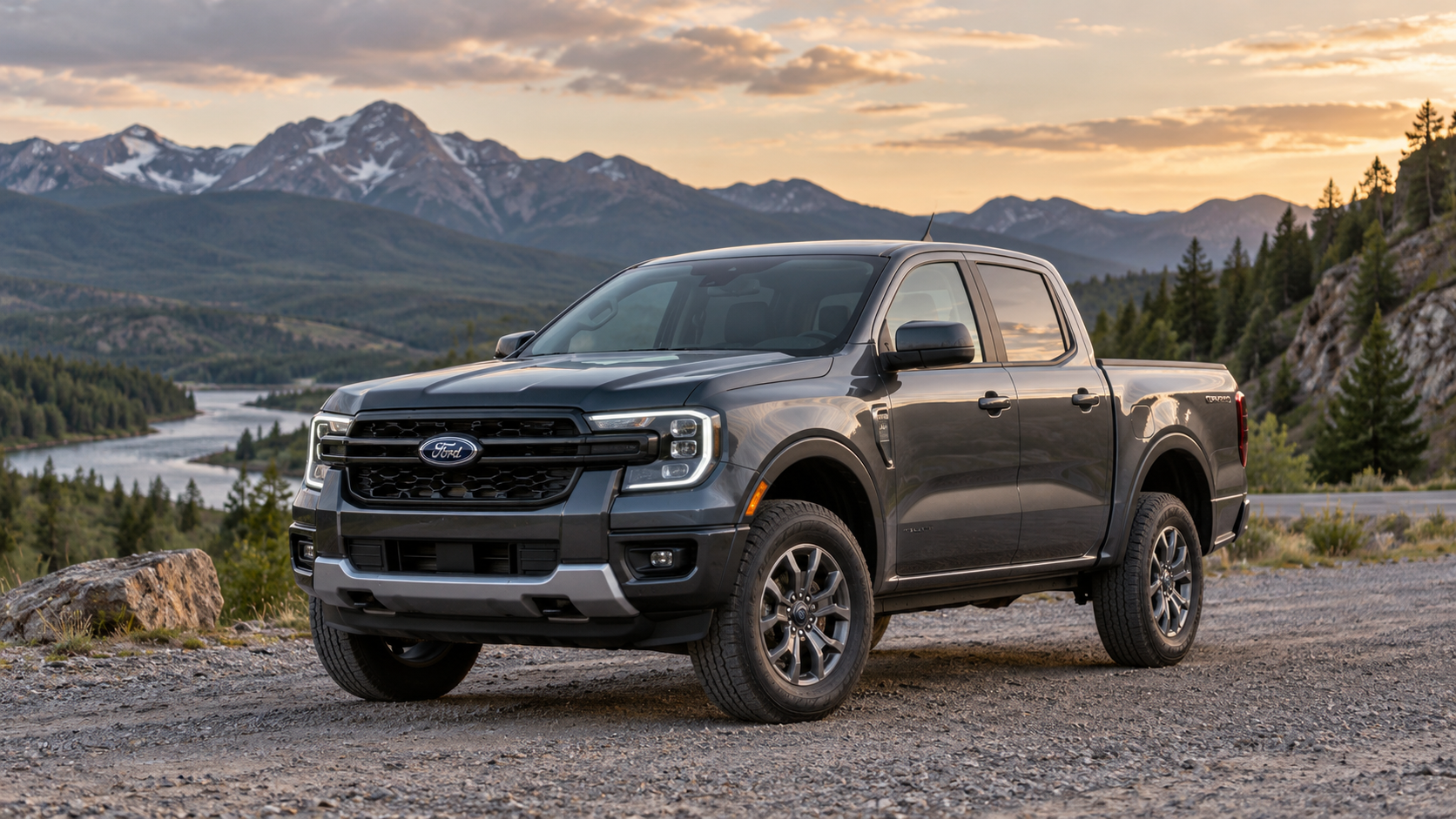
If you are shopping for a used Ford Ranger, the safest choices depend heavily on which generation you are considering. For the modern U.S.-market Ranger, a late-build 2023 is arguably the best year to target. It benefits from several years of production improvements while avoiding the first-year uncertainty of the redesigned 2024 Ranger.
The biggest reliability concern with the 2019–2023 Ranger is the 10R80 10-speed automatic transmission. Ford issued a technical service bulletin covering harsh or delayed engagement and shifting on 2019–2023 Rangers, with possible causes including transmission software, sticking valve-body components, and movement of the CDF clutch-cylinder sleeve. Importantly, Ford’s bulletin identifies a transmission build-date cutoff of August 15, 2022 for affected 10R80 units. That makes build date and service history more useful than model year alone when comparing late second-generation Rangers.
Ford Ranger Reliability by Year
| Year | Reliability Outlook | What to Know |
|---|---|---|
| 2019 | Caution | First year back in the U.S.; early production recalls and 10R80 concerns. |
| 2020 | Average to Good | More mature than 2019, although a specific production window had a transmission bearing issue. |
| 2021 | Good | Generally a better-developed truck, but still within the range covered by Ford’s 10R80 shift-quality bulletin. |
| 2022 | Good | Late examples become especially attractive; check the transmission build date and service history. |
| 2023 | Best modern used pick | Final year of the generation. Later-built trucks are especially appealing because of the transmission-related production cutoff. |
| 2024 | Wait and See | Major redesign. Several early recalls and assembly-related issues make it less attractive for a reliability-first used buyer. |
| 2025 | Promising, Limited Data | Second year of the redesign, but still too new for strong long-term reliability conclusions. |
| 2026 | Too New to Judge | Long-term durability is not yet established; some vehicles are included in a trailer-module software recall. |
2019 Ford Ranger: First-Year Problems
The Ranger returned to the U.S. market for the 2019 model year after disappearing from American showrooms following 2011. Although the underlying Ranger platform had already been sold internationally, 2019 was still the first year of this configuration being produced for the modern U.S. market.
One early issue involved the transmission shift-cable bracket. Ford recalled certain 2019 Rangers because the bracket fasteners may not have been tightened correctly. If the bracket loosened, the transmission could potentially be in a different gear than the shifter indicated.
Ford also documented transmission complaints involving the 10R80 automatic. Some amount of transmission whine was considered normal, but the 10-speed later became the subject of more substantial Ford service bulletins addressing harsh or delayed shifts.
Verdict: The 2019 Ranger is not automatically a bad truck, but there is little reason to choose one over a similarly priced 2021–2023 example unless the 2019 has excellent maintenance records and a substantial price advantage.
2020 Ford Ranger: Improved, With One Transmission Issue to Check
The 2020 Ranger benefited from another year of production experience, but Ford documented a specific 10R80 transmission problem on some trucks built between October 21 and December 16, 2019.
Affected Rangers could develop a high-pitched transmission whine at low speeds. Ford traced the problem to the output-shaft bearing and prescribed replacement of several transmission components.
This was tied to a relatively narrow production window rather than every 2020 Ranger, so checking the door-jamb build date and service history is worthwhile.
Verdict: A solid value if it shifts correctly and does not fall into the problem build range—or if the documented repair has already been completed.
2021 Ford Ranger: A Good Used-Truck Sweet Spot
By 2021, the Ranger platform had been in North American production for several years. There was no complete mechanical redesign, which is generally good news when buying used.
However, the 2021 Ranger still uses the 2.3-liter EcoBoost engine paired with Ford’s 10R80 10-speed automatic, and it falls within the model-year range covered by Ford’s broader transmission service bulletin.
The symptoms buyers should watch for include:
- Hard engagement when selecting Drive or Reverse
- Long hesitation before the transmission engages
- Harsh upshifts or downshifts
- Clunking during low-speed gear changes
- Transmission-related warning lights or fault codes
Not every unusual shift indicates a failing transmission. The 10R80 uses adaptive shift logic, and software or learned values can affect shift quality. However, persistent harsh shifting deserves investigation before purchase.
Verdict: One of the better value years, particularly when the truck has a clean service history and the transmission behaves properly during both cold and fully warmed-up driving.
2022 Ford Ranger: Good, but Build Date Matters
The 2022 Ranger is mechanically similar to the preceding years, so many of the same advantages and concerns apply.
The especially important date is August 15, 2022. Ford’s 2023 technical service bulletin addressing harsh or delayed 10R80 shifting applies to transmissions built on or before that date.
The bulletin says potential causes can include:
- PCM or TCM software
- Transmission solenoid strategy
- Sticking valves in the main control valve body
- Axial movement of the CDF clutch-cylinder sleeve
That last item is especially significant because it is an internal mechanical problem rather than simply a software calibration issue.
Verdict: A good year overall. When shopping at the upper end of 2022 production, check the actual build information instead of assuming every 2022 truck is identical.
2023 Ford Ranger: Our Pick for the Best Modern Ranger Year
The 2023 Ranger has an important advantage: it was the final model year before the North American redesign.
That means Ford had several years to refine manufacturing of this generation, while buyers still get essentially the same proven 2.3-liter EcoBoost and 10-speed powertrain used throughout the 2019–2023 run.
There is one important qualification. Ford’s transmission bulletin technically includes the 2023 Ranger because early 2023-model-year trucks could contain transmissions produced before the August 15, 2022 cutoff.
For that reason, the ideal truck is not merely a “2023.” It is a later-production 2023 with clean maintenance records and a smooth-shifting transmission.
Verdict: The 2023 is the model year we would shop first when looking for a 2019–2023 Ranger.
What Was Actually Fixed in the Ranger’s 10-Speed Transmission?
This is where the model-year discussion becomes more useful than simply labeling certain Rangers “good” or “bad.”
Ford’s TSB 22-2428 applies to several Ford vehicles using 10-speed transmissions, including the 2019–2023 Ranger.
For the Ranger’s 10R80, Ford identifies vehicles with transmissions built on or before August 15, 2022. The service procedure distinguishes among software, valve-body and internal transmission problems rather than treating every harsh-shifting transmission the same way.
For a used-truck shopper, this means the most desirable examples are generally trucks built after Ford’s specified production cutoff, although normal inspection and maintenance history still matter.
2024 Ford Ranger: Better Truck, But First-Year Risk
The 2024 model is a fundamentally different Ranger for North America. Ford changed the frame dimensions, suspension layout, body, interior, electronics and available powertrains. The 2.3-liter EcoBoost remained available, while Ford also introduced an available 2.7-liter EcoBoost V6 and the Ranger Raptor’s 3.0-liter EcoBoost V6.
Ford said the redesigned truck underwent testing equivalent to more than 4.9 million customer miles before launch. Even so, early production generated several recalls.
Among them, certain 2024 Rangers were recalled because a fuel-vapor-line bracket could contact and damage the vapor line, potentially creating a fuel-vapor leak.
Another recall covered certain 2024–2025 Rangers because an upper-control-arm ball-joint fastener could be loose or missing. Ford’s investigation began after a control arm separated from the steering knuckle on a low-mileage Ranger.
Those issues do not prove that the entire 2024 Ranger is unreliable. They do illustrate why reliability-focused used buyers often prefer the final year of an established generation over the first year of a redesign.
Verdict: The 2024 Ranger has major improvements in capability, technology and packaging, but the 2023 remains the more conservative reliability choice until the redesigned generation accumulates more long-term mileage.
2025 Ford Ranger: Potentially Better, but Still Too New
The 2025 model benefits from another year of production experience with the redesigned truck. That makes it more attractive than the launch-year 2024 on paper.
There still is not enough long-term mileage on 2025 Rangers to say they are more durable than a well-sorted 2021–2023 truck. Some recalls have also continued into the newer generation, although several involve specific production defects or software rather than evidence of an inherently unreliable powertrain.
Verdict: Reasonable if you want the newest design, but it is too early to crown the 2025 the most reliable Ranger.
What About Older Ford Rangers?
The older compact Ranger is almost a separate vehicle from today’s midsize truck. In the United States, the original Ranger was sold through the 2011 model year. Ford did not sell a 2012 Ranger in the U.S.; the nameplate returned for 2019.
Late examples of the old Ranger can be appealing because they use relatively simple, well-established mechanical systems. However, at this age, condition matters considerably more than model year.
Buyers should inspect older Rangers for:
- Frame and body rust
- Cooling-system deterioration
- Suspension and steering wear
- Transmission condition
- Oil and coolant leaks
- Deferred maintenance
There is also a serious recall consideration. NHTSA and Ford have issued Do Not Drive warnings for certain older Rangers that still have unrepaired Takata airbag inflators. The affected Ranger population includes some 2004–2011 trucks depending on the airbag and recall campaign.
Anyone considering an older Ranger should therefore run the VIN through the NHTSA recall lookup before driving the vehicle.
Best Ford Ranger Years to Buy
For shoppers looking at the modern Ranger, our ranking would be:
- Late-build 2023: Best combination of a mature platform and later production.
- 2022: Good value, particularly with favorable build information and transmission behavior.
- 2021: Mature enough to avoid many first-year concerns while often costing less than a 2023.
- 2020: Generally reasonable, but check for the specific output-shaft-bearing production window.
- 2019: Can be a good truck, but the first year would not be our first choice unless the price and service history are compelling.
Ford Ranger Years to Approach More Carefully
2019
The first modern U.S. model year had early-production recalls and sits squarely within the 10R80 problem range. It is not necessarily a year to avoid completely, but later trucks are generally preferable.
2024
The first year of the redesigned Ranger brought worthwhile improvements, but it also restarted the normal process of identifying production and assembly issues. Buyers prioritizing proven reliability may prefer to let the new generation mature.
Older Rangers With Open Takata Recalls
This is different from an ordinary reliability complaint. An older Ranger covered by a Takata Do Not Drive warning should not be driven until the recall repair has been completed.
What to Check Before Buying a Used Ranger
Regardless of year, a good inspection can matter more than moving one model year forward or backward.
1. Test the Transmission Cold
Drive the truck before the seller has had an opportunity to warm it up. Pay attention to the initial engagement into Drive and Reverse and the first several upshifts.
2. Drive It Again When Fully Warm
Some transmission symptoms become more noticeable after the fluid and transmission reach operating temperature. Test low-speed acceleration, steady cruising, downshifts and stop-and-go driving.
3. Check the Build Date
The driver’s-door certification label provides production information. This becomes particularly important when researching issues that Ford ties to specific production periods.
4. Ask for Transmission Repair Records
A truck that has already received the correct Ford repair may actually be preferable to one that has an undocumented history and is beginning to exhibit symptoms.
5. Check the VIN for Recalls
Use the NHTSA VIN lookup rather than assuming every recall has already been completed. Recalls follow specific VIN ranges, so two Rangers from the same model year may have different recall histories.
6. Get a Pre-Purchase Inspection
A mechanic familiar with Ford trucks can inspect the drivetrain, cooling system, turbocharger plumbing, suspension, leaks and stored diagnostic codes before you commit to the purchase.
So, What Is the Best Ford Ranger Year?
For a modern used Ford Ranger, we would start with a late-production 2023. It is the final year of the 2019–2023 generation, and later trucks have the advantage of being produced after an important transmission-related cutoff identified by Ford.
The 2021 and 2022 Rangers are also strong used-truck candidates, provided the 10-speed transmission behaves properly and the truck has been maintained.
The 2019 deserves more scrutiny because it was the first U.S. model year, while the redesigned 2024 deserves more time before it can be considered one of the Ranger’s most proven years.
The bigger lesson is that Ranger reliability cannot be reduced to model year alone. With the 2019–2023 trucks in particular, build date, transmission behavior, repair history and maintenance records can matter just as much as the number on the registration.
Sources
- Ford TSB 22-2428 – 10R60/10R80 Harsh or Delayed Engagement and Shifting
- Ford TSB 20-2198 – Ranger 10R80 Output Shaft Bearing Whine
- Ford 2019 Ranger Transmission Shift Cable Bracket Recall
- Ford – Introduction of the Redesigned 2024 Ranger
- Ford 2024–2025 Ranger Upper Control Arm/Ball Joint Recall
- Ford 2024 Ranger Fuel Vapor Line Recall
- NHTSA – Older Ford Ranger Takata Do Not Drive Warning
- NHTSA Vehicle Recall Lookup
Leave a Reply