
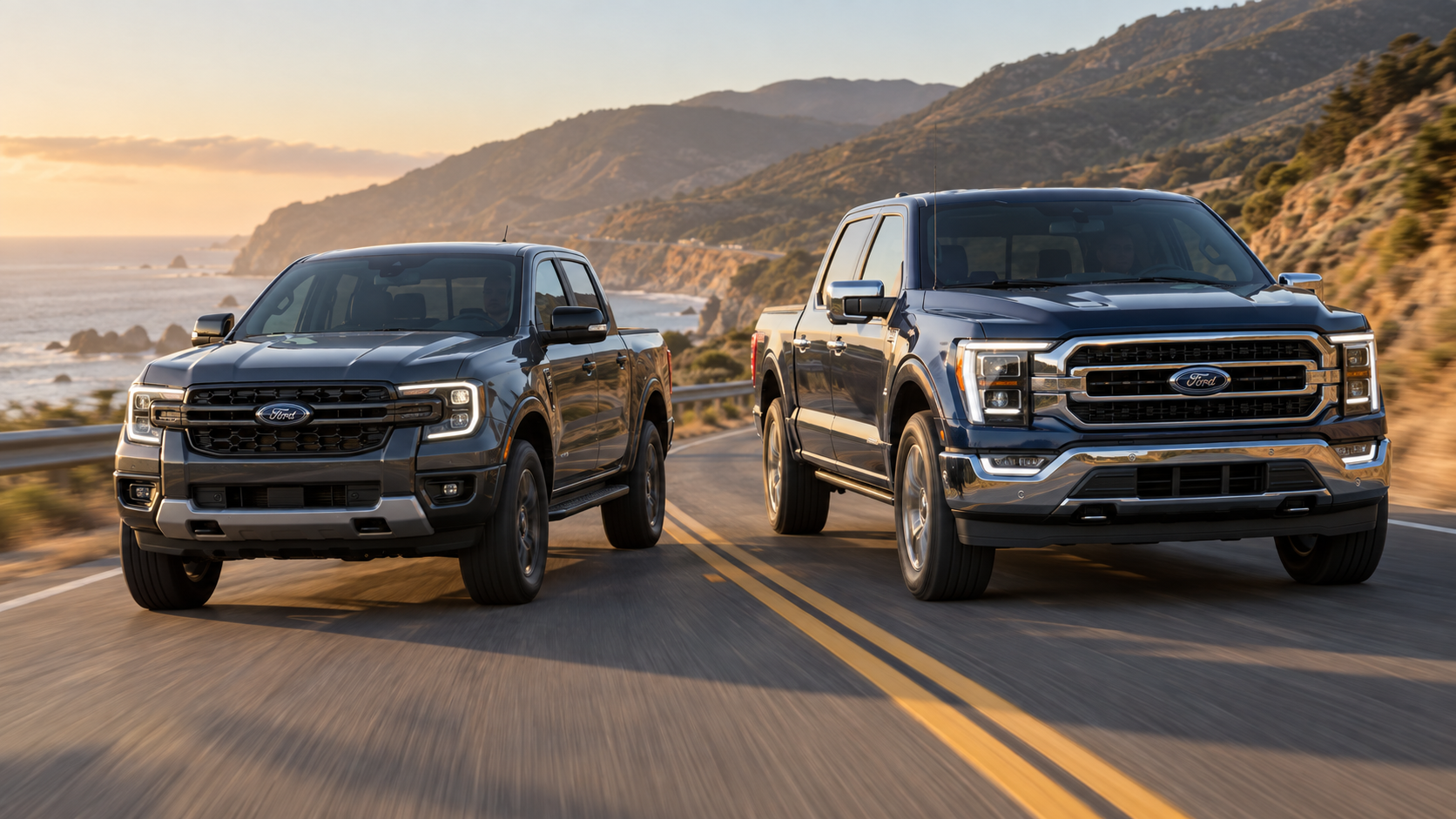
The Ford Ranger and Ford F-150 are both pickup trucks, but they feel different to drive. The Ranger is a midsize truck that is easier to maneuver in town and park in tight spaces. The F-150 is larger, roomier, and has the more substantial feel many drivers expect from a full-size pickup.
If you’re choosing between them, the main question is how you’ll use the truck. For commuting, errands, and occasional hauling, the Ranger’s smaller footprint may be appealing. For more cabin space, frequent towing, or the feel of a full-size truck, the F-150 has the advantage.
Quick takeaway: The Ranger feels more compact and manageable. The F-150 feels bigger and more spacious. Neither is automatically more comfortable; ride quality depends on the model year, trim, tires, suspension, and whether the truck is carrying a load.
Ford Ranger vs. F-150 driving experience
| Driving situation | Ford Ranger | Ford F-150 |
|---|---|---|
| City streets and parking | Its smaller footprint makes it easier to place in a lane, turn around, and fit into tighter parking spaces. | It takes up more space, so parking garages and crowded lots can require more attention. |
| Highway driving | Modern Rangers are composed on the highway, though the truck can feel busier over rough pavement than a larger pickup. | The larger body and cabin create a more full-size-truck experience, with more room to stretch out. |
| Cabin space | The cabin is smaller, particularly for rear-seat passengers. | The larger cabin is useful for carrying adults, family, or extra gear. |
| Power and capability | Engine choices vary by year and trim. The standard engine is suited to everyday driving, while available engines add power. | There are more configurations and powertrain choices, with greater capability available in many versions. |
How the Ranger feels on the road
The Ranger’s biggest everyday advantage is its size. It is still a body-on-frame pickup, but it feels less cumbersome than an F-150 when navigating narrow streets, parking lots, and other tight areas. Drivers moving from a full-size truck may find it easier to judge the Ranger’s corners and fit it into a parking space.
The current-generation Ranger also offers a comfortable ride for a midsize pickup. Road tests have described it as stable and improved over the previous generation. Still, it can feel more active over broken pavement than a larger truck, and the exact ride depends on the trim, wheels, tires, and suspension setup.
Engine choice changes the experience, too. A standard Ranger can feel lively in ordinary driving, while an available V6 delivers stronger acceleration. The off-road Ranger Raptor is a different proposition, with specialized suspension and performance equipment that make it less representative of a standard Ranger.
How the F-150 feels on the road
The F-150’s larger size is noticeable from the driver’s seat. It has a broader cabin and more room for passengers, but it can feel less convenient when turning around, squeezing into a parking spot, or driving through a narrow area.
That size also gives the F-150 a more substantial character. Depending on the configuration, it can feel more settled and roomy on a long drive. Its range of engines, cab styles, and trims means two F-150s can feel quite different from each other. A work-focused model on firm tires may ride differently from a well-equipped version with comfort-oriented features.
What changes if you drive a 2014 F-150?
If you’re comparing a new Ranger with a 2014 F-150, you’re comparing different generations as well as different truck sizes. The Ranger will likely feel newer inside, with more recent technology and a more compact footprint. Your F-150 will feel wider and roomier, with the heavier, full-size presence of an older truck.
Don’t assume the Ranger will automatically ride more smoothly. A newer design may feel more refined in some ways, but ride comfort can change significantly with the truck’s tires, suspension, trim, and condition. Your F-150’s current setup matters: worn shocks, tire pressure, or aftermarket wheels can affect how it drives today.
For a useful comparison, test-drive the Ranger on the same kinds of roads you normally use. Try a tight parking lot, a rough stretch of pavement, and a highway entrance. Pay attention to steering effort, road noise, seat comfort, visibility, and how much room you have around you.
Which truck is easier to live with?
The Ranger is likely the easier truck to live with if your daily driving involves tight parking, crowded streets, or limited space at home. It keeps the practical pickup format while taking up less room than an F-150.
The F-150 is the better fit if you value a larger cabin, often carry passengers, or regularly need full-size-truck capability. Its larger dimensions are a trade-off: you get more space and a more substantial truck, but maneuvering and parking take more room.
Ford Ranger or F-150: the driving verdict
Choose the Ranger if you want a pickup that feels more manageable in everyday driving and you don’t need the F-150’s extra space or capability. Choose the F-150 if the larger cabin, full-size feel, and available work capacity matter more than easy parking.
If you already own a 2014 F-150, a current Ranger will probably feel like a meaningful size change. The best way to know whether that change suits you is to drive both back to back, ideally on the same route and with the Ranger trim you’re actually considering.
Leave a Reply