
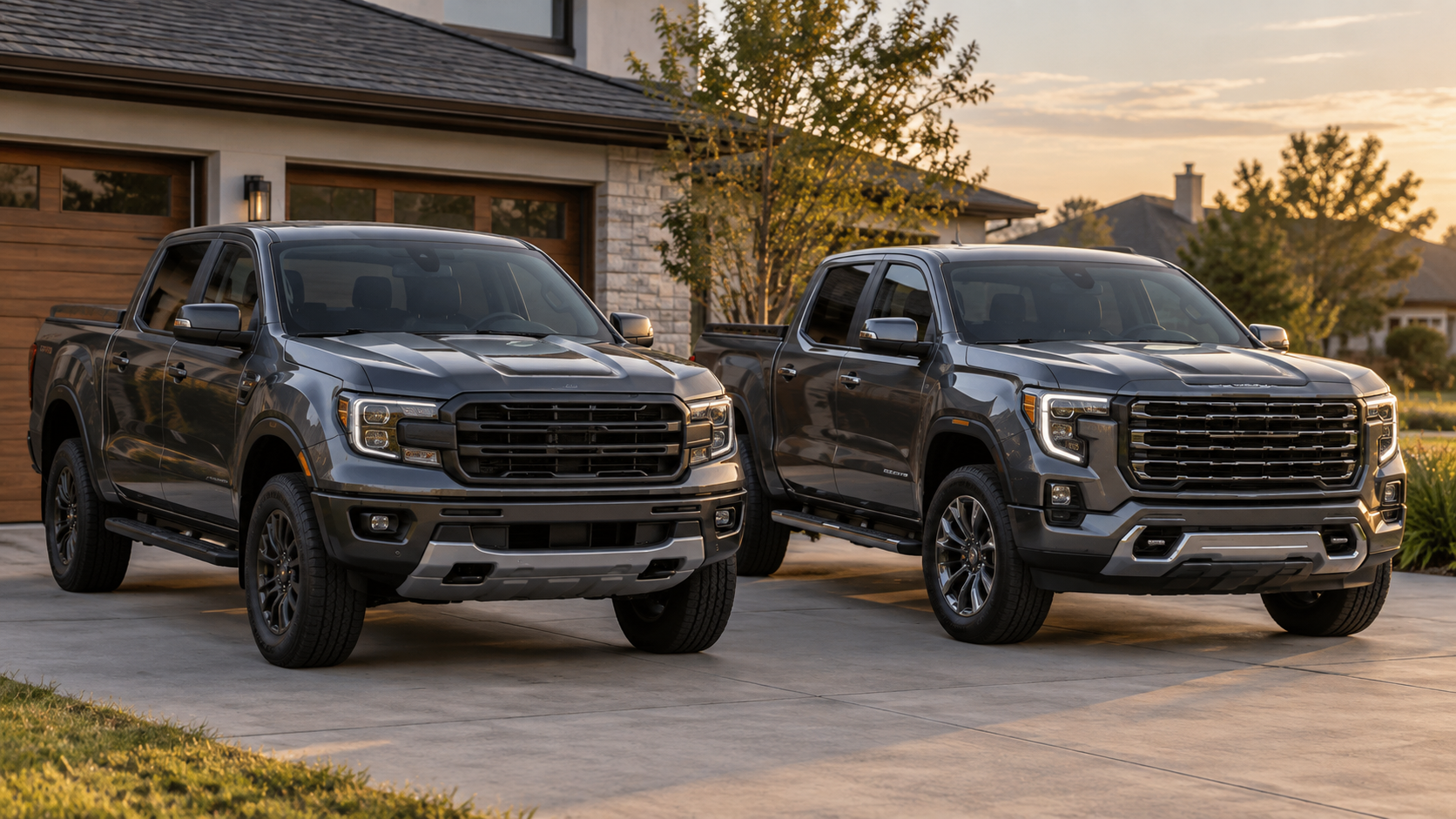
The Ford Ranger and GMC Canyon occupy almost exactly the same place in the truck market: both provide real pickup capability without the sheer size of a modern full-size truck. But if you are shopping used, reliability varies substantially depending on the model year.
The Ranger has an especially important dividing line. Ford discontinued the compact Ranger in the United States after 2011 and didn’t bring the nameplate back until the 2019 model year. The Canyon, meanwhile, returned for its second generation in 2015 and was redesigned again for 2023.
That means comparing a Ranger and Canyon isn’t just a matter of choosing a brand. A late-production truck from one generation can be a considerably safer used purchase than the first year of the next generation.
Our short version: among relatively modern used trucks, the 2022–2023 Ford Ranger and 2020–2022 GMC Canyon are some of the years we would look at first. The 2015–2018 Canyon deserves more caution because of steering and transmission concerns, while the 2019 Ranger was the first U.S. model year of its generation. The redesigned 2023-and-newer Canyon and 2024-and-newer Ranger are technologically much newer, but they do not yet have the same long-term track record.
Ford Ranger vs. GMC Canyon Reliability by Year
The ratings below are an editorial assessment rather than an official manufacturer reliability score. They consider known recalls, technical service information, complaint patterns, generation maturity, and how much real-world history each model year has accumulated.
| Model Year | Ford Ranger | GMC Canyon | Reliability Take |
|---|---|---|---|
| 2015 | Not sold in U.S. | Mixed | First year of the second-generation Canyon; steering and transmission complaints make later years preferable. |
| 2016 | Not sold in U.S. | Mixed | Still an early second-generation Canyon, with a relatively high number of owner complaints. |
| 2017 | Not sold in U.S. | Caution | The new 8-speed automatic became associated with a well-documented shudder problem. |
| 2018 | Not sold in U.S. | Caution | 8-speed torque-converter shudder remains the biggest concern. |
| 2019 | Mixed | Mixed | Ranger returned to the U.S. as a new model; Canyon transmission concerns had not completely disappeared. |
| 2020 | Good | Good | Both were established platforms by this point, although transmission behavior is worth checking on either truck. |
| 2021 | Good | Good | Generally stronger used choices than the early years of their respective generations. |
| 2022 | Very Good | Very Good | Late-generation maturity makes 2022 one of the more appealing years for both trucks. |
| 2023 | Very Good | Mixed | Ranger was in the final year of its established generation; Canyon was completely redesigned. |
| 2024 | Too New / Mixed | Mixed | First year of the redesigned Ranger; Canyon continued to experience some electronics and lighting issues. |
| 2025 | Too New | Too New | Long-term durability is still developing, and both have accumulated recalls or reliability concerns. |
| 2026 | Too New | Too New | There simply isn’t enough long-term ownership history yet to call either one proven. |
Important: a reliability rating for an entire model year cannot tell you the condition of an individual truck. Maintenance history, mileage, previous repairs, accidents, modifications, and whether outstanding recalls have been completed can matter more than the difference between two adjacent model years.
2015 GMC Canyon: First-Year Problems Make Later Trucks More Appealing
The 2015 Canyon marked the return of GMC’s midsize pickup after a two-year absence and represented a major redesign from the older first-generation truck.
It offered a much more modern cabin and chassis than the previous Canyon, but first-year ownership data reveals several areas worth checking carefully.
One of the most significant was the electric power-steering system. Certain 2015 Canyon trucks were built with a connection between the steering motor and torque sensor that could develop fretting corrosion. Loss of electric assist significantly increased steering effort, particularly at lower speeds, and GM eventually addressed affected vehicles through recall and service actions.
There were also numerous reports involving shifting quality.
Verdict: not automatically a bad truck, but we would generally choose a later second-generation Canyon if prices are similar.
2016 GMC Canyon: Better, But Still an Early-Generation Truck
The 2016 Canyon carried over the basic second-generation design while expanding the powertrain lineup with the available 2.8-liter Duramax turbo-diesel.
It is an interesting year because the platform itself was no longer brand new, but complaint databases still show considerably more complaints for 2016 than for many of the later second-generation trucks.
Transmission behavior is one of the recurring themes among owner reports.
Verdict: acceptable with a strong maintenance history, but 2020–2022 trucks are generally more attractive if your budget allows.
2017 GMC Canyon: The 8-Speed Transmission Arrives
For 2017, GMC updated the available 3.6-liter V6 and paired it with an 8-speed automatic transmission.
That combination improved the Canyon on paper, but it also introduced one of the best-known issues from this generation: transmission and torque-converter shudder.
General Motors issued technical guidance addressing shake or shudder during light-throttle acceleration on 2017–2018 Canyon trucks equipped with the 8L45 transmission. Owner complaint data also identifies 2017 as one of the more troublesome Canyon years.
Verdict: one of the Canyon years we would approach most cautiously.
2018 GMC Canyon: Transmission Shudder Remains the Main Concern
The basic 2017 formula continued into 2018, which means the 8-speed automatic remains the biggest item to investigate.
A test drive should include steady-speed cruising and light acceleration rather than just hard acceleration. The notorious shudder can feel similar to driving over rumble strips.
A truck that has already received the appropriate transmission-fluid service or other documented repairs is much more attractive than one with an unknown history.
Verdict: potentially fine after the right repairs, but not our first choice among used Canyons.
2019 Ford Ranger vs. 2019 GMC Canyon
2019 finally gives us a direct modern Ranger-versus-Canyon comparison.
The Ranger returned to American dealerships with a 2.3-liter EcoBoost turbocharged four-cylinder and Ford’s 10-speed automatic transmission. It was based on Ford’s global Ranger architecture rather than being a continuation of the old compact Ranger sold through 2011.
The powertrain delivered an impressive combination of torque, towing capability, and fuel economy, but 2019 was still the first U.S. model year. Owner complaints include drivetrain, engine, electrical, brake, and transmission concerns, and the model year was subject to multiple recalls.
The 2019 Canyon was much farther into its generation, although complaints involving its automatic transmission continued.
Verdict: neither is the year we would specifically seek out. Condition and service history should determine the better purchase.
2020 Ford Ranger vs. 2020 GMC Canyon
By 2020, both trucks had the advantage of additional production experience.
The Ranger retained its 2.3-liter EcoBoost and 10-speed automatic. The Canyon continued to offer a broader engine lineup, including four-cylinder, V6, and diesel choices depending on configuration.
Ford has published technical service information covering harsh or delayed engagement and shifting on 2019–2023 Rangers equipped with the 10R80 automatic, so the transmission should still receive particular attention during a test drive.
On balance, though, 2020 represents an improvement over the early years of each truck.
Verdict: a good year to consider for either model.
2021 Ford Ranger vs. 2021 GMC Canyon
The 2021 trucks are another relatively attractive pairing.
The Ranger remained mechanically familiar while Ford added the off-road-oriented Tremor package. The Canyon lineup also became more focused, with the AT4 replacing the previous All Terrain branding and giving buyers a more rugged factory configuration.
The Ranger’s 10-speed transmission is still something we would evaluate carefully because Ford’s later service bulletin includes 2021 trucks. However, neither model year stands out in complaint data the way earlier Canyon years or the 2019 Ranger do.
Verdict: good used-truck candidates, assuming they pass a pre-purchase inspection.
2022 Ford Ranger vs. 2022 GMC Canyon
2022 sits in a particularly favorable position because both trucks were near the ends of mature generations.
There were no dramatic powertrain reinventions. Engineers and assembly plants had already been building essentially the same trucks for several years, while most of the major early-generation problems were well understood.
That does not make a 2022 Ranger or Canyon failure-proof. It simply removes some of the uncertainty associated with buying the first year of a redesigned vehicle.
Verdict: one of the strongest model years to cross-shop. We would put 2022 near the top of the list for either truck.
2023 Ford Ranger vs. 2023 GMC Canyon
This is one of the easiest years to separate.
The 2023 Ranger was the final U.S. model year of the outgoing generation. Its 2.3-liter EcoBoost and 10-speed drivetrain had already accumulated several years of real-world use.
The Canyon went in the opposite direction. GMC completely redesigned it for 2023.
The new Canyon switched to a 2.7-liter turbocharged four-cylinder producing 310 horsepower and paired it with an 8-speed automatic. GMC also standardized the crew-cab, short-bed body configuration and dramatically expanded the truck’s technology and off-road features.
Every Canyon gained an 11.3-inch center touchscreen, and the lineup became more aggressively off-road oriented, particularly with the introduction of the AT4X.
But the redesign also brought first-year teething problems. GM issued a service update for certain 2023 Canyon and Colorado trucks after an over-the-air software update could leave the 12-volt battery low or discharged. Owner reports have also included infotainment and other electrical issues.
Verdict: if reliability is the priority, the 2023 Ranger’s mature platform makes it the more conservative used choice.
2024 Ford Ranger vs. 2024 GMC Canyon
Ford redesigned the Ranger for 2024, bringing the truck much closer to Ford’s newer global pickup design language.
The 2.3-liter EcoBoost remained available, but Ford added an available 2.7-liter EcoBoost V6 and introduced the U.S.-market Ranger Raptor with a 3.0-liter EcoBoost V6.
The interior also took a major step forward. Depending on trim, buyers could get large digital instrumentation and a vertically oriented infotainment screen running Ford’s newer SYNC technology.
Like many first-year redesigns, however, the 2024 Ranger experienced some recalls. One notable campaign involved an improperly tightened or missing front upper-control-arm ball-joint fastener on certain trucks, which could allow the control arm to separate from the steering knuckle.
The 2024 Canyon was in the second year of its new generation, but it was not trouble-free either. A significant number of complaints involved headlight flickering, and GM recalled affected trucks to replace headlight LED driver modules with corrected software.
Consumer Reports also reports below-average reliability for the 2024 Canyon compared with other vehicles from the same model year.
Verdict: neither has accumulated enough trouble-free history for us to rank it alongside the best late-generation trucks yet.
2025 Ford Ranger vs. 2025 GMC Canyon
The 2025 versions benefit from being past the initial launch year of their current designs, but buyers should not interpret that to mean all early problems have disappeared.
Both trucks have been involved in recall campaigns, and Consumer Reports’ owner-survey data currently describes the 2025 Ranger as less reliable than the average vehicle from the same model year.
The current Canyon also remains a considerably more software-dependent vehicle than its predecessor.
Verdict: too new for a confident long-term reliability judgment. Check the VIN for outstanding recalls before purchase.
2026 Ford Ranger vs. 2026 GMC Canyon
There isn’t enough elapsed time to meaningfully judge long-term 2026 reliability.
Consumer Reports currently predicts roughly average reliability for the 2026 Ranger based largely on experience with the 2024 and 2025 versions, but prediction and demonstrated long-term durability are not the same thing.
Likewise, the 2026 Canyon remains part of a generation that has only been on the road since 2023.
Verdict: buy based on warranty coverage, price, features, and how much tolerance you have for possible new-generation issues rather than assuming either truck is already proven.
Ford Ranger Generations and Major Changes
1998–2011 Ford Ranger: The Old Compact Ranger
The older Ranger was a genuinely compact pickup compared with today’s truck. It used relatively simple naturally aspirated engines, basic automatic and manual transmissions, and comparatively little electronic technology.
Its simplicity is a large part of the reason these trucks remain popular with used-truck buyers. Parts availability is good and many repairs are straightforward.
However, age now matters more than the reputation of the model. Rust, deferred maintenance, worn suspension components, cooling-system issues, and previous repairs can dominate the ownership experience of a 15- to 25-year-old truck.
Another major consideration is the Takata airbag recall. Certain 2004–2011 Rangers were included in serious Takata campaigns. Anyone shopping for an older Ranger should verify the VIN through NHTSA and make absolutely sure required airbag repairs were completed.
2019–2023 Ford Ranger: The Ranger Returns
The Ranger returned to the United States for 2019 as a considerably larger and more sophisticated truck.
Its defining powertrain was the 2.3-liter EcoBoost four-cylinder paired with a 10-speed automatic. Available equipment expanded to include modern driver-assistance systems, touchscreen infotainment, Apple CarPlay and Android Auto, blind-spot monitoring, adaptive cruise control on certain trims, and sophisticated off-road packages.
The primary reliability concern to investigate is the behavior of the 10-speed automatic. Ford issued service information covering harsh or delayed engagement and harsh or delayed shifting on 2019–2023 Rangers.
For that reason, we prefer the later years of this generation, particularly 2022 and 2023.
2024–Present Ford Ranger: More Engines and Much More Technology
The latest Ranger is wider, more modern inside, and available with considerably more powertrain variety.
The familiar 2.3-liter EcoBoost continues, while a 2.7-liter EcoBoost V6 is available in portions of the lineup. The Ranger Raptor sits at the top with a high-output 3.0-liter EcoBoost V6.
Large touchscreens, digital gauges, connected features, multiple camera views, modern trailering technology, and additional driver-assistance systems make this the most technologically sophisticated Ranger sold in America.
The tradeoff is complexity. There is simply more hardware and software capable of generating faults, recalls, or annoying glitches than there was in the old Ranger.
GMC Canyon Generations and Major Changes
2004–2012 GMC Canyon: The Original Canyon
The first Canyon arrived for 2004 as GMC’s version of GM’s compact/midsize pickup platform shared with the Chevrolet Colorado.
Early trucks used four- and five-cylinder engines, while later versions gained larger engines and an available 5.3-liter V8.
The technology is basic by modern standards, which can be an advantage for someone buying an inexpensive work truck. But as with the old Ranger, age, rust, previous maintenance, and overall condition matter enormously today.
2015–2022 GMC Canyon: Modern Midsize Canyon
The Canyon returned for 2015 after sitting out the 2013 and 2014 model years.
This generation brought a far more modern interior and offered unusual powertrain variety for the midsize segment. Depending on year and configuration, buyers could choose a four-cylinder gasoline engine, 3.6-liter V6, or 2.8-liter Duramax diesel.
Later models also gained modern infotainment, Apple CarPlay and Android Auto, additional safety technology, and increasingly capable off-road packages.
Reliability improved as the generation matured, but there are two important dividing lines: the 2015 steering issue and the transmission shudder associated particularly with 2017–2018 8-speed trucks.
That is why the 2020–2022 Canyon is generally more appealing to us than the earliest second-generation trucks.
2023–Present GMC Canyon: Turbo Power and a Technology Overhaul
GMC essentially reinvented the Canyon for 2023.
The multiple-engine strategy disappeared. The new Canyon uses GM’s 2.7-liter turbocharged four-cylinder with 310 horsepower, paired with an 8-speed automatic.
The truck also became crew-cab and short-bed only, while off-road capability became a much larger part of its identity. Elevation, AT4, Denali, and AT4X versions span the range from conventional midsize pickup to high-end off-road truck.
The cabin is dramatically more modern, with an 11.3-inch infotainment display and substantially more software-driven functionality than the previous generation.
That technology is one of the Canyon’s strengths, but it has also contributed to some of the early-generation complaints involving infotainment, electrical systems, software updates, and batteries.
The Biggest Ranger Reliability Issue: The 10-Speed Automatic
If you’re shopping for a 2019–2023 Ranger, spend time evaluating the transmission.
Ford’s own technical service information acknowledges that some Rangers equipped with the 10R80 can experience harsh or delayed engagement and harsh or delayed shifts.
During a test drive, pay attention to:
- Delayed engagement when shifting from Park into Drive or Reverse
- Hard shifts at lower speeds
- Unusual gear hunting
- Clunks during acceleration or deceleration
- Slipping or flaring between gears
A slightly busy 10-speed transmission is not necessarily failing, but pronounced banging, slipping, or delayed engagement deserves further diagnosis before purchase.
The Biggest Canyon Reliability Issue: The 8-Speed Shudder
For 2017–2019-era Canyon trucks with the 8-speed automatic, one of the biggest concerns is torque-converter shudder.
Drivers commonly describe the sensation as a vibration or the feeling of driving over rumble strips during light-throttle cruising.
GM issued service bulletins addressing this condition, including revised transmission-fluid procedures.
If you’re considering one of these trucks, ask specifically whether transmission-shudder work has been performed and request documentation.
What About the Canyon Diesel?
The 2.8-liter Duramax gives the second-generation Canyon a unique appeal, particularly for buyers interested in torque, towing, and highway range.
But diesel ownership also adds emissions-control equipment that a gasoline Ranger does not have.
For someone prioritizing simplicity and lower repair risk rather than maximum diesel torque or fuel economy, the gasoline engines are generally the less complicated choice.
Which Ranger Years Would We Look for?
For a modern used Ranger, our search would begin with 2022 and 2023.
They combine the updated features of the 2019–2023 truck with several years of production experience behind them. They also avoid buying the first year of the redesigned 2024 Ranger.
A well-maintained 2020 or 2021 can also be a good purchase at the right price, but transmission operation deserves close attention.
The 2019 isn’t necessarily a truck to avoid completely, but we would want a meaningful discount relative to a comparable later model.
Which Canyon Years Would We Look for?
For the second-generation Canyon, 2020, 2021, and 2022 are the years we would examine first.
They come after the most prominent early steering and 8-speed-shudder issues and benefit from several years of production maturity.
The 2017 and 2018 trucks require considerably more scrutiny because of the transmission-shudder history.
Meanwhile, the 2023-and-newer Canyon is effectively a different vehicle. It is much more modern and arguably more desirable in terms of design and technology, but buyers should accept that its long-term reliability record is still being established.
Ranger or Canyon: Which Is More Reliable?
There isn’t one answer that applies to every model year.
Among recent used trucks, the Ford Ranger has a particularly appealing reliability case in 2022 and 2023 because those were mature years of the 2019–2023 generation. The Canyon’s sweet spot is slightly earlier, with 2020–2022 representing the mature end of its second generation.
If you’re comparing a 2023 Ranger with a 2023 Canyon strictly from a reliability-risk perspective, the Ranger has one major advantage: it was the last year of an established generation while the Canyon was in the first year of a complete redesign.
Once you move into 2024–2026 trucks, the decision becomes less certain. Both manufacturers are selling sophisticated pickups with turbocharged engines, software-heavy interiors, advanced safety systems, and numerous electronic modules. Neither current generation has yet accumulated the decade of ownership history necessary to call it exceptionally durable.
What to Check Before Buying Either Truck
- Run the VIN through the NHTSA recall lookup.
- Ask for complete maintenance and repair records.
- Test the transmission both cold and fully warmed up.
- Drive at steady highway speeds and under light acceleration.
- Test every infotainment, camera, lighting, and driver-assistance function.
- Check underneath the truck for leaks, impact damage, and off-road damage.
- Inspect the frame for corrosion on older trucks.
- Confirm that aftermarket lifts, tunes, or oversized tires have not created additional problems.
- Pay for a pre-purchase inspection before buying an out-of-warranty truck.
Bottom Line
If reliability is the main goal, we’d rather buy a late-production example of an established generation than the first year of the newest design.
For the Ford Ranger, 2022 and 2023 stand out as particularly attractive used years. The platform had several years to mature, while the 2024 redesign reset the clock with new hardware and technology.
For the GMC Canyon, 2020 through 2022 are the years we’d look at most closely. They avoid the earliest second-generation steering concerns and come after the period most closely associated with the 8-speed transmission shudder.
The redesigned Canyon is substantially nicer inside, while the latest Ranger offers more powertrain choices and technology. But if your priority is minimizing repair uncertainty rather than owning the newest truck, the final years of the previous generations remain extremely compelling.
Reliability information changes as vehicles age and manufacturers issue new recalls. This article reflects information available through September 2026. Always check a specific vehicle’s VIN for open recalls before purchase.
Leave a Reply